Tag: water

Before the Flames: How Water and Soil Shape Wildfire Risk

The summer of 2026 brought another season of major wildfires across Europe. Between 1 July and 31 August, fires larger than 30 hectares affected extensive areas across the Iberian Peninsula, southern France, Italy, Greece, the Balkans, Ukraine and Algeria. Across Europe and North Africa, more than 1.2 million hectares were affected, including 19 individual fires larger than 10,000 hectares (1).

For the European Union alone, 692,419 hectares had burned by early October. That was less than during the record-breaking 2025 season, but almost twice the 2006–2025 average of 360,510 hectares (2).

When fires reach this scale, the obvious questions are about heat, drought and climate change. And rightly so. But there is another factor that deserves more attention, namely water. Not the water used by firefighters to extinguish a fire, but the water present (or missing) in the landscape during the months before it started.

A fire starts long before the first flame

For vegetation to burn, it first has to become sufficiently dry. How quickly that happens depends on much more than air temperature alone. Water stored in the soil helps determine how much moisture remains available to vegetation. Soil moisture therefore affects both the amount of vegetation that can grow and how dry and flammable that vegetation eventually becomes. That makes the relationship between water and wildfire more complicated than simply saying “less water means more fire” (3).

A global study of 9,840 large wildfire events found an interesting pattern. In relatively humid regions, major fires were generally preceded by unusually dry soils. In arid regions, however, wetter-than-normal conditions several months earlier could contribute to greater vegetation growth. When those landscapes subsequently dried out, that additional biomass could become additional fuel. Across climate regions, soil moisture generally declined during the months leading up to major fires (3).

In other words, the conditions for a wildfire can develop months before anything starts burning. The match or lightning strike may ignite the fire. The landscape determines what happens next.

Landscapes are also water systems

Healthy landscapes do something we do not always notice: they manage water. Vegetation intercepts rainfall, while soils store water and influence how it moves through the landscape. Some water becomes available to plants, while some water moves deeper underground or eventually reaches streams and rivers (4).

When these systems are disturbed, the relationship between rainfall, soils and vegetation changes.

And fire itself can make the problem worse. A global analysis found that fire altered plant–soil water relations, accelerating soil-moisture loss and changing vegetation water uptake. The effects increased with fire severity and were strongest in forests (5).

That creates important feedback. A dry landscape can become more susceptible to fire, while a fire can subsequently alter the landscape’s hydrology. So perhaps we should stop thinking about wildfire exclusively as a fire-management problem. It is also a landscape-management problem.

From fighting fires to building resilience

Europe monitors wildfires through systems such as the European Forest Fire Information System, which combines satellite observations with expert mapping to track burnt areas and provide updated information on the fire season (2).

That information is essential. But monitoring and firefighting address only part of the problem. Soil moisture influences both vegetation growth and how dry and flammable that vegetation becomes (3). Building wildfire resilience therefore also means looking at conditions long before ignition, including how we manage soils, forests, wetlands, agricultural land and water across entire catchments.

Forests and their soils influence how rainfall is intercepted, stored and released (4). This raises practical questions, such as: Can soils absorb and retain rainfall? Can vegetation access enough water during prolonged dry periods? What role can wetlands and other naturally wet areas play? And are we designing landscapes primarily to drain water away, or also to store it for when conditions become dry?

These questions connect wildfire prevention with issues often discussed separately: regenerative agriculture, wetland restoration, biodiversity, drought resilience and climate adaptation. The NBS4Drought project, for example, is investigating wetlands as nature-based solutions for resilience to extreme drought (6). Looking at these issues together offers a broader perspective on how landscapes regulate water, without assuming that drought measures automatically reduce wildfire risk.

Fire is not simply a symptom of bad water management

There is an important caveat. Wildfires have many causes and controls. Ignition can come from people or lightning, while weather and climate strongly affect how fires spread. Vegetation type, land use and human activity matter too. Soil moisture does not by itself cause fires. Instead, it influences whether sufficient biomass is present and whether that biomass is dry enough to burn (3).

Nor is fire inherently unnatural. Fire is part of the ecology of many ecosystems (3). The aim is therefore not to create landscapes that never burn. It is to avoid landscapes becoming unnecessarily vulnerable to severe fires. And that requires looking beyond the fire itself to the conditions that develop long before it starts.

Learning to keep water in the landscape

I find this particularly interesting because water connects so many environmental issues that we often discuss separately:

  • Healthy soils are discussed in regenerative agriculture.
  • Wetlands are discussed in biodiversity restoration.
  • Forests are discussed in relation to carbon sequestration.
  • Water retention is discussed as climate adaptation.
  • Wildfires are discussed as natural disasters.

But these systems do not recognize those categories. Forest vegetation and soils influence how rainfall is intercepted, stored and released (4). Soil moisture also affects vegetation growth and the conditions that allow it to burn (3). Research into wetlands as nature-based solutions for drought resilience illustrates another connection between ecosystems and water management (6).

Perhaps that is the more interesting lesson from another summer of European wildfires. Obviously, we need to become better at detecting and fighting fires. But resilience starts much earlier. It starts with a more fundamental question:

“How do we create landscapes that are better able to hold water, sustain vegetation and regulate themselves when the next period of extreme heat and drought arrives?”

Because by the time the flames appear, much of the story has already been written.

References

Click here to expand the references

(1) European Union Agency for the Space Programme. (2026, September 2). Severe fires affected Europe and North Africa in July and August 2026. https://eu-space.europa.eu/components/earth-observation-copernicus/image-of-the-day/severe-fires-affected-europe-and-north-africa-july-and-august-2026

(2) Joint Research Centre. (2026, October 8). Current wildfire situation in Europe. European Commission. https://joint-research-centre.ec.europa.eu/scientific-activities/natural-and-man-made-hazards/forest-fires/current-wildfire-situation-europe_en

(3) O, S., Hou, X., & Orth, R. (2020). Observational evidence of wildfire-promoting soil moisture anomalies. Scientific Reports, 10, Article 11008. https://doi.org/10.1038/s41598-020-67530-4

(4) European Environment Agency. (2015). Water-retention potential of Europe’s forests (EEA Technical Report No. 13/2015). https://www.eea.europa.eu/en/analysis/publications/water-retention-potential-of-forests

(5) Baur, M. J., Friend, A. D., & Pellegrini, A. F. A. (2024). Widespread and systematic effects of fire on plant-soil water relations. Nature Geoscience, 17. https://doi.org/10.1038/s41561-024-01563-6

(6) European Commission. (2025). Demonstrating wetlands as Nature-Based Solutions on resilience development to extreme drought across European cities and landscapes (NBS4Drought). CORDIS. https://cordis.europa.eu/project/id/101181351

Cover image: Forest, Vuur, Brandend bos. Photo from Vlad_Aivazovsky on Pixabay

An Updated Case Study on the Ocean Cleanup

Over the past seven decades, global plastic production has grown dramatically. In 1950, annual production amounted to approximately two million tonnes, whereastoday it exceeds 450 million tonnes [1]. This quantity is comparable to the combined weight of the world’s human population, and is projected to grow [2].

Plastic packaging truly exemplifies the characteristics of the linear economy: fossil-based, single-use, short-lived, with very low recycling rates and high rates of mismanaged waste [3]. Current estimates suggest that only around 9% of plastic waste is effectively recycled, and approximately 19% is incinerated. Nearly half is sent to sanitary landfills, while the remainder is either dumped in landfills, openly burned, or released into the natural environment [4].

More plastic than fish

Only 0.5% of the yearly plastic production eventually ends up in the ocean. That might seem marginal, but the ocean plastic pollution problem is not small at all. Over 1 million metric tons is still a massive amount of pollution [5]. In fact, academics claim that plastic pollution in the marine environment is “nearing planetary boundary threat conditions” [6].

The accumulation of floating plastics in the marine environment is particularly concerning due to their widespread distribution across the ocean surface. In addition to facilitating the transport of invasive species, plastic debris can threaten vulnerable habitats and negatively affect communities that depend on healthy marine ecosystems. Plastic pollution can harm marine life through ingestion and entanglement, while microplastics and associated pollutants enter and accumulate in the food chain [6].

In a business-as-usual scenario, the total mass of plastic will exceed the biomass of fish in the ocean by 2050. Reducing production through regulation, alongside improved waste management and circular solutions, is essential to limit both new plastic flows and environmental leakage [7].

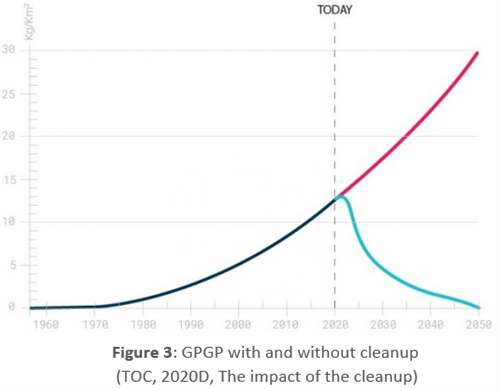
However, these measures won’t affect the plastic that has already accumulated in the ocean over decades, also called “legacy pollution”. While part of this material may return to coastlines and can be addressed through coastal cleanups, large accumulations in remote ocean currents, such as the Great Pacific Garbage Patch (GPGP), will require targeted and sustained cleanup efforts [7].

The Ocean Cleanup

One prominent initiative tackling this challenge is The Ocean Cleanup(TOC), a Netherlands-based non-profit founded in 2013 by Boyan Slat, who was just 18 at the time. TOC’s mission is to develop technologies that both remove existing plastic accumulated in ocean garbage patches and intercept new waste in rivers before it reaches the sea. This dual strategy reflects scientific findings that suggest that roughly 1% or 1,000 rivers worldwide are responsible for close to 80% of plasticentering the oceans [8].

To guide its long-term vision, TOC set an ambitious objective:toreduce 90% of floating ocean plastic by 2040, through a combination of scaled ocean cleanup systems, targeted river interventions, and broader reductions in plastic use supported by improved waste management worldwide [9].

When the first GreenMarked case study on The Ocean Cleanup was published in 2020, the initiative was still in an experimental phase, focused on demonstrating that large-scale plastic removal at sea was technically possible. In the subsequent years, TOC has undergone a clear shift from concept validation to sustained operations. Early offshore trials revealed both the complexity of open-ocean cleanup and the need for rapid design iteration. After initial setbacks with its first system in 2018, subsequent designs demonstrated increasing reliability, leading to towed, U-shaped systems capable of consistently capturing plastic in the GPGP [10].


Figure 1: The Ocean Cleanup (n.d.) is cleaning up plastic in the Great Pacific Garbage Patch, the largest known accumulation zone of plastic. Retrieved from The Ocean Cleanup Media Gallery and available for editorial use.

At the same time, the scope of operations expanded upstream, reflecting the dual strategy it adopted in response to early criticism highlighted in the first case-study as well as emerging scientific evidence. As such, river interception systems were deployed alongside offshore cleanup to address concerns that ocean cleanup alone would focus on symptoms rather than sources. By combining these approaches, TOC significantly accelerated its impact. In 2025 alone, the organization removed over 25 million kilograms of plastic, which is more than the total collected in all previous years combined [11]. This momentum continued into March 2026, when TOC reached a landmark milestone of50 million kilograms of trash removed worldwide [10].

Recent critique

Recent scientific research has focused on the potential ecological consequences and uncertainties surrounding large-scale cleanup activities. Marine biologists have investigated the risks to neuston (organisms living at the water’s surface) and unintended bycatch in open ocean systems, and warn that remediation operations could have varying impacts on these vulnerable communities [11].

Others stress the importance of weighing the net environmental benefits of removing concentrated patch plastics against the costs and unintended effects, and call for robust environmental impact assessments and better governance for high-seas cleanup interventions [12].

TOC has responded by integrating scientific oversight into its projects by commissioning independent environmental impact assessments, adjusting system design to limit incidental bycatch, and actively contributing to open-access research. Recent studies using TOC’s operational data suggest that, targeting plastic hotspots can limit interactions with neuston and improve overall environmental outcomes [13]. Together, these efforts indicate that cleanup can be an environmentally responsible complementto prevention, provided it continuously adapts based on scientific guidance.

Future

With its dual strategy now fully implemented and key milestones achieved, The Ocean Cleanup appears on track to reach its long-term objectives. The rapid scaling of offshore cleanup systems, combined with targeted river interception, has translated ambition into measurable impact, demonstrating that large-scale removal of legacy ocean plastic is technically and operationally feasible.

At the same time, the case study reinforces a central reality: cleanup alone is not sufficient. Lasting success will depend on parallel progress in source reduction, regulatory change, and improved waste management worldwide. Within this broader context, TOC’s work represents a critical and increasingly mature contribution to reducing ocean plastic pollution, complementing prevention rather than replacing it.

References

Click here to expand the references
  1. [1] Ritchie, H., Samborska, V., & Roser, M. (2026). Plastic pollution. Our World in Data. Retrieved from https://ourworldindata.org/plastic-pollution
  2. [2] The Ocean Cleanup. (n.d.). Ocean plastic pollution explained. Retrieved from https://theoceancleanup.com/ocean-plastic-pollution-explained/
  3. [3] Ellen MacArthur Foundation. (n.d.). Plastics – Overview. Retrieved from https://www.ellenmacarthurfoundation.org/topics/plastics/overview
  4. [4] Organisation for Economic Co-operation and Development (OECD). (2022). Global plastics outlook: Economic drivers, environmental impacts and policy options. Downloaded from https://www.oecd.org/content/dam/oecd/en/publications/reports/2022/02/global-plastics-outlook_a653d1c9/de747aef-en.pdf
  5. [5] Sainte-Rose, B., Lebreton, L., Pham, Y., Tjallema, A., & Maes, C. (2026). Modelling the cleanup of the North Pacific Garbage Patch based on 3 years of operational experience. Scientific Reports, 16, 8050. https://doi.org/10.1038/s41598-026-40859-y
  6. [6] Ellen MacArthur Foundation. (2021). The solution to plastic pollution. Retrieved from https://www.ellenmacarthurfoundation.org/articles/the-solution-to-plastic-pollution
  7. [7] Meijer, L. J. J., van Emmerik, T., van der Ent, R., Schmidt, C., & Lebreton, L. (2021). More than 1000 rivers account for 80% of global riverine plastic emissions into the ocean. Science Advances, 7(18), eaaz5803. https://doi.org/10.1126/sciadv.aaz5803
  8. [8] The Ocean Cleanup. (n.d.). The Ocean Cleanup. Retrieved from https://theoceancleanup.com/
  9. [9] The Ocean Cleanup. (n.d.). Milestones. Retrieved from https://theoceancleanup.com/milestones/
  10. [10] The Ocean Cleanup. (2025–2026). 2025 in review: The Ocean Cleanup. Retrieved from https://theoceancleanup.com/updates/2025-in-review-the-ocean-cleanup/
  11. [11] Spencer, M., Culhane, F., Chong, F., Powell, M. O., Roland Holst, R. J., & Helm, R. (2023). Estimating the impact of new high seas activities on the environment: The effects of ocean-surface macroplastic removal on sea surface ecosystems. PeerJ, 11, e15021. https://doi.org/10.7717/peerj.15021
  12. [12] Bergmann, M., Arp, H. P. H., Carney Almroth, B., Dey, T., Farrelly, T., Gündoğdu, S., Helm, R. R., Krieger, A., Syberg, K., Tekman, M. B., Thompson, R. C., Villarrubia-Gómez, P., & Wang, M. (2024). Ocean plastic cleanups need a global framework with science-based criteria. Science, https://epic.awi.de/id/eprint/58076/1/e_Letter_PRT_Final_exclEndnote.pdf
  13. [13] Egger, M., van Vulpen, M., Spanowicz, K., Wada, K., Pham, Y., Wolter, H., Fuhrimann, S., & Lebreton, L. (2024). Densities of neuston often not elevated within plastic hotspots territory inside the North Pacific Garbage Patch. Environmental Research: Ecology, 3, 035002. https://doi.org/10.1088/2752-664X/ad4f92

Cover image: The Ocean Cleanup (n.d.) Boyan Slat, founder and CEO of The Ocean Cleanup, is pictured on a beach in Honduras. Retrieved from The Ocean Cleanup Media Gallery and available for editorial use.

Sh*tty Waters: The UK’s Sewage Scandal

With the recent late-May heat wave sweeping Europe, many are keen to take to rivers, lakes and coasts to cool down. Yet in the U.K., regular swimmers know to check online sewage discharge maps before heading out – a tragic reflection of the polluted state of the nation’s waters. Throughout the country, environmental crimes are committed regularly as water companies discharge sewage into waterways. Activist and environmental organisations such as Surfers Against Sewage, The Rivers Trust, and local groups belonging to the Sewage Campaign Network are fighting to hold water companies and governments accountable and protect the health of humans and wildlife alike. Although the sewage scandal in the UK has come to increasing public attention in recent years, much remains to be done to clean the country’s waters and eliminate this environmental crisis.

Sewage discharge is the release of raw, untreated sewage into rivers, lakes, canals, and oceans. When large volumes of water overwhelm the sewer network, Combined Sewer Overflows (CSOs) release this waste into waterways [1].

Although the use of CSOs is legally permitted in emergency situations to prevent sewage backing into homes and businesses, investigations have highlighted that water companies are systematically using CSOs outside of “exceptional circumstances”, even during times of low, or no, rainfall [2]. This practice, known as “dry spilling,” is strictly illegal but widespread. In 2025, sewage was discharged into waterways in England and Wales 386,466 times for a total of over 2.5 million hours [3]. Although these figures show a decrease in the number of releases compared to the year before, the dip is mostly explained by 2025 being a much drier year in the UK than 2024 [4]. What’s more, there is an ecological penalty – drier weather means that released sewage is less diluted as it enters low-flow rivers, causing increased impacts on ecosystems and unsuspecting swimmers [3].

Figure 1:A combined sewer overflow outlet used to discharge raw sewage into waterways. By Kate Boicourt (2010). Licensed under CC BY 2.0.

Even treated sewage can have substantial effects on our ecosystems [5]. Residual nutrients can cause eutrophication, resulting in algal blooms that kill fish and other aquatic life deprived of oxygen. Furthermore, pharmaceutical chemicals are known to disrupt the hormones of aquatic species. For example, co-exposure to nano-plastics and endocrine-disrupting chemicals – such as those found in pharmaceuticals and personal care products – disrupt reproductive functions in fish by altering hormone levels and impairing gamete development [6]. A study on the estuarine mummichog (Fundulus heteroclitus) found that exposure to synthetic estrogen (found in birth control pills, which enters water systems via human urine) during early development altered sex determination and feminised male fish [7].

So, what can be done to reduce our reliance on CSOs and prevent sewage discharge?

Accountability and transparency are setting the wheels in motion to ensure that water companies face consequences. CSO monitoring has increased since 2024, with every storm overflow in England now fitted with an event duration monitor [4]. Installing separated, rather than the current combined, sewage and surface water systems on new developments would also help to reduce our reliance on CSOs. Nature-based solutions – such as desealing urban areas for better drainage, reinstating wetlands, or installing sustainable urban drainage systems – would increase water storage in the soil to offload stress from the grid [2].

England’s Environment Agency is taking enforcement actions against water companies where it finds evidence of illegal dry spilling [4]. However, while recent enforcement resulted in over £6.9 million in fines for law-breaking water companies, this penalty is a drop in the ocean. To put this figure into perspective, since the privatization of the water system in 1989, a staggering £74.2 billion in dividends has been paid out to private shareholders and investment[8]. By prioritizing corporate payouts over upgrading outdated infrastructure and upholding environmental responsibility, the system is prioritizing profit over public health and environmental safety.

Figure 2:Sewage pipe on beach. By Eric Jones (2011). Licensed under CC BY 2.0.

Illegal use of CSOs is dirtying the U.K. ‘s waters. This not only threatens public health, but also aquatic life through eutrophication and the long-term effects of chemicals and plastics found in sewage.

Momentum is building to improve the situation with increased monitoring of CSOs, separate water and sewer systems for new developments, and nature-based solutions like reinstating wetlands and urban desealing. Yet, as long as corporate profits and shareholder dividends are prioritised over infrastructure upgrades, regulatory fines will remain a drop in the ocean.

Ultimately, the cleaning of the nation’s waters depends on sustained public pressure forcing corporate accountability, strict enforcement and improved infrastructure.

References

Click here to expand the references
  1. Clark, A. (2025, April 15). Constituency data: Sewage discharges in England. House of Commons Library. https://commonslibrary.parliament.uk/constituency-data-sewage-discharges-in-england/
  2. Surfers Against Sewage. (2026). Combined sewer overflows. https://www.sas.org.uk/water-quality/water-quality-facts-and-figures/combined-sewer-overflows/
  3. The Rivers Trust. (2026, March 26). Sewage discharges: England and Wales’ 2025 annual summary data released. https://theriverstrust.org/about-us/news/sewage-discharges-2025-annual-summary-data
  4. Department for Environment, Food & Rural Affairs, Environment Agency, & Hardy, E. (2026, March 27). Fewer and shorter storm overflow spills in 2025, new monitoring data shows. GOV.UK. https://www.gov.uk/government/news/fewer-and-shorter-storm-overflow-spills-in-2025-new-monitoring-data-shows
  5. The Rivers Trust. (2025). 5 things the sewage map can tell you about your river. https://theriverstrust.org/about-us/news/5-things-the-sewage-map-can-tell-you-about-your-river
  6. Yang, Z., & Wang, J. (2025). From gonads to generations: Mechanistic insights into reproductive disruption by polystyrene nanoplastics and co-contaminants in fish. Environmental Chemistry and Ecotoxicology, 7, 1871–1883. https://doi.org/10.1016/j.enceco.2025.08.018
  7. Chehade, I., Sing-Judge, C., Corrigan, E., Lister, A., Van Der Kraak, G., & MacLatchy, D. (2025). Effects of 17α‐Ethinylestradiol on development and gonadal differentiation in the estuarine mummichog, Fundulus heteroclitus. Journal of Experimental Zoology Part A: Ecological and Integrative Physiology. Advance online publication. https://doi.org/10.1002/jez.70045
  8. Dearbail, J. (2024). Water industry investors have withdrawn billions, claims research, BBC News. https://www.bbc.co.uk/news/articles/cw4478wnjdpo

Cover image: Seven Sisters cliff, East Sussex, England. Photo by Luca Upper on Unsplash.

The Himalayan Challenge: Power for China, Tension for Everyone

China’s energy ambitions are straining relations with its neighbor, India. At the center of the tensions lies a monumental project: the construction of a 60,000 MW hydroelectric dam on the Yarlung Tsangpo River [1].

It wouldn’t be the first time Beijing has attempted an engineering feat that borders on the impossible. Back in 2006, China inaugurated the Three Gorges Dam on the Chang Jiang — still the second-largest dam in the world, with a production capacity between 20,000 and 25,000 MW, capable of covering around 3% of the country’s total energy demand [2].

The new project, however, would move to Tibet, a region already extremely sensitive from a geopolitical standpoint. To complicate matters further, the Yarlung Tsangpo doesn’t flow toward China: after crossing the Himalayas, it turns south into India and Bangladesh, where it becomes the Brahmaputra River [1].

Figure 1:Site Location of the Medog Hydropower Station on the Yarlung Tsangpo – Brahmaputra River. Author, 2025.

The first official statements about the project date back to 2023, immediately stirring both concern and controversy — not only for its delicate geopolitical implications but also for its potential environmental impacts. Despite the criticism, in 2024 the initiative was officially approved and classified as a “priority and strategic project”, aimed at helping China achieve carbon neutrality by 2060. Construction officially began on July 19, 2025 [3].

At present, many details remain undisclosed. What is known is that the Medog Hydropower Station project includes a main dam and five hydroelectric power plants distributed along a 50 km stretch of river, strategically chosen to exploit an impressive elevation drop of about 2,000 meters. To maximize energy production, the plan also involves straightening some river bends and diverting the water through specially built underground tunnels [3].

The Ecological Price of the Dam

Although several dams already exist along the Yarlung Tsangpo, the difference this time lies in the scale of the project. It has already been nicknamed “The Mother of all Dams” — a title that captures both its immense size and its potential environmental cost [1].

The first consequence would concern the river’s natural flow and seasonal floods, which are vital to downstream aquatic ecosystems. Water quality would also deteriorate: upstream, sediments and oxygen-poor zones would accumulate, while downstream soils would be deprived of nutrients and coastal erosion would intensify. Local flora and fauna would be severely affected by variations in water level, oxygen, and temperature. Fragile habitats and endemic species might not survive [4].

These damages would add to the already ongoing processes. Today, 22% of the Yarlung Tsangpo basin is under significant human pressure [5], mainly due to agricultural expansion and changes in land use. The result is a substantial loss of native vegetation and biodiversity [6].

Finally, there is the seismic risk. In January 2025, a 6.8 magnitude earthquake damaged four reservoirs in Tibet, highlighting the fragility of dams built in mountainous areas with high tectonic activity [7].

Water as a Weapon

Environmental concerns are accompanied by another major fear: that China could turn theYarlung Tsangpo dam into an instrument of political leverage. Once again, this wouldn’t be unprecedented.

In 2021, Beijing reduced the Mekong River’s water flow by 50% — officially for power line maintenance. The river, which originates in China and flows through Cambodia, Laos, Myanmar, Thailand, and Vietnam, saw millions of people across Southeast Asia directly affected by that decision. Even earlier, in 2019, Chinese dams on the Mekong retained record levels of water, triggering an unprecedented drought in downstream regions, devastating ecosystems, and undermining both local economies and food security [1].

Tensions have also surfaced along the China–India border. In 2017, in the Indian state of Assam — the first to be crossed by the Brahmaputra — the river’s water suddenly turned black and muddy following a series of debris flows in the Chinese region. It became unfit for human consumption, with severe repercussions for local ecosystems [7]. Indian authorities accused Beijing of pollution linked to the excavation of an underground tunnel meant to divert part of the river’s course. China denied the accusations, dismissing even the existence of the project [8].

The dam on the Yarlung Tsangpo is not merely an unprecedented feat of engineering; it is a symbol of the new global era, where environment, energy, and geopolitics are increasingly intertwined.

On one hand, it represents a step forward for China toward carbon neutrality and energy self-sufficiency. On the other hand, it risks igniting regional tensions and causing irreversible damage to the ecosystems of the Himalayas and the Sundarbans of Bengal.

The future of the Brahmaputra does not concern only Beijing or New Delhi, but billions of living beings who depend on that river for their very survival.

References

Click here to expand the references
  1. Scenarieconomici.it. (n.d.). India e Cina in lotta per una grande diga himalayana che può militarizzare l’acqua. Retrieved October 27, 2025, from

    https://scenarieconomici.it/india-e-cina-in-lotta-per-una-grande-diga-himalayana-che-puo-militarizzare-lacqua/

  2. Geopop.it. (n.d.). Diga delle Tre Gole: l’impianto idroelettrico più grande al mondo si trova in Cina. Retrieved October 27, 2025, from https://www.geopop.it/diga-delle-tre-gole-limpianto-idroelettrico-piu-grande-al-mondo-si-trova-in-cina/
  3. Geopop.it. (n.d.). La più grande centrale idroelettrica della Cina sarà in Tibet. Retrieved October 27, 2025, from https://www.geopop.it/diga-centrale-idroelettrica-piu-grande-cina-tibet/
  4. Institute for Energy Research (IER). (n.d.). How do dams impact the environment? Retrieved October 27, 2025, from https://iere.org/how-do-dams-impact-the-environment/
  5. PubMed. (n.d.). Human pressure on the Yarlung Tsangpo basin. Retrieved October 27, 2025, from https://pubmed.ncbi.nlm.nih.gov/40378791/
  6. MDPI. (2024). Remote Sensing – Volume 17, Issue 16, Article 2872. Retrieved October 27, 2025, from https://www.mdpi.com/2072-4292/17/16/2872
  7. Reuters. (2025, January 10). Tibet quake highlights earthquake risk for dams on the “Roof of the World”. Retrieved from https://www.reuters.com/world/asia-pacific/tibet-quake-highlights-earthquake-risk-dams-roof-world-2025-01-10/
  8. NDTV. (2017, December 6). China denies building tunnel causing pollution in the Brahmaputra. Retrieved from https://www.ndtv.com/india-news/china-denies-building-tunnel-causing-pollution-in-the-brahmaputra-1787432

What About Glaciers in the Middle of the World?

The disappearance of glaciers worldwide is one of the main consequences of climate change. This is why the United Nations declared 2025 the Year of Glacier Conservation, an initiative aimed at raising awareness of their importance and promoting actions for their protection.

These ecosystems regulate the global climate and provide fresh water to millions of people, but they are rapidly disappearing, especially in tropical areas like Ecuador, where they are extremely vulnerable [1].

These giants of ice and snow have been lost in many places around the world, and Ecuador is no exception. On the other hand, one of Ecuador’s most important mountains, El Carihuairazo, is part of the Protected Area of ​​the Ecuadorian Highlands. At 5,018 meters above sea level, the majestic flight of the Andean condor can be observed. Trekking, climbing, and hiking are available. This imposing volcano has completely lost its glacier, and according to INAMHI data, 50% of the glaciers in Ecuador have been lost in the last 50 years, with an average loss of 20 to 25 meters per year [2].

Among the consequences of glacial melting in Ecuador are serious ones. One of the most critical is water scarcity, as river and stream flows decrease, especially during the dry season. This directly impacts agriculture, human consumption, and hydroelectric power generation — fundamental pillars of the country’s development. Another consequence is an imbalance in páramo ecosystems, which depend on water from glaciers to maintain their biodiversity and water regulation capacity [3].

At the social level, indigenous and rural communities living in Andean regions are facing the loss of traditional practices, ancestral cultures, and livelihoods linked to water cycles. Added to this is the increase in local climate changes, such as changes in rainfall patterns, increased exposure to droughts or intense rainfall, and the intensification of extreme events such as landslides and soil erosion, which exacerbates the vulnerability of these territories.

Figure 1: Andean landscapes and their glaciers. Photo by Author.

To counteract the problems caused by climate change and the melting of glaciers specifically in Ecuador, the Pontifical Catholic University of Ecuador (PUCE), in collaboration with the IRD, Georgia University and other international institutions, will host the conference “Frozen Past 6: Sciences, humanities and aesthetics of ice through time”, which will take place from July 7 to 12, 2025 in Quito. This event is being organized for the first time in South America and is part of the International Year of Glacier Conservation, which highlights its relevance and urgency in the context of climate change [4].

The conference will bring together glaciologists, archaeologists, historians, artists, scientists, and Indigenous leaders, fostering an interdisciplinary dialogue on the value of ice in various dimensions. The goal is to create a space for debate and reflection on glacier preservation from scientific, cultural, and community perspectives, promoting an integrated and participatory approach [5].

Figure 2: Andean landscapes. Photo by Author.

Initiatives like this congress, which promote dialogue between science, art, culture, and communities, are vital spaces for raising awareness and finding collaborative solutions. Glacier conservation is not just a task for experts; it is a collective responsibility that demands political commitment, environmental education, and citizen participation. It is time to reflect deeply on our actions and assume the duty to protect these icy remnants, which are also living memories of the planet and essential sources of life.

References

Click here to expand the references
  1. B. Mancheno (27 de febrero de 2025). Ecuador perdió un glacial dedito al cambio climático . Teleamazonas.

    https://www.google.com/search?client=safari&rls=en&q=evento+de+los+glaciares+en+el+Ecuador&ie=UTF-8&oe=UTF-8#fpstate=ive&vld=cid:ce013a07,vid:fgrcLWMB2Pw,st:0

  2. UNESCO. (2023, 23 octubre). Los glaciares tropicales. UNESCO. https://www.unesco.org/es/articles/los-glaciares-tropicales?hub=66916
  3. Dirección de Gestión de Turismo Riobamba (2020) Volcán Carihuirazo https://riobamba.com.ec/es-ec/chimborazo/volcanes/volcan-carihuairazo-ab38149d9
  4. Universidad Católica del Ecuador (3 de julio de 2025) Congress No. 6 Frozen pasts. https://fp6.puce.edu.ec/en/main/
  5. N.Jimenez (2 de julio de 2025) ¿Qué factores ponen en riesgo a los glaciares en Ecuador? Contenido publicado en TELEAMAZONAS.COM. Para hacer uso del mismo, cita la fuente y haz un enlace a la nota original https://www.teleamazonas.com/actualidad/reportajes-24horas/factores-ponen-riesgo-glaciares-ecuador-98111/

Cover image: Andean landscapes and their glaciers. Photo courtesy of Paolo Arévalo, photographer.

The Tragedy of the Commons: Oxygen Depletion in Lakes

Environmental issues are the main highlight of recent times: of all, climate change is calling for attention on multiple levels as it, in turn, triggers many other threats that need brave decisions to be overcome. One of these regards lakes which lately are experiencing a dramatic decrease in oxygen levels, particularly in their deeper waters, globally [1].

This phenomenon, known as hypoxia, poses serious risks to aquatic life, water quality, and the overall health of freshwater ecosystems. While the surface may appear calm and serene, the underlying crisis of oxygen depletion signals a pressing environmental challenge that demands attention [2].

Oxygen reduction in lakes can result from both natural processes and human activities. Key contributing factors include eutrophication which is a process fuelled by an excessive nutrient load (mainly nitrogen and phosphorus) mostly —from agricultural runoff, sewage discharge, and urban stormwater. These nutrients cause rapid algae growth. When the algae die, they sink to the bottom and decompose, consuming large amounts of oxygen in the process.

Climate change, also in this case, is expecting the process by intensifying stratification due to rising global temperatures. Warmer water also holds less dissolved oxygen, compounding the problem. Additionally, more frequent heat waves and storm events can further disrupt lake ecosystems. A Chinese team on Science Advances, observed that global warming is the main cause of the significant decrease of the oxygen dissolved in 83% of the 15,000 lakes studied between 2003 and 2023 [3].  The deoxygenation rate in lakes has been found to be way higher than that recorded in oceans and rivers and could increase tenfold by the end of the century.

Thermal stratification is harsher in summer months as lakes often become stratified. The warm, oxygen-rich surface layer becomes separated from the colder, deeper layers and without mixing, the bottom layer becomes isolated from the atmosphere and can lose oxygen over time. Pollution, in particular microbiological pollution, is exacerbating the problem pushing a positive feedback loop since an increased microbial activity would consume oxygen during decomposition.

Also in the Alpine and sub-Alpine lakes of Trentino, there is multiple evidence of oxygen depletion in the LTERM lakes (Tovel and Garda Lake) as well as the smaller ones (like the Lavarone Lake) [4]. Analysing long-term trends and seasonal variability of oxygen levels in the deep lakes south of the Alps, the oxygen levels are decreasing at an alarming rate [5].

Consequences of lake hypoxia are devastating for wildlife in the lakes: fish and other aerobic organisms need oxygen to survive so hypoxic or anoxic (completely oxygen-depleted) conditions can lead to massive fish kills and the collapse of local aquatic populations. This would lead to the loss of the entire ecosystem as the food web of the lake would be disrupted and, in turn, this would lead to a general loss of biodiversity.  In low-oxygen environments, harmful substances such as methane, ammonia, and hydrogen sulfide can be released from lake sediments and this is a further impact on an already weak ecosystem. Additionally, the lack of oxygen can cause the release of phosphorus from sediments, further fueling eutrophication. In general, water quality would be negatively impacted and many lakes serve as sources of drinking water. Low oxygen can affect taste, odor, and safety, complicating treatment processes and increasing costs for water purification.

Addressing the oxygen crisis in lakes requires a combination of short-term interventions and long-term systemic changes that would start with nutrient reduction. This, in turn, can only be achieved by implementing more sustainable agricultural practices (e.g., buffer strips, precision fertilization), upgrading wastewater treatment plants (through drip or precision irrigation) and controlling urban runoff are crucial to reduce nutrient inputs.

Restoring wetlands can also be helpful as they act as natural filters, capturing nutrients before they end up in the lake. The Ramsar Convention (issued in 1971) has been a successful treaty to ensure the conservation of such fundamental areas, as it is focused on the conservation of wetlands Mechanical aerators or oxygenation systems can also help restore oxygen levels, particularly in small or isolated lakes.

The lack of oxygen in lakes is more than a hidden ecological issue—it is a clear indicator of environmental stress with wide-reaching implications for biodiversity, human health, and water security. While the challenges are complex, a combination of science-driven policy, sustainable land management, and community engagement offers a path toward revitalizing and preserving these vital freshwater systems for future generations and since lakes are important biodiversity hubs, their preservation is prioritarian.

References:

Click here to expand the references
[1] Rose, K.C., Ferrer, E.M., Carpenter, S.R. et al.,2024– Aquatic deoxygenation as a planetary boundary and key regulator of Earth system stability. Nature Ecology and Evolution 8: 1400–1406.

[2] Joshua M. Tellier, Nicholas I. Kalejs, Benjamin S. Leonhardt, David Cannon, Tomas O. Hӧӧk, Paris D. Collingsworth, 2022- Widespread prevalence of hypoxia and the classification of hypoxic conditions in the Laurentian Great Lakes. Journal of Great Lakes Research 48/1: 1,2022: 13-23. 

[3] Zang Y., Shi K., Woolway R., Wank X., Zahng Y., 2025- Climate warming and heatwaves accelerate global lake deoxygenation. Science Advances, 11/12: DOI: 10.1126/sciadv.adt5369. 

[4] Corradini F., Boscaini A., Flaim G., Filippi M., Borsati A., Zandonati M., 2005- Fisica, idrochimica e idrologia del lago di Lavarone (Trentino, Italia). Studi Trentini Scienze Naturali, Acta Geologica 82: 175-187.

[5] Rogora, M., Buzzi, F., Dresti, C. et al.,2018-  Climatic effects on vertical mixing and deep-water oxygen content in the subalpine lakes in Italy. Hydrobiologia 824: 33–50.

Cover image: Blanca Lake, Washington, USA. Image by Caleb Jack on Unsplash.

This article is part of the project “Quiz Ambientali per un Trentino Più Verde!” carried out by Econtrovertia APS and sponsored by Fondazione Cassa Rurale di Trento (Notice of Approval of December 20, 2024).

The Hidden World of Brazilian Ponds: The Battle of Cloud Fish

During the rainy seasons in Brazil, temporary puddles form, creating small habitats where Cloud fish can survive and reproduce. These annual fish belong to the Rivulidae family and are named Killifish,representing Brazil’s most endangered freshwater fish. They are known for their beautiful colors, shapes, small size, and, most notably, their life cycle in their temporary aquatic environments. This tiny fish, which rarely reaches five centimeters in total length, evolved with an amazing survival strategy called diapause, which is a period of suspended development that occurs in many groups of animals. Rivulid fish are the only vertebrate animals that have this characteristic. In the case of the annual fish, the eggs diapause during dry seasons all over the six Brazilian biomes. After a year, when the rainy season strikes again, they complete their development, and the eggs hatch, giving birth to a new generation of individuals [1].

This natural cycle is essential for the perpetuation of these species, which depends on the occurrence of these puddles to complete their life cycle. The formation of these puddles is closely linked to the intense rains that occur in all regions of Brazil. However, it is known that climate change in the country can alter the rainfall regime, influencing the seasonal dynamics of these environments. That, together with habitat destruction by agriculture, urban expansion, landfilling and illegal capture, poses a big threat to the fish of the Rivulidae family. According to Ward (2016, as cited by Da Silva, 2024), climate change has a significant impact on these freshwater ecosystems primarily by altering rainfall patterns. This can lead to variations in water depth and flow, and in some cases, can even cause the disappearance of small water bodies [2].

Figure 1:Male individual of Hypsolebias janaubensis (Davi Hincannds de Oliveira. Pirassununga, 2023).

To understand more about the species importance and conservation in Brazil, I interviewed Davi Hinncands de Oliveira, biologist, Master in biodiversity conservation and Aquaculture technician at ICMBio/ CEPTA (Chico Mendes Institute for Biodiversity Conservation / National Center for Research and Conservation of Continental Aquatic Biodiversity).

What’s the significance of fish from the Rivulidae family in freshwater ecosystems?

Killifish are omnivorous fish with a preference for a carnivorous diet in the environments where they occur, and can feed on small organic matter debris and aquatic invertebrates. For this reason, in nature they act as biological controllers, capable of reducing infestation rates of eggs and larvae of species of mosquitoes that transmit contagious diseases, as well as combating the proliferation of different pests and other pathogens.

What are some of the challenges in the conservation of these animals?

Because these animals live in microhabitats, they are threatened by several problems. However, they are very common in private properties such as farms, large houses and even large plots of land in cities. This is one of the biggest challenges for their conservation, as many owners destroy their microhabitats, judging them to be dirty and without any productive potential. However, these locations are monitored annually by PAN… [The National Action Plan (PAN) of the Chico Mendes Institute for Biodiversity Conservation (ICMBio) which aims to protect and preserve fish from the Rivulidae family… and in conjunction with this monitoring, there is an environmental education work with the owners to make these people aware that these microhabitats, are not actually a problem; they contain life and species that are critically endangered. Our work consists of making these people understand that in nature everything is important and interconnected. Therefore, a Pantera onca is no more important than a killifish because the richness of fauna and flora in those environments is connected to an entire chain of organisms. Another problem that is illegal wildlife trade…

How does the illegal wildlife trade affect their populations?

The aquarium hobby market generates a lot of money. In Brazil, for example, fish rank third among the most traded animals, with dogs and cats coming first. It is a hobby practiced by many people. And in other countries they may even rank first. For this reason, some aquarists are fascinated by Rivulidae’s fish life cycle and want to obtain these animals. These people acquire the eggs of these fish through smuggling and have contact with other people who also breed them through clandestine groups. From this, they exchange information about the reproduction and maintenance of the fish. They even exchange species through eggs, which unfortunately facilitates smuggling, so that the animals have genetic viability. But many also act directly in the puddles, capturing adult individuals using information passed on by the clandestine groups.

In conclusion, killifish, or, “cloud fish,” are vital components of freshwater ecosystems, but the general population is often unaware of their significance. These small fish utilize a unique survival strategy called diapause, allowing their eggs to remain dormant during dry seasons and hatch when rains return. However, climate change and human activities like habitat destruction and illegal wildlife trade threaten their existence. The public must be aware of the importance of these species and the impact of illegal trade. Before acquiring any exotic animals, always check the IUCN’s red list to ensure they are not endangered. By raising awareness and making informed decisions, we can protect our fauna and maintain the delicate balance of our ecosystems, preserving both biodiversity and cultural heritage.

Cover image: Temporary puddle located in the northern region of Minas Gerais, Brazil. Davi Hinncands de Oliveira, March 2023.

Preview image and figure 1: Male individual of Hypsolebias janaubensis (Davi Hincannds de Oliveira. Pirassununga, 2023).

The Dirty Water Dilemma

The health of our oceans and rivers is an indicator of the well-being of our planet. But beneath their serene surfaces, lie complex ecosystems threatened by pollution. In this blog post, we dive into the interwoven threads of sewage pollution, eco-activism and chemical pollution to understand the challenges facing our waterways today.

Surface water

Surface water in the Netherlands contains many chemical substance, in particular many flame retardants. Only 4% of Dutch streams and rivers meet European water quality standards. By 2027, every ditch, river and stream across Europe must comply with the European Water Framework Directive [1].

Sewage Spills

Also on the other side of the North Sea, a worrying development is emerging. Reports indicate a trend of sewage discharges into the rivers and seas of the United Kingdom (UK), raising concerns about the safety of waterways. England and Wales are the only countries in the world to have fully privatised its water and sewage system. Consequently, these companies discharged the equivalent of 450 years of untreated wastewater in 2023, an increase of 54% compared to 2022 [2].

“80% of the world’s sewage is dumped untreated into our oceans”[3]

Sewer overflow poses a serious risk to public health by contaminating drinking water, spreading pathogens through the air, transferring diseases through the food chain, and exposing people to polluted water during recreational activities [4].

There is an urgent need for better environmental monitoring, upgrading water treatment facilities, and improving infrastructure to reduce the spread of diseases, including the risk of Covid-19 transmission. Ensuring public safety requires a concerted effort to enhance the management of water and sewage systems [4]. However, upgrading wastewater treatment plants in England and Wales to remove the chemical pollution will cost roughly €50 billion, approx. 8% of the annual GDP of London [5].

Eco-activism

“The Dirty Protest” stated that they had “enough of all this shit”, and came up with a “petition against shit in our ocean signed with shit from our ocean” [3]:

Drugged fish

If human waste alone was not enough, researchers found a wide variety of prescription and illegal drugs plus a variety of pesticides in coastal waters and marine organisms [6]. Sewage treatment plants do not filter these chemicals out, as they were never designed for it [5]. Consequently, wildlife living in rivers and coastal waters where sewage is discharged are exposed to cocktails of drugs [6].

“In the marine life we’re finding they’re full of drugs, they’re full of contraceptive pills, anti-depressants, anti-anxiety medication, every single marine species we’ve looked at so far is full of cocaine.”

[Professor Alex Ford – University of Portsmouth]

Drug exposure affects not only the fish themselves but also their offspring. In fish, addiction can be inherited over several generations. This can have long-term effects on ecosystems even if the problem were to be solved now. However, the wider effects of those drugs remain largely unknown [5].

Regulation

UK law relating to sewage discharges largely derived from EU law, but its language is imprecise. Moreover, key legislation in this area has been costly and difficult to apply. As mentioned above, the Netherlands is among many EU countries failing to timely implement EU wastewater legislation [7].

The EU recognised that there are still sources of pollution that are not yet adequately addressed by the current regulation, including sewage spills. In March 2024, the Council and the European Parliament reached a provisional agreement to review the urban wastewater treatment directive. The directive is among the key deliverables under the EU’s zero-pollution action plan [8].

If we want to tackle the amount of drugs in our waterways, we need to do more to improve filtration in sewage treatment plants and force water companies to take more responsibility for ensuring that wastewater does not harm wildlife [5].

Sustainability Implications of Dutch Far-right Victory

Marine Le Pen in France, Giorgia Meloni in Italy, the British leaving the European Union in 2020, former Eastern Bloc countries flirting with communism again and reaching out to Vladimir Putin’s Russia. The Dutch elections, in which the far-right PVV party lead by populist Geert Wilders became the biggest party in the game, fits into the growing right-wing sentiment in Europe[1]. GreenMarked explored the implications of this election result for sustainability in the Netherlands.

Anti-sustainability by the PVV

As with the Brexit, Wilders wants a “binding referendum” on a Dutch “Nexit” [2]. Moreover, Wilders denies the urgency of climate change and wants to cancel the Paris Agreement:

“The Climate Bill, the Climate Agreement and all other climate measures go straight through the shredder. No billions wasted on pointless climate hobbies, but more money for our people.”

PVV election programme 2023 [2]

In addition, the entire energy transition should be cancelled if it is up to the PVV. Wilders wants “no more wind turbines and solar parks” as well as “eliminating all climate subsidies”. Instead, coal and gas power plants should stay open” and “new nuclear power plants should be added”, the latter then being the only low-carbon energy source. Contradicting, though, is that Wilders calls for “keeping the solar panel subsidy scheme in place” [2].

While these statements are very alarming, it is important to understand the Dutch political landscape. Dutch politics is characterised by a robust multi-party system, in which no single party traditionally achieves an absolute majority in parliament. Therefore, coalition governments are the norm, requiring parties to engage in complex negotiations to form alliances and shape policy agendas, known as the Dutch “polder model“.

Despite gaining almost a quarter of the votes, it remains questionable whether other parties are willing to enter a coalition with the PVV. Potential coalition parties have been particularly critical of PVV’s controversial anti-Islam views, which are considered unconstitutional. Instead, these potential coalition parties stated that they want to adhere to the rule of law [3]. The outcome depends on the current formation process. Last time, it took almost ten months to come up with a new cabinet.

Dutch constitution

Adhering to the constitution goes beyond freedom of speech and religion. The Dutch Constitution also includes climate policy, although not explicitly. The Constitution mentions that the government takes care of the environment (article 21), but also has to ensure security of existence (article 20) and public health and housing (article 22). All those articles relate to climate as well [3].

This is obvious where the environment is concerned. However, livelihood security, public health and housing are also threatened by floods, forest fires, dangerously high temperatures, extreme weather – in short, the effects of climate change. Severe storms destroy homes, businesses and vehicles, heat waves cost the lives of vulnerable elderly people in particular [3].

Moreover, climate change will hit the poorest parts of the world hardest – think of the devastating floods in Pakistan. This leads to more displaced people, more refugees, more international conflicts, which is terrible in itself, but on top of that, it leads to more pressure on livelihoods, healthcare and housing in our own societies [3].

Legal perspective

This has also been recognised by the Dutch courts. An example is the Urgenda case we reported on in 2021. Here, the Dutch Court and Supreme Court ruled that the Dutch State was violating human rights with insufficiently ambitious climate policies. The human rights that formed the legal basis of that judgment were the “Right to life” and the “Right to private and family life” [4]. Dutch judges are not permitted to review laws for compliance with the Constitution [3].

Fig. 1: Caretaking of the world. Copyright-free photo by Dorothe on Pixabay.

Climate dossier cannot be dismissed

In a democratic constitutional state, politicians may enact any law they want, as long as they abide by the Constitution. The fundamental rights enshrined therein require effective policies in line with the Paris Agreement [3].

As such, top advisers to the Dutch government concluded that a new Dutch cabinet cannot “put climate policy through the shredder” [5]. In addition, these advisers foresee that “applying the brakes [on climate policy] will harm business rather than help” [5].

“EU countries such as Germany and France, which are laying out roadmaps for a low-carbon economy, could be a draw for companies looking to adopt clean technology. As a result, the Netherlands may find itself ‘at the back of the bus’ in Europe, but should still join them to the final destination of a low-carbon society.” [5]

The Netherlands must do its part to keep global warming below 2 °C and should only raise its ambitions in that regard, not lower them. Which measures will be taken to achieve that goal can be negotiated, but the fact that this effective policy must be in place should not be a question at the formation table. Otherwise they risk being overruled by the judge[3].

Beyond climate targets, the Netherlands cannot ignore the consequences of global warming, being the “increasing blue risk”. Even if limited to 2 °C, the Netherlands will face a rise in sea-water way beyond the capacity of its Delta Works defence system [6]. Extreme countermeasures must be taken to prevent the majority of land from flooding [7]. However, can we expect sound water safety policies from a party that denies the root cause of the climate crises?

For both climate policy and water safety policy, doing nothing now will only make it more difficult and expensive in the future. Countering the climate crisis is not only about complying with European directives, but also about protecting their coasts, their land, their people and their future. That is why relating human rights were integrated into the Dutch Constitution.

This article is part of the project “PILLOLE D’ACQUA PIANA: seminari itineranti, blog e podcast per una gestione sostenibile delle risorse idriche in Piana Rotaliana” carried out by ECONTROVERTIA APS and supported by Fondazione Caritro (Prot. no. U445.2023/SG.386 of April 23, 2023).

The Alien Crayfish

In a recent article, we reported how common and apparently harmless animal species such as the cat are actually one of the most invasive species we interact with almost daily [1].
We also reported on the meaning of invasive species, which more generally can be called allochthonous species:

In biology, an allochthonous or alien species is defined as any living species that, due to human action, is found to inhabit and colonize a territory other than its historical range, self-sustaining reproductively in the new range. [2]

What is happening in Italian lakes and streams, however, has precisely to do with an invasive species, the Louisiana red crayfish (Procambarus clarkii). This crayfish, native between the southern United States and northern Mexico, is now widespread worldwide [3]. The alien species P. clarkii is a dangerous invader whose extreme aggressiveness and ecological and biological characteristics are taking over native crayfish populations.

The problem does not stop on the competition between species for the resources available to them, but unfortunately also on the pest and disease front. The red crayfish has had time to adapt and become healthy carriers of the “crayfish plague”, while native species are not prepared to deal with this disease.
Recently, in the municipality of Colle Brianza, there is precisely an outbreak of crayfish plague, which is causing a die-off of the native crayfish (Austropotamobius pallipes). The Lecco section of WWF promptly took action and, albeit with delays caused by slow bureaucracy, installed the first barriers to prevent infected crayfish from moving upstream and infecting even healthy ones upstream. You can follow the status of the work and all updates on the dedicated page [4].

Fig. 1: Procambarus clarkii (2006). Photo by Mike Murphy on Wikimedia Commons.

In Trentino, too, we are dealing with this problematic invasive species: it was previously known to be present in Lagolo Lake and has recently been found by researchers at the Edmund Mach Foundation (FEM) in other lakes as well [5]. But neighboring South Tyrol has also recently reported that the situation is getting out of hand, for example at Lake Caldaro, where the crayfish has invaded the biotope despite barriers [6]. In the latter case, it cannot be ruled out that the displacement of the crayfish was facilitated by humans: if someone sees a crayfish walking along the edge of the lake, remember that moving it elsewhere could speed up the proliferation of this species and create even more damage.

These current events teach how active citizenship can help counter emergencies caused by alien species, without necessarily having to wait for institutions to take the initiative. There is also to remember, however, how it was man who introduced these animals, so it is up to all of us and our society in general to take charge of these issues so that they are managed in the best possible way.

Brazil’s Burning Beats

Brazil is grappling with an unprecedented heatwave and water scarcity, particularly in the Northern region, where the Caatinga biome, a unique ecosystem, is undergoing desertification for the first time. Here, local communities are strongly affected by these events. How is the climate crisis reshaping Brazilian lands and communities?

Brazilian Heat

Brazil has been experiencing unprecedented heatwaves, with the thermal sensation reaching a staggering 52 degrees Celsius at Rio de Janeiro this week [1]. This extreme temperature, unheard of in the country’s history, has posed significant challenges to the population and the environment.

In response to the soaring temperatures, Brazilians have been advised to take several safety measures, with hydration being paramount. Drinking plenty of water helps regulate body temperature and prevent heat-related illnesses. However, access to clean drinking water is not universal across the country.

Water Access: A historical challenge in the Northern region

While hydration is a crucial safety measure, not all Brazilians have equal access to water. This is especially true for the Northern region of the country, where water scarcity is a significant issue. Many communities in this region struggle with inadequate water supply, affecting their ability to cope with the heatwave.

To address this issue, several programs have been initiated to guarantee water to the population [2]. These programs aim to improve water infrastructure, increase the availability of clean drinking water, and promote sustainable water management practices. Despite the challenges, these initiatives represent a beacon of hope for many communities.

Fig.1:Caatinga in Paraíba (Jaime Dantas. Paraíba, November 10 2020). Source: Unsplash.com

Caatinga: A unique ecosystem under threat

Located in the interior northeastern part of Brazil, Caatinga is a unique ecosystem characterized by semi-arid tropical vegetation. It covers 850,000 km², nearly 10% of Brazil’s territory. The name “Caatinga” is a Tupi word meaning “white forest” or “white vegetation”. The Caatinga is a xeric shrubland and thorn forest, which consists primarily of small, thorny trees that shed their leaves seasonally. Cacti, thick-stemmed plants, thorny brush, and arid-adapted grasses make up the ground layer. Most vegetation experiences a brief burst of activity during the three-month-long rainy season [3].

Despite its resilience, the Caatinga biome is now facing a significant threat – desertification. This process of environmental degradation is common in arid, semi-arid, and dry sub-humid areas under climate change. In Brazil, 62% of the areas susceptible to desertification were originally occupied by this biome many of which have already been significantly altered [4].

Impact on Local Communities

The desertification of the Caatinga biome has a profound impact on the local communities that inhabit this region. These communities, primarily composed of smallholder farmers, rely heavily on the land for their livelihoods. They practice dry farming and cattle raising, and there is also a great dependency on forestry products.

The desertification process directly affects these communities, particularly those that depend on agriculture and livestock for their survival. The transformation of the biome into a desert environment results in a decline in vegetation productivity, which in turn impacts agricultural output. This environmental change also increases the climatic vulnerability of the affected regions, making them more prone to climatic changes that affect all segments of society: from the agricultural industry to the trade, service, and industrial sectors.

The ongoing environmental changes in Brazil, particularly the desertification of the Caatinga biome, pose significant challenges for the local communities. These changes not only threaten the unique biodiversity of the region but also jeopardize the livelihoods of millions of people who depend on this land. It underscores the urgent need for comprehensive climate action and sustainable water management strategies in Brazil. The resilience of these communities and the future of this unique biome depend on our collective ability to mitigate these environmental changes and adapt to a new climate reality.

This article is part of the project “PILLOLE D’ACQUA PIANA: seminari itineranti, blog e podcast per una gestione sostenibile delle risorse idriche in Piana Rotaliana” carried out by ECONTROVERTIA APS and supported by Fondazione Caritro (Prot. no. U445.2023/SG.386 of April 23, 2023).

12 Years Later: the Ghost of Fukushima’s Water

On the morning of August 24, 2023, the release of water from the Fukushima Power Plant into the Pacific Ocean officially began.

Although the news did not resonate much in Western countries, all the headlines were shouting: “Is it safe?”. In Asia, the news made much more of an uproar. Numerous protests arose in Japan and neighboring countries such as South Korea and China, which, together with Hong Kong, banned the import of fish from Japan [1].

March 11, 2011 – The Nuclear Disaster

2:46 P.M.– a magnitude 9.0 earthquake hits the Miyagi prefecture in Japan. The safety systems at the Fukushima-Daiichi plant are then activated: the reactors are shut down, nuclear fission is stopped and emergency pumps lower the temperature.

3.36 P.M. – waves 10 to 20 meters high begin to hit the coast of Tōhoku, the region to which Fukushima prefecture belongs. The plant’s tsunami wall is 9 meters high and a 13 m wave rushes over it, flooding the inner perimeter and knocking out the secondary generators of the cooling pumps. The tertiary generators are then activated, batteries that last 6h.

Around 10 P.M. – the batteries have exhausted their life. The secondary diesel generators have not been repaired because the site is still inaccessible due to the damage to the infrastructure throughout the region. The fuel rods begin to heat up. Seawater is then used to cool them quickly [2].

Fig. 1: Nuclear Power Plant. Free source photo by Ajay Pal Singh Atwal on unsplash.com

August 24, 2023 – Is It Safe?

The International Atomic Energy Agency (IAEA) has approved the plan to release Fukushima’s Power Plant cooling water into the Pacific Ocean.

These, after cooling down the temperature of the reactor, rest in special tanks where radioactive nuclei are removed. The only radionuclide that is not removed is tritium (hydrogen with three neutrons) because it is bound to oxygen within the water molecule itself. Here, only 20 g of water contains tritium, out of a total volume of 1.34 million cubic meters, this is the level of dilution [3].

However, the point of view of Greenpeace experts is slightly different from the one of the IAEA. They only recognise the safety of the operation in the short term, worrying about the long-term effects.

When asked by a reporter from the Guardian if it was safe to swim in the Fukushima sea in September at the surf festival, the answer was that ‘the problem was not going for a swim there,but “organically bound tritium – over the years, when it gets into seaweed, shellfish or fish and then consumed by humans over a long period. What does that do to human health? It’s difficult to say.” [4].

This last thought, on the other hand, does not concern Japan only. The Fukushima spill is just an opportunity to shed light on a phenomenon that has already been happening for a while. Nuclear plants in general, including those in China and South Korea, continuously spill diluted radioactive water into the ocean [4]. It would be a good idea to stop using the oceans as a receptacle for everything from solid to liquid waste.

Back to the original question: is what is happening in Fukushima safe? Yes, or at least it is not causing more damage than is already being done, neither to humans nor to the flora and fauna that inhabit Japan’s shores. We will continue to eat sushi, at least in the near future [5].

This article is part of the project “PILLOLE D’ACQUA PIANA: seminari itineranti, blog e podcast per una gestione sostenibile delle risorse idriche in Piana Rotaliana” carried out by ECONTROVERTIA APS and supported by Fondazione Caritro (Prot. no. U445.2023/SG.386 of April 23, 2023).

Cover image: Sea Wave, Free Licensed Photo by Todd Tuner on  unsplash.com

Preview image: Nuclear Power Plant. Free source photo by Ajay Pal Singh Atwal on unsplash.com

The Glacier Caravan from Satellite

The Glacier Caravan [1], an initiative organized by the NGO Legambiente, now in its fourth edition, recently ended. With the scientific collaboration of the Italian Glaciological Committee (CGI), the caravan made a 6-stage journey to monitor the dramatic retreat of glaciers due to the climate crisis.

We will retrace the 6 stages through as many satellite images of each glacier, allowing everyone to see how dramatic the situation is with each passing year.

Lares and Mandrone Glaciers: 1986 – 2000 – 2023

High mountains and glaciers are very inaccessible and unstable areas, where it is best not to venture unless highly prepared and equipped. That is why nowadays much of the surveying for glacier monitoring is done remotely, thanks to satellite constellations constantly orbiting the earth.

For example, Claudia Notarnicola, director of the Institute for Earth Observation at Eurac Research, recently published a paper [2] showing that globally, snow remains on average two weeks less than in 1982. NASA MODIS data [3], which offer daily snow cover maps from February 2000, were used for this study.
Using other satellites, we could go back even further: NASA’s Landsat program has been active since the 1970s and the first satellite was launched in 1972 [4].

Moreover, thanks to new tools such as STAC (SpatioTemporal Asset Catalog) based data catalogs [5] and operators such as Microsoft offering this data for free [6], we can access satellite images from around the world quickly and efficiently.

This process of democratizing satellite data allows many new scientists to analyze and understand the environment around us, reducing the barriers to entry caused by the huge amount of imagery to manage.

Belvedere Glacier: 2000 – 2023

Ochsentaler Glacier: 2000 – 2023

Morteratsch Glacier: 2000 – 2023

Rutor Glacier: 2000 – 2023

Dosde Glacier: 2000 – 2023

The images above have been generated by the author using Landsat data from the public STAC collection offered by Microsoft. It is a false color composite that highlights snow and ice. The color channels correspondence is red: Landsat Swir16, green: Landsat Nir, Blue: Landsat Red.

They don’t contain only the cited glaciers but a broader area, to give a better general overview. Additionally, the light blue area does not necessarily correspond exactly to the glacier extent, since it can contain seasonal snow as well. The reduction of the ice coverage is anyway evident.

This article is part of the project “PILLOLE D’ACQUA PIANA: seminari itineranti, blog e podcast per una gestione sostenibile delle risorse idriche in Piana Rotaliana” carried out by ECONTROVERTIA APS and supported by Fondazione Caritro (Prot. no. U445.2023/SG.386 of April 23, 2023).

Blue Water, Clear Water… Mountain Water

“Have you ever observed the fall of torrential rain in a bare valley?

Recall for a moment. The spectacle demonstrates with the mute eloquence of things, how it accomplishes that work of gradual demolition operated with brutal energy by the waters, which unrestrainedly run robbery down the bare woodland stoops.”

These are the (markedly antiquated) words with which opens a technical-scientific-disclosure tract by the Italian Touring Club, Propaganda Commission “For the Forest and for the Pasture” with the eloquent title, “The Forest versus the Stream.” Year 1910! [1]

By reading this essay now, it is really well edited, not only in typographical terms (with numerous black and white pictures and hand-drawn color extracts, a fact not taken for granted at the time) but especially in technical terms.

Anyone with a little experience in water management in mountain and valley environments will understand what is reported here, which turns out to be thoroughly modern, although written more than a hundred years ago. Because when you think about it, everything technical that we still do today in our mountains has nothing really new. Sure, materials, construction techniques and supporting machinery change. Monitoring tools (practically nonexistent at the time) also change: think of new laser, remote sensing or integrated data collection technologies. But at the root of it all, the needs for our valleys, in terms of water-forest-human coexistence, are still the same.

Regarding the Faussimagna torrent (in the Cozie Alps, between Cuneo and Turin), the presentation of it, following a flood event that destroyed some villages along the valley, is of absolute simplicity and directness: “The King, in the aftermath of the tragic flood, rushed to the places devastated by the torrent. The citizens, appalled by the mourning of the frightful night, demanded the embankment of the Faussimagna […]. – We must reforest up there! – exclaimed the King, pointing to the high, bare cliff face of Mount St. Bernard. Such is in fact the only remedy: the ubertose plain, the safety of the settlements are not defended with the levees, which are too often impotent, but with the forest on the mountain”. However modern you may find in these words, remember that they are dated the year 1906!

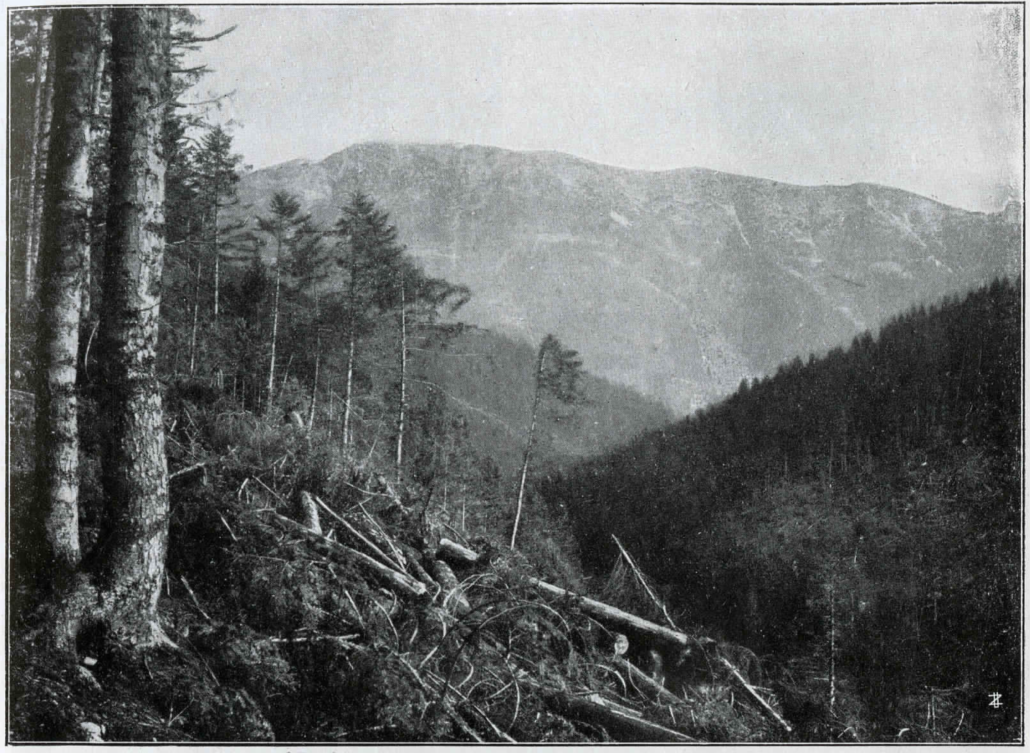
Fig. 1: Storm Vaia but in the early 1900s. “The effects of a hurricane. Even the richly forest-covered ground could not prevent the effects of the wild waters of the bare mountain area above”. Photo. Pietro Rizzi, isp. for. and C. D. Bonomo – Asiago. Source: [1]

For the Veneto area, then, the problem is not limited only to mountain streams, for which the same prescriptions implemented in the rest of the Alps also applied and still apply. Indeed, Veneto sees the presence of a dense network of lowland waters, variously exploited and no less fearsome than Alpine streams.

Accommodation of slopes in upstream sections, correction of ravines, planting of tree and shrub species, correction and modification of embankments and curves, consolidation of landslides, defense against avalanches. The table of contents of a modern book on hydraulic-forestry systems would certainly not look much different.
It is enough to look at these images to understand that much of what we see in our valleys today is just the legacy of centuries-old knowledge, technique and building architecture always aimed at safeguarding man and his spaces.

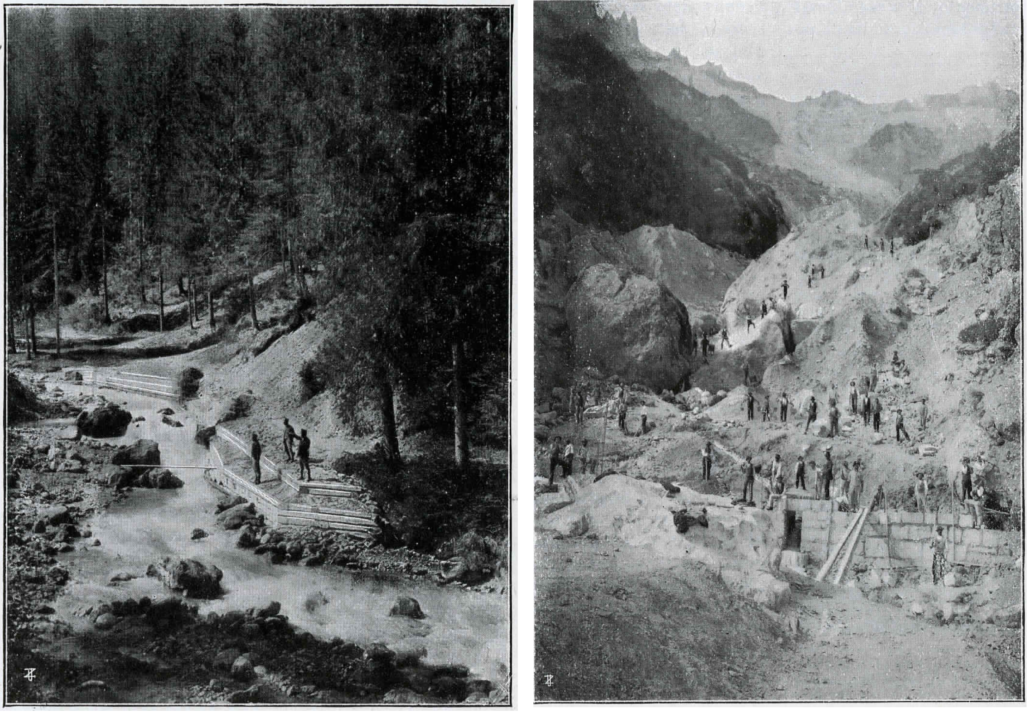
Fig. 2a –left side:  “A log defense at a bend. Without this defense, the stream would run over the slope somewhat devoid of trees, beginning its demolition, which, once started, could extend upward with serious consequences“. Photo: Fini – Treviso. Source: [1]

Fig. 2b –right side: “The construction of a large bridleway in the Rotolon Valley above Recoaro (Vicenza)”. Photo. Magistrato delle Acque – Venice. Source: [1]

However, mountain waters are not only the bearers of calamities and natural disasters. A positive example is certainly the activity of fluitation: the mode of timber transport that was practiced for centuries on the waterways. And the hand of man has not been slow, even in this case, to put its modifications on it. The so-called “risine” are nothing more than channels, made of rubble when they were fixed, but more frequently of temporary lumber strands, to be used as chutes where logs or other woody assortments could slide down mountain slopes. Historic and noteworthy for the Italian Tyrol (i.e., present-day Trentino) are the fluitation transport systems developed in the 19th century in the Lagarina Valley and along the Avisio River. In each case,  “fluitation affected in a customary way a large part of the main hydrographic network of the Italian Tyrol. Fluitation with rafts was mandatory only on the Adige downstream of the Burgstall (Postal) station” [2].

Finally, with regard to a modernity of visions and needs that have never radically changed over the centuries, I am pleased to quote the final lines of the treatise on forest and stream. From the perspective of modern bottom-up integration, the multifunctionality of forests and mountains, and the protection of the environment and local people, my impression is that certain concepts were already well understood more than a century ago. Will we finally be aware of this?

“The State except in mountain basins, for the arrangement of which it must provide directly because of the high public interests of a general character which advise it, and except for the creation of a forest domain of a special character, can only exert an action of encouragement and aid to the work of local authorities and private individuals.

The forest, let us remember, is a great cheap laboratory of future wealth […] and its workers great or small, visible and invisible, are only waiting to be put to work and to be quietly thrown to work, in the solemn industrious peace of their fruitful and mysterious agglomerations”.

This article is part of the project “PILLOLE D’ACQUA PIANA: seminari itineranti, blog e podcast per una gestione sostenibile delle risorse idriche in Piana Rotaliana” carried out by ECONTROVERTIA APS and supported by Fondazione Caritro (Prot. no. U445.2023/SG.386 of April 23, 2023).

From Crisis to Culture: The Birth of Ribeirinho Communities

Ribeirinhos are a traditional population that lives near the rivers and survives from artisanal fishing, hunting, clearing and extractivism. Due to the geographic aspects of Brazil, it is in the Amazon that most of this population lives. In addition to natives, these populations also include descendants of migrants from the Northeast of the country [1].

These populations were born during the late 50s when Brazil went through the rubber crisis. Brazil was a significant player in the rubber industry during the late 19th and early 20th centuries. At that time, the demand for natural rubber, mainly used in tire manufacturing, had driven economic growth in the Amazon region. Then, the development and widespread adoption of synthetic rubber triggered the crisis. During World War II, advances in chemistry led to the creation of synthetic alternatives to natural rubber and after the war, the dependency on natural rubber was indeed significantly reduced. Consequently, this led to a sharp decline in the price of natural rubber in the global market, severely affecting Brazil’s rubber-based economy.

As the rubber economy collapsed, many individuals and families from rubber-producing areas were forced to migrate to urban centers in search of alternative sources of income. However, a significant portion of these individuals chose to remain close to their ancestral lands along the riverbanks. This decision led to the formation of the Ribeirinho communities.

New home, old habits

The establishment of Ribeirinho communities was not only a response to economic hardship but also a reflection of their deep cultural ties to the Amazon environment. These communities maintained traditional practices, knowledge, and customs, while also integrating new elements influenced by the changing economic landscape.

Ribeirinhos adapted to their changing circumstances by adopting a lifestyle that combined elements of traditional subsistence activities with new economic endeavors. They engaged in fishing, small-scale agriculture, gathering of forest resources, and other activities that allowed them to make use of the rich natural resources provided by the Amazon ecosystem. Over time, these communities developed a unique way of life that revolved around their close connection to the rivers and forests.

Fig. 1: Household by the Amazon river. (Nareeta Martin, May, 2, 2019. Amazon, Brazil). Source: unsplash.com

Lifestyle and challenges

The inhabitants of the Amazon region have developed a way of life that revolves around the cyclical patterns of river floods and droughts, which occur annually. The majority of ribeirinhos’ households are situated in remote rural zones, often widely dispersed from one another. Notably, certain houses might shift locations periodically, owing to the unique characteristics of the area: floating houses and houseboats. These innovative structures, constructed from wooden planks and supported by logs, rest upon the rivers and adapt to the changing water levels.

For the Brazilian Institute of Geography and Statistics (IBGE) this isolation represents a big challenge for the annual data survey that composes the Demographic Census. However, the same challenge faced by their agents is also the challenge these communities face when trying to have access to health, potable water and education: travelling many kilometers into the river, and also on foot and dealing with drought and heat [2].

Beyond the difficulties in accessing basic needs, Ribeirinhos are directly affected by the increasing environmental disasters in the Amazon basin and its surroundings. In late June this year, a shocking complaint revealed the devastating consequences of pollution and irresponsible activity of the EDP Energias do Brasil in northern Brazil [3]. In that episode, more than 45 traditional quilombolaand riverside communities in the Floodable Natural Fields of Maranhão were affected. But the consequences are way larger for the country. These wetlands are protected by the Ramsar Convention, an international treaty aimed at the conservation and sustainable use of these vital ecosystems. They play a key role in preserving biodiversity, regulating the climate, storing water and providing essential environmental services to society.

This article is part of the project “PILLOLE D’ACQUA PIANA: seminari itineranti, blog e podcast per una gestione sostenibile delle risorse idriche in Piana Rotaliana” carried out by ECONTROVERTIA APS and supported by Fondazione Caritro (Prot. no. U445.2023/SG.386 of April 23, 2023).

Water Emergency is the New Normal in Trentino

The year 2022, just like its predecessors before, holds the sad primacy of being the warmest and driest year ever recorded, also in Trentino [1].

Everything starts from a winter that, in the last few years, could count on very few snow events: the snow plant engineering companies have overcome the problem with artificial snow and accumulation basins at high altitudes but the consequences for agriculture and the production of electric energy have been devastating.

In Trentino, in the last few months, the results have been visible to anyone: the Santa Giustina basin lacked 40 meters of water and the lowered level has uncovered, on the left bank, the bridge on the old road above the San Romedio watercourse that had been covered with the fill up of the hydroelectric basin in the fifties. The Garda Lake, on the first of March 2023, recorded a volume of 120 million meter cubes (on the 459 maximum allowed): its level is 46 cm above the hydrometric zero measured in Peschiera del Garda, against the 99 cm of the average value of the same period.

The four rivers carrying water outside Trentino have showed lowered discharge values. Along with the above mentioned case of Adige, the Brenta river in Grigno has recorded a 30 % deficit compared to the same average value of the previous year, in the same period. In the month of January, the Sarca water quota to the Garda Lake was 10 cubic meters/sec against the average 18 (average value of the last ten years). In the month of February, the Chiese river, tributary of the Idro lake, has been estimated up to 2.5 cubic meter/second (against the 4.4 of the last ten years) [2].

In general, all the superficial water bodies of Trentino (377 among rivers, streams and 21 lakes) and underground water bodies (22) have recorded significant reductions, and, in some cases, the lowest values ever recorded.

Fig. 1: Many lakes of Trentino have been suffering a dry state, till May 2023. Free source photo by armennano downloaded from Pixabay.

The emergency was visible in the whole provincial territory: in march 2023, the basins of malga Bissina and Boazzo ( in the Alto Chiese, mountain range of Adamello) showed a capacity of 16 % (accounting for less than 12 millions meter cubes of water). In the Laste Trento station, in 2022, 751 mm of water have fallen down (against the 936 expected) which accounted for a 20 % loss. In Bassa Valsugana, Altipiani Cimbri e Vallarsa, the deficit is even harsher since 35 % of the regular precipitation quota (recorded on 2021) had been missing.

Not to forget, there is the stockage of snow in the glacier: snow cumulating in winter time is in fact the water to be used during summer time. Glaciers, all around the world, are suffering, and Marmolada is just the least of the environmental hazards that could lead to the 75 % of the perennial snow to disappear by the end of the century. Climatic models foreseen extreme scenarios happening all around the world, including Trentino: models picture a relatively constant precipitation scenario in terms of abundance but with far less days of rain. This means rains will be rare in the future but with more abundant when they actually take pace, bringing to the paradox of dryness and droughts.

Fig. 2: Rarer but more forceful precipitations will bring to more dry states with the need for crop irrigation. Free source photo by ThorstenF downloaded from Pixabay.

Climate is really changing and quite fast: enough to think that February 14th, Arpa Agency of Veneto has recorded the zero thermal level at 3,000 meters. It was the first time that such a low number had been recorded. In May 2023, tensions and fears have gone looser since rain fell so the focus had been removed from the problem. It is easy to forget that this will be the “new normal” and that therefore, its management has to be ordinary. Solutions have to be conceived holistically, looking for mitigation measures that take into account a shared and coordinated strategy that, just like reported in the IPCC document “Climate Change 2022” [3] foreseen the mitigation of the climate change events. This would include a substantial reduction of the fossil fuel use, a spread electrification (of private and public vehicles), a better energy efficiency and the use of alternative energetic sources (like, for example, hydrogen). It would also be important to educate people to a more sustainable use of the resources and a higher consciousness of its value (by, for example, the education of the youth and citizen science.

This article is part of the project “PILLOLE D’ACQUA PIANA: seminari itineranti, blog e podcast per una gestione sostenibile delle risorse idriche in Piana Rotaliana” carried out by ECONTROVERTIA APS and supported by Fondazione Caritro (Prot. no. U445.2023/SG.386 of April 23, 2023).

Drinking Water from the Sea: the World’s Next Edge?

Still reminding of this winter drought, in Italy, we are approaching summer with a low level of water severity throughout the peninsula. It means that in the short term, we will not have problems with drinking water shortages [1]. However, waiting and hoping for a change, that the waterways will fill up again following the same dynamics as in the past, is unacceptable. Real and tangible solutions are needed to address the water crisis.

What technological solutions are available?

There are two systems for recycling water from the sea, and industrial and public wastewater to date: distillation and hyperfiltration, also known as reverse osmosis desalination.

Distillation splits salts and water by boiling the solution and then condensing the vapor. In other words, the saline solution boils in large tanks, and by condensing the water vapor in a different tank, clean water is produced.

In reverse osmosis desalination, on the other hand, salty or seawater pass through membranes that act as filters, separating the salt molecules from the water molecules. Therefore, making it suitable for agricultural, industrial or even drinking uses [2].

While with the former technique the process is thermal, with the latter it is mechanical and the purity of the water produced depends on the cross-section of the filters. However, both methods are extremely expensive because they require massive amounts of energy [2]. In fact, desalinating 1 cubic meter of seawater requires about 1 kWh or more of energy [3].

In addition, hyperfiltration presents some risks to the environment. First and foremost, the wastewater must be disposed of appropriately because it is hypersaline. Then, small fish and plankton, often get trapped in the pores of filters. The result is damage to the local trophic chain [2].

Where are these technologies already a reality?

Reverse osmosis desalination is already a widely used method, especially in Middle Eastern countries, where it is the most widely used drinking water supply method, given the scarcity of freshwater supplies.

Saudi Arabia holds the largest global desalination capacity with more than 5.5 million m³ of drinking water produced daily. Follows the United Arab Emirates, where the drinking water supply agencies of Abu Dhabi and Dubai produce 3.9 million m³ and 2.3 million m³ per day, respectively [4].

This technology is also widely used in the United States, particularly in California and Florida. But also in Pacific countries, such as Japan, South Korea, and Hong Kong.

Although little known, this process is also an affirmed reality in Europe. Spain is the leading producer of drinking water from hyperfiltration, producing 1.6 million cubic meters daily. In second place there is Italy, extracting about 200,000 cubic meters per day. Follow Cyprus, Malta and Greece [4].

New developments on the horizon?

The main focus of current research is to improve the efficiency of this process to reduce the prohibitive costs. Richard Muller, Professor of Physics at UC Berkeley, emphasizes a vital concept: “The world doesn’t have a shortage of water; it has a shortage of cheap water”. Only if the costs of desalination would fall down, this method will be considered a tangible way to solve the global shortage of drinking water [3].

Good news comes from the University of Texas. An article published on Science reveals that the density and mass distribution of the material used to make the osmotic membrane are the basis for more efficient filtration. A perfectly regular nanoscale membrane can purify a much higher amount of water, with a substantial cost advantage per liter of drinking water that would save up to 40 % of the energy required [5].

Another research, published on Nature Sustainability, proposes a type of metal-organic membrane (MOF, Metal-Organic-Framework), whose properties would allow seawater to be filtered mechanically, thanks to the porosity of the membrane, coupled with the added value of sunlight that allows water purification without the use of chemicals [6].

Technological development is certainly making great strides to make hyperfiltration an efficient process. Once the correct key is found, however, we will still keep in mind two things: the environmental risks that hypersaline wastewaters represent, and that drinking water – no matter how it is produced – remains a valuable resource that should not be wasted.

This article is part of the project “PILLOLE D’ACQUA PIANA: seminari itineranti, blog e podcast per una gestione sostenibile delle risorse idriche in Piana Rotaliana” carried out by ECONTROVERTIA APS and supported by Fondazione Caritro (Prot. no. U445.2023/SG.386 of April 23, 2023).

Caiçara People: Guardians of Brazil’s Coastal Heritage

The Caiçara People: Origins and Heritage

Nestled along the breathtaking Brazilian coastline, a vibrant and resilient community known as the Caiçara people has thrived for centuries. With deep roots in the land and a profound connection to water, the Caiçara people embody a unique cultural heritage that intertwines traditional practices with modern influences.

The Caiçara people trace their ancestry back to a diverse mix of indigenous tribes, European settlers, and African slaves who settled along Brazil’s coastal regions [1]. This blend of cultures and influences has given rise to a distinct identity that distinguishes the Caiçara from other communities in the country. Water has been a central element in their lives, shaping their traditions, livelihoods, and cultural practices.

Caiçaras have developed a lifestyle that revolves around sustainable fishing, agriculture, and small-scale craftsmanship. Their deep connection to the sea has enabled them to adopt practices that ensure the preservation of marine ecosystems for future generations. From handcrafted wooden canoes to intricate fishing techniques passed down through generations, the Caiçara people’s traditional knowledge serves as a testament to their deep understanding of the ocean and its resources [2].

Fig. 1: Fishermen selling the catch of the day. Free-source photo by Tadeu Jr from  Unsplash (Manaus, Brazil. April 12, 2018).

Water is the source of Caiçaras’ sustenance, livelihood, and spiritual connection. Passed down through generations, their traditional fishing practices rely on the abundance of marine resources. The rhythms of the tides and seasons guide their daily lives, influencing fishing patterns, agriculture, and community celebrations. Water serves as a symbol of unity, linking the Caiçara people to their ancestral heritage and the natural world.

Environmental Challenges: Threats to Livelihood and Culture

Today, the Caiçara people face numerous environmental challenges, mainly water-linked, that directly affect their livelihoods and cultural preservation efforts [3]. Uncontrolled urbanization, inadequate waste management, and industrial activities contribute to water pollution along Brazil’s coastlines. Pollutants and waste find their way into rivers, estuaries, and the ocean, endangering the delicate ecosystems that support marine life. As water quality deteriorates, the Caiçara people’s ability to sustain their traditional fishing practices is compromised. Their health, economic stability, and cultural practices suffer as they are forced to navigate polluted waters.

In addition to water pollution, overfishing and habitat destruction present significant challenges for the Caiçara people. Large-scale commercial fishing operations employ unsustainable practices, depleting fish stocks and damaging vital habitats such as coral reefs and mangroves. The Caiçara people, who have long understood the importance of ecological balance, find themselves in conflict with these destructive practices. The diminishing fish populations not only threaten their way of life but also undermine the delicate harmony they have maintained with the marine environment for generations.

By acknowledging these challenges and supporting sustainable initiatives, we can help ensure the resilience and preservation of the Caiçara people’s rich coastal heritage for generations to come. Let us stand as allies to the guardians of Brazil’s coastal heritage, the Caiçara people, in their quest to protect the waters that define their identity and sustain their communities.

This article is part of the project “PILLOLE D’ACQUA PIANA: seminari itineranti, blog e podcast per una gestione sostenibile delle risorse idriche in Piana Rotaliana” carried out by ECONTROVERTIA APS and supported by Fondazione Caritro (Prot. no. U445.2023/SG.386 of April 23, 2023).

Spain’s Wetlands at Risk: We need different Agricultural Practices to Ensure Conservation

In its last annual report, the Copernicus Climate Change Service has stated that in 2022, Europe suffered records on extreme events such as wildfires, floods, temperature rising and drought. It is estimated that last year Europe had the worst drought episode in the last 500 years [1]. Some countries in the south of Europe are more sensitive to droughtand increase of temperatures, due to the Mediterranean climate [2]. Periodic droughts are nothing new for several ecosystems that thrive in this climate, for example, according to the Convention on Biological Diversity (CBD), Spain is one of the most biodiverse countries in Europe [3]. The success of said ecosystems depends on water dynamics properly functioning. In the Ramsar convention, wetlands are recognized as key regulators of the water cycle.

The Ramsar Convention is an agreement signed already by 172 countries, which main objectives are to recognize the importance of wetlands and to protect them [4]. The text defines a wetland as “areas of marsh, fen, peatland or water, whether natural or artificial, permanent or temporary, with water that is static or flowing […].” Wetlands are thus critical in water regulation and providing for biodiversity as well as human consumption.

Humans, as any other form of life in Earth, are dependent on water. But water is not an unlimited resource to use at will. Wetlands, lakes, and aquifers have concrete dynamics of discharge and recharge, and once these dynamics get altered, the ecosystem and the species that inhabit it – humans among them –, will suffer the consequences. The wetland situation in Spain has come to a critical point [5].

Spanish wetlands have many ecological functions. Not only they help with the regulation of the water cycle, but in many other processes. Birds are highly dependent on these places, as they are the last resting point in migration routes to Africa. Wetlands are also refuges for many species reliant on water during dry summer seasons, characteristic of the Mediterranean climate. Amphibians, for example, which are also one of the animal groups most affected by global warming.

Fig. 1: Flamingos resting in Delta de l’Ebre Natural Park. Photo by Mikipons on Wikimedia Commons.

Wetlands are also sources for human water consumption, either for drinking, irrigation, or industrial use. A sensible human use could be compatible with natural water dynamics, but alas, this is not the case. One of the most known and iconic wetlands in Spain is Doñana, of crucial importance for bird migration, or threatened species as the Iberian lynx or the Imperial Eagle. The wetland is recharged thanks to a subjacent aquifer, which has also been used for irrigation of near crops. However, over the last decades, the aquifer is getting worse and worse [6]. The most urgent threats are the impending drought and global warming, yes, but also the lack of responsibility with regard to water usage.

Spain is known as the “kitchen garden of Europe”, providing up to 5.7 million tons of vegetables [7]. Vegetable production requires intensive irrigation farming in a naturally dry land, and this production level needs considerable amounts of water. Until 1990, there were approximately 1.08 million hectares of irrigation farming in the country. During the last decades, with help of the Spanish government and EU’s Common Agricultural Policy, the number has gone up to 3.45 million hectares [8]. Most of the country’s vegetables production is focused on the south, see Andalucía or Murcia.

“It is no longer sustainable – it never was, to start with – to subsidize monocultures, or help planting rice fields in dry lands, forcing farmers to use extra water from aquifers”

Fig. 2: Plastic sea” or vegetable greenhouses in El Ejido, Almería, Spain. Photo by ANE on Wikimedia Commons.

It is urgent to rethink our need to have any vegetable or fruit we want available all year long. This is very recent, and until not so long ago, people respected the seasonality of food. The fact that we can get mangos or avocados at will seem innocuous, but it has serious consequences, especially for southern Europe landscapes, ecosystems and biodiversity. But this kind of actions, although helpful, have to be accompanied by bigger scale ones.

The CAP takes one third of the European budget. Its first objective is to help farmers improve productivity, but this cannot be done at any cost. But other objective is to make a reasonable and sustainable use of natural resources [9]. What is proposed here is a shift in the way of seeing the agricultural production in the UE.

The first step would be creating a map database of all the agricultural landscapes, their climate, water and soil resources, biodiversity, … And then, another estimate of the consumption needs of each country. With this information, the UE can estimate what has to be produced, and distribute the different crops that are needed over the map, considering where each crop is going to be adequate without overexploiting the ecosystem. It is no longer sustainable – it never was, to start with – to subsidize monocultures, or help planting rice fields in dry lands, forcing farmers to use extra water from aquifers. Now we intend to solve it with water transfers from one watershed to another – terrible in biodiversity terms, due to invasive species – in order to keep afloat something unsustainable.

Dry-land crops in dry lands, irrigation crops in humid lands. Laws, policies, and programs have to be done from the start following an ecological perspective, that pays attention to sustainability and ecosystem needs. The Earth needs society to be engaged with its preservation that will stop focusing on the economic perspective that overexploits the land. Wetlands, among other ecosystems, are suffering our greed. Their degraded state affects biodiversity, but also us, and we can, and must adapt our lifestyle in order to protect them.

This article is part of the project “PILLOLE D’ACQUA PIANA: seminari itineranti, blog e podcast per una gestione sostenibile delle risorse idriche in Piana Rotaliana” carried out by ECONTROVERTIA APS and supported by Fondazione Caritro (Prot. no. U445.2023/SG.386 of April 23, 2023).

Even the Netherlands Faces Imminent Shortage of Drinking Water

The history of the Netherlands is inextricably linked to water. The country maintains an international reputation for innovative, integrated and inclusive solutions that protect people and infrastructure from flooding, prevent water scarcity and ensure clean and safe water [1]. For more than a century, it has been taken for granted that clean drinking water flows from the tap in Dutch households, but that time seems to be ending. What is happening in the water country per excellence?

According to a report by the Dutch National Institute for Public Health and the Environment (RIVM), the demand for drinking water in the Netherlands is expected to be much greater in 2030 than in 2020 [2]. On one hand, the Dutch economy and number of inhabitants continue to grow. On the other hand, the changing climate is causing more frequent and severe droughts, which are reducing the amount of drinking water available.

By 2030, the demand for freshwater in the Netherlands is likely to exceed the available supply by up to 30 %. Without immediate action by the national government, provinces, water boards and consumers, these extra cubic meters of water cannot be extracted, and drinking water shortages will arise, the RIVM warns. This shortfall could significantly affect the country’s economy, environment and public health [2].

Four Dutch provinces already struggle with insufficient water reserves to guarantee drinking water at peak times in the summer months. They would be powerless in the face of unexpected increases in drinking water demand. In other Dutch provinces, drinking water companies are called to find additional water sources within the next few years to continue satisfying the increasing demand of water [2].

Nonetheless, these water companies are already facing their own challenges. Often, they use all surface- or groundwater they are licenced to extract, thus resulting in insufficient reserves. And yet, recent nature protection agreements with the government should prevent extraction of the total quantity of water permitted under older licences [2].

Fig. 1: A sailing ship on the Dutch Ijsselmeer during sunset. Free source photo by Alfred Grupstra from Pixabay.

To tackle current and future shortages, the Netherlands needs a new water system that is able to cope with both drought and prolonged wet periods. Possible solutions include reducing rainwater run-off and building up larger water reserves in the dunes and the Ijsselmeer, a closed-off inland bay in the central Netherlands. Meanwhile, water stakeholders are working to raise public and industry awareness about water use and conservation. Work is also being done to find new extraction sites and expand the range of existing licences. For instance, new licences will include different source types, such as brackish groundwater, which is a hybrid water type between freshwater and seawater often found in river estuaries [2].

Besides these radical measures, the RIVM stressed the importance of raising awareness among consumers and industry that drinking water cannot be taken for granted [2]. Read How much water does your 24-hours day consume? on GreenMarked to learn how you can decrease your own water consumption.

This article is part of the project “PILLOLE D’ACQUA PIANA: seminari itineranti, blog e podcast per una gestione sostenibile delle risorse idriche in Piana Rotaliana” carried out by ECONTROVERTIA APS and supported by Fondazione Caritro (Prot. no. U445.2023/SG.386 of April 23, 2023).
The Alpine Drought Observatory

The drought, a consequence of the climate crisis we are experiencing, is real.
In the previous article we talked about the current situation in Italy and how citizens perceive the problem. We should not despair but be aware of the problem and try to adapt as best we can.

In fact, the Italian government has recently issued a decree to set up a steering committee for the water crisis and the appointment of an extraordinary national Commissioner for the adoption of urgent interventions related to the water scarcity phenomenon. [1]

The information that the committee and the commissioner will have to evaluate regarding the state of water resources is often provided by regional bodies, which makes it complicated to have an overall picture of the situation updated quickly. For this reason, a permanent drought observatory (ADO) has been set up for the Alpine area, a project led by Eurac Research of Bolzano together with several national and international partners, funded by the Interreg Alpine Space Programme, co-funded by the European Union. [2]

The Alpine Drought Observatory (ADO) aims to create an online drought monitoring platform and develop policy implementation guidelines for proactive drought management in the Alpine Space region. [3]

Video 1: A video produced by the ADO, illustrating the drought issue from multiple point of views and why this cooperative project is necessary.

The ADO portal makes it possible to visually assess the current drought situation in the Alps via an interactive map. For each predefined area, various indicators are available.

Indices

We could start looking into the indices, numerical indicators computed starting from satellite data that describe:

  • Atmosphere: Precipitation Anomalies (%) and Standardised Precipitation Index (SPI)
  • Top-Soil: Standardized Precipitation-Evapotranspiration Index (SPEI) and Soil Moisture Anomalies
  • Vegetation Health: Normalized Difference Vegetation Index (NDVI) and Vegetation Health Index (VHI)
  • Surface- and Ground-Water: Standardized Snowpack Index (SSPI) and Hydrological Indices (SDI, SGI, ..)

The interactive map allows you to view the trend of these data over time by clicking on the area of interest, which allows us to evaluate the data in comparison to even 40 years ago!

Fig. 1: The interactive time series viewer on the ADO website, allowing you to analyse and compare data starting from 1980.

Impacts

Another set of indicators available on the platform are impacts. You could for instance check the reported impacts of drought during the previous years in a specific region just selecting “Reported Impacts” and then clicking the area of interest. Additionally you can as well investigate impact probabilities and related risks.

Fig. 2: The interactive impact reports on the ADO website.

Vulnerabilities

The vulnerability factor identifies factors contributing to agriculture’s vulnerability to drought. The factors are:

  • Farm size
  • Livestock density
  • High input farming
  • Production intensity
  • Utilised agricultural area
  • Share of permanent grassland

All the factors are described in details on the website, please have a look there if you would like to know more on a specific indicator.

Fig. 3: The vulnerability factors showed on the interactive map on the ADO website. You can choose from multiple factors and get all the details about them with one click.

Try it!

All the described functionalities are open to everyone visiting the website. If you would like to test all of this, you can also try it out directly in the embedded version of the website below, or visit the ado.eurac.edu webpage.

The correct information and dissemination of problems related to the climate crisis, such as that of drought, can certainly benefit from projects such as ADO, which make information that until recently remained confined to researchers and insiders more accessible and within everyone’s reach.

This article is part of the project “PILLOLE D’ACQUA PIANA: seminari itineranti, blog e podcast per una gestione sostenibile delle risorse idriche in Piana Rotaliana” carried out by ECONTROVERTIA APS and supported by Fondazione Caritro (Prot. no. U445.2023/SG.386 of April 23, 2023).

Drought in Italy: Perception and Reality

The word “drought” has recently returned to our vocabulary. First used sporadically, it is now becoming almost a daily recurrence. We hear it in news reports, social media posts, and exclamations and mutterings of people near lakes, rivers or streams. As GreenMarked, we have written about it in the past (The Aftermath of Exceptional Droughts; How much water does your 24-hours day consume?) and will continue doing it in the future.

Nonetheless, it seems that Italians’ awareness of droughts is not very high. In mid-2021, a poll by Ipsus reported that only 20 % of the Italian population is concerned about the state of water resources. Moreover, 70 % of respondents considered drought as an exclusive issue of specific areas or times of the year. The most significant number of concerned citizens was in Southern Italy, where 25 % of the population is aware of the problem. In the Northwest, the percentage is 16 %, 19 % in the Northeast, and 22 % in Center Italy [1].

And yet, according to the Environmental Protection and Research Center (Istituto Superiore per la Protezione e la Ricerca Ambientale – “ISPRA”), the inhabitants of northern and central Italy are those who have to worry the most about droughts.Following a low precipitation winter, the Po River, Eastern Alps, and Northern and Central Apennines hydrographic districts are registering MEDIUM water severity levels. In other words, the seasonal flows are lower-than-average, water demands are higher-than-standard, and water reservoirs cannot guarantee a regular delivery rate. Consequently, there is a high risk of economic losses and impacts on the environment. Conversely, the hydrographic districts of the Southern Apennines, Sicily and Sardinia showed LOW water severity levels at the beginning of April, and water demand was still met [2].

The district water severity level is given by the level average of many water bodies in the district. The Po River district, for example, has a medium water scarcity level that has been calculated from average monthly flow values reporting a condition of “severe” and “extreme” drought [2]. The same happened in the Eastern Alps district this winter. The Adige, Brenta-Bacchiglione, Livenza, Piave and Tagliamento river basins have recorded water severity levels corresponding to “moderate and severe drought”, and yet, at the district level, the average value corresponded to “medium water severity level” [3].

Fig. 1: Map illustration of the water scarcity levels in Italy. Image by GreenMarked. Data by ISPRA [2].

The other side of the coin is extreme precipitation events. Especially in summer, droughts are characterized by high temperatures and long periods without rain, and they are interrupted by severe thunderstorms that cause extensive economic-social and environmental damage. Damages are related to the rainfall intensity and excessive runoff, which often causes flooding and hydrogeological disruptions.

The perception lack of droughts increases the danger related to hydrogeological risk, which affects 94 % of the Italian municipalities.
“More than 8 million people live in areas of high danger, often not being aware of it”, reported the Director of the National Association for the Management and Protection of the Territory and Irrigated Waters (“ANBI”). “This lack of knowledge is often an exacerbating factor when it comes to emergencies” [4].

It is, thus, necessary to continue to talk about droughts, extreme events, and the climate crisis to increase people’s awareness and make citizens ready, trained, and able to deal with emergencies.
However, treating droughts as an emergency and merely considering it in the short term is a serious mistake. The models and data acquired by the authorities depicted a situation that needs to be addressed with a medium-to-long-term strategy. Only by doing so, we can adapt to the climate crisis, manage the available water resource to the best, and make the water network as efficient as possible [5].

This article is part of the project “PILLOLE D’ACQUA PIANA: seminari itineranti, blog e podcast per una gestione sostenibile delle risorse idriche in Piana Rotaliana” carried out by ECONTROVERTIA APS and supported by Fondazione Caritro (Prot. no. U445.2023/SG.386 of April 23, 2023).

Bolivia’s Chiquitanía Running Out of Water

Intensive monocultural farming based on agrochemicals and transgenic crops is provenly unsustainable and has a great impact on worldwide forests [1] [2]. As never before, the Chiquitanía, a tropical region in the Bolivian department of Santa Cruz de la Sierra, has been hit by severe droughts caused by the catastrophic 2018-2019 wildfires. Large areas of forestland were burnt and hundreds of local communities devasted because their lifestyles and food supply depended on forests.

The droughts and fires continue also today and are linked to a growing deforestation activity in the region. Worsened by Evo Morales’ (2015-2019) laws and decrees that favor land trafficking, the expansion of the agricultural frontier has kept destroying forested areas through slash-and-burn practices. Land is deforested, soil eroded, water courses are dried out.

In the Chiquitanía region, rivers, streams and lakes are literally disappearing. Illegal damns put up by cattle and agribusiness farms have made the San Lorenzo river so dry that hardly any water arrives to the communities. Lake Cáceres in Puerto Suarez is also drying out. Lake Concepción has practically disappeared because its tributaries have been diverted and contaminated by agrochemicals used for transgenic soybeans. Lake Guapomo, in San Ignacio de Velasco, and the river at Aguas Calientes keep receiving untreated sewage inputs [3].

Authorities have not made enough effort to tackle the issue. Although the misuse or contamination of environmental elements has been verified and confirmed by official public report [4], no sanction or countermeasure against agribusiness and cattle farmers has been enforced. This forced communities to buy what little water is left and share it with their animals and crops.

Undoubtedly, this situation cannot continue. Access to water is a human right and pursuing illegal actions that hinder the access to water by downstream communities is a crime that cannot be allowed and that must be denounced.

Fig. 1:A dry agroecological parcel in the Chiquitanía (Probioma, August 2022).

Cover image: Typical landscape of the Chiquitanía region at San Jose de Chiquitos (David Lazarus, February 20, 2014. CC BY-SA 4.0, https://commons.wikimedia.org/w/index.php?curid=61382172).

Preview image: A dry agroecological parcel in the Chiquitanía (Probioma, August 2022).

The Aftermath of Exceptional Droughts

The hot and dry summer seems to have ended in the Netherlands and neighboring countries. Sunbeams have given way to raindrops and rainbows again, while nature looks as green as ever. Below the “green” surface, however, the impact of this year’s exceptional drought is still visible.

Dutch groundwater levels reached historic lows this summer [1]. In neighboring Germany, a study from the Karlsruhe Institute of Technology showed that the drought effects have accumulated over the years, as winter precipitation can no longer compensate for summer shortages. This particularly affects groundwater resources, Germany’s main source of drinking water [2].

Declining groundwater levels due to a reduced refilling rate, and the increased water demand in summer, made water utility companies struggle to meet demand. Several countries even experienced water shortages [2]. The Head of Policy and Development of one of the Dutch water utility companies told GreenMarked that “water boards are in transition. For centuries, the policy was to drain water to the sea as quickly as possible. Instead, we now need to hold it and “conserve” it as best as we can”.

If the climate crisis is not addressed, Germany’s groundwater levels are expected to drop “significantly” by the end of the century. Such a scenario will put enormous pressure on local water resources, threatening the country’s water and food security even more [2].

“During future dry periods, strong usage conflicts can be expected in areas of low water availability between water suppliers and industry (process and cooling water), additionally amplified by increasing agricultural irrigation demand.”[2]

In Mexico, one of the world’s water quality hotspots regions [3], water overuse is extreme, reaching can be up to 300 % in certain areas. It means that three times more water is extracted than what can naturally be replenished. A documentary from Deutsche Welle reveals that excessive water extraction in Mexico City causes subsidence of up to 40 cm every year, bursting underground water pipes. Millions of Mexicans have already been directly affected, leaving them dependent on private water companies delivering drinking water with trucks. However, storing water in domestic storage tanks can pose crucial risks to water quality, and requires consistent monitoring [4].

“Competition with nature for water has become a battle for human existence”[5]

Worldwide, about 4 billion people face severe water shortages for at least one month a year [4]. The case of Mexico City shows that the problem is not limited to water availability alone. The usability of water for human purposes and the health of ecosystems depends on both sufficient water quantity and appropriate water quality [3].

Fig. 1: The effect of exceptional drought on an ecosystem. Free photo from Patleem on Pixabay.

Sustainable Development Goal no. 6 aims to achieve “safe and affordable drinking water for all” and to “reduce the number of people suffering from water scarcity” [6]. Meeting these goals requires a shift in focus from solutionsthat look exclusively to water quantity (e.g. increasing water use efficiency) to those that contribute to both water quantity and water quality improvements[3].

Read How much water does your 24-hours day consume? on GreenMarked to find out how you can contribute.

Creating Water in the Desert: An Innovation to Fight Water Shortages in Extreme Droughts

It is an image that plagues large parts of Europe: extreme drought. Even the Netherlands, known for its exceptional water management, is facing an official water shortage [1]. Research by Dutch newspaper NRC has shown that Western Europe hot temperatures have moved 500 kilometres north in the last 50 years, increasing summer air temperatures by more than 1°C [2].

The current Dutch summer now resembles a French summer of yesteryear. In the past decade, temperatures in the Netherlands were equivalent to those in large parts of central France in the 1970s. Instead, summers in central France are now roughly as warm as in northern Spain in the 1970s, which in turn now features southern Spain temperatures [2].

The climate crisis, severe droughts and population growth has put pressure on the scarce global freshwater resources and led to severe water shortages in many regions
of the world. At the same time, global water demand is expected to rise by 55 % by 2050, and 25 % of large cities already suffer from water stress [3]. Likewise, many municipalities in Spain and France had to cut off households’ drinkable water this summer.

To find a solution, we need a different approach. Crossovers between art and science allow to break through established patterns and can lead to radical innovations. This mentality enabled Dutch artist Ap Verheggen to develop SunGlacier, an innovative company specialized in solar-powered sculptures that can produce water from thin air [4]. His “counter-intuitive aim” [was] to create ice and water in the desert by making use of solar energy” [5]. “Sun, gravity and air are widely and freely available everywhere. They do the work.” [6].

SunGlacier is in fact a water multiplier. It blows outdoor air through an artificial cold rain shower. The water vapor of the outdoor air condenses against the cold falling water droplets and increases their volume. The result is a growing waterfall, as depicted in Figure 1. The air cooler and the water pump ensure that water is regularly pumped to the rain shower [6].

Fig. 1: SunGlacier’s Growing Waterfall Technology. Source: SunGlacier.

From the beginning, the company has focused on a portable size off-grid application, powered by solar energy. This led to the creation of an incredibly efficient system capable of producing large amounts of water with low energy consumption [5].

SunGlacier is planning to build an industrial prototype with a Dutch mechanical engineering corporation and have ongoing negotiations with a company supplying horticultural greenhouse system. With SunGlacier’s technology, they intend to make closed ecosystem greenhouses.

The potential impact of Verheggen’s water machine is immense. If his now patented invention can be applied worldwide, millions of people in arid regions could gain access to drinking water. It would also make farming possible in places where this is now unthinkable. Verheggen is however more cautious: “Hopefully, in five years, tens of thousands of SunGlaciers will have been sold. This will not solve any immediate global problems, but this invention can help take the pressure off drinking water and food supply problems in the long run” [6].

How much water does your 24-hours day consume?

Following the latest IPCC report, Climate Change 2022:
Impacts, Adaptation and Vulnerability, 3.3 billion people are highly vulnerable to climate impacts, and half of the world’s population experiences severe water shortages for at least a month per year [1]. In Southern Europe, more than a third of the population will face water shortages if global warming reaches + 2°C [2].

Due to its potential impact, the water crisis constantly ranks in the top five risks to the global economy, according to the World Economic Forum [3]. Understanding our water consumption is crucial to ensure that we have sufficient water to sustain all the world’s living beings.

A research study by the Dutch University of Twente has shown that the indirect water consumption of many households is 50 to 100 times higher than the direct household consumption. An average person uses 5000 liters of water daily, equivalent to 50 bathtubs, but depending on where you live and what you eat, your water usage will range from 1500 to 10000 liters a day [4].

How is all this possible?

Personal water consumption is not limited to direct household water consumption but also the indirect one. The Water Footprint Network (“WFN”) defined the personal water footprint as “the amount of water you use in your daily life, including the water used to grow the food you eat, to produce the energy you use and for all the products in your daily life – your books, music, house, car, furniture and the clothes you wear” [4].

Our diet has the most significant impact on our water footprint. Livestock farming accounts for 20 to 33 % of all freshwater consumption in the world, mainly due to water usage for animal feed. A kilogram of meat requires five to ten kilograms of feed, whereas the production of a hamburger from farm to fork is equivalent to having 35 showers. In terms of feed and water footprint, it would thus be way more efficient to eat the same amount of maize or soy eaten by a cow, by ourselves. Different diets have therefore different water footprints. In the Netherlands, a vegetarian diet (2700 liters per day) uses 40 % less water than a carnivorous diet (4300 liters per day), while a vegan diet saves even more.

Another major consumer of water is coffee because it is grown in tropical fields prone to severe water evaporation. Producing sufficient coffee beans for one cup of coffee requires 140 liters of water which are equivalent to 1000 coffee cups of filtered water. Additionally, water resources in these areas are limited available and cannot be used for other purposes simultaneously.

And what about the clothes we wear? Cotton is the raw material used for most clothing and is significantly water-intensive. According to the world average, the process to make a pair of jeans (cultivation of cotton, dyeing and production) requires about 8000 liters of water. In some parts of the world, the same pair of jeans requires as much as 12,000 liters, indicating considerable differences in effective production processes (e.g., adopting sustainable irrigation methods). It is easy to imagine the enormous impact of fast fashion.

Figure 1:Rough water footprint estimation of a Western European consumer. Source: Mekonnen & Hoekstra – National Water Footprint Accounts, 2011 [5].

While most people – especially in developed regions – live in urban areas, most water is used in farming and, to a lesser extent, in industrial and mining activities of rural areas. Urban people cannot see the water consumption and pollution associated with the goods consumed in their everyday life because water exploiting activities take place far away from cities or are practically hidden from their view. Besides, the cost of water consumption and pollution is not or hardly included in the price of the goods produced, resulting in a lack of awareness and lack of true pricing [6].

People living in rainy regions like the Netherlands may see water scarcity as a distant problem. However, Dutch people are more closely connected to water shortages than they might think. Only a fraction of the Dutch water footprint originates from its territory, leaving 89 % to foreign sources [7].

“A surprising 40 % of the water footprint of European consumers lies outside of the continent, often in places facing severe water problems. Much of our food and many other goods are imported from countries with water-stressed catchments.”

(Hoekstra, 2020, p.VIII)

As the Dutch water footprint is relatively large, it requires a disproportionate amount of water to maintain its lifestyle. The fragmentation of our worldwide water usage can have huge impacts on local water resources. The growing demand for water and the overexploitation of scarce freshwater supplies lead to water scarcity, economic decline and water disputes in many parts of the world [8].

What can we do about it?

Everybody can make a positive impact on their personal water footprint. Awareness is the first step towards change, so a good way to start is to measure your own water footprint using WFN’s personal calculator. Our daily life actions can enhance living conditions and preserve water-dependent plants and animals worldwide [4].

Of course, we cannot do it alone. The water footprint of corporate production processes also plays an important role. Yet, relevant information in this field is entirely lacking [6]. As companies increasingly focus on their indirect supply chain (scope 3) emissions, it is time that they start disclosing their water footprint. Such disclosure would allow consumers to buy water-friendly products and encourage responsible water usage.

Let’s work together towards a fair and efficient use of freshwater resources worldwide!

Bibliography:

[1] IPCC. (2022). Technical Summary IPCC WGII Sixth Assessment Report (FINAL DRAFT). Downloaded 1 March 2022, from https://report.ipcc.ch/ar6wg2/pdf/IPCC_AR6_WGII_FinalDraft_TechnicalSummary.pdf

[2] IPCC. (2021). Fact sheet – Europe. Downloaded 1 March 2022, from https://report.ipcc.ch/ar6wg2/pdf/IPCC_AR6_WGII_FactSheet_Europe.pdf

[3] World Economic Forum. (2021). The Global Risk Report 2021. Downloaded 1 March 2022, from https://www3.weforum.org/docs/WEF_The_Global_Risks_Report_2021.pdf

[4] The Water Footprint Network. (n.d.). Personal water footprint. Retrieved 1 March 2022, from https://waterfootprint.org/en/water-footprint/personal-water-footprint/

[5] Mekonnen, M. M., & Hoekstra, A. Y. (2011). National water footprint accounts: The green, blue and grey water footprint of production and consumption. Volume 1: Main Report. Downloaded 1 March 2022, from https://digitalcommons.unl.edu/cgi/viewcontent.cgi?article=1077&context=wffdocs

[6] Hoekstra, A. Y. (2020). The Water Footprint of Modern Consumer Society (2nd edition) London: Routledge. https://doi.org/10.4324/9780429424557

[7] Van Oel, P. R., Mekonnen, M. M., & Hoekstra, A. Y. (2008). The external water footprint of the Netherlands. Downloaded 1 March 2022, from https://www.waterfootprint.org/media/downloads/Report33-ExternalWaterFootprintNetherlands.pdf

[8] Hogeboom, R. J., De Bruin, D., Schyns, J. F., Krol, M. S., & Hoekstra, A. Y. (2020). Capping human water footprints in the world’s river basins. Earth’s Future, 8(2). https://doi.org/10.1029/2019EF001363.

Cover- and preview image: globe in a waterdrop. Free-source photo by TeGy on Pixabay.

An increasing blue risk – The Netherlands and the rising sea level

The Netherlands has always been known for its water management. Approximately 70 % of the Dutch people live in a flood-sensitive area[1], and the engineering works to make it all possible are looked with worldwide amazement. More international fame was gained through the construction of the Delta Works. Consisting of a series of dams, sluices and storm surge barriers [2], the Delta Works has been voted one of the seven modern world wonders.

Recognizing the need for such a defence system did not go without a struggle. Despite numerous warnings, a flood disaster had to occur before politicians approved the construction of the Delta North Sea Protection Works. The tragedy of 1953 took nearly two thousand people’s lives and flooded 1290 km², four times the size of Malta. In fact, also Amsterdam and the entire province of Zuid Holland (including cities such as The Hague and Rotterdam) were close to being flooded [3].

“The problem of the Dutch is that they are so self-effacing, so modest, that they no longer believe their own history.”

Johan van Veen (1893–1959)

The Delta Works defence system anticipated a 40 cm rise in sea-water, a value which is unfortunately much lower than the expected rise foreseen by the climate crisis. If the world’s greenhouse gas (“GHG”) emissions do not decline unprecedentedly, the sea level could rise by almost three meters within 2100. Even if the Paris Agreement target of keeping the average global temperature increase under 2 °C is met before the end of the century, the Royal Netherlands Meteorological Institute (KNMI) still predicts a sea-level rise of two meters [4].

Dutch scientists have considered a scenario where the next generation has to give up cities like Amsterdam, Rotterdam, and The Hague. Some even state that the Dutch newborns “will not be able to be Dutch anymore, because the country of the Netherlands will no longer be there” [3]. Is there still hope? In the end, Dutch people would not be Dutch if they did not fight water. Yet hope seems limited to engineers that believe in a makeable world while ecologists have given up already.

Rutger Bregman interviewed seven leading Dutch scientists for his book “Het water komt” (The water is coming). To deal with a sea-level rise up to two meters, they suggested extreme countermeasures which go far beyond the current Delta program. The country would need to build the world’s largest pumping stations to coninuously pump water from the low rivers into the high sea. Furthermore, it would require 25 times more sand to strengthen the coast and a permanent fleet of dredging ships to continuously spray sand upon the North Sea coast. And this would only be the beginning [3].

“If the earth warms by more than 2 degrees, sea levels will continue to rise, requiring us to think even bigger.” [3]

Bas Jonkman, professor of Hydraulic Engineering at Delft University, sees possibilities even beyond a 2 meters sea-level rise. He envisions the displacement of Amsterdam’s Schiphol Airport into the sea, and construction of artificial islands in front of beaches. Housing dozens of wind turbines, they will break the incoming waves. To boost their effect against an additional sea-level rise, the island could connected with one big ring dyke. Ecologists foresee environmental disasters, but Jonkman argued that “nature is dynamic, with the potential to restore. Despite the discrepancies, both ecologists and engineers agree that it is fundamental that a scenario of more than 2 meters sea-level rise must be avoided at all costs. That would require to push down GHGs to absolute zero (not net-zero) as soon as possible.

The Dutch Climate Agreement aims at a GHG reduction of 49 % by 2030 compared to 1990, followed by 95 % by 2050 [5]. To meet these targets, some eight million buildings must become gas-free, nine million cars must run on electricity or hydrogen, the electricity grid capability must become at least three times bigger, a quarter of the North Sea must be filled with wind turbines, 75 million solar panels must be connected, and 100 thousand hectares of forest must be planted [3]. The cost of the operation has been roughly estimated at € 500 to 700 billion, which is 70 to 100 % of the Dutch GDP, and five times as much as the Delta Works [6].

“This will be the largest reconstruction of our country. Ever.” [3]

To achieve the GHG objectives, everyone has to do their part but the government has a guiding and exemplary role. Its decarbonizing attempt must not lead to adverse effects elsewhere, but rather contribute to a more sustainable world as a whole. In Renewable energy at what price?, I explained that base metals mining needed for the Global North energy transition leads to ecological destruction in the Global South, destroying the habitat of the local population, often without compensation. The Dutch government should acknowledge this and act accordingly [7].

Estimates by PBL Netherlands Environmental Assessment Agency suggest that GHGs will be cut by only 38 to 48 % within 2030, much lower than the EU’s Fit for 55. The Dutch Council of State – the highest advisory body of the government and House of Representatives – concluded that Dutch climate policy is “not enough to meet the climate targets”, even though “the nature and extent of the climate crisis require immediate action” [8].

The coalition of the new Rutte IV cabinet has made the climate crisis fight a top priority. By earmarking € 35 billion over the next ten years and appointing a special Minister of Climate and Energy, Dutch climate policy should align itself with the EU’s directive of achieving a 55 % GHG reduction compared to 1990 by 2030. In addition, an independent scientific council will be established to evaluate and advise on the required new climate policy [9].

The Rutte IV coalition, however, has not specifically explained how it will tackle the climate crisis effects and especially the upcoming sea-level rise, which will hit hard on the Dutch coasts. It remains unclear how Dutch water engineers and managers are preparing for the outlined sea-level rise scenarios, as current policies are still too often focused on the short term. Both in the short and long term, the Netherlands must counteract the climate crisis not only to abide by European directives but to protect their coasts, their land, people and future.

Figure 1: Delta North Sea Protection Works (source: Deltawerken | 18 August 2015 | Mirko Tobias Schäfer | Flickr)

Bibliography:

[1] PBL. (2014). Small chances – big consequences: casualties and social disruption as a focus for water safety policy.[Translated by Author]. Retrieved 11 December 2021, from https://www.pbl.nl/publicaties/kleine-kansen-grote-gevolgen

[2] BenDor, T.K. (n.d.) Flood Control. Downloaded 11 December 2021, from https://todd.bendor.org/media/Flood_Control_BenDor.pdf

[3] Bregman, R. (2020). The water is coming: a letter to all Dutch people. [Translated by Author]. De Correspondent. Downloaded 6 December 2020, from https://decorrespondent.fetchapp.com/files/a8a80f35

[4] Haasnoot, M., Bouwer, L., […] Sloff, K. & Mosselman, E. (2018). Possible consequences of accelerated sea level rise for the Delta Programme: an exploration.[Translated by Author]. Downloaded 11 December 2021, from https://www.deltares.nl/app/uploads/2018/08/Deltares_Mogelijke-gevolgen-van-versnelde-zeespiegelstijging-voor-het-Deltaprogramma.pdf

[5] Klimaatakkoord. (2019). National Climate Agreement – The Netherlands.Downloaded 13 December 2021, from https://www.klimaatakkoord.nl/binaries/klimaatakkoord/documenten/publicaties/2019/06/28/national-climate-agreement-the-netherlands/20190628+National+Climate+Agreement+The+Netherlands.pdf

[6] Borst, T. & Keulemans, M. (2019, 10 October). Will climate policy really cost the Netherlands 1,000 billion euros?[Translated by Author]. Retrieved 13 December 2021, from https://www.volkskrant.nl/nieuws-achtergrond/gaat-het-klimaatbeleid-nederland-echt-1-000-miljard-euro-kosten~bd4fe21a/

[7] Hoekstra, E. (2019, 21 February). Renewable energy at what price?Retrieved 13 December 2021, from https://greenmarked.it/renewable-energy_price/

[8] Raad van State. (2021, 30 September). Advice on the Climate Memorandum 2021. [Translated by Author]. Downloaded 15 December 2021, from https://www.rijksoverheid.nl/binaries/rijksoverheid/documenten/brieven/2021/10/28/brief-raad-van-state-over-klimaatnota/Raad+van+State+Advies+op+Klimaatnota+2021.PDF

[9] Nijenhuis, H. (2021, 16 December). Will the new coalition agreement achieve the climate goals?[Translated by Author]. Retrieved 16 December 2021, from https://www.parool.nl/nederland/gaan-we-de-klimaatdoelen-nu-wel-halen-met-het-nieuwe-regeerakkoord~b51898b8/

Cover and preview image:inundated coast area. Free-source photo by Cobe68 on Pixabay.

This article is part of the project “Environmental Blogging Boost 4 Students”, aimed at increasing the spread of agroecology and sustainable water management in Trentino. The project is financed by the BIM Adige Water Catchments Consortium (grant approved by provision n. 100 of June 06, 2021).

Agroecology for a better water management in Trentino

Trentino has an average year precipitation of more than 1000 mm with obvious differences in space and time as some areas of the territory receive more rain than others. All in all, the yearly volume of water from precipitation accounts to 11.7 billion m3 since 2.3 billion are lost through evaporation and evapotranspiration [1]. In Trentino, there are 14,000 capture points catching water from springs and wells, waterways (rivers and lakes) and underground. In addition to them, there are plenty of “artificial lakes” (reservoirs) that have been set up for hydroelectric purposes to supply for the ever increasing need of water. They provide for 394 million m3 of water which accounts for 8 % of the needs. Just to compare Trentino with the “rest of the world”, while irrigated land accounts for only 20 % of the global cultivated area, it contributes to about 40 % of crop production [2]. These numbers prove that Trentino enjoys a good availability of water but particularly in the plain areas of the territory, in the last years, the situation has started to change due to changes in weather and climate regimes.

Fig. 1:lakes and water reservoirs are important capture points in Trentino (photo by shogun on Pixabay).

Several reports by Meteotrentino prove that the last two years have been warmer and drier: 2019, for instance, has been the second warmest year ever recorded (after 1850), and Trentino has registered temperatures higher than 1.5 – 2 °C, if compared to the period 1961-1990. The year 2020 has not been different: monthly data show higher temperatures (particularly in the Fall) and lower precipitation as well as the first months of 2021. In particular, March 2021 has been characterized by particularly strong winds and zero precipitations. This inevitably translates in the global warmer and drier climatic regimes happening worldwide, meaning that Trentino is no different than other areas [3].

Withstanding the complexity of the situation, we need to envisage a versatile strategy that takes into serious considerations the weather patterns while posing alternatives to catching water from sources commonly used in irrigation and perhaps making irrigation more sustainable (for instance, by making crops more efficient). One viable solution could be the use of crops which are less greedy of water or promote the use of varieties that require less irrigation. Irrigation, on the other hand, must be efficient through the use of digitalization and the conversion to sustainable methods (drip irrigation, micro-irrigation and precision irrigation). A complex strategy like this must be based on funds and agreements between the different stakeholders but above all on instilling an education in the public and private sector, acting also on the younger generations. The European Common Policy (CAP) can surely be the way to make it happen. While farmers consider irrigation to be sustainable when it provides uninterrupted access to water resources at a price not exceeding the marginal revenue that they generate (clearly without accounting for environmental externalities), from the standpoint of water resources, irrigation is sustainable if it does not deplete freshwater stocks or environmental flows [4]. It is thus crucial to take into account the strong link between territory and agriculture, as expressed by ecological status of the waterbody and the hydraulic risk.

Fig. 2: drip irrigation can be used in different vine training systems and represents a more sustainable irrigaton method (figure edited from the photos by Markus Winkler on Unsplash and Fotokalde on Pixabay).

Agriculture is an important sector in Trentino’s economy and farmers have made it possible to preserve the territory while agricultural practices aimed at food production were taking place. This delicate connubium happened for many years but now climate change is calling for more action and this will be possible with the implementation of the Agenda 2030 and the Sustainable Development Goals. Trentino has made a major effort to implement them through the definition of a Provincial Strategy for Sustainable Development and in particular for the Goal no. 6 that refers to Water (Clean Water and Sanitation). The participation of citizens and stakeholders in the implementation of the Agenda, has proposed some priorities for the future years and this is a milestone and a virtuous example for their bigger involvement in the res publica [5]. Here are some ideas to make Trentino more sustainable for water use:

•   Rationalize the use of water in the sectors that use a lot of water, like agriculture with a common focus on the sustainable use of the resource. This action would start from a proper education of the stakeholders.

•   Promote a common culture of water by involving citizens with meaningful initiatives (e.g., citizen science events). This would inform the general public about the need of preserving the resource.

•   Enhance the availability and accessibility of water data in the territory, involving all the stakeholders. The implementation of such data would help set up monitoring and research studies.

•   Evaluate the caption of water by private citizens and require their action with initiatives that benefit the territory to promote, once more, the importance of water and good water management.

Fig. 3: typical apple orchards in Trentino-South Tyrol in winter time(photo by 12019 on Pixabay).

Bibliography:

[1] Provincia Autonoma di Trento (2006) Piano Generale di Utilizzazione delle Acque Pubbliche.

[2] Chartzoulakis K.  and Bertaki M. (2015) Sustainable water management in agriculture under climate change. Agric. Agric. Sci. Procedia 4, 88-98.

[3] Meteotrentino (2019, 2020, 2021) Analisi metereologica mensile.

[4] Borsato E., Rosa L., Marinello F., Tarolli P. and D’Odorico P. (2020) Weak and strong sustainability of irrigation: a framework for irrigation practices under limited water availability. Frontiers in sustainable food systems 4, 1-16.

[5] Provincia Autonoma di Trento (2021) Report del processo partecipativo con cittadinanza ed associazioni Trentino Agenda 2030.

This article is part of the project “Environmental Blogging Boost 4 Students”, aimed at increasing the spread of agroecology and sustainable water management in Trentino. The project is financed by the BIM Adige Water Catchments Consortium (grant approved by provision n. 100 of June 06, 2021).

The climate crisis and the floods in Central Europe

Summer 2021 will probably be remembered for the next years in Central Europe as “the summer of the floods”. From the 13th to the 18th of July, intense storms dropped 150-200 mm of rain in 24 hours, filling-up streams, overtopping riverbanks, washing away adjoining cars, houses and trees and even triggering destructive landslides.

According to the press, more than 200 people in Germany, Luxemburg, Belgium, and the Netherlands lost their lives in such a tragic event. Thousands more were injured and evacuated as well. Visiting one of the mostly damaged towns, Adenau, German Chancellor Angela Merkel called the event: “Terrifying, the German language can barely describe the devastation” [1]. Minor, but still relevant, damages caused by the same storm were also reported in Switzerland, Austria, Italy, France, Czech Republic and the UK [1].

The climate crisis is surely one of the main causes of such a great calamity.

The affected area

The rivers Rhein, Meuse, and their tributaries were responsible for most of the devastation. In Liège, a large Belgian city, people were asked to evacuate their homes even in the city center. The same request was made in the Dutch province of Limburg and in many other towns of the affected area.

Worse than in Benelux, the river Ahr – a tributary of the Rhine – destroyed 20 of the 35 bridges crossing its path
in Ahrweiler, northwestern Germany. Additionally, a series of flash floods completely swallowed the village of Schuld [2].  

For a long time after the event, international newspapers published tragic pictures of the effects of this huge natural disaster. Here the most suggestive.

Some satellite images by ESA (the European Space Agency) and NASA can perfectly describe the extraordinary power of this flood. Figure 1 shows the flooding in the area surrounding the city of Roermond, the Netherlands. The picture on the left was taken on the 16th of July. It could be named “the calm before the flood”. Instead, the view on the right shows the inundated area immediately after the occurrence: it was taken on the 18th of July.

Fig. 1: The area of Roermond, in the Netherlands, was completely inundated by the Meuse and the Roer Rivers [3].Picture: NASA, Earth Observatory, 2021.

The Climate Crisis role

Scientific literature stated that floods are not unknown events for Central European rivers. In a way, this last one resembles the floods of 2006 and 2013 that hit in Elbe and Danube basins [2]. Usually, events of such an intensity hit with a recurrence interval of 500 – 1000 years. However, the estimation of the recurrence interval lies in an analysis of historical records. Global warming is altering local weather conditions leading to a higher number of extreme events worldwide [4].

Summer 2021 floods seem to be a direct consequence of the extreme heatwaves that hit the Pacific Northwest and Northern Europe in June and early July 2021. The higher the temperature of the atmosphere, the higher the amount of absorbed water vapor, and hence, the higher the precipitation rate [1].

Additionally, global warming may also be affecting the northern hemisphere jet stream, leading to more frequent successions of long-time droughts and heavy rainfalls [2]. Although the correlation between global warming and the jet stream seems reasonable given the recent weather anomalies, it remains unproved.

Unproved does not mean inexistent. The remarks of Prof. Carl-Friedrich Schleussner, Head of the Climate Science at Climate Analytics and researcher at the Humboldt-Universität Berlin, on the summer 2021 floods perfectly explain why studying unassessed global warming effects is key nowadays [1]:

“The question is not whether climate change had contributed to the event, but rather how much”.

Bibliography:

[1] 2021 European floods. (2021). In Wikipedia. https://en.wikipedia.org/w/index.php?title=2021_European_floods&oldid=1054159466

[2] JBA. (n.d.). Summer Floods in Europe 2021. Retrieved November 12, 2021, from https://www.jbarisk.com/flood-services/event-response/summer-floods-in-europe-2021/

[3] Dauphin, L. (2021, July 19). Deadly Floods Surprise Europe [Text.Article]. NASA; NASA Earth Observatory. https://earthobservatory.nasa.gov/images/148598/deadly-floods-surprise-europe

[4] Becker, A., & Grünewald, U. (2003). Flood Risk in Central Europe. Science, 300(5622), 1099–1099. https://doi.org/10.1126/science.1083624

This article is part of the project “Environmental Blogging Boost 4 Students”, aimed at increasing the spread of agroecology and sustainable water management in Trentino. The project is financed by the BIM Adige Water Catchments Consortium (grant approved by provision n. 100 of June 06, 2021).

Trentino and its farming sector. Time to return the favor for cleaner water courses

Many City Plans have been blocked to secure farming zones and tamper industrial expansion, substantial incentives have been provided by the Province of Trento to increase the competitiveness and welfare of farming enterprises, and large-size social events focused on local agricultural goods and traditions have been favored and helped to grow thanks to public provincial funds. Strategic deals with neighboring networks have been opened to promote food & wine destinations, and huge amounts of money have been spent to launch attractive marketing campaigns that sponsor agricultural products from Trentino.

Trentino has done a lot for its farming sector. Can the people of Trentino now ask for help in return? The provincial environment and health need it. The water courses of Trentino need it.

Looking at the groundwater and surface waters geoportal of the National Institute for Environmental Protection and Research (Istituto Superiore per la Protezione e la Ricerca Ambientale – ISPRA), it is disturbing to see that several monitoring stations in the Adige and Non Valleydetected exceedances of the admissible contamination thresholds[1]. AMPA, glyphosate, and metolachlor-ESA are the most commonly detected contaminating substances in surface waters. Atrazine desis, flonicamid, and metolachlor-ESA, instead, are those that are most frequently detected in groundwater [2].

When related to the hectares of utilized agricultural area (“UAA”), the amount of active ingredients contained in plant protection products distributed in Trentino is much higher than the national one [3]. More than 9 kg/hectare compared to the national average of 4 kg/hectare! This environment liability compromises the ecological state of Trentino’s surface and groundwaters, harms public health, and thus represents a cost in the Provincial balance sheet.

We really need Trentino’s farming sector to look for strategic solutions to lower its environmental impact, especially on public waters and health. The Province and community of Trento have done so much to promote its farming sector. It would be fair if it now returned the favor.

Fig. 1: vineyards and the irrigation channel “Fossa di Caldaro” in the rural area of Mezzocorona (Trento) Italy. (Author, September 21, 2021).
Fig. 2: a detail of the Natura 2000 site “La Rupe” in Mezzolombardo (Trento), Italy. Located along the Noce river, the site is one of the few left natural places in the contaminated Adige valley bottom. (Author, December 06, 2021).

Bibliography:

[1] ISPRA. (n.d.). Geoportale di monitoraggio ambientale [Map]. Retrieved December 10, 2021, from https://sinacloud.isprambiente.it/portal/apps/webappviewer/index.html?id=a38bab6b0aee4464ade50d6cbe2e3bbc

[2] Paris, P., Pace, E., Maschio, G., & Ursino, S. (2020). Rapporto nazionale pesticidi nelle acque—Dati 2017-2018 (2020th ed.). ISPRA. https://www.isprambiente.gov.it/files2020/pubblicazioni/rapporti/rapporto_334_2020.pdf

[3] Menapace, E., Ferrari, C., Mantoan, J., Dallafior, V., & Martinelli, R. (2020). Rapporto sullo stato dell’ambiente 2020—Agricoltura (No. 9). APPA. http://www.appa.provincia.tn.it/rapporto_ambiente_2020/rapamb_2020_pressioni/-Agricoltura/pagina19.html

This article is part of the project “Environmental Blogging Boost 4 Students”, aimed at increasing the spread of agroecology and sustainable water management in Trentino. The project is financed by the BIM Adige Water Catchments Consortium (grant approved by provision n. 100 of June 06, 2021).

Stop alle microplastiche dalla nostra lavatrice!

Il 20 maggio è divampato un incendio su una nave al largo dello Sri Lanka [1] provocandone l’affondamento e la dispersione nell’ecosistema marino di numerosissime sostanze tossiche, tra cui combustibili, oli, resine e plastiche. Le vicine spiagge e la costa sono state invase dalla plastica rilasciata nell’oceano e gli animali, tra cui le tartarughe [2], stanno già morendo a causa di questa massiccia contaminazione di inquinanti.

Cosa possiamo fare noi in questo caos? Abbiamo già parlato dell’importanza della protezione e conservazione degli ecosistemi marini in un precedente post ma oggi vorremmo presentare una nuova e concreta possibilità per ridurre ancora di più il nostro impatto su di essi.

Sapevate che anche fare la lavatrice contribuisce all’inquinamento dei mari? Ogni capo, lavandolo, si deteriora e rilascia delle fibre che finiscono “giù per il tubo”, che non costituirebbero un problema se i nostri vestiti fossero composti al 100 % di materiali biodegradabili come cotone, lana, lino, seta, canapa ecc. Purtroppo, gran parte dell’industria tessile utilizza fibre plastiche, come il poliestere. Il problema del poliestere riguarda quello che accade dopo la sua produzione, durante il suo utilizzo e il suo degradamento. Si stima infatti che il 35 % della plastica negli oceani provenga proprio dalle nostre lavatrici [3, 4], che ad ogni lavaggio scaricano moltissime fibre sintetiche.

Fig. 1: Il filtro per microplastice di PlanetCare. Autore, Giugno 2021.

Una start-up, Planet Care, sta cercando di risolvere questo problema con un filtro per lavatrice molto facile da installare. Selezionata da Amazon tra le cinque start-up più innovative dell’anno, è in corsa per raggiungere il primo posto e dunque un finanziamento di 100 000 €. Qui puoi votare per loro. Dal loro sito, potete trovare un kit composto da contenitore e cartucce filtranti di facile installazione; noi lo abbiamo già acquistato e testato! La loro politica di riutilizzo dei filtri permette di ridurre al minimo i rifiuti, poiché una volta rimandati (gratuitamente) al mittente verranno rigenerati e riutilizzati.

Fig. 2: Cartucce filtranti PlanetCare ed istruzioni per il montaggio, chiare ed efficaci. Autore, Giugno 2021.

Con la consapevolezza dell’impatto delle nostre azioni quotidiane possiamo adottare questa ed altre innumerevoli strategie per inquinare meno. Sta a noi capire come e fare ed iniziare ad agire!

Bibliografia:

[1] Sri Lanka: Burning ship coats beaches in oil and debris. (2021, May 28). BBC News. https://www.bbc.com/news/world-asia-57278473

[2] Mallawarachi, B. (2021, June 22). Turtle carcasses wash ashore in Sri Lanka after ship fire. SFGATE. https://www.sfgate.com/news/article/Turtle-carcasses-wash-ashore-in-Sri-Lanka-after-16264277.php

[3] Parlamento Europeo. (2020, December 29). L’impatto della produzione e dei rifiuti tessili sull’ambiente (infografica). https://www.europarl.europa.eu/news/it/headlines/society/20201208STO93327/l-impatto-della-produzione-e-dei-rifiuti-tessili-sull-ambiente-infografica

[4] Ocean Clean Wash. (n.d.). Microfiber Pollution: Our Clothes Pollute the Oceans. Ocean Clean Wash. Retrieved June 25, 2021, from https://www.oceancleanwash.org/

A case study on the success of The Ocean Cleanup

Etienne Hoekstra

29 January 2020

Plastic pollution around the world

The United Nations (UN) identified plastic pollution as one of the world’s biggest environmental challenges (UN Environment Programme, 2018), and embedded it in the Sustainable Development Goal 14: “Conserve and sustainably use the oceans, seas and marine resources” (UN, n.d.).

Plastic pollution in oceans was first documented in the 1970s. In 2010, Jambeck et al. (2015, p.768) estimated that “275 million metric tons of plastic waste was generated in 192 coastal countries […] with 4.8 to 12.7 million [metric tons] entering the ocean”, thus affecting all major ocean basins (Geyer et al., 2017). In addition, ocean currents can form extensive plastic fragments such as the Great Pacific Garbage Patch (GPGP), which is supposed to cover a surface area triple the size of France (Lebreton et al. 2018).

From the 6.3 million metric tons of plastic waste that had been created in 2015, “around 9% of which had been recycled, 12% was incinerated, and 79% was accumulated in landfills or the natural environment” (Geyer, Jambeck & Law, 2017, p.1). If the situation remains unchanged, the amount of plastic waste gathered in landfills or the natural environment will more than double by 2050 (Geyer et al., 2017).

The Ocean Cleanup

Tackling these issues requires social entrepreneurship, meaning the skill to seek changes and turn issues into opportunities (Dees, 2001). Boyan Slat, the initiator of The Ocean Cleanup (TOC) project, took the opportunity to create value from cleaning up parts of the ocean that are contaminated by plastic and other kinds of waste. His idea became a pioneer project and inspired hundreds of people around the world (TOC, n.d.A).

TOC has been developing a technology that could passively collect half of the Pacific Ocean plastic waste within ten years. “Passively” means that the heavy work is delegated to ocean currents, while an artificial, floating coastline actively captures the plastic. Marine life fishes can swim under the floating barriers placed in a V-shape. The barriers carry the collected plastic to a central point where ships are able to remove the plastic from the water, and transport it to the mainland for recycling. (Rijksoverheid, 2016; TOC, 2020A).

The aim of the project is to clean-up half of the GPGP before 2025, and the remaining half before 2050. The aim can be visualized in Figure 3, together with a scenario of no-action. Although the figure is limited to the GPGP, TOC has equal long-term goals for other ocean garbage patches. For example, TOC aims to reduce the amount of ocean plastic with 90% by 2040 (TOC, 20202D; TOC, n.d.C). If TOC’s operations were complemented by a considerable reduction of plastic sources on land, a plastic-free ocean could be accomplished by 2050 (TOC, 2020C). However, this requires “radical changes at the individual, corporate, and governmental levels of society” (TOC, n.d.C).

Criticism

Despite the ambition to accomplish a plastic free ocean and the received recognition, the TOC project has received criticism as well. Van Franeker & Kühn (2018) reviewed the impact of TOC operations and concluded that if TOC indeed managed to clear half of the GPGP by 2025, it would only remove about 0.1% of the plastic that ends in the ocean every year. Likewise, many scientists stressed that the plastic sources reduction is in fact the most effective mitigation strategy (Rochman; Sherman & Sebille, 2016). Although TOC acknowledges source reduction as important, it does not see it as the solution to current ocean plastic pollution issues (TOC, 2015).

Furthermore, Sherman & Sebille (2016, p.2) declared that “ocean plastic removal might be more effective […] closer to shore than inside the plastic accumulation zones in the centers of the gyres”, like the GPGP. TOC, instead, focuses on ocean garbage patches in high seas gyres “because the plastic floating outside of these ocean garbage patches either naturally removes itself from the ocean by beaching onto a coastline, or eventually also ends up in an ocean garbage patch” (TOC, n.d.B).

Moving forward

To move beyond its first testing and 2015 prototype phase, TOC conducted a feasibility study. Costs were covered with a crowdfunding campaign that raised $100,000. The study included topics such as engineering, oceanology, ecology, maritime law, finance and recycling, and was conducted by a voluntary collaboration of more than a hundred private citizens, organizations and institutions (Slat et al., 2014). The favorable outcome illustrated the sustaining aspect of the innovation.

The positive media coverage that came with the favorable feasibility study was used for the second crowdfunding campaign. This campaign raised over 2 million dollars, becoming the most successful crowdfunding campaign opened by an NGO, so far (TOC, 2015; ABN AMRO, 2014). It allowed TOC to develop and test different prototypes in different locations (TOC, 2020A).

In late 2016 TOC initiated another fundraising round. In May 2017, it issued a press release stating that it “successfully raised 21.7 million USD in donations since last November [bringing TOC’s] total funding since 2013 to 31.5 million USD, [which enables TOC] to initiate large-scale trials of its cleanup technology in the Pacific Ocean” (TOC, 2017). The fact that this latter funding round comprised solely on donations demonstrates the legitimacy perceived by the initial investors that supported the project.

Eventually, after “hundreds of scale-model tests, a series of prototypes, research expeditions and multiple iterations”, a first full-scale clean-up system was ready in 2018 (TOC, 2018). The unique business approach of TOC, however, also created legal complications that had to be solved before the full-scale system could be launched. To overcome these hurdles, TOC signed a covenant with the Dutch Ministry of Infrastructure and Water Management (MIW, 2018). With an applicable legal framework and support from the Dutch government, TOC was ready to launch its first full-scale clean-up system. The aim of the operation was to test the system and collect relevant data while cleaning up the GPGP (TOC, 2018). Nevertheless, the operation was prematurely terminated because the system was not able to actually capture the plastic due to “an inconsistent speed difference between the system and the plastic” (TOC, 2020A, p.17). This led to a systematic failure (TOC, 2020A).

Thanks to a cooperation with two other organizations, TOC later came with an updated prototype, the “System 001/B”. After one year of testing, TOC stated on 3 October 2019 that its self-contained prototype succeeded in passively capturing and concentrating plastic from the GPGP using the natural forces of the ocean. This was the first true success since Boyan Slat presented his ideas in 2012 (TOC, 2019).

Additionally, TOC recycled the captured plastics into valuable goods: it turned them into sunglasses, a durable and useful product. This entrepreneurial activity is crucial to ensure future operations, as potential profit will be fully reinvested and, thus, completed the infinite circle (TOC, 2020B).

The adjustments in the prototype were incorporated in the newly designed system (002), that requires  comprehensive  examination  and  modelling  before  becoming  the  next  full-scale clean-up system (TOC,  2020). Ultimately, “a fleet of systems” would be necessary to be able to clean up the entire GPGP and smaller plastic patches” (TOC, 2020A).

Furthermore, TOC is “looking to expand [its] operations all over the globe to help tackle the 1000 most polluting rivers, five years from the commencement of the scale-up phase” (TOC, 2020A, p.8). Replying to the criticism, TOC not only acknowledges plastic source reduction as important, but also strives for action.


Fig. 2: A seagull holding a plastic package in its peak (Ingrid Taylar, 2016).

Bibliography

ABN AMRO (2014, 11 July). Seeds faciliteert succesvolste crowdfunding voor non-profit organisatie. Retrieved 30 November 2020, from https://www.abnamro.com/nl/newsroom/nieuws/2014/seeds-faciliteert-succesvolste-crowdfunding-voor-non-profit-organisatie.html

Dees, J.G. (2001, 30 May). The Meaning of Social Entrepreneurship. Downloaded 7 December 2020, from https://centers.fuqua.duke.edu/case/wp-content/uploads/sites/7/2015/03/Article_Dees_MeaningofSocialEntrepreneurship_2001.pdf

Franeker, J.A. van & Kühn, S. (2018, 13 September). The Ocean Cleanup. Downloaded 6 November 2020, from https://www.wur.nl/upload_mm/0/0/a/3f5469b5-3e79-423f-a947-80b5a5b06c1a_FAQ-OceanCleanup2018_finalNL_CH-JAF.pdf

Geyer, R., Jambeck, J.R. & Law, K.L. (2017). Production, use, and fate of all plastics ever made. DOI: 10.1126/sciadv.1700782

Jambeck, J.R., Geyer, R., Wilcox, C., Siegler, T.R., Perryman, M., Andrady, A., Narayan, R. & Law, K.L. (2015). Plastic waste inputs from land into the ocean.Science, 347(6223), pp.768-771. DOI: 10.1126/science.1260352

Lebreton, L., Slat, B. […] Brambini, R. & Reisser, J. (2018, 22 March). Evidence that the Great Pacific Garbage Patch is rapidly accumulating plastic. Retrieved 6 November 2020, from https://www.nature.com/articles/s41598-018-22939-w

Ministry of Infrastructure and Water Management of the Netherlands (2018, 6 June). Convenant tussen de Minister van Infrastructuur en Waterstaat en The Ocean Cleanup betreffende de inzet van systemen bedoeld om plastic op volle zee, dat drijft in de bovenste waterlagen, op te ruimen.Retrieved 6 December 2020, from https://zoek.officielebekendmakingen.nl/stcrt-2018-31907.html#d17e790

Rijksoverheid (2016, 29 November). Waterinnovaties in Nederland.Downloaded 6 November 2020, from https://www.rijksoverheid.nl/binaries/rijksoverheid/documenten/brochures/2016/11/29/waterinnovaties-in-nederland/Waterinnovaties-2016.pdf

Rochman, C. M. (2016). Strategies for reducing ocean plastic debris should be diverse and guided by science. Environmental Research Letters, 11(4), 041001. DOI: http://dx.doi.org/10.1088/1748-9326/11/4/041001

Sherman, P. & Sebille, E. van (2016). Modeling marine surface microplastic transport to assess optimal removal locations. Environmental Research Letters, 11(1), 014006. DOI: http://dx.doi.org/10.1088/1748-9326/11/1/014006

Slat, B.D., Arens, E. […] Zuijderwijk, N. & de Sonneville, J. (2014, 3 June). How the oceans can clean themselves. A feasibility study. Downloaded 30 November 2020, from https://ds1.static.rtbf.be/article/pdf/toc_feasibility_study_lowres-1401893379.pdf

The Ocean Cleanup (2015, 30 June). Annual Report 2014.Downloaded 30 November 2020, from https://assets.theoceancleanup.com/app/uploads/2019/04/TOC_2014_Annual_Report.pdf

The Ocean Cleanup (2017, 3 May). THE OCEAN CLEANUP RAISES 21.7 MILLION USD IN DONATIONS TO START PACIFIC CLEANUP TRIALS. Retrieved 12 December 2020, from https://theoceancleanup.com/press/press-releases/the-ocean-cleanup-raises-217-million-usd-in-donations-to-start-pacific-cleanup-trials/

The Ocean Cleanup (2018, 8 September). THE WORLD’S FIRST OCEAN CLEANUP SYSTEM LAUNCHED FROM SAN FRANCISCO. Retrieved 6 December 2020, from https://theoceancleanup.com/press/press-releases/the-worlds-first-ocean-cleanup-system-launched-from-san-francisco/

The Ocean Cleanup (2019, 2 October). THE OCEAN CLEANUP SUCCESSFULLY CATCHES PLASTIC IN GREAT PACIFIC GARBAGE PATCH.Retrieved 13 December 2020, from https://theoceancleanup.com/press/press-releases/the-ocean-cleanup-successfully-catches-plastic-in-great-pacific-garbage-patch/

The Ocean Cleanup (2020A, 9 June). Annual Report 2019.Downloaded 6 November 2020, from https://assets.theoceancleanup.com/app/uploads/2020/06/Annual_Report_2019.pdf

The Ocean Cleanup (2020B, 24 October). THE OCEAN CLEANUP INTRODUCES FIRST PRODUCT MADE WITH OCEAN PLASTIC POLLUTION.Retrieved 13 December 2020, from https://theoceancleanup.com/press/press-releases/the-ocean-cleanup-introduces-first-product-made-with-ocean-plastic-pollution/

The Ocean Cleanup (2020C). About – The impact of the cleanup.Retrieved 13 December 2020, from https://theoceancleanup.com/about/

The Ocean Cleanup (n.d.A). THE FIRST PRODUCT MADE WITH PLASTIC FROM THE GREAT PACIFIC GARBAGE PATCH. Retrieved 7 December 2020, from https://products.theoceancleanup.com/

The Ocean Cleanup (n.d.B). FAQ –
How will you clean up 50% of the plastic in 5 years?Retrieved 16 December 2020, from https://theoceancleanup.com/faq/

The Ocean Cleanup (n.d.C). Can you provide an overall solution to ocean plastic pollution?  Retrieved 17 December 2020, from https://theoceancleanup.com/faq/can-you-provide-an-overall-solution-to-ocean-plastic-pollution/

United Nations (n.d.). Goal 14: Conserve and sustainably use the oceans, seas and marine resources.Retrieved 7 December 2020, from https://www.un.org/sustainabledevelopment/oceans/

Join our Telegram channel

Eco-yoga villages to face future droughts

Heerlen (The Netherlands), 25 July 2019

Today was the hottest day ever measured in the Netherlands. Last year we already faced a severe dry summer, in which 1944’s heat record was broken. Normally, the Netherlands faces extreme drought once every three years. Today, half way through this year’s summer, many Dutch provinces surpassed the “magical forty” degree reaching an astounding 40,7 °C. When thinking about the Netherlands, you rather think of water reservoirs rather than droughts. However, the average Dutch landscape now looks more like Spain’s dry lands.

How can we face future droughts, then, if countries so rich in water resources, like the Netherlands, experience such severe water scarcities? What can we do to prepare ourselves? Is creating livable surroundings a potential solution?

Here is an example from my last year’s travel through South America, where I visited many places dealing with water scarcity issues. One of them was the desert of Peru, some miles north from the capital Lima. A former area full of sand and dust had been transformed in less than 25 years into a green oasis.

The name of the area was “Eco Truly Park”, and referred to the round eco-friendly buildings made from mud and locally recycled materials instead of cement. In addition, the Park truly strove for self-sufficiency, focusing on permaculture. Besides, the people who live there abide Hindu principles (i.e. Hare Krishna), which means that the food is vegetarian and mainly local.

The Park’s toilets used hay instead of water and residuals were used in the garden after some time. The small amount of water used was purified ocean water, as the park is located near the beach.

The Eco Truly Park is part of “Eco Yoga Villages“, a foundation with similar communities around South America and the world. Its aim is to protect the environment by promoting activities such as recycling, yoga, vegetarianism, sustainable farming, etc.

In Colombia, I visited another village fully surrounded by nature. There I could only hear the sound of a rough river in the background. I felt like time stood still for a moment, or like time did not exist in that moment. It was a place where one lived from sunrise to sunset, with electricity only available in the kitchen. A place where one used only what nature offered. That was life in its purest form, where everything related to capitalism seemed very far away. This form of life is a remedy for the materialistic world and allows you to fully disconnect from technology.

yes

Let’s talk, strike and vote for the environment

Today’s calls for better climate change policies and actions have been roaring around the globe and have already reached 136 countries. I am happy to have given my contribution to the strike by speaking in Mezzocorona about the new friendship between the environmental movements and the Catholic Church. A friendship that started in 2015, when Pope Francis published the Laudato Si’ enciclica, and continued on April 17, when he met Greta Thunberg in Rome.

These days, the environmental crises is not only discussed in the Laudato Si’ or at the 2nd Global Climate Strike but also in the EU election campaigns. These elections are not only about immigrants. The EU has been one of the greatest leaders and pioneers to set new environmental protection laws and conservation goals. Think about how limited the impact of our environmental measures would be, if they were restricted to our environmental measures would be, if they were restricted to our national borders. How effective would national river pollution measures be, if a river passed through five or six different EU states? And take the EU
Water Framework into account. It’s an outstanding achievement that was obtained only thanks to the EU.
For me, the EU is the most powerful institutionalized protector of the environment.
For me, the EU means that no matter if I’m in Veneto, Trentino, Tyrol or Upper Austria, there will always be some basic environmental protection laws that guarantee my right to have a clean and livable environment.

Veneto – Lessinia. Monte Carega
Trentino. Monte Bondone
Tyrol. Brenner highway
Upper Austria. Linz

Telegram: @greenmarked
LinkedIn: @greenmarked
Instagram: @greenmarked.it

Facebook:  @greenmarked.it


© GreenMarked.it is managed by ECONTROVERTIA APS — Via Alcide De Gasperi 1, 38015 Lavis (TN), Italy — VAT IT02667560227