
Tag: most viewed

A case study on the success of The Ocean Cleanup

Etienne Hoekstra

29 January 2020

Plastic pollution around the world

The United Nations (UN) identified plastic pollution as one of the world’s biggest environmental challenges (UN Environment Programme, 2018), and embedded it in the Sustainable Development Goal 14: “Conserve and sustainably use the oceans, seas and marine resources” (UN, n.d.).

Plastic pollution in oceans was first documented in the 1970s. In 2010, Jambeck et al. (2015, p.768) estimated that “275 million metric tons of plastic waste was generated in 192 coastal countries […] with 4.8 to 12.7 million [metric tons] entering the ocean”, thus affecting all major ocean basins (Geyer et al., 2017). In addition, ocean currents can form extensive plastic fragments such as the Great Pacific Garbage Patch (GPGP), which is supposed to cover a surface area triple the size of France (Lebreton et al. 2018).

From the 6.3 million metric tons of plastic waste that had been created in 2015, “around 9% of which had been recycled, 12% was incinerated, and 79% was accumulated in landfills or the natural environment” (Geyer, Jambeck & Law, 2017, p.1). If the situation remains unchanged, the amount of plastic waste gathered in landfills or the natural environment will more than double by 2050 (Geyer et al., 2017).

The Ocean Cleanup

Tackling these issues requires social entrepreneurship, meaning the skill to seek changes and turn issues into opportunities (Dees, 2001). Boyan Slat, the initiator of The Ocean Cleanup (TOC) project, took the opportunity to create value from cleaning up parts of the ocean that are contaminated by plastic and other kinds of waste. His idea became a pioneer project and inspired hundreds of people around the world (TOC, n.d.A).

TOC has been developing a technology that could passively collect half of the Pacific Ocean plastic waste within ten years. “Passively” means that the heavy work is delegated to ocean currents, while an artificial, floating coastline actively captures the plastic. Marine life fishes can swim under the floating barriers placed in a V-shape. The barriers carry the collected plastic to a central point where ships are able to remove the plastic from the water, and transport it to the mainland for recycling. (Rijksoverheid, 2016; TOC, 2020A).

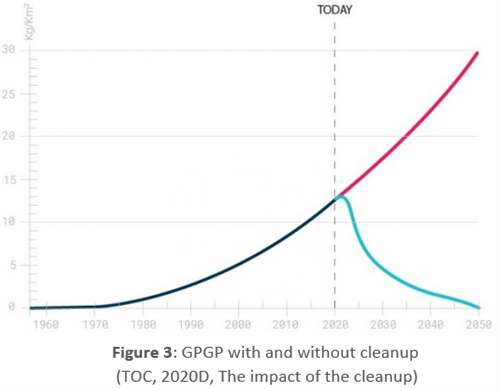
The aim of the project is to clean-up half of the GPGP before 2025, and the remaining half before 2050. The aim can be visualized in Figure 3, together with a scenario of no-action. Although the figure is limited to the GPGP, TOC has equal long-term goals for other ocean garbage patches. For example, TOC aims to reduce the amount of ocean plastic with 90% by 2040 (TOC, 20202D; TOC, n.d.C). If TOC’s operations were complemented by a considerable reduction of plastic sources on land, a plastic-free ocean could be accomplished by 2050 (TOC, 2020C). However, this requires “radical changes at the individual, corporate, and governmental levels of society” (TOC, n.d.C).
Criticism

Despite the ambition to accomplish a plastic free ocean and the received recognition, the TOC project has received criticism as well. Van Franeker & Kühn (2018) reviewed the impact of TOC operations and concluded that if TOC indeed managed to clear half of the GPGP by 2025, it would only remove about 0.1% of the plastic that ends in the ocean every year. Likewise, many scientists stressed that the plastic sources reduction is in fact the most effective mitigation strategy (Rochman; Sherman & Sebille, 2016). Although TOC acknowledges source reduction as important, it does not see it as the solution to current ocean plastic pollution issues (TOC, 2015).

Furthermore, Sherman & Sebille (2016, p.2) declared that “ocean plastic removal might be more effective […] closer to shore than inside the plastic accumulation zones in the centers of the gyres”, like the GPGP. TOC, instead, focuses on ocean garbage patches in high seas gyres “because the plastic floating outside of these ocean garbage patches either naturally removes itself from the ocean by beaching onto a coastline, or eventually also ends up in an ocean garbage patch” (TOC, n.d.B).

Moving forward

To move beyond its first testing and 2015 prototype phase, TOC conducted a feasibility study. Costs were covered with a crowdfunding campaign that raised $100,000. The study included topics such as engineering, oceanology, ecology, maritime law, finance and recycling, and was conducted by a voluntary collaboration of more than a hundred private citizens, organizations and institutions (Slat et al., 2014). The favorable outcome illustrated the sustaining aspect of the innovation.

The positive media coverage that came with the favorable feasibility study was used for the second crowdfunding campaign. This campaign raised over 2 million dollars, becoming the most successful crowdfunding campaign opened by an NGO, so far (TOC, 2015; ABN AMRO, 2014). It allowed TOC to develop and test different prototypes in different locations (TOC, 2020A).

In late 2016 TOC initiated another fundraising round. In May 2017, it issued a press release stating that it “successfully raised 21.7 million USD in donations since last November [bringing TOC’s] total funding since 2013 to 31.5 million USD, [which enables TOC] to initiate large-scale trials of its cleanup technology in the Pacific Ocean” (TOC, 2017). The fact that this latter funding round comprised solely on donations demonstrates the legitimacy perceived by the initial investors that supported the project.

Eventually, after “hundreds of scale-model tests, a series of prototypes, research expeditions and multiple iterations”, a first full-scale clean-up system was ready in 2018 (TOC, 2018). The unique business approach of TOC, however, also created legal complications that had to be solved before the full-scale system could be launched. To overcome these hurdles, TOC signed a covenant with the Dutch Ministry of Infrastructure and Water Management (MIW, 2018). With an applicable legal framework and support from the Dutch government, TOC was ready to launch its first full-scale clean-up system. The aim of the operation was to test the system and collect relevant data while cleaning up the GPGP (TOC, 2018). Nevertheless, the operation was prematurely terminated because the system was not able to actually capture the plastic due to “an inconsistent speed difference between the system and the plastic” (TOC, 2020A, p.17). This led to a systematic failure (TOC, 2020A).

Thanks to a cooperation with two other organizations, TOC later came with an updated prototype, the “System 001/B”. After one year of testing, TOC stated on 3 October 2019 that its self-contained prototype succeeded in passively capturing and concentrating plastic from the GPGP using the natural forces of the ocean. This was the first true success since Boyan Slat presented his ideas in 2012 (TOC, 2019).

Additionally, TOC recycled the captured plastics into valuable goods: it turned them into sunglasses, a durable and useful product. This entrepreneurial activity is crucial to ensure future operations, as potential profit will be fully reinvested and, thus, completed the infinite circle (TOC, 2020B).

The adjustments in the prototype were incorporated in the newly designed system (002), that requires  comprehensive  examination  and  modelling  before  becoming  the  next  full-scale clean-up system (TOC,  2020). Ultimately, “a fleet of systems” would be necessary to be able to clean up the entire GPGP and smaller plastic patches” (TOC, 2020A).

Furthermore, TOC is “looking to expand [its] operations all over the globe to help tackle the 1000 most polluting rivers, five years from the commencement of the scale-up phase” (TOC, 2020A, p.8). Replying to the criticism, TOC not only acknowledges plastic source reduction as important, but also strives for action.
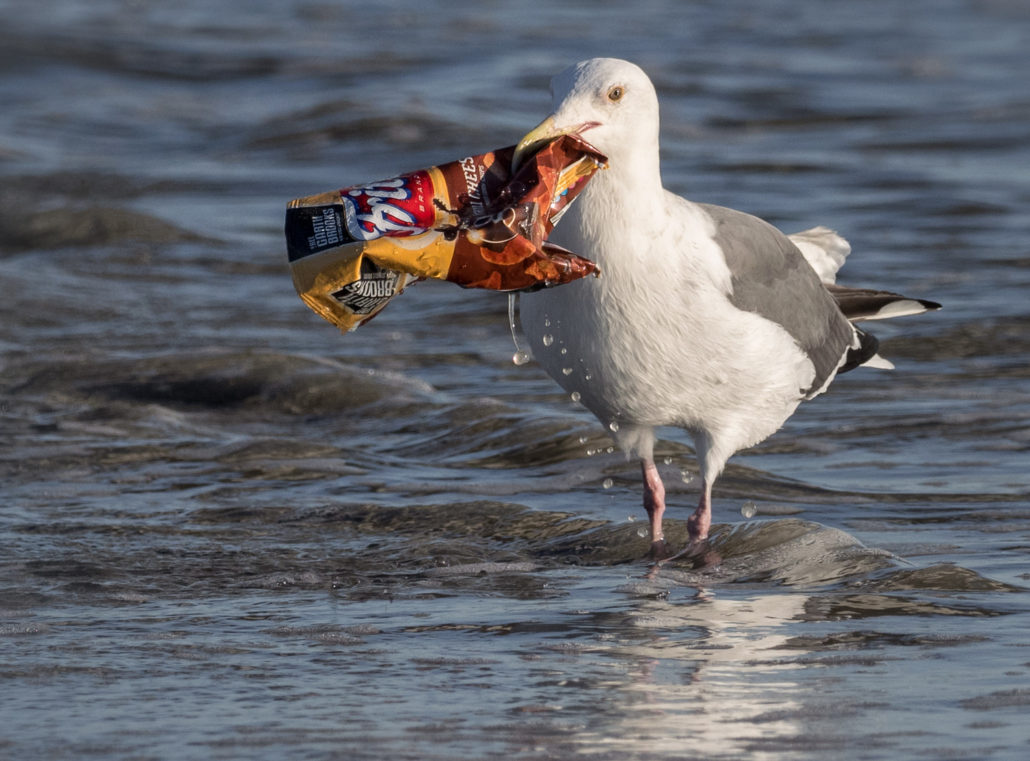

Fig. 2: A seagull holding a plastic package in its peak (Ingrid Taylar, 2016).

Bibliography

ABN AMRO (2014, 11 July). Seeds faciliteert succesvolste crowdfunding voor non-profit organisatie. Retrieved 30 November 2020, from https://www.abnamro.com/nl/newsroom/nieuws/2014/seeds-faciliteert-succesvolste-crowdfunding-voor-non-profit-organisatie.html

Dees, J.G. (2001, 30 May). The Meaning of Social Entrepreneurship. Downloaded 7 December 2020, from https://centers.fuqua.duke.edu/case/wp-content/uploads/sites/7/2015/03/Article_Dees_MeaningofSocialEntrepreneurship_2001.pdf

Franeker, J.A. van & Kühn, S. (2018, 13 September). The Ocean Cleanup. Downloaded 6 November 2020, from https://www.wur.nl/upload_mm/0/0/a/3f5469b5-3e79-423f-a947-80b5a5b06c1a_FAQ-OceanCleanup2018_finalNL_CH-JAF.pdf

Geyer, R., Jambeck, J.R. & Law, K.L. (2017). Production, use, and fate of all plastics ever made. DOI: 10.1126/sciadv.1700782

Jambeck, J.R., Geyer, R., Wilcox, C., Siegler, T.R., Perryman, M., Andrady, A., Narayan, R. & Law, K.L. (2015). Plastic waste inputs from land into the ocean.Science, 347(6223), pp.768-771. DOI: 10.1126/science.1260352

Lebreton, L., Slat, B. […] Brambini, R. & Reisser, J. (2018, 22 March). Evidence that the Great Pacific Garbage Patch is rapidly accumulating plastic. Retrieved 6 November 2020, from https://www.nature.com/articles/s41598-018-22939-w

Ministry of Infrastructure and Water Management of the Netherlands (2018, 6 June). Convenant tussen de Minister van Infrastructuur en Waterstaat en The Ocean Cleanup betreffende de inzet van systemen bedoeld om plastic op volle zee, dat drijft in de bovenste waterlagen, op te ruimen.Retrieved 6 December 2020, from https://zoek.officielebekendmakingen.nl/stcrt-2018-31907.html#d17e790

Rijksoverheid (2016, 29 November). Waterinnovaties in Nederland.Downloaded 6 November 2020, from https://www.rijksoverheid.nl/binaries/rijksoverheid/documenten/brochures/2016/11/29/waterinnovaties-in-nederland/Waterinnovaties-2016.pdf

Rochman, C. M. (2016). Strategies for reducing ocean plastic debris should be diverse and guided by science. Environmental Research Letters, 11(4), 041001. DOI: http://dx.doi.org/10.1088/1748-9326/11/4/041001

Sherman, P. & Sebille, E. van (2016). Modeling marine surface microplastic transport to assess optimal removal locations. Environmental Research Letters, 11(1), 014006. DOI: http://dx.doi.org/10.1088/1748-9326/11/1/014006

Slat, B.D., Arens, E. […] Zuijderwijk, N. & de Sonneville, J. (2014, 3 June). How the oceans can clean themselves. A feasibility study. Downloaded 30 November 2020, from https://ds1.static.rtbf.be/article/pdf/toc_feasibility_study_lowres-1401893379.pdf

The Ocean Cleanup (2015, 30 June). Annual Report 2014.Downloaded 30 November 2020, from https://assets.theoceancleanup.com/app/uploads/2019/04/TOC_2014_Annual_Report.pdf

The Ocean Cleanup (2017, 3 May). THE OCEAN CLEANUP RAISES 21.7 MILLION USD IN DONATIONS TO START PACIFIC CLEANUP TRIALS. Retrieved 12 December 2020, from https://theoceancleanup.com/press/press-releases/the-ocean-cleanup-raises-217-million-usd-in-donations-to-start-pacific-cleanup-trials/

The Ocean Cleanup (2018, 8 September). THE WORLD’S FIRST OCEAN CLEANUP SYSTEM LAUNCHED FROM SAN FRANCISCO. Retrieved 6 December 2020, from https://theoceancleanup.com/press/press-releases/the-worlds-first-ocean-cleanup-system-launched-from-san-francisco/

The Ocean Cleanup (2019, 2 October). THE OCEAN CLEANUP SUCCESSFULLY CATCHES PLASTIC IN GREAT PACIFIC GARBAGE PATCH.Retrieved 13 December 2020, from https://theoceancleanup.com/press/press-releases/the-ocean-cleanup-successfully-catches-plastic-in-great-pacific-garbage-patch/

The Ocean Cleanup (2020A, 9 June). Annual Report 2019.Downloaded 6 November 2020, from https://assets.theoceancleanup.com/app/uploads/2020/06/Annual_Report_2019.pdf

The Ocean Cleanup (2020B, 24 October). THE OCEAN CLEANUP INTRODUCES FIRST PRODUCT MADE WITH OCEAN PLASTIC POLLUTION.Retrieved 13 December 2020, from https://theoceancleanup.com/press/press-releases/the-ocean-cleanup-introduces-first-product-made-with-ocean-plastic-pollution/

The Ocean Cleanup (2020C). About – The impact of the cleanup.Retrieved 13 December 2020, from https://theoceancleanup.com/about/

The Ocean Cleanup (n.d.A). THE FIRST PRODUCT MADE WITH PLASTIC FROM THE GREAT PACIFIC GARBAGE PATCH. Retrieved 7 December 2020, from https://products.theoceancleanup.com/

The Ocean Cleanup (n.d.B). FAQ –
How will you clean up 50% of the plastic in 5 years?Retrieved 16 December 2020, from https://theoceancleanup.com/faq/

The Ocean Cleanup (n.d.C). Can you provide an overall solution to ocean plastic pollution?  Retrieved 17 December 2020, from https://theoceancleanup.com/faq/can-you-provide-an-overall-solution-to-ocean-plastic-pollution/

United Nations (n.d.). Goal 14: Conserve and sustainably use the oceans, seas and marine resources.Retrieved 7 December 2020, from https://www.un.org/sustainabledevelopment/oceans/

Join our Telegram channel

Dirty Dutch Recycling

Citizens, businesses, and governments are increasingly aware of the need to use energy more efficiently and sustainably in the future. The transition from a linear to a circular economy is thus seen as both necessary and desirable (Kroes, 2018).

The role of recycling is crucial to achieve a resource efficient society, and a circular economy in general (Worrel & Reuter, 2014). Nevertheless, the sustainability of recycling itself is rarely questioned. What if recycling was part of the unsustainability of our global economy? This possibility is confirmed in this case study focusing on the Dutch market for recycled metal scrap.

Scrap consists of recyclable materials left over from the manufacturing and consumption of goods (Meena et al., 2018). In the Netherlands, eighty percent of the generated metal scrap is recycled (Tam & Tam, 2006). However, most of the Dutch smelters in charge of scrap recycling have gone bankrupt in the last decades, as a result of competing prices and weaker environmental regulations in other parts of the world (Wester, 2020A).

Scrap recycling was therefore delocalized, and Dutch traders now send large quantities of scrap metals to countries outside of Europe. Since Asia became the manufacturing factory of the world, there are more goods coming in Europe than going back to Asia (Wester, 2020B). To prevent container ships from returning empty, shipping costs to Asia are very low. On top of that, environmental pollution from international shipping is hardly taxed. This makes scrap transportation to other European countries inconvenient and uncompetitive (Wester, 2020A).

Remarkably, when scrap metal is exported rather than melted in the country of origin, the environmental impact remains zero on paper. The shipping industry does not need to record carbon dioxide emissions, so Dutch CO2 emissions from scrap metal are only counted when it is melted in the Netherlands. When scrap is exported, emissions simply vanish from the records and from any environmental impact evaluation (Wester, 2020).

Shipping scrap to other parts of the world means that high seas are entered. High seas are open-access resources, i.e. they are not subject to the legal sovereignty of any state. Thus, there is no entity guaranteeing its intergenerational survival or protection from depletion or pollution. (Debaere, 2020).

Furthermore, shipping was not even mentioned in the 2015 Paris Agreement global targets for carbon emission reduction, or anywhere else in the agreement (UNFCCC, 2015). Still, marine vessels account for approximately 5% of the global CO2 emissions, 7% of the sulphur dioxide emissions, and 23% of the nitrogen oxides emissions (Kesieme et al., 2019). The last two emissions are linked to acid rain, which causes considerable pollution of land ecosystems (Graßl, 2002).

Fig. 1: The HMM Algeciras – the biggest marine vessel worldwide – in Antwerp, Belgium. Photo source: Author, October 2020.

So where exactly does all the scrap metal go?

After China’s ban on scrap metal import, Turkeyhas quickly become the biggest importer with a share of 30 to 40% of the global scrap. Of all the scrap that is shipped from the Netherlands, approximately 80% is melted down in Turkey. Cheap labour and energy costs, on top of loose and often not enforced environmental standards,makes Turkey highly competitive in the global scrap metal recycling market. That is why Turkish smelters can afford buying scrap metal at prices up to double the prices offered by Dutch traders. Thus, a total of approximately 60,000 Dutch lorries full of scrap metals found their way to Turkey last year (Wester, 2020A).

One can question whether the recycling of scrap metals, as it is done now, is sustainable at all. This has consequences for the purchaser of these metals, especially for the end consumer An example comes from the Dutch Sluishuis, a futuristic designed apartment building in Amsterdam, which promotes itself as “ultra-sustainable”. Among various reasons, Sluishuis claims to be “ultra-sustainable” due to its “maximum use” of recycled and renewable construction materials. They advertised the new flats under the motto “circular building” (Sluishuis, 2020). Although Sluishuis has right intentions, it purchases steel for beams and pillars from one of the dirty factories in Turkey. This shows how difficult it is to build “sustainably”, even when your intentions are right (Wester, 2020A).

Wester (2020A) shows that even if metal traders were to melt more sustainably in the Netherlands, the scrap recycling capacity would not be sufficient since the manufacturing industry was largely delocalized. Clearly, at this moment it is not possible to build a clean smelter in the Netherlands. So, today “the more scrap we process abroad, the better the CO2 footprint of the Netherlands [looks like], while [instead] it leads to more emissions worldwide”. On paper the Netherlands is a recycling world champion, but in truth it has exported the scrap metal, climate, and waste problem somewhere else (Wester, 2020A).

Bibliography

Debaere, P.M. (2020, 31 August). The Tragedy of the (Water) Commons. Downloaded on 8 October 2020, from https://papers.ssrn.com/sol3/Delivery.cfm/UVA-GEM-0174.pdf?abstractid=3682604&mirid=1

Graßl, H., Kokott, J. […] Schubert, R. & Schulze, E.D. (2002, 18 January). Charging the use of global commons.Downloaded on 8 October 2020, from http://dlc.dlib.indiana.edu/dlc/bitstream/handle/10535/4321/wbgu_sn2002_engl.pdf?sequence=1

Kesieme, U., Kayvan, P., Murphy, A. & Chrysanthou, A. (2019, January). Attributional life cycle assessment of biofuels for shipping: Addressing alternative geographical locations and cultivation systems. Retrieved on 8 October 2020, from https://doi.org/10.1016/j.jenvman.2019.01.036

Kroes, F.G.H. (2018). Circulaire oogst. Educatieve Uitgeverij EnDusZo: Rotterdam

Meena, S., Sakalle, R. & Tiwari, N. (2018, May). An Experimental Study On Concrete As A Partial Replacement Of Sand With Stone Dust And Steel Scrap. Retrieved on 8 October 2020, from http://www.academia.edu/download/57013236/IRJET-V5I599.pdf

Sluishuis (2020). Duurzaamheid.Retrieved on 8 October 2020, from https://sluishuis.nl/duurzaamheid/

Tam, V.W.Y. & Tam, C.M. (2006). A Review on the Viable Technology for Construction Waste Recycling, pp. 209-221. Retrieved on 7 October 2020, from https://doi.org/10.1016/j.resconrec.2005.12.002

United Nations Framework Convention on Climate Change (2015, 15 December). Adoption of the Paris Agreement. Retrieved on 8 October 2020, from https://unfccc.int/resource/docs/2015/cop21/eng/l09r01.pdf

Wester, J. (2020A, 15 September). Nederlands schroot reist de hele wereld over – waarom?Retrieved on 7 October 2020, from https://www.nrc.nl/nieuws/2020/09/15/nederlands-schroot-reist-de-hele-wereld-over-waarom-a4012127

Wester, J. (2020B, 16 October). Plasticafval: hoe een Nederlands dropzakje kon eindigen in een Turkse berm. Retrieved on 18 October 2020, from https://www.nrc.nl/nieuws/2020/10/16/plastic-afval-hoe-een-nederlands-dropzakje-kon-eindigen-in-een-turkse-berm-a4016112

Worrel, E. & Reuter, M.A. (2014). Chapter 1 – Recycling: A Key Factor for Resource Efficiency. Handbook of Recycling, pp. 3-8. Retrieved on 7 October 2020, from https://doi.org/10.1016/B978-0-12-396459-5.00001-5

Un Fico Secco

“Non ne capisco un fico secco” penso, seduta e affranta nel mio giardino davanti al fico (ficus carica) enorme, immobile e pieno di ferite. Lui e il mio bisnonno devono essere stati giovani insieme. Durante la guerra il mio bisnonno alzava le tavole che coprivano i canali d’irrigazione e ci si nascondeva sotto, aspettando che passasse la ronda fascista che cercava gli anarchici. Poteva passarci ore lì sotto, a volte giorni. Lui non vedrà la fine della guerra e morirà di crepacuore poco dopo, distrutto da quella vita vissuta nel terrore, ma il fico no. Lui ne uscirà indenne per vedere la nascita di mia mamma in quella casa e poi ancora, il mio arrivo in fasce e le mie capanne sotto i suoi rami.

C’era la pandemia e tutti avevano problemi più seri del mio fico. Il lavoro che non ripartiva, compreso il mio, e poi il numero crescente di contagiati e il terrore di spostarsi, ammalarsi, infettare. Sarei dovuta partire il 9 marzo per una missione di un anno in Cambogia, ma la pandemia aveva bloccato anche me e adesso mi ritrovavo ad affrontare una strana primavera per la prima volta dopo anni, nel giardino di casa.

Il mio fico non è particolarmente bello né armonico. È storto e ritorto. È cresciuto in un angolo e si allunga verso il centro del giardino e, come tutti i fichi, sembra avere un innato attaccamento alla vita. Qualcuno della mia famiglia molti anni fa, per impedire che si espandesse troppo nel giardino, deve avergli piegato un ramo ancora tenero verso l’interno ed è cresciuto così, con una forma innaturale che poi ha trovato il suo equilibrio e ora si allunga verso l’alto.

È una pianta rustica dicono tutti, non ha bisogno di cure e dà frutti completamente “biologici” senza nessun bisogno di trattamenti. Difficilmente viene attaccata da malattie e parassiti e si cicatrizza con velocità. Sarà per quello che da anni sta nell’angolo del mio giardino senza che nessuno veramente si accorga di lui se non a settembre, quando ci riempie di piccoli succosissimi frutti dalla buccia viola.

Il fico sporca, il fico infesta, il fico ricresce anche se lo tagli cento volte, il suo latte è irritante e poi non ci salire sopra perché il fico è traditore. Lo sento ripetere da anni eppure non riesco a far finta di niente pensando che, anche se dovesse morire, ributterebbe. Gli ho visto quei buchi nel tronco e mi rendo conto che il ritardo nelle foglie non è dovuto ad un’annata un po’ infelice per tutti ma deve esserci qualcosa di più. Sarà per il mio attaccamento a lottare per quelle cause che alcuni definiscono perse o sarà perché mi rendo conto che quel fico ha assistito a tutta la mia vita e a buona parte di quella della mia famiglia che non riesco proprio a non fare niente, mentre so che qualcosa lo sta logorando da dentro.

A questo punto, come ogni umano disorientato e impaurito del nuovo millennio che si rispetti, chiedo aiuto a Google indicando i sintomi, l’area geografica e la problematica. Google si rivela un prezioso alleato, suggerendomi l’infestazione da punteruolo nero.

So di non essere una botanica, né un’agronoma e, a dirla tutta, so di avere una predilezione solo per le piante grasse che notoriamente non richiedono grandi doti a chi le cura. Penso che non so niente di entomologia e che al massimo ho letto dei pannelli informativi in un museo in Thailandia, che sono laureata in scienze politiche ed ho una specializzazione in storia delle religioni, e che tutto questo fa di me una completa inetta davanti ad un albero attaccato da una specie alloctona che lo divora da dentro. Dalla mia ho solo una forte attitudine a lottare contro le ingiustizie. Si, le ingiustizie, perché per me è di questo che si sta parlando.


Fig. 1: adulto di punteruolo del fico. Fonte: autrice.

Stando a quel poco che si sa, l’alees cribratus(per i nemici “punteruolo nero del fico”) arriva sui nostri lidi con un carico di fichi infetti al porto di Genova, trova un clima abbastanza gradevole per i suoi gusti e si insedia. Piano pianino, larva dopo larva, fico dopo fico esce dalla Liguria ed approda in Toscana. Dove arriva distrugge una coltura dopo l’altra e poi avanti nella sua conquista potenzialmente illimitata visto che al momento non ha antagonisti naturali (se non consideriamo me e qualche altro valoroso combattente chiaramente).

Il fico è completamente indifeso e questo lo rende, ai miei occhi, meritevole di tutti gli sforzi possibili. La femmina adulta del punteruolo depone una sola larva alla fine di un minuscolo forellino generalmente nel colletto dell’albero. La larva per nutrirsi e crescere comincia la sua lenta e inarrestabile risalita del tronco dove scava profondi cunicoli masticando e digerendo la polpa dell’albero. Il tutto avviene praticamente senza che dall’esterno si noti nulla, finché la larva non è ormai insetto e riemerge più in alto nel tronco per poi uscire e continuare il suo ciclo indisturbata. Nella maggior parte dei casi ci si accorge dell’infestazione quando l’albero è talmente svuotato da spezzarsi alla base.


Fig. 2: colature di segatura lasciate sul tronco dal punteruolo del fico. Fonte: autrice.

Dal poco che emerge da internet non ci sono grandi ricerche in merito e, ad oggi, non ci sono rimedi efficaci, ma solo qualche palliativo che ci si passa come raccomandazione tra un blog di agricoltura e l’altro. Vista la situazione penso che qualunque cosa possa fare la differenza e comincio con quello che mi suggerisce l’intuito. Tra i consigli più gettonati c’è quello di lavare l’albero con dei forti getti d’acqua per infastidire gli insetti adulti e farli uscire allo scoperto nel tentativo di catturali. È così che mi ritrovo faccia a faccia con il primo punteruolo nero. Ho delle reazioni simil-isteriche perché non so bene come comportarmi e non so bene quali siano le sue armi. Ci guardiamo sospettosi ma poi, mossa da disperazione, lo fermo tra pollice ed indice. Le sue zampe fortissime si attaccano e cercano di liberarsi dalla presa delle mie dita senza riuscirci. Mi rendo conto con gli esemplari successivi che non è dotato di particolare velocità, che non cerca di volare e che se si sente preso in trappola si lascia cadere fingendosi morto. In una giornata ne catturo 12, ma non basta perché le larve sono il mio vero problema.

Per cercare le larve parto dalle “colature di segatura” che trovo sul tronco e seguo il cunicolo che prosegue in profondità dentro il tronco con un pezzetto di fil di ferro.Procedo a tentoni svuotando pazientemente tutto il cunicolo senza sapere se arriverò mai a qualcosa finché la segatura non finisce e il fil di ferro riemerge umido e con della colatura bianca. Ho trovato la mia prima larva. La aggancio con l’estremità del fil di ferro e quando esce sento un pezzetto del peso che mi porto dentro staccarsi. Forse ce la possiamo fare.

In realtà in breve tempo mi rendo conto che le larve sono molto più di quello che si vede. È bastato scavare un po´attorno alle radici per accorgersi che sono tutte piene di cunicoli, martoriate e in alcuni punti già cicatrizzate. Il fil di ferro non mi basta più e allora prendo un cacciavite ed un martelletto e comincio a scavare dove il tronco è più morbido e questo mi permette di trovare una ventina di larve cicciotte, affamate e distruttrici. Ad ogni estrazione sento di alleviare un po’ il dolore dell’albero ma cresce anche la consapevolezza che le ferite sono molte più di quello che pensavo e l’infestazione più profonda.

In breve tempo l’albero diventa il luogo di un delitto efferato e attorno a lui la scena del crimine si sviluppa e gli oggetti d’indagine si moltiplicano: vasetti di alcool dove gettare le larve e gli insetti raccolti, pinzette, martelli, fil di ferro, guanti e pennelli.
Le ferite vengono disinfettate con del verderame e la terra attorno alle radici smossa e ripulita per assicurarsi che non ci siano insetti interrati.

In breve, capisco che non solo quello che sto facendo ha un impatto ma che può essere anche utile ad altre persone che potrebbero avere lo stesso problema e magari può anche servire per creare una rete dove scambiarsi consigli. Così comincio a fare video di tutti i ritrovamenti, dell’estrazione delle larve, delle tracce che lasciano, dell’azione di scavare con un cacciavite al buio nel tronco di un albero e creo un canale YouTube “lalarvainseno”nel quale non tardano ad arrivare consigli, suggerimenti e richieste di aiuto. Fra i più utili quello di un signore che mi suggerisce di coprire il tronco con una rete per impedire a nuovi esemplari di raggiungerlo e ad eventuali adulti che nascano dalle larve di andare a nutrirsi di foglie e frutti sulla chioma.


Fig. 3: indagini e scene del crimine sul fico del bisnonno. Fonte: autrice.

Alla fine anche la mia laurea e i miei anni di esperienza nel mondo della cooperazione inaspettatamente si rivelano utili. Ho pensato di adattare un software che si usa per fare questionari nei villaggi sperduti dell’Africa, per creare una mappa locale degli esemplari infetti, di quelli morti e di quelli in salute cercando allo stesso tempo di classificarne la specie e l’età per creare una banca dati di quello che sembra stia andando perduto, nel tentativo di rallentarne il processo.

Ad oggi l’albero si presenta con un delizioso tutù verde attorno al tronco, e, come se dovessimo compensare anni di noncuranza, non passa giorno in cui non venga controllato ed ispezionato per intercettare il più velocemente possibile eventuali nuove larve. Non possiamo dire ancora se è salvo,

le radici e parte del tronco sono profondamente solcate ma non mostra ancora segni di cedimentoe nonostante tutto, come ogni settembre che si rispetti da cent’anni a questa parte, ha qualcosa in serbo per noi: viola, piccolino e succosissimo.

Sitografia:

‘Armonia Verde’: “Ecco i rimedi contro il punteruolo nero”. (2017, July 28). Luccaindiretta. https://www.luccaindiretta.it/in-azienda/2017/07/28/armonia-verde-ecco-i-rimedi-contro-il-punteruolo-nero/99224/

Gargani Elisabetta, & Benvenuti Claudia. (2017, February 14). Il punteruolo nero del fico: Un’emergenza in Toscana; si cercano soluzioni. Rivista di Agraria.org. https://www.rivistadiagraria.org/articoli/anno-2017/punteruolo-nero-del-fico-unemergenza-toscana-si-cercano-soluzioni/

Bibliografia:

Ciampolini, Farnesi, Scarselli, & Lorenzi. (2008). Contro il curculionide del fico decisiva la lotta agli adulti.

Ciampolini, M., Perrin, H., & Regalin, R. (2005). Aclees Cribratus, nuovo per l’Italia nocivo per il fico allevato in vivaio. 4.

Ciampolini, Regalin, R., Ivano, F., & Claudio, C. (2007). Prime osservazioni sulla bio-etologia di Aclees sp. (Curculionidae, Molytinae) esiziale a Ficus carica L. in Italia. ResearchGate.

Telegram: @greenmarked
LinkedIn: @greenmarked
Instagram: @greenmarked.it

Facebook:  @greenmarked.it


© GreenMarked.it is managed by ECONTROVERTIA APS — Via Alcide De Gasperi 1, 38015 Lavis (TN), Italy — VAT IT02667560227