Tag: ocean

Before the Flames: How Water and Soil Shape Wildfire Risk

The summer of 2026 brought another season of major wildfires across Europe. Between 1 July and 31 August, fires larger than 30 hectares affected extensive areas across the Iberian Peninsula, southern France, Italy, Greece, the Balkans, Ukraine and Algeria. Across Europe and North Africa, more than 1.2 million hectares were affected, including 19 individual fires larger than 10,000 hectares (1).

For the European Union alone, 692,419 hectares had burned by early October. That was less than during the record-breaking 2025 season, but almost twice the 2006–2025 average of 360,510 hectares (2).

When fires reach this scale, the obvious questions are about heat, drought and climate change. And rightly so. But there is another factor that deserves more attention, namely water. Not the water used by firefighters to extinguish a fire, but the water present (or missing) in the landscape during the months before it started.

A fire starts long before the first flame

For vegetation to burn, it first has to become sufficiently dry. How quickly that happens depends on much more than air temperature alone. Water stored in the soil helps determine how much moisture remains available to vegetation. Soil moisture therefore affects both the amount of vegetation that can grow and how dry and flammable that vegetation eventually becomes. That makes the relationship between water and wildfire more complicated than simply saying “less water means more fire” (3).

A global study of 9,840 large wildfire events found an interesting pattern. In relatively humid regions, major fires were generally preceded by unusually dry soils. In arid regions, however, wetter-than-normal conditions several months earlier could contribute to greater vegetation growth. When those landscapes subsequently dried out, that additional biomass could become additional fuel. Across climate regions, soil moisture generally declined during the months leading up to major fires (3).

In other words, the conditions for a wildfire can develop months before anything starts burning. The match or lightning strike may ignite the fire. The landscape determines what happens next.

Landscapes are also water systems

Healthy landscapes do something we do not always notice: they manage water. Vegetation intercepts rainfall, while soils store water and influence how it moves through the landscape. Some water becomes available to plants, while some water moves deeper underground or eventually reaches streams and rivers (4).

When these systems are disturbed, the relationship between rainfall, soils and vegetation changes.

And fire itself can make the problem worse. A global analysis found that fire altered plant–soil water relations, accelerating soil-moisture loss and changing vegetation water uptake. The effects increased with fire severity and were strongest in forests (5).

That creates important feedback. A dry landscape can become more susceptible to fire, while a fire can subsequently alter the landscape’s hydrology. So perhaps we should stop thinking about wildfire exclusively as a fire-management problem. It is also a landscape-management problem.

From fighting fires to building resilience

Europe monitors wildfires through systems such as the European Forest Fire Information System, which combines satellite observations with expert mapping to track burnt areas and provide updated information on the fire season (2).

That information is essential. But monitoring and firefighting address only part of the problem. Soil moisture influences both vegetation growth and how dry and flammable that vegetation becomes (3). Building wildfire resilience therefore also means looking at conditions long before ignition, including how we manage soils, forests, wetlands, agricultural land and water across entire catchments.

Forests and their soils influence how rainfall is intercepted, stored and released (4). This raises practical questions, such as: Can soils absorb and retain rainfall? Can vegetation access enough water during prolonged dry periods? What role can wetlands and other naturally wet areas play? And are we designing landscapes primarily to drain water away, or also to store it for when conditions become dry?

These questions connect wildfire prevention with issues often discussed separately: regenerative agriculture, wetland restoration, biodiversity, drought resilience and climate adaptation. The NBS4Drought project, for example, is investigating wetlands as nature-based solutions for resilience to extreme drought (6). Looking at these issues together offers a broader perspective on how landscapes regulate water, without assuming that drought measures automatically reduce wildfire risk.

Fire is not simply a symptom of bad water management

There is an important caveat. Wildfires have many causes and controls. Ignition can come from people or lightning, while weather and climate strongly affect how fires spread. Vegetation type, land use and human activity matter too. Soil moisture does not by itself cause fires. Instead, it influences whether sufficient biomass is present and whether that biomass is dry enough to burn (3).

Nor is fire inherently unnatural. Fire is part of the ecology of many ecosystems (3). The aim is therefore not to create landscapes that never burn. It is to avoid landscapes becoming unnecessarily vulnerable to severe fires. And that requires looking beyond the fire itself to the conditions that develop long before it starts.

Learning to keep water in the landscape

I find this particularly interesting because water connects so many environmental issues that we often discuss separately:

  • Healthy soils are discussed in regenerative agriculture.
  • Wetlands are discussed in biodiversity restoration.
  • Forests are discussed in relation to carbon sequestration.
  • Water retention is discussed as climate adaptation.
  • Wildfires are discussed as natural disasters.

But these systems do not recognize those categories. Forest vegetation and soils influence how rainfall is intercepted, stored and released (4). Soil moisture also affects vegetation growth and the conditions that allow it to burn (3). Research into wetlands as nature-based solutions for drought resilience illustrates another connection between ecosystems and water management (6).

Perhaps that is the more interesting lesson from another summer of European wildfires. Obviously, we need to become better at detecting and fighting fires. But resilience starts much earlier. It starts with a more fundamental question:

“How do we create landscapes that are better able to hold water, sustain vegetation and regulate themselves when the next period of extreme heat and drought arrives?”

Because by the time the flames appear, much of the story has already been written.

References

Click here to expand the references

(1) European Union Agency for the Space Programme. (2026, September 2). Severe fires affected Europe and North Africa in July and August 2026. https://eu-space.europa.eu/components/earth-observation-copernicus/image-of-the-day/severe-fires-affected-europe-and-north-africa-july-and-august-2026

(2) Joint Research Centre. (2026, October 8). Current wildfire situation in Europe. European Commission. https://joint-research-centre.ec.europa.eu/scientific-activities/natural-and-man-made-hazards/forest-fires/current-wildfire-situation-europe_en

(3) O, S., Hou, X., & Orth, R. (2020). Observational evidence of wildfire-promoting soil moisture anomalies. Scientific Reports, 10, Article 11008. https://doi.org/10.1038/s41598-020-67530-4

(4) European Environment Agency. (2015). Water-retention potential of Europe’s forests (EEA Technical Report No. 13/2015). https://www.eea.europa.eu/en/analysis/publications/water-retention-potential-of-forests

(5) Baur, M. J., Friend, A. D., & Pellegrini, A. F. A. (2024). Widespread and systematic effects of fire on plant-soil water relations. Nature Geoscience, 17. https://doi.org/10.1038/s41561-024-01563-6

(6) European Commission. (2025). Demonstrating wetlands as Nature-Based Solutions on resilience development to extreme drought across European cities and landscapes (NBS4Drought). CORDIS. https://cordis.europa.eu/project/id/101181351

Cover image: Forest, Vuur, Brandend bos. Photo from Vlad_Aivazovsky on Pixabay

An Updated Case Study on the Ocean Cleanup

Over the past seven decades, global plastic production has grown dramatically. In 1950, annual production amounted to approximately two million tonnes, whereastoday it exceeds 450 million tonnes [1]. This quantity is comparable to the combined weight of the world’s human population, and is projected to grow [2].

Plastic packaging truly exemplifies the characteristics of the linear economy: fossil-based, single-use, short-lived, with very low recycling rates and high rates of mismanaged waste [3]. Current estimates suggest that only around 9% of plastic waste is effectively recycled, and approximately 19% is incinerated. Nearly half is sent to sanitary landfills, while the remainder is either dumped in landfills, openly burned, or released into the natural environment [4].

More plastic than fish

Only 0.5% of the yearly plastic production eventually ends up in the ocean. That might seem marginal, but the ocean plastic pollution problem is not small at all. Over 1 million metric tons is still a massive amount of pollution [5]. In fact, academics claim that plastic pollution in the marine environment is “nearing planetary boundary threat conditions” [6].

The accumulation of floating plastics in the marine environment is particularly concerning due to their widespread distribution across the ocean surface. In addition to facilitating the transport of invasive species, plastic debris can threaten vulnerable habitats and negatively affect communities that depend on healthy marine ecosystems. Plastic pollution can harm marine life through ingestion and entanglement, while microplastics and associated pollutants enter and accumulate in the food chain [6].

In a business-as-usual scenario, the total mass of plastic will exceed the biomass of fish in the ocean by 2050. Reducing production through regulation, alongside improved waste management and circular solutions, is essential to limit both new plastic flows and environmental leakage [7].

However, these measures won’t affect the plastic that has already accumulated in the ocean over decades, also called “legacy pollution”. While part of this material may return to coastlines and can be addressed through coastal cleanups, large accumulations in remote ocean currents, such as the Great Pacific Garbage Patch (GPGP), will require targeted and sustained cleanup efforts [7].

The Ocean Cleanup

One prominent initiative tackling this challenge is The Ocean Cleanup(TOC), a Netherlands-based non-profit founded in 2013 by Boyan Slat, who was just 18 at the time. TOC’s mission is to develop technologies that both remove existing plastic accumulated in ocean garbage patches and intercept new waste in rivers before it reaches the sea. This dual strategy reflects scientific findings that suggest that roughly 1% or 1,000 rivers worldwide are responsible for close to 80% of plasticentering the oceans [8].

To guide its long-term vision, TOC set an ambitious objective:toreduce 90% of floating ocean plastic by 2040, through a combination of scaled ocean cleanup systems, targeted river interventions, and broader reductions in plastic use supported by improved waste management worldwide [9].

When the first GreenMarked case study on The Ocean Cleanup was published in 2020, the initiative was still in an experimental phase, focused on demonstrating that large-scale plastic removal at sea was technically possible. In the subsequent years, TOC has undergone a clear shift from concept validation to sustained operations. Early offshore trials revealed both the complexity of open-ocean cleanup and the need for rapid design iteration. After initial setbacks with its first system in 2018, subsequent designs demonstrated increasing reliability, leading to towed, U-shaped systems capable of consistently capturing plastic in the GPGP [10].


Figure 1: The Ocean Cleanup (n.d.) is cleaning up plastic in the Great Pacific Garbage Patch, the largest known accumulation zone of plastic. Retrieved from The Ocean Cleanup Media Gallery and available for editorial use.

At the same time, the scope of operations expanded upstream, reflecting the dual strategy it adopted in response to early criticism highlighted in the first case-study as well as emerging scientific evidence. As such, river interception systems were deployed alongside offshore cleanup to address concerns that ocean cleanup alone would focus on symptoms rather than sources. By combining these approaches, TOC significantly accelerated its impact. In 2025 alone, the organization removed over 25 million kilograms of plastic, which is more than the total collected in all previous years combined [11]. This momentum continued into March 2026, when TOC reached a landmark milestone of50 million kilograms of trash removed worldwide [10].

Recent critique

Recent scientific research has focused on the potential ecological consequences and uncertainties surrounding large-scale cleanup activities. Marine biologists have investigated the risks to neuston (organisms living at the water’s surface) and unintended bycatch in open ocean systems, and warn that remediation operations could have varying impacts on these vulnerable communities [11].

Others stress the importance of weighing the net environmental benefits of removing concentrated patch plastics against the costs and unintended effects, and call for robust environmental impact assessments and better governance for high-seas cleanup interventions [12].

TOC has responded by integrating scientific oversight into its projects by commissioning independent environmental impact assessments, adjusting system design to limit incidental bycatch, and actively contributing to open-access research. Recent studies using TOC’s operational data suggest that, targeting plastic hotspots can limit interactions with neuston and improve overall environmental outcomes [13]. Together, these efforts indicate that cleanup can be an environmentally responsible complementto prevention, provided it continuously adapts based on scientific guidance.

Future

With its dual strategy now fully implemented and key milestones achieved, The Ocean Cleanup appears on track to reach its long-term objectives. The rapid scaling of offshore cleanup systems, combined with targeted river interception, has translated ambition into measurable impact, demonstrating that large-scale removal of legacy ocean plastic is technically and operationally feasible.

At the same time, the case study reinforces a central reality: cleanup alone is not sufficient. Lasting success will depend on parallel progress in source reduction, regulatory change, and improved waste management worldwide. Within this broader context, TOC’s work represents a critical and increasingly mature contribution to reducing ocean plastic pollution, complementing prevention rather than replacing it.

References

Click here to expand the references
  1. [1] Ritchie, H., Samborska, V., & Roser, M. (2026). Plastic pollution. Our World in Data. Retrieved from https://ourworldindata.org/plastic-pollution
  2. [2] The Ocean Cleanup. (n.d.). Ocean plastic pollution explained. Retrieved from https://theoceancleanup.com/ocean-plastic-pollution-explained/
  3. [3] Ellen MacArthur Foundation. (n.d.). Plastics – Overview. Retrieved from https://www.ellenmacarthurfoundation.org/topics/plastics/overview
  4. [4] Organisation for Economic Co-operation and Development (OECD). (2022). Global plastics outlook: Economic drivers, environmental impacts and policy options. Downloaded from https://www.oecd.org/content/dam/oecd/en/publications/reports/2022/02/global-plastics-outlook_a653d1c9/de747aef-en.pdf
  5. [5] Sainte-Rose, B., Lebreton, L., Pham, Y., Tjallema, A., & Maes, C. (2026). Modelling the cleanup of the North Pacific Garbage Patch based on 3 years of operational experience. Scientific Reports, 16, 8050. https://doi.org/10.1038/s41598-026-40859-y
  6. [6] Ellen MacArthur Foundation. (2021). The solution to plastic pollution. Retrieved from https://www.ellenmacarthurfoundation.org/articles/the-solution-to-plastic-pollution
  7. [7] Meijer, L. J. J., van Emmerik, T., van der Ent, R., Schmidt, C., & Lebreton, L. (2021). More than 1000 rivers account for 80% of global riverine plastic emissions into the ocean. Science Advances, 7(18), eaaz5803. https://doi.org/10.1126/sciadv.aaz5803
  8. [8] The Ocean Cleanup. (n.d.). The Ocean Cleanup. Retrieved from https://theoceancleanup.com/
  9. [9] The Ocean Cleanup. (n.d.). Milestones. Retrieved from https://theoceancleanup.com/milestones/
  10. [10] The Ocean Cleanup. (2025–2026). 2025 in review: The Ocean Cleanup. Retrieved from https://theoceancleanup.com/updates/2025-in-review-the-ocean-cleanup/
  11. [11] Spencer, M., Culhane, F., Chong, F., Powell, M. O., Roland Holst, R. J., & Helm, R. (2023). Estimating the impact of new high seas activities on the environment: The effects of ocean-surface macroplastic removal on sea surface ecosystems. PeerJ, 11, e15021. https://doi.org/10.7717/peerj.15021
  12. [12] Bergmann, M., Arp, H. P. H., Carney Almroth, B., Dey, T., Farrelly, T., Gündoğdu, S., Helm, R. R., Krieger, A., Syberg, K., Tekman, M. B., Thompson, R. C., Villarrubia-Gómez, P., & Wang, M. (2024). Ocean plastic cleanups need a global framework with science-based criteria. Science, https://epic.awi.de/id/eprint/58076/1/e_Letter_PRT_Final_exclEndnote.pdf
  13. [13] Egger, M., van Vulpen, M., Spanowicz, K., Wada, K., Pham, Y., Wolter, H., Fuhrimann, S., & Lebreton, L. (2024). Densities of neuston often not elevated within plastic hotspots territory inside the North Pacific Garbage Patch. Environmental Research: Ecology, 3, 035002. https://doi.org/10.1088/2752-664X/ad4f92

Cover image: The Ocean Cleanup (n.d.) Boyan Slat, founder and CEO of The Ocean Cleanup, is pictured on a beach in Honduras. Retrieved from The Ocean Cleanup Media Gallery and available for editorial use.

From Climate Refugees to Innovators of Resilience: The Experience of Tuvalu

Small Island Developing States (SIDS) are among the most exposed to the challenges imposed by global warming because of the sea-related risks like coastal erosion, saline intrusion into freshwater and marine inundation [1]: this, coupled with high socioeconomic vulnerability and limited capacities of the public and private sectors, has made them a priority on the latest COP events and IPCC reports. In consideration of the rapid population growth and urbanization, atoll countries have engaged in the construction of coastal protection areas like seawalls and breakwaters which are typical adaptation measures against climate change despite the recognition of the adverse impacts of these structures on coastal processes and environments. One of the largest projects of this kind, has been launched in 2017 as a flagship initiative in the atoll of Kiribati [2].

The country has a population of almost 10,000 people and a whole surface area not larger than 26 Km2: it is the fourth smallest country in the world, after Vatican City, Monaco and Nauru. The country includes three reef islands and six atolls in the midst of the Polinesian islands whose maximum height is 4.5 m a.s.l. while on average it never exceeds 1.83 m. All of these make the country one of the most vulnerable to climate change and sea-level rise. To complicate things even further, the country is subjected to extraordinary tides: the fiercer ones are called by residents “King Tide” and can reach peaks higher than 3 meters submerging the main road of the island along with the houses built near the shores.

The Tuvalu Coastal Adaptation Project can rely on 36 million dollars from the Green Climate Fund, 2.9 from the local government and 1.3 from Australia’s Department of Foreign Affairs and Trade and so far has focused on land reclamation and the construction of a 2.7 Km of resilient coastal barrier across the three key islands of Funafuti (which is the capital), Nanumea and Nanumanga. These measures have significantly reduced inundation during King Tides and storm surges and have made Tuvalu the first country in the Pacific to access climate finance. The project is using cutting-edge technology like the LiDAR-based hazard dashboard that allows the government to move from reactive emergency response to predictive urban planning with an extremely fine precision. Until now, detailed and accurate measurement of land height and its relationship to sea level has not existed for the majority of atoll islands in the Pacific region, including Tuvalu so using this technology has filled the gap of this crucial missing baseline to support detailed understanding and responding to wave and sea level rise impacts. As a follow up of the project, a new urbanistic scheme will follow, prioritizing the safety of the residents and the critical infrastructures like the airport. The hospital will be built inland leaving a buffer zone to separate it from the sea but there will also be wastewater collection plants for the airport that will be purified and used against water scarcity [3].

It is essential to preserve this piece of paradise from the fierce effect of climate change because, over the years, the government never had the funds to foster the adaptation measures needed. The economy of the country is mainly reliant on tourism and the fishing industry but overfishing has made the country’s economy extremely vulnerable. Without interventions, it has been calculated that by the end of this century, more than 50% of the cities would be flooded on a daily basis by the tides while early assessment of the projects point to a reduction of more than $660,000 over 40 years while securing a statistical value of life for at least 62% of the atoll’s residents [4]. Another important yet hard-to-calculate benefit of the project, is the relief on the psychological stress of the residents: by building up, rather than just planning for evacuation, the residents feel safer so the narrative shifts from “climate refugees” to “innovators of resilience”.

The project represents a wonderful example of resilient and sustainable approach: it strengthens the institutions, human resources and awareness for these peculiar ecosystems but most of all, it reduces the vulnerability of the residents establishing a long-term plan for resilience.

References

Click here to expand the references
  1. Duvat, V. (2013). Coastal protection structures in Tarava Atoll, Republic of Kiribati. Sustainability Science, 8(3), 363–379.
  2. Kench, P. S. (2012). Compromising reef island shoreline dynamics: Legacies of the engineered paradigm of the Maldives. In J. A. G. Cooper & O. H. Pilkey (Eds.), Pitfalls of shoreline stabilization: Selected case studies (pp. 165–186). Springer.
  3. TCAP. (n.d.). Homepage. Accessed on March 11, 2026. http://www.tcap.tv/
  4. Saddington, L. (2025). The chronopolitics of climate change adaptation: Land reclamation in Tuvalu. Territory, Politics, Governance, 13(4), 448–467.

Cover image: Aerial view to Rufas island, West Papua, Indonesia. Photo by Enests Vaga on Unsplash.

Combating the Invasive Crayfish Problem with Crayfish-infused Beer?

On a still morning in Berlin’s Britzer Garten, a fisherman wades waist-deep through the main lake. He is out to check his traps for crayfish. The fisherman, licensed to catch invasive red swamp crayfish (Procambarus clarkii), will pass his catches on for sale as delicacies. Berlin-born start-up Holycrab! transforms invasive species into gourmet products, such as regionally caught crayfish-infused beers and cooking stocks [1]. The invasive red swamp crayfish is just one of several invasive crayfish species in Europe, such as the signal crayfish (Pacifastacus leniusculus) and the spinycheek crayfish (Faxonius limosus). Throughout Europe, crayfish species are wreaking havoc on ecosystems, displacing native crayfish populations and spreading crayfish plague. Species native to Europe, such as the noble crayfish (Astacus astacus) and white-clawed crayfish (Austropotamobius pallipes), have been reduced in number by as much as 80% in some places [2].

“Holycrab!, a Berlin start-up, are the brains behind regionally caught crayfish-infused beers and cooking stocks.”

Meet the signal crayfish

Another famous invasive species is the signal crayfish, known for the distinctive turquoise and white patches on its claws. Signal crayfish have long antennae, two front legs with large pincer claws, and eight additional legs for feeding and walking [3]. They are also characterized by a smooth ridge along the middle of the rostrum and can reach 16-18 cm long [4]. Like many invasive species in Europe, signal crayfish survive in a broad temperature and salinity range [5]. This means that they live in a variety of habitats, from headwater springs and streams to large rivers, lakes and wetlands, including in urban environments [3]. What’s more, they are highly mobile and can travel distances of up to 1 km overland to move between water bodies [6]. Signal crayfish take shelter under rocks and boulders, within tree roots or in burrows and cavities in banks [7].


Figure 1:Signal crayfish spreads to Europe. Drawing by author, Jun 2025.

The water mold killing Europe’s crayfish

Crayfish plague (Aphanomyces astaci) is caused by a fungi-like organism from North America. It is listed in the top 100 of the “World’s Worst” invaders by the International Union for the Conservation of Nature (IUCN) [5]. North American crayfish live in a balanced host-parasite relationship, meaning they are immune to its effects and are highly resistant to infection [5]. However, the crayfish plague can be fatal to many native crayfish species [4]. Since the 19th century, the plague has drastically spread across Europe, reducing native crayfish populations. In 1960, the signal crayfish was introduced in Europe in an plight to control the crayfish plague as it appeared to be immune to it. It was not yet understood, however, that the signal crayfish was a carrier of the disease and served to exacerbate the problem.

Beyond the plague: the rapid spread of invasive crayfish

Signal crayfish are opportunistic polytrophic feeders (they feed on many kinds of food—plants, fish, and even other crayfish) [5]. They are bigger, grow and mature faster, and are more aggressive than native crayfish [8]. By burrowing into the banks of rivers, signal crayfish cause erosion, bank collapse and sediment pollution [9]. The burrows can be up to 2m deep, with interconnecting tunnels that weaken the bank. Their burrows can also displace threatened riverside species such as the water vole (Arvicola amphibius) [7]. The signal crayfish can have considerable impacts on other populations of macro-invertebrates, benthic fish, and aquatic plants. The species has even been introduced in fish farms to clear weeds from ponds [5]. By predating on fish eggs or taking the refuges of salmonid fish, signal crayfish can reduce the value of commercial fisheries [7].


Figure 2:Female signal crayfish (Pacifastacus leniusculus). Photo by Lisa Hupp/USFWS on Flickr. July 2017.

What can we do about invasive crayfish?

To combat invasive crayfish species, like the red swamp crayfish and the spinycheek crayfish, eels were introduced in Berlin’s waters as natural predators of the crayfish. However, this measure was not sufficient to calm the booming crayfish population, and tandem measures with trapping are said to be required to control populations [10]. In the UK, however, trapping is not permitted as a control measure. This is because, although trapping can reduce crayfish numbers in the short term, the method is more likely to take out larger individuals and thus reduce competition for juveniles [4]. For this reason, in Berlin, trapping occurs alongside the release of young eels [10].

Crayfish plague outbreaks are caused by the introduction of new signal crayfish and the transfer of spores between waterbodies [4]. Therefore, biosecurity (to prevent the transfer of individual crayfish and spores of the crayfish plague between waterbodies) is regarded by InsideEcology (2020) as the best defense against signal crayfish. Crayfish plague spores can survive up to two weeks in damp conditions but are killed by drying or disinfection. Fishers should disinfect boots and equipment before moving between waterways and avoid fishing from different waterways on the same day. Boat and canoe owners should apply appropriate “boat-hygiene” measures to prevent contamination, such as checking the interior and exterior of the boat for young or small crayfish [7].

Biosecurity relies largely on education, and thus public education and involvement have been described as one of the most important measures for preventing the further spread of the signal crayfish [8]. This specifically relates to waterway users, people in the aquarium trade and those connected to hydraulic building constructions [2]. Indeed, to make crayfish-infused products flavorsome and enticing to environmentally conscious consumers, spreading knowledge on crayfish’s effects on the ecosystem is needed.

References

Click here to expand the references
  1. [1] Holycrab! (n.d.). Holycrab! – Delicacies made from invasive species. https://holycrab.berlin/
  2. [2] Amt der Niederösterreichischen Landesregierung. (2025, June29). Gebietsfremde Krebsarten verdrängen heimische Flusskrebse. Amt der Niederösterreichischen Landesregierung – Abteilung Naturschutz. Retrieved June29,2025, from https://www.noe.gv.at/noe/Naturschutz/Gebietsfremde_Krebsarten_verdraengen_heim ische_Flusskrebs.html
  3. [3] Minnesota Department of Natural Resources. (2025). Signal crayfish (Pacifastacusleniusculus). Minnesota DNR. Retrieved June 26, 2025, from https://www.dnr.state.mn.us/invasives/aquaticanimals/signal-crayfish.html
  4. [4] Inside Ecology. (2020, May 26). Invasive non-native species (UK): Signal crayfish. Inside Ecology. (Original work published September 27, 2017). Retrieved June 26, 2025, from https://insideecology.com/2017/09/27/invasive-non-native-species-uk-signal-crayfish/
  5. [5] U.S. Fish and Wildlife Service. (2015, June). Ecological risk screening summary: Signal crayfish (Pacifastacus leniusculus) [PDF]. Retrieved June 26, 2025, from https://www.fws.gov/sites/default/files/documents/Ecological-Risk-Screening Summary-Signal-Crayfish.pdf
  6. [6] Hunt, R., Thomas, J. R., James, J., & Cable, J. (2018). Transmission and terrestrial dispersal of non-native ectosymbionts on invasive crayfish. Hydrobiologia, 820(1), 135–144. https://doi.org/10.1007/s10750-018-3647-3
  7. [7] The Inland Waterways Association. (2017, November 10). Crayfish in canals and rivers. The Inland Waterways Association. Retrieved June 26, 2025, from https://waterways.org.uk/about-us/news/signal-crayfish
  8. [8] Naturschutzbund Österreich. (2025, June 29). Signalkrebs (Pacifastacus leniusculus). Naturschutzbund Österreich. Retrieved June 29, 2025, from https://naturschutzbund.at/signalkrebs.html
  9. [9] South Water Green Project. (n.d.). This species is invasive—and delicious, so why aren’t we eating it? Retrieved June 26, 2025, from https://southwatergreenproject.org/this species-is-invasive-and-delicious-so-why-arent-we-eating-it/
  10. [10] rbb24. (2024, May). Berliner Gewässer: Sumpfkrebs konnte bisher nicht ausgerottet werden. rbb24. Retrieved July 4, 2025, from https://www.rbb24.de/panorama/beitrag/2024/05/berlin-wasser-fluss-see-rote-amerikanische-sumpfkrebs-invasion-nicht-gestoppt-.html

Cover image: Female signal crayfish (Pacifastacus leniusculus). Free-source photo by Lisa Hupp/USFWS on Flickr. July 2017.

The Unbearable Weight of the Fishing Industry

The European Union, as explicitly outlined by Agenda 2030 with a specific sustainable development goal, has long been trying to regulate fishing activities in its seas, given the importance of the sector both in terms of the fleet (almost 80,000 boats) and as the largest importer of fish products (34% of total trade) [1]. To achieve this, in recent years there has been a significant effort to end illegal, unreported, and unregulated fishing (IUU fishing) in order to build a sustainable global and national fishing industry, given that globally, per capita fish consumption is over 20 kg per year (with a European average of 25 kg and an Italian average of 28 kg) [2].

Such a growing market demand for fish is primarily met through trawling, which accounts for 65% of the national catch, even though it involves only a quarter of the fleet. It is well known how this type of fishing damages seabed biodiversity, but in addition to its deleterious effects, the damage caused by illegal fishing must be considered. Both phenomena are characterized by the lack of regulatory tools that could stop the significant economic advantages of IUU fishing, which, as stated in a special report published in 2022 by the European Court of Auditors, is “one of the greatest threats to marine ecosystems, undermining efforts to manage fish resources sustainably” [3].

Feeding ten billion people in 2030 becomes an even more ambitious goal if the pressure from the fishing sector is added to the pressures from the livestock and agricultural industries in general. For this reason, open sea and land-based fish farms have been multiplying in recent years. Aquaculture focuses on species that bring the most profits (such as sea bass, sea bream, and salmon), which are most often raised in closed areas because in the open sea they would have to face storms and waves that would increase costs. This type of farming results in the organic material produced by the fish remaining in suspension, as currents do not carry it away, and as seen in some areas of Greece and Turkey, there is no longer any Posidonia, life, and, in general, biodiversity [4]. Additionally, infestations of parasites are common, which, as happens on land, are treated with chemicals, antibiotics, and even formaldehyde added directly to the tanks.

The consequences are obviously borne by the local inhabitants who realize that wild fish are disappearing (as in Norway, where salmon have almost vanished), but the pollution of water resources is a damage for all of humanity. Another problem is the feed for farmed fish: they are often fed with feed made from small pelagic fish like sardines caught in the waters of West Africa. According to a study published by the British NGO Feedback, in 2020, about two million tons of wild fish were used as feed to produce 1.5 million tons of salmon. Most of this fish was imported from West Africa, where it could have fed between 2.5 and 4 million people [5]. It is clear that aquaculture promises sustainability but deprives local communities of primary resources, essentially failing its goal.

The latest documentary by Francesco de Augustinis, Until the End of the World, very well illustrates the fish farming industry, focusing also on how this type of farming is considered a lower impact alternative on the climate, but in fact is unsustainable as well as the implications related to animal welfare. In this regard, the fish farming industry accepts mortality rates unimaginable in land-based farming: the Norwegian National Veterinary Institute indicates that 16.7% of fish die before reaching the slaughterhouse. The documentary shows how there are ships that perform emergency slaughter to make the animals edible before they die, or how the use of chemicals is now a consolidated practice. The problem is not only confined to realities like Norway if we consider that the second largest producer of Atlantic salmon in the world is a country facing the Pacific Ocean (Chile!). Aquaculture, with the promise of feeding the world in a more sustainable way than any other production process, can have a devastating environmental and social impact: it is a food industry that continues to grow and has actually surpassed the catching industry for a long time but cannot be considered the “green solution” for the sustainable future of the planet.

References:

Click here to expand the references
[1] Eurostat, 2023-  EU fleets caught 3.4 million tonnes of fish in 2022. Eurostat. https://ec.europa.eu/eurostat/web/products-eurostat-news/w/ddn-20231121-2

[2] Istat Working Papers, 2024- Statistiche sulla pesca in Italia, uso integrato di indagini campionarie e dati amministrativi. Istat Working papers 4. https://www.istat.it/it/files/2020/05/IWP-4-2020.pdf

[3] Corte dei Conti Europea, 2022- Azione dell’UE per contrastare la pesca illegale. Relazione speciale. https://www.eca.europa.eu/Lists/ECADocuments/SR22_20/SR_Illegal_fishing_IT.pdf

[4] Rountos K., Peterson B., & Karakassis I., 2012- Indirect effects of fish cage aquaculture on shallow Posidonia oceanica seagrass patches in coastal Greek waters. Aquaculture Environment Interactions, 2(2), 105–115.

[5] O’Sullivan C.- 2024- Our survival depends on the ocean – Feedback. Feedback. https://feedbackglobal.org/our-survival-depends-on-the-ocean/

The High Seas Treaty: Protecting Oceans’ Biodiversity

What is the first thing that goes through our minds when we think about oxygen production in our planet? For most people, it surely is the color green – trees, forests, the Amazon rainforest, etc. The fact is, it is the wrong color and what should cross our minds is blue. The ocean produces between 50 and 70% of the oxygen that can be found in the atmosphere [1]. Not the ocean itself, of course, but some of the microorganisms that live in it: unicellular algae and cyanobacteria. These creatures, as plants do, are able to photosynthesize.

Fig 1: Distribution map of oceanic chlorophyll. Photo from NOAA National Environmental Satellite on Wikimedia Commons.

These organisms are just a fraction of the whole biodiversity that can be found in Earth’s seawater. Most of the planet is water, it is called the “blue planet” after all. It is estimated that we only know about two-thirds of the whole marine biodiversity, which would be about 250 000 species. Ocean ecosystems and the living beings that inhabit them are incredibly relevant to sustaining Earth’s life balance [2]. This is why it’s vital to protect and conserve them [3].

With this goal, about a year ago on the 19th of July of 2023, the United Nations (UN) signed the informally known High Seas Treaty – whose official name would be Agreement under the United Nations Convention on the Law of the Sea on the Conservation and Sustainable Use of Marine Biological Diversity of Areas Beyond National Jurisdiction –, that as main priority to conserve biodiversity on high seas, spaces that are normally unprotected, as they do not belong to any countries [4].

Among the different objectives in the Kunming-Montreal declaration (COP15 from the Convention on Biological Diversity), one of them is to attain 30% of the protected ocean area by 2030 [5]. There are still 6 years left, but the current situation is quite distant from the objective: only about 8% of the seawater is protected – or “declared as such” –, as some areas do not even have a management plan. One of the main difficulties to deal with is international management, as these areas are unclaimed by countries. The High Seas Treaty, which had been under negotiations for 20 years, proposes certain tools to manage the marine protected areas (MPA) in these “no man’s waters”.

Fig. 2: Map of Marine Protected Areas. Photo from Marine Conservation Institute on Wikimedia Commons.

But what do we have to protect marine biodiversity from? The main threats are overexploitation of fishing resources, water quality decrease, oil spills, habitat fragmentation, invasive species, algal blooms, and climate change [6].

According to the UN Food and Agriculture Organization (FAO), we have gone from 90% of fish populations being in a biologically sustainable status, to 64% by 2015 [7]. This overexploitation is actually the main threat to marine biodiversity. It is urgent to reduce the exploitation of fishing resources, focusing on large-scale fisheries and bottom-trawling. We should work on promoting small-scale traditional fishing which has lower impacts, as well as reducing our consumption.

As well as terrestrial ecosystems, marine ones also experiment with habitat fragmentation. It is easier to observe it in coastal areas, as human intervention is more noticeable. However, in deep waters, the main causes of fragmentation are due to dragnets. These can destroy marine ecosystems, which usually have very complex structures, difficult to recover once perturbated. The designation of marine protected areas in international waters, now sustained by the Treaty, will offer an advantage when protecting key nesting or passing areas for sensitive species.

Marine transport is also responsible for many impacts on seawater ecosystems. Consumption is disproportionate, especially in first-world countries. As an example, in the Mediterranean basin, lies about 1/3 of the global marine transport. Transport not only fragments habitats and has direct impacts on living beings wherever it passes through, it also represents one of the main introduction paths for invasive species. Keeping the actual consumption and production–level means keeping up with this amount of marine transport, and consequently keeping up with its impacts.

Algal blooms do not sound as bad, is it not good for them to grow? More algae means more oxygen, right? Not exactly. Algae produce oxygen through the photosynthetic process, but their excess can destroy a whole ecosystem through a process known as eutrophication. If there is an excess of nutrients algae proliferate in an uncontrolled way. When this happens, they can keep the sunlight from getting to deeper zones, where the organisms will end up dead. Ironically, fertilizers can worsen the ecosystem quality to the point of destruction, as if there would have been an oil spill.

Next year (2025) in Nice (France), a UN summit will be held about oceans, in which we will hear about the treaty, its application, and how many countries will subscribe to it. We can only hope they will take it seriously, and start working on updating the existing MPAs, developing new ones, and ensuring their wellbeing.

References:

Click here to expand the references
[1] Rodríguez H. (2023, 3 January). El verdadero pulmón del planeta está en los océanos. Retrieved on 18 June 2024, from https://www.nationalgeographic.com.es/naturaleza/verdadero-pulmon-planeta-esta-oceanos_14776

[2] Pasca Palmer C. La biodiversidad y los ecosistemas marinos mantienen la salud del planeta y sostienen el bienestar social. Retrieved on 19 June 2024, from https://www.un.org/es/chronicle/article/la-biodiversidad-y-los-ecosistemas-marinos-mantienen-la-salud-del-planeta-y-sostienen-el-bienestar#:~:text=Los%20oc%C3%A9anos%20son%20una%20de,especies%20marinas%20del%20mundo1

[3] World Wildlife Foundation (2023, 7 February). Necesitamos triplicar la protección de los océanos hasta 2030. Retrieved on 18 June 2024, from https://www.worldwildlife.org/descubre-wwf/historias/necesitamos-triplicar-la-proteccion-de-los-oceanos-hasta-2030

[4] European Parliament (2024, 19 March). Recommendation on the draft Council decision on the conclusion, on behalf of the European Union, of the Agreement under the United Nations Convention on the Law of the Sea on the conservation and sustainable use of marine biological diversity of areas beyond national jurisdiction . Retrieved on 18 June 2024, from https://www.europarl.europa.eu/doceo/document/A-9-2024-0177_ES.html#_section1

[5] General Assembly United Nations (2023, 14 April). Proyecto de acuerdo en el marco de la Convención de las Naciones Unidas sobre el Derecho del Mar relativo a la conservación y el uso sostenible de la diversidad biológica marina de las zonas situadas fuera de jurisdicción nacional. Retrieved on 18 June 2024, from https://www.un.org/bbnj/sites/www.un.org.bbnj/files/a_conf232_2023_crp2_rev1_es.pdf

[6] Mancera-Pineda J.E., Gavio B., Lasso-Zapata J. (2013, December). Main threats to marine biodiversity in Actualidades Biológicas. Retrieved on 18 June 2024, from http://www.scielo.org.co/scielo.php?pid=S0304-35842013000200001&script=sci_arttext

[7] FAO. (2022). El estado mundial de la pesca y la acuicultura 2022: Hacia la transformación azul. Retrieved on 18 June 2024, from https://doi.org/10.4060/cc0461

En Route To Sustainability

Having the ocean as its playing field, sailing has always had a close connection with nature and the marine environment. Only in recent years, however, have teams, events and organizations in the sailing industry begun to address the environmental impact their sport can cause [1]. The sustainability principles developed in this field are essentially based on three pivotal principles: using renewable energy sources for vessel production and navigation, reducing marine pollution, and respecting aquatic biodiversity [2]. Fortunately, adopting sustainable sailing practices is not difficult, especially since sailboats are powered most of the time by one renewable source, wind.

World Sailing, the governing body of the sport of sailing recognized by the International Olympic Committee (IOC) and the International Paralympic Committee (IPC), is considered a leading international federation in sustainability [3]. Due to the very environment in which the sport is practised, sailors are already concerned about nature conservation, and the federation has already implemented strategies to reduce its impact on the marine environment.

With the growing worldwide awareness of environmental issues and the urgency to mitigate negative impacts on the planet, to define a global strategy in this regard World Sailing first established a Commission on Sustainability, composed of experts from within and outside the sport.  The result of this initial work was the production of a document, the 2030 Agenda, an ambitious plan that aims to integrate sustainable practices into all areas of the sport [1].

The 2030 Sustainability Agenda

In this dossier, produced in 2016 and adapted in subsequent years, a detailed plan is laid out that aligns the operations of the sailing world with the United Nations Sustainable Development Goals (SDGs) and the sustainability strategies of the International Olympic Committee (IOC). This document aims to transform sailing into an activity that respects the environment and actively contributes to its protection and improvement.

The Agenda is structured around several operational areas,  containing specific recommendations with key goals and deadlines. These, include technical standards, events, training, venues and facilities, membership and participation [4]. Some of the key objectives are:

  1. Create a framework for measuring and improving the life cycle of vessels. For example, it is expected that by 2028, 90% of materials used in Olympic boats will be recyclable or reusable.
  2. Reduce the use of single-use plastics and improve water quality at the race hosting venues. A key goal was to abolish the use of single-use plastic in World Sailing-organized events by 2019 and encourage this practice in domestic events by 2030, as well.
  3. Integrate sustainability into sailing teaching programs by raising awareness and promoting best practices among members and stakeholders.
  4. Implement effective strategies to reduce carbon emissions in line with the goals of the Paris Agreement (2015) on climate change.

To achieve these ambitious goals, the Federation has collaborated and is actively working with various partners to fund research and develop programs that promote sustainability. This collaborative approach is key to maximizing resources and ensuring that best practices are adopted globally [4]. Indeed, sailing is increasingly seen as a leader in sustainability in the world of sport: organizations such as The Ocean Race (a race between boats around the world, held every three to four years), SailGP (an international sailing competition featuring catamarans), and Sustainable Marine Alliance (an association created to promote the integration of sustainability into the marine industry to accelerate the transition to a healthier ocean) are all committed to promoting ocean health and broader climate action, often in collaboration with each other [1].

Fig. 1: Athletes preparing for a competition. Free-source picture by Dieter Ludwig Scharnagl downloaded from Pixabay.

Implementing such an ambitious agenda has presented and will certainly present difficult challenges, but the potential benefits could be significant. Promoting sustainability in sailing not only protects marine ecosystems but also creates a positive example for other sports industries and local communities. In addition, a commitment to protecting our planet can increase the sport’s popularity by attracting new participants and supporters who are sensitive to environmental issues.

World Sailing is demonstrating how sport can be a powerful vehicle for positive change. Through the 2030 Sustainability Agenda, sailing is not only a sport that harnesses the forces of nature but also becomes an active guardian of the marine environment. This commitment to environmental sustainability is a critical step toward a future where sport and nature coexist in harmony, inspiring millions of people around the world to protect and love our seas and oceans.

References

Click here to expand the references

References

Click here to expand the references
  1. Bhatti, A. (2024, March 4). Sustainable Sailing: How to Conserve the environment While Sailing — Sea Going Green. Sea Going Green. https://www.seagoinggreen.org/blog/2023/07/21/sustainable-sailing-how-to-conserve-the-environment-while-sailing#:~:text=Sailing%20sustainably%20essentially%20revolves%20around,are%20powered%20by%20the%20wind
  2. Sustainability. (n.d.). https://www.sailing.org/inside-world-sailing/sustainability/
  3. Agenda 2030. (n.d.). https://www.sailing.org/inside-world-sailing/sustainability/agenda-2030-2/

The Dirty Water Dilemma

The health of our oceans and rivers is an indicator of the well-being of our planet. But beneath their serene surfaces, lie complex ecosystems threatened by pollution. In this blog post, we dive into the interwoven threads of sewage pollution, eco-activism and chemical pollution to understand the challenges facing our waterways today.

Surface water

Surface water in the Netherlands contains many chemical substance, in particular many flame retardants. Only 4% of Dutch streams and rivers meet European water quality standards. By 2027, every ditch, river and stream across Europe must comply with the European Water Framework Directive [1].

Sewage Spills

Also on the other side of the North Sea, a worrying development is emerging. Reports indicate a trend of sewage discharges into the rivers and seas of the United Kingdom (UK), raising concerns about the safety of waterways. England and Wales are the only countries in the world to have fully privatised its water and sewage system. Consequently, these companies discharged the equivalent of 450 years of untreated wastewater in 2023, an increase of 54% compared to 2022 [2].

“80% of the world’s sewage is dumped untreated into our oceans”[3]

Sewer overflow poses a serious risk to public health by contaminating drinking water, spreading pathogens through the air, transferring diseases through the food chain, and exposing people to polluted water during recreational activities [4].

There is an urgent need for better environmental monitoring, upgrading water treatment facilities, and improving infrastructure to reduce the spread of diseases, including the risk of Covid-19 transmission. Ensuring public safety requires a concerted effort to enhance the management of water and sewage systems [4]. However, upgrading wastewater treatment plants in England and Wales to remove the chemical pollution will cost roughly €50 billion, approx. 8% of the annual GDP of London [5].

Eco-activism

“The Dirty Protest” stated that they had “enough of all this shit”, and came up with a “petition against shit in our ocean signed with shit from our ocean” [3]:

Drugged fish

If human waste alone was not enough, researchers found a wide variety of prescription and illegal drugs plus a variety of pesticides in coastal waters and marine organisms [6]. Sewage treatment plants do not filter these chemicals out, as they were never designed for it [5]. Consequently, wildlife living in rivers and coastal waters where sewage is discharged are exposed to cocktails of drugs [6].

“In the marine life we’re finding they’re full of drugs, they’re full of contraceptive pills, anti-depressants, anti-anxiety medication, every single marine species we’ve looked at so far is full of cocaine.”

[Professor Alex Ford – University of Portsmouth]

Drug exposure affects not only the fish themselves but also their offspring. In fish, addiction can be inherited over several generations. This can have long-term effects on ecosystems even if the problem were to be solved now. However, the wider effects of those drugs remain largely unknown [5].

Regulation

UK law relating to sewage discharges largely derived from EU law, but its language is imprecise. Moreover, key legislation in this area has been costly and difficult to apply. As mentioned above, the Netherlands is among many EU countries failing to timely implement EU wastewater legislation [7].

The EU recognised that there are still sources of pollution that are not yet adequately addressed by the current regulation, including sewage spills. In March 2024, the Council and the European Parliament reached a provisional agreement to review the urban wastewater treatment directive. The directive is among the key deliverables under the EU’s zero-pollution action plan [8].

If we want to tackle the amount of drugs in our waterways, we need to do more to improve filtration in sewage treatment plants and force water companies to take more responsibility for ensuring that wastewater does not harm wildlife [5].

12 Years Later: the Ghost of Fukushima’s Water

On the morning of August 24, 2023, the release of water from the Fukushima Power Plant into the Pacific Ocean officially began.

Although the news did not resonate much in Western countries, all the headlines were shouting: “Is it safe?”. In Asia, the news made much more of an uproar. Numerous protests arose in Japan and neighboring countries such as South Korea and China, which, together with Hong Kong, banned the import of fish from Japan [1].

March 11, 2011 – The Nuclear Disaster

2:46 P.M.– a magnitude 9.0 earthquake hits the Miyagi prefecture in Japan. The safety systems at the Fukushima-Daiichi plant are then activated: the reactors are shut down, nuclear fission is stopped and emergency pumps lower the temperature.

3.36 P.M. – waves 10 to 20 meters high begin to hit the coast of Tōhoku, the region to which Fukushima prefecture belongs. The plant’s tsunami wall is 9 meters high and a 13 m wave rushes over it, flooding the inner perimeter and knocking out the secondary generators of the cooling pumps. The tertiary generators are then activated, batteries that last 6h.

Around 10 P.M. – the batteries have exhausted their life. The secondary diesel generators have not been repaired because the site is still inaccessible due to the damage to the infrastructure throughout the region. The fuel rods begin to heat up. Seawater is then used to cool them quickly [2].

Fig. 1: Nuclear Power Plant. Free source photo by Ajay Pal Singh Atwal on unsplash.com

August 24, 2023 – Is It Safe?

The International Atomic Energy Agency (IAEA) has approved the plan to release Fukushima’s Power Plant cooling water into the Pacific Ocean.

These, after cooling down the temperature of the reactor, rest in special tanks where radioactive nuclei are removed. The only radionuclide that is not removed is tritium (hydrogen with three neutrons) because it is bound to oxygen within the water molecule itself. Here, only 20 g of water contains tritium, out of a total volume of 1.34 million cubic meters, this is the level of dilution [3].

However, the point of view of Greenpeace experts is slightly different from the one of the IAEA. They only recognise the safety of the operation in the short term, worrying about the long-term effects.

When asked by a reporter from the Guardian if it was safe to swim in the Fukushima sea in September at the surf festival, the answer was that ‘the problem was not going for a swim there,but “organically bound tritium – over the years, when it gets into seaweed, shellfish or fish and then consumed by humans over a long period. What does that do to human health? It’s difficult to say.” [4].

This last thought, on the other hand, does not concern Japan only. The Fukushima spill is just an opportunity to shed light on a phenomenon that has already been happening for a while. Nuclear plants in general, including those in China and South Korea, continuously spill diluted radioactive water into the ocean [4]. It would be a good idea to stop using the oceans as a receptacle for everything from solid to liquid waste.

Back to the original question: is what is happening in Fukushima safe? Yes, or at least it is not causing more damage than is already being done, neither to humans nor to the flora and fauna that inhabit Japan’s shores. We will continue to eat sushi, at least in the near future [5].

This article is part of the project “PILLOLE D’ACQUA PIANA: seminari itineranti, blog e podcast per una gestione sostenibile delle risorse idriche in Piana Rotaliana” carried out by ECONTROVERTIA APS and supported by Fondazione Caritro (Prot. no. U445.2023/SG.386 of April 23, 2023).

Cover image: Sea Wave, Free Licensed Photo by Todd Tuner on  unsplash.com

Preview image: Nuclear Power Plant. Free source photo by Ajay Pal Singh Atwal on unsplash.com

A case study on the success of The Ocean Cleanup

Etienne Hoekstra

29 January 2020

Plastic pollution around the world

The United Nations (UN) identified plastic pollution as one of the world’s biggest environmental challenges (UN Environment Programme, 2018), and embedded it in the Sustainable Development Goal 14: “Conserve and sustainably use the oceans, seas and marine resources” (UN, n.d.).

Plastic pollution in oceans was first documented in the 1970s. In 2010, Jambeck et al. (2015, p.768) estimated that “275 million metric tons of plastic waste was generated in 192 coastal countries […] with 4.8 to 12.7 million [metric tons] entering the ocean”, thus affecting all major ocean basins (Geyer et al., 2017). In addition, ocean currents can form extensive plastic fragments such as the Great Pacific Garbage Patch (GPGP), which is supposed to cover a surface area triple the size of France (Lebreton et al. 2018).

From the 6.3 million metric tons of plastic waste that had been created in 2015, “around 9% of which had been recycled, 12% was incinerated, and 79% was accumulated in landfills or the natural environment” (Geyer, Jambeck & Law, 2017, p.1). If the situation remains unchanged, the amount of plastic waste gathered in landfills or the natural environment will more than double by 2050 (Geyer et al., 2017).

The Ocean Cleanup

Tackling these issues requires social entrepreneurship, meaning the skill to seek changes and turn issues into opportunities (Dees, 2001). Boyan Slat, the initiator of The Ocean Cleanup (TOC) project, took the opportunity to create value from cleaning up parts of the ocean that are contaminated by plastic and other kinds of waste. His idea became a pioneer project and inspired hundreds of people around the world (TOC, n.d.A).

TOC has been developing a technology that could passively collect half of the Pacific Ocean plastic waste within ten years. “Passively” means that the heavy work is delegated to ocean currents, while an artificial, floating coastline actively captures the plastic. Marine life fishes can swim under the floating barriers placed in a V-shape. The barriers carry the collected plastic to a central point where ships are able to remove the plastic from the water, and transport it to the mainland for recycling. (Rijksoverheid, 2016; TOC, 2020A).

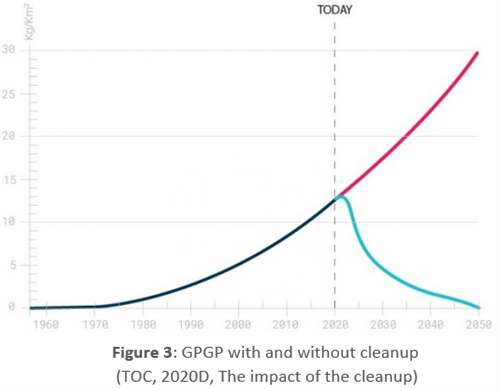
The aim of the project is to clean-up half of the GPGP before 2025, and the remaining half before 2050. The aim can be visualized in Figure 3, together with a scenario of no-action. Although the figure is limited to the GPGP, TOC has equal long-term goals for other ocean garbage patches. For example, TOC aims to reduce the amount of ocean plastic with 90% by 2040 (TOC, 20202D; TOC, n.d.C). If TOC’s operations were complemented by a considerable reduction of plastic sources on land, a plastic-free ocean could be accomplished by 2050 (TOC, 2020C). However, this requires “radical changes at the individual, corporate, and governmental levels of society” (TOC, n.d.C).

Criticism

Despite the ambition to accomplish a plastic free ocean and the received recognition, the TOC project has received criticism as well. Van Franeker & Kühn (2018) reviewed the impact of TOC operations and concluded that if TOC indeed managed to clear half of the GPGP by 2025, it would only remove about 0.1% of the plastic that ends in the ocean every year. Likewise, many scientists stressed that the plastic sources reduction is in fact the most effective mitigation strategy (Rochman; Sherman & Sebille, 2016). Although TOC acknowledges source reduction as important, it does not see it as the solution to current ocean plastic pollution issues (TOC, 2015).

Furthermore, Sherman & Sebille (2016, p.2) declared that “ocean plastic removal might be more effective […] closer to shore than inside the plastic accumulation zones in the centers of the gyres”, like the GPGP. TOC, instead, focuses on ocean garbage patches in high seas gyres “because the plastic floating outside of these ocean garbage patches either naturally removes itself from the ocean by beaching onto a coastline, or eventually also ends up in an ocean garbage patch” (TOC, n.d.B).

Moving forward

To move beyond its first testing and 2015 prototype phase, TOC conducted a feasibility study. Costs were covered with a crowdfunding campaign that raised $100,000. The study included topics such as engineering, oceanology, ecology, maritime law, finance and recycling, and was conducted by a voluntary collaboration of more than a hundred private citizens, organizations and institutions (Slat et al., 2014). The favorable outcome illustrated the sustaining aspect of the innovation.

The positive media coverage that came with the favorable feasibility study was used for the second crowdfunding campaign. This campaign raised over 2 million dollars, becoming the most successful crowdfunding campaign opened by an NGO, so far (TOC, 2015; ABN AMRO, 2014). It allowed TOC to develop and test different prototypes in different locations (TOC, 2020A).

In late 2016 TOC initiated another fundraising round. In May 2017, it issued a press release stating that it “successfully raised 21.7 million USD in donations since last November [bringing TOC’s] total funding since 2013 to 31.5 million USD, [which enables TOC] to initiate large-scale trials of its cleanup technology in the Pacific Ocean” (TOC, 2017). The fact that this latter funding round comprised solely on donations demonstrates the legitimacy perceived by the initial investors that supported the project.

Eventually, after “hundreds of scale-model tests, a series of prototypes, research expeditions and multiple iterations”, a first full-scale clean-up system was ready in 2018 (TOC, 2018). The unique business approach of TOC, however, also created legal complications that had to be solved before the full-scale system could be launched. To overcome these hurdles, TOC signed a covenant with the Dutch Ministry of Infrastructure and Water Management (MIW, 2018). With an applicable legal framework and support from the Dutch government, TOC was ready to launch its first full-scale clean-up system. The aim of the operation was to test the system and collect relevant data while cleaning up the GPGP (TOC, 2018). Nevertheless, the operation was prematurely terminated because the system was not able to actually capture the plastic due to “an inconsistent speed difference between the system and the plastic” (TOC, 2020A, p.17). This led to a systematic failure (TOC, 2020A).

Thanks to a cooperation with two other organizations, TOC later came with an updated prototype, the “System 001/B”. After one year of testing, TOC stated on 3 October 2019 that its self-contained prototype succeeded in passively capturing and concentrating plastic from the GPGP using the natural forces of the ocean. This was the first true success since Boyan Slat presented his ideas in 2012 (TOC, 2019).

Additionally, TOC recycled the captured plastics into valuable goods: it turned them into sunglasses, a durable and useful product. This entrepreneurial activity is crucial to ensure future operations, as potential profit will be fully reinvested and, thus, completed the infinite circle (TOC, 2020B).

The adjustments in the prototype were incorporated in the newly designed system (002), that requires  comprehensive  examination  and  modelling  before  becoming  the  next  full-scale clean-up system (TOC,  2020). Ultimately, “a fleet of systems” would be necessary to be able to clean up the entire GPGP and smaller plastic patches” (TOC, 2020A).

Furthermore, TOC is “looking to expand [its] operations all over the globe to help tackle the 1000 most polluting rivers, five years from the commencement of the scale-up phase” (TOC, 2020A, p.8). Replying to the criticism, TOC not only acknowledges plastic source reduction as important, but also strives for action.


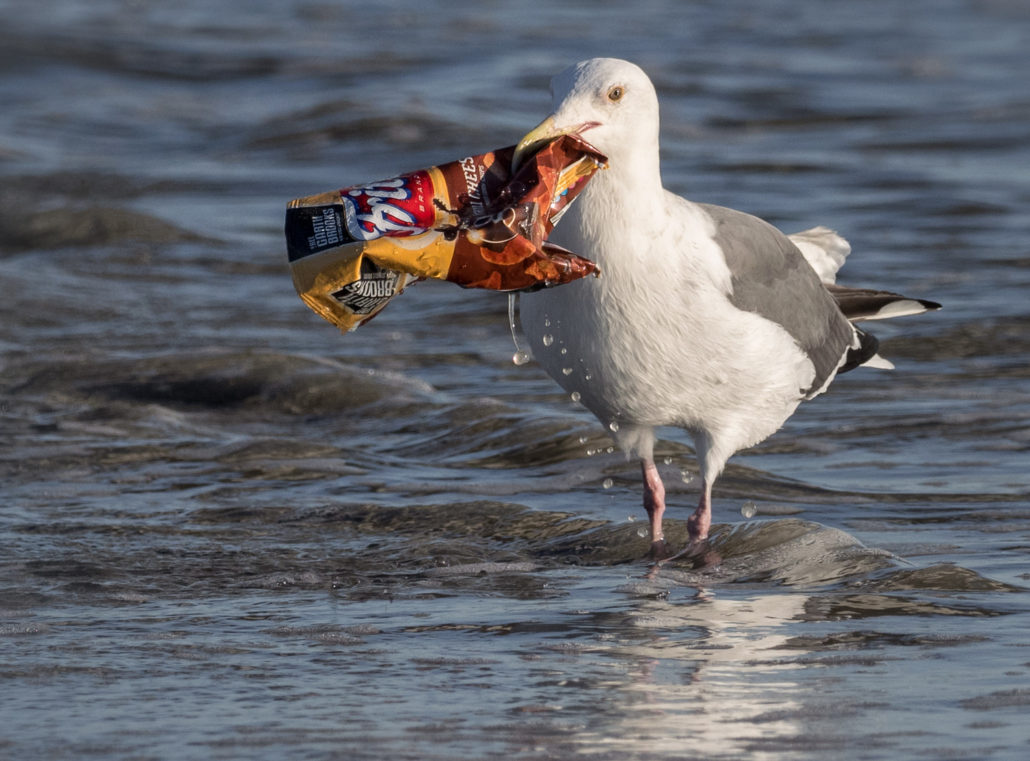
Fig. 2: A seagull holding a plastic package in its peak (Ingrid Taylar, 2016).

Bibliography

ABN AMRO (2014, 11 July). Seeds faciliteert succesvolste crowdfunding voor non-profit organisatie. Retrieved 30 November 2020, from https://www.abnamro.com/nl/newsroom/nieuws/2014/seeds-faciliteert-succesvolste-crowdfunding-voor-non-profit-organisatie.html

Dees, J.G. (2001, 30 May). The Meaning of Social Entrepreneurship. Downloaded 7 December 2020, from https://centers.fuqua.duke.edu/case/wp-content/uploads/sites/7/2015/03/Article_Dees_MeaningofSocialEntrepreneurship_2001.pdf

Franeker, J.A. van & Kühn, S. (2018, 13 September). The Ocean Cleanup. Downloaded 6 November 2020, from https://www.wur.nl/upload_mm/0/0/a/3f5469b5-3e79-423f-a947-80b5a5b06c1a_FAQ-OceanCleanup2018_finalNL_CH-JAF.pdf

Geyer, R., Jambeck, J.R. & Law, K.L. (2017). Production, use, and fate of all plastics ever made. DOI: 10.1126/sciadv.1700782

Jambeck, J.R., Geyer, R., Wilcox, C., Siegler, T.R., Perryman, M., Andrady, A., Narayan, R. & Law, K.L. (2015). Plastic waste inputs from land into the ocean.Science, 347(6223), pp.768-771. DOI: 10.1126/science.1260352

Lebreton, L., Slat, B. […] Brambini, R. & Reisser, J. (2018, 22 March). Evidence that the Great Pacific Garbage Patch is rapidly accumulating plastic. Retrieved 6 November 2020, from https://www.nature.com/articles/s41598-018-22939-w

Ministry of Infrastructure and Water Management of the Netherlands (2018, 6 June). Convenant tussen de Minister van Infrastructuur en Waterstaat en The Ocean Cleanup betreffende de inzet van systemen bedoeld om plastic op volle zee, dat drijft in de bovenste waterlagen, op te ruimen.Retrieved 6 December 2020, from https://zoek.officielebekendmakingen.nl/stcrt-2018-31907.html#d17e790

Rijksoverheid (2016, 29 November). Waterinnovaties in Nederland.Downloaded 6 November 2020, from https://www.rijksoverheid.nl/binaries/rijksoverheid/documenten/brochures/2016/11/29/waterinnovaties-in-nederland/Waterinnovaties-2016.pdf

Rochman, C. M. (2016). Strategies for reducing ocean plastic debris should be diverse and guided by science. Environmental Research Letters, 11(4), 041001. DOI: http://dx.doi.org/10.1088/1748-9326/11/4/041001

Sherman, P. & Sebille, E. van (2016). Modeling marine surface microplastic transport to assess optimal removal locations. Environmental Research Letters, 11(1), 014006. DOI: http://dx.doi.org/10.1088/1748-9326/11/1/014006

Slat, B.D., Arens, E. […] Zuijderwijk, N. & de Sonneville, J. (2014, 3 June). How the oceans can clean themselves. A feasibility study. Downloaded 30 November 2020, from https://ds1.static.rtbf.be/article/pdf/toc_feasibility_study_lowres-1401893379.pdf

The Ocean Cleanup (2015, 30 June). Annual Report 2014.Downloaded 30 November 2020, from https://assets.theoceancleanup.com/app/uploads/2019/04/TOC_2014_Annual_Report.pdf

The Ocean Cleanup (2017, 3 May). THE OCEAN CLEANUP RAISES 21.7 MILLION USD IN DONATIONS TO START PACIFIC CLEANUP TRIALS. Retrieved 12 December 2020, from https://theoceancleanup.com/press/press-releases/the-ocean-cleanup-raises-217-million-usd-in-donations-to-start-pacific-cleanup-trials/

The Ocean Cleanup (2018, 8 September). THE WORLD’S FIRST OCEAN CLEANUP SYSTEM LAUNCHED FROM SAN FRANCISCO. Retrieved 6 December 2020, from https://theoceancleanup.com/press/press-releases/the-worlds-first-ocean-cleanup-system-launched-from-san-francisco/

The Ocean Cleanup (2019, 2 October). THE OCEAN CLEANUP SUCCESSFULLY CATCHES PLASTIC IN GREAT PACIFIC GARBAGE PATCH.Retrieved 13 December 2020, from https://theoceancleanup.com/press/press-releases/the-ocean-cleanup-successfully-catches-plastic-in-great-pacific-garbage-patch/

The Ocean Cleanup (2020A, 9 June). Annual Report 2019.Downloaded 6 November 2020, from https://assets.theoceancleanup.com/app/uploads/2020/06/Annual_Report_2019.pdf

The Ocean Cleanup (2020B, 24 October). THE OCEAN CLEANUP INTRODUCES FIRST PRODUCT MADE WITH OCEAN PLASTIC POLLUTION.Retrieved 13 December 2020, from https://theoceancleanup.com/press/press-releases/the-ocean-cleanup-introduces-first-product-made-with-ocean-plastic-pollution/

The Ocean Cleanup (2020C). About – The impact of the cleanup.Retrieved 13 December 2020, from https://theoceancleanup.com/about/

The Ocean Cleanup (n.d.A). THE FIRST PRODUCT MADE WITH PLASTIC FROM THE GREAT PACIFIC GARBAGE PATCH. Retrieved 7 December 2020, from https://products.theoceancleanup.com/

The Ocean Cleanup (n.d.B). FAQ –
How will you clean up 50% of the plastic in 5 years?Retrieved 16 December 2020, from https://theoceancleanup.com/faq/

The Ocean Cleanup (n.d.C). Can you provide an overall solution to ocean plastic pollution?  Retrieved 17 December 2020, from https://theoceancleanup.com/faq/can-you-provide-an-overall-solution-to-ocean-plastic-pollution/

United Nations (n.d.). Goal 14: Conserve and sustainably use the oceans, seas and marine resources.Retrieved 7 December 2020, from https://www.un.org/sustainabledevelopment/oceans/

Join our Telegram channel

Tra il dire e il fare c’è di mezzo il mare (pieno di plastica?)

Così dice il famoso detto. Tutti sono coscienti che il cambiamento climatico sta diventando la priorità per le politiche future, ma con fatica, e con la paura di perdere voti, si sta cercando di ostacolare ogni possibile misura che aiuti l’ambiente. Coraggio, bisogna avere coraggio, niente di più. E così, in Italia, nelle ultime settimane, è arrivata nella scena politica il clamoroso dibattito sulla Plastic Tax. La Plastic Tax è la tassa sulla plastica monouso, una misura che esiste già in vari altri paesi europeicome la Francia e la Danimarca [1]. Oltre a cercare di ridurre l’uso di plastica nella vita quotidiana, e quindi di promuovere tipi di imballaggi più eco-friendly, la Plastic Tax permetterebbe di portare circa 3 miliardi nelle casse dello stato. Soldi che potrebbero essere utilizzati per incentivare la ricerca, la produzione di materiali biodegradabili e aiutare le aziende di settore ad ammortizzare il colpo [2]. Questa tassa recepirebbe la direttiva europea di questa primavera, che porta alla riduzione (e per alcuni prodotti all’eliminazione) della plastica monouso, con eccezion fatta per le siringhe. In più, la Plastic Tax incentiverebbe l’economia circolare, ridurrebbe la quantità di rifiuti e l’inquinamento, tutelando così l’ambiente.

Credo che la discussione politica sulla Plastic Tax sia stata ridicola [3]. Ancora più ridicola trovo la visione di certi politici, i quali perdono il coraggio per avere sicura la propria poltrona. Sì, coraggio; quello che ci vuole oggi per avere un mondo più green e più equo. Il coraggio di non fermarsi a previsioni economiche di breve termine, il coraggio di pensare alle generazioni future, ai giovani e al nostro pianeta. Quindi, tra dire e il fare c’è di mezzo il mare. Esatto, cari politici; prima di dire e metterci la bella faccia per far felice Greta (Fig.1), attivatemi! Noi giovani vogliamo solo questo: più coraggio.

Fig.1: Greta oggi a Torino con i Fridays For Future per il 69° sciopero per il clima. Fonte: https://twitter.com/GretaThunberg

Referenze:

[1] Foderi, A., 2019. Come funziona la plastic tax fuori dall’Italia. Wired. URL https://www.wired.it/attualita/politica/2019/12/09/plastic-tax-italia-europa/ (accessed 12.13.19).

[2] Fortuna, G., 2019. Italy’s plastic tax proposal angers “packaging valley” before crucial regional vote. www.euractiv.com. URL https://www.euractiv.com/section/energy-environment/news/plastic-tax-proposal-angers-italys-packaging-valley-before-crucial-regional-vote/ (accessed 12.13.19).

[3] Open, 2019. Dalla sugar alla plastic tax: ecco come cambia la Manovra 2020 [WWW Document]. Open. URL https://www.open.online/2019/12/07/manovra-cosa-cambia-slittano-sugar-e-plastic-tax-nuove-accise-sulla-benzina/ (accessed 12.13.19).

Telegram: @greenmarked
LinkedIn: @greenmarked
Instagram: @greenmarked.it

Facebook:  @greenmarked.it


© GreenMarked.it is managed by ECONTROVERTIA APS — Via Alcide De Gasperi 1, 38015 Lavis (TN), Italy — VAT IT02667560227