
Eco-Battles: The Stealth Trash Ninjas


March 30th will again be International Zero Waste Day, first debuted in 2023 by the United Nations General Assembly [1], which proclaimed it in December 2022. This day aims to address the serious impact of waste on human health, the economy and the environment by promoting the transition to a circular economy.
“The waste crisis is undermining the Earth’s ability to sustain life in all its forms. Waste costs the global economy billions of dollars each year”
United Nations Secretary-General António Guterres
In Italy, as in the rest of the world, there is still a long way to go, but something good is there! In fact, the Italian recycling chain is a well-established industrial sector, which achieves much higher percentages of recycled waste than the European average [2]. However, we can and must do even better!

Figure 1: Waste treatment by type of recovery and disposal, 2022 (% of total treatment) Source: Eurostat (env_wastrt)
Efforts at global, European, national, local and household level must now be directed towards reducing waste at source. As can be seen from the following graph, which shows how plastic waste is treated in Europe, the amount of plastic that is recycled is increasing over the years, but the amount that is incinerated is also increasing. Finally, that which ends up in landfills shows no sign of decreasing.
It is not only we individual citizens who must do our best in this field, but legislators must be the first to pursue the goal. For example, how is it legal to market a product such as the disposable electronic cigarette? If classic cigarettes are a dangerous source of waste, the addition of a lithium battery only makes the situation worse. Fortunately in Europe, Belgium has taken action by blocking the sale of these products from 1 January [3], let us hope that Italy and Europe will also follow as soon as possible.
Waste reduction must take place in all sectors, not only those that generate very tangible waste such as packaging. The case of PerFluoroAlkyl Substances (PFAS), for example, is much debated, especially thanks to regular reports by Greenpeace. The latest report came out just a few days ago (22 January 2025) [4] and highlights how these invisible pollutants, which can be considered industrial waste, are present throughout Italy. If you want to learn more about this topic, you can watch the episode of Presadiretta of 6 October 2024 (in Italian) by clicking here.
The sampling campaign of Greenpeace found these substances in all the regions, you can check out the values personally in the next interactive map (description in italian only):

Even in the mountainous region of Trentino-South Tyrol, where supposedly the water should be cleaner thanks to the direct flow from the mountains, those substances have been found. The amount is not alarming and remains below the limits, but it is important to take action now to prevent a worsening of the situation in the future. The Province of Trento, in its SproSS (Provincial Strategy to Sustainable Development)[5] plans explicitly to tackle this point with goal number 18: Minimising pollutant loads in soils, water bodies and aquifers, taking into account the good ecological status levels of natural systems.We hope to see important measures to limit the water pollutants being introduced in the coming years.
Finally, it’s clear how complex the waste management topic is and from how many different point of views could be seen and tried to addressed, but it is necessary to keep in mind that we can make the difference by adopting conscious life-styles and also supporting researchers and ONGs that are trying to rise the awareness, which leads to new regulations protecting us and the environment we live in.
This article is part of the project “Quiz Ambientali per un Trentino Più Verde!” carried out by Econtrovertia APS and sponsored by Fondazione Cassa Rurale di Trento (Notice of Approval of December 20, 2024).

Cover image: Junkyard Campfire Moon Homeless by baggeb on Pixabay. Free image available under the Pixabay License.

Waste production is nowadays one of the main pressures on the environment. This is because of its many drivers (including economic and domestic activities) and its connected impacts, like the pollution of soil, emissions in the atmosphere, and exhaustion of energetic resources [1]. Waste reduction is therefore a priority and as such, it needs to focus on waste management but also on the overall lower waste production: using the principles of circular economy to inspire the future, is fundamental.
Many territories have worked in the past years with these goals in mind: one of them, is Trentino. In the recently published Report on Waste [2], it is stated how Trentino has reached a high standard for the quantity of waste sorting (average 79.1% in 2021) with some areas doing better than others (see Figure 1). Even if the quantity of recycled waste was high, the quality was not as much. The study has in fact shown how organic waste contained almost 6% of materials that should not have been there (like glass, metals, textile and non-biodegradable plastics).
The Report on Waste also shows how in the last years, sorting has increased from 16.3% in 2001 to 79.1% in 2021 (see Figure 1): the ambitious goal settled by the Law 152/2006 (65% of waste sorted) is long surpassed in the provincial territory. The non-recyclable waste component represents a little more of 18% of the waste while organic waste accounts for almost 19% and paper for 14%.
These important results show how in twenty years, thanks to the education and information of the citizens along with an efficient collecting system, Trentino has reached an excellent standard even if some work can still be done (as stated, in particular on the quality of the waste which is sometimes not appropriate). Sustainable waste management includes the integration of the circular economy: it is in fact necessary that each of us makes an effort to change their routine. The consumeristic society and the need for things “here- and – now” have increased the use of non-disposable items and our neglect for where the raw materials come from. The principles of circular economy invite us to reuse items and objects, to fix them when broken to not buy new ones unless we really need them. This will make us more aware of the impact they have and therefore that each of us has [2].

Fig 1: Waste Management in Trentino. Data from Rapporto Rifiuti Trentino 2022. Photo by GreenMarked, 2024.
The Report evaluates the environmental cost of E-commerce highlighting how buying online is an advantage for the environment only if the item cannot be found within 15 km from the consumer. It is obvious how E-commerce is posing a detrimental effect because of packaging: the global value of it is going to reach 28.6 billion dollars in 2027 (it was 9.62 in 2019). In Italy, Corepla (the Italian consortium for the recycling of plastics packaging) claims that E-commerce takes up 15% of the whole plastics in the market, which accounts for almost 300,000 tons [3]. The Scuola Superiore San’Anna di Pisa has calculated that our online purchases generate a packing effect which is ten times higher than the classic plastic bag of the shops (182 kg of carbon dioxide instead of 11).
There has been an increase of +300% in online purchases on the global scale and +70% in Trentino (for the year 2020) so we need to find alternatives to these major challenges.
One of these could mock La Poste (the largest French mailing company), which has recently signed an agreement with the Finnish start-up RePackthat has created a virtuos model of circular economy. Once the consumer receives their item, the envelopes, thanks to a pre-paid label, are sent back to the company to be re-used, after being cleaned. RePack is collaborating with more than 150 brands and has already circulated more than 250thousand packages in Europe. It has recently won the German Design Award in the “Excellent Communication Design Packaging” category.
Waste management is surely one of this century’s major challenges, and many of the Sustainable Development Goals focus on it, making it a worldwide emergency. It has a cascade effect on the biodiversity of our ecosystems, and the quality of our waters and soils therefore it affects food production: it is a challenge we need to win, for our future generations.

In recent times, inflation has been on the rise and the cost of living has increased in all areas. Price increases are everywhere, but we would like to focus on one particular phenomenon plaguing supermarket products: the shrinkflation. [1] The neologism comes from the fusion of two English terms such as “to shrink” and “inflation”. This marketing move makes it appear to the less careful consumer that prices have not increased or have increased only slightly, while the packages get smaller or their contents get lighter. Personally, I’m finding this more and more often, but it is easier when it comes to products we are used to buying. An example would be Elmex toothpaste, which went from 100ml packs to 75ml, same box and almost identical tube but with a quarter less product! To top it off, you can now find “bargain” formats with two 75ml toothpastes together.

Plenty of other products are suffering the same fate, even beer! In fact, Peroni Nastro Azzuro “national” beer is now sold in 62cl format, when usually all beers of that format are 66cl.
The tools to understand the phenomenon and try to defend ourselves are there. For example, it is advisable to always refer to the price per kg or liter of the products, to have a comparable indication with others brands or formats. The Internet then, with some discernment, helps us understand if the product previously had a different format. For example, the Italian web page shows that Nastro Azzurro beer is available in 62 cl format while the English version still shows 66 cland not 62 cl.
In France, the supermarket chain Intermarchè recently went a step further in defense of consumers with an advertising campaign pointing the finger at the giant Uniliver, pointing out that some of its products such as Magnum ice creams have shrunk for no reason.
Uniliver responded by taking Intermarché to court for defamation.[2] Even Carrefour started a similar campaign: they will identity products affected by the shrinkflation and mark that clearly. [3]

The harm is not only to us consumers, who are being bypassed. The environment also pays the cost of this malpractice, because packaging that is nearly the same but with less product content means more waste to dispose of for the same amount of product.
Not surprisingly, packaging waste has increased from 66 million tons in 2009 to 78.5 million tons in 2019, an increase of more than 10 percent in 10 years. In terms of virgin material, 40% of the plastic and 50% of the paper used in Europe is for packaging [4]. We cannot afford to increase this amount by one percentage point every year. To get an idea of the absurdity of certain food packaging, check out this article from GreenMe.
March 30, exactly two months from now, will be International Zero Waste Day [5], let’s not be caught unprepared and keep our attention level high to avoid scamming and waste!

The other night I was in downtown Bologna. After an ice cream with friends, I took away the water bottle I had bought but I had not finished—a plastic half-liter bottle.
Once I drank all of my water, I faced an important moral dilemma: should I have looked for a plastic bin or thrown it in one of the many roadside trash cans?
Apart from the shortage of publicly accessible recycling bins in downtown Bologna, Italy lacks a system for valuing waste, and the ability to sort is just an ethical issue left to citizens’ common sense and morals.
What would happen if we switched from an ethical issue to an ethical and economic issue, placing a concrete value on waste?
The initiative “A Buon Rendere – molto più di un vuoto“ (lit. “In Return- much more than an empty space”) is a campaign launched by the “Associazione Comuni Virtuosi” to encourage the transition to a circular economy in the packaging sector by introducing a collection system for beverage containers based on a Deposit Return System, or DRS.
The idea is that the consumer pays a deposit for the container (€0.10 to €0.25) in addition to the sale price of the good. This, however, will be refunded when the empty packaging is returned. In other words, the consumer actually buys only the contents and borrows the packaging [1].
A similar system is already in use in Italy for glass bottles. Some beverage companies give the option of using a returnable service, thus reusing the glass bottle for about 20 cycles.
What makes DRS different from returnable glass, however, is the material for which it is designed and its durability: single-use plastic and aluminum packaging. However, the key difference is that the returnable glass is a voluntary service, while the DRS is mandatory by law in countries where it is active [2].
In Europe, 13 countries already have an active DRS and as many will introduce it by 2025. Among them, however, is not Italy [2]. Yet, the DRS could be a solution to align with the European Green Deal directives on waste recycling, particularly plastic packaging.
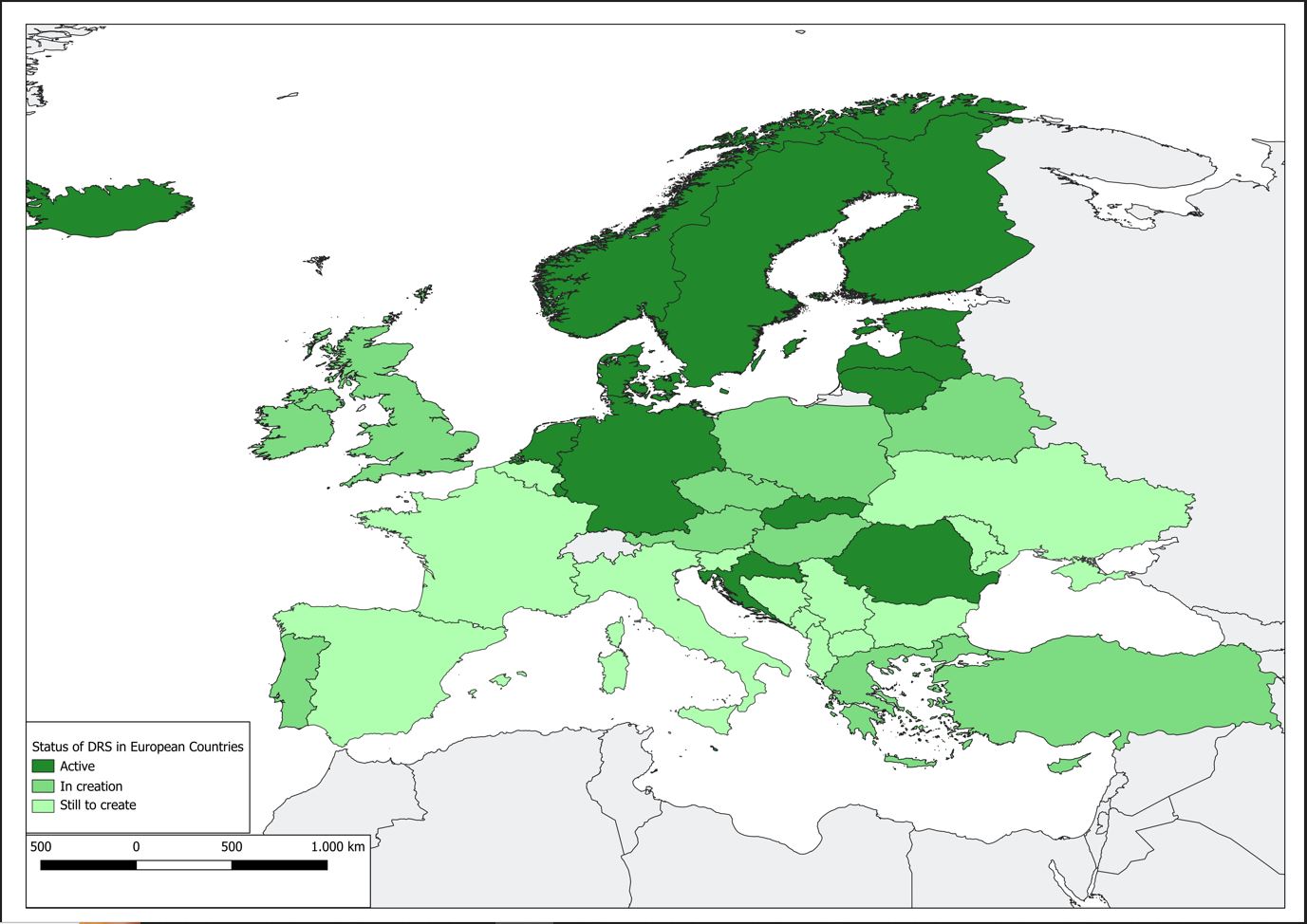
The main goal of the European Green Deal’s Circular Economy Action Plan is for each member state to reduce packaging waste by 15 % compared to 2018 by encouraging reuse, recycling, and banning unnecessary forms of packaging [3]. A DRS could help in the achievement of this goal.
Indeed, a factsheet by the NGO Reloop, highlights the positive impacts of DRSs, pointing out that in the United States and Australia, the introduction of these systems has reduced the amount of plastic bottles and other beverage packaging abandoned in the environment by up to 84 % and 54 %, respectively. The most successful example cited in the review is, however, Germany where, prior to the introduction of DRS, plastic beverage packaging accounted for about 80 % of trash. Then, after the introduction of the “Pfandsystem“, this value was reduced to ‘almost zero’ [4].
However, the benefits are not only for the environment. Public Administrations, the commercial sector, and the beverage companies also benefit.
PAs have lower operating costs from removing abandoned waste and cleaning up their territory. The large-scale retail and commercial sector gains from hosting take-back systems. In addition to receiving compensation for the distributor’s presence in the stores, it has been shown that people tend to visit stores more frequently to leave empty packaging and then take the opportunity to make purchases.
Finally, beverage companies have access to large quantities of high-quality raw materials that can be recovered at low cost. They also improve their environmental profile and image to the public [1].
What about us, in Italy, are we ready for a DRS? Since the different kinds of waste management and treatment systems we have across the whole peninsula, it is first necessary to succeed in harmonizing the diversity among the various municipalities. Meanwhile, we must continue to educate citizens about reuse and recycling and talk about differentiating, whether there is an economic payoff or whether it remains an ethical and moral issue.
By the way, in the end, I found a plastic bin to leave my bottle in.

The holiday season has also been archived for this winter. We all attended big lunches and dinners, bought and wrapped gifts for our loved ones and ourselves. Besides many good memories, what are we left with? A mountain of waste and packaging to dispose of! Not surprisingly, a recent analysis by Transport & Environment [1] reports how this Christmas brings a +133 % spike in pollution caused by the logistics of transporting goods.
Although we all try to pay attention to how to dispose of this packaging by sorting it as best we can, by now this is no longer enough: according to the April 2022 report by ECCO [2] in 2020 almost 100 kg per person of plastic was consumed in Italy: we are the second in Europe and that is nothing to be proud of. About 40 percent of this plastic is turned into packaging, which will end up in supermarkets and then in our homes especially at parties and banquets. Sadly, much of this plastic waste will never be recycled [3]. We have covered this issue previously, talking about how some packaging should be redesigned from scratch.
The European Union (“EU”) is trying to put a stop to this with the Circular Economy Package. The Circular Economy Package [4] and the new EU Packaging Regulation [5], approved in late November 2022, wants to improve the entire sector, from disposable to bioplastic packaging. Included in this regulatory package are targets related to reducing and reusing packaging, leading to limiting single-use as much as possible. Europe Direct’s Florence page has created an excellent list of questions and answers on the topic that we recommend reading.
In Italy, the legislation has been widely criticized by Stefan Pan [6], Confindustria’s delegate for Europe in an interview with Sole 24 Ore, who speaks of disastrous scenarios for Italy’s excellent recycling supply chain caused by this new legislation. FederDistribuzione and CONAI are also of the same opinion, expressing fears of the fallout on Italian industries.
Not surprisingly, during the press conference for the presentation of the circular economy regulatory package, European Commission Vice President in charge of the Green Deal Frans Timmermans spoke in Italian to reassure on the objectives of the legislation. You can listen to him in this excerpt from the press conference:
So on the one hand we have Europe trying to give clear directions on how to proceed and on the other the industrial lobbies struggling to adapt but will have to do so anyway.
“Reuse is not in competition with recycling” Frans Timmermans
But there are also other players on this chessboard: citizens, the media, associations and nongovernmental organizations (NGOs). Among all the environmental organizations, GreenPeace launched a major initiative together with ilfattoquotidiano.it called “Plastic Carts” [7]. This initiative sought to assess actions to reduce the packaging of the largest supermarket chains in Italy. The report draws a tragic situation for almost all the chains involved.
This survey highlights another important fact: Law No. 141 of 2019, also referred to as the Climate Decree, allows supermarket customers to “use their own containers as long as they are reusable, clean, and suitable for food use,” but both citizens and merchants are not informed and prepared for this possibility [8].
Did you know that in Italy, thanks to Law 141 of 2019, you can use your reusable bulk containers in all supermarkets?
We cannot forget to mention the initiative “A Buon Rendere – molto più di un vuoto” [9] launched by the Associazione Comuni Virtuosi and other partners, which “aims to facilitate the transition to a circular economy in the packaging sector” by introducing a national deposit deposit system (DRS). In exchange for a deposit on the packaging of the beverage purchased (plastic or glass bottle or can), this system would allow some containers to be reused or at least improve recycling collection and the quality of recyclable material. The deposit system on beverage packaging has existed and worked for decades in countries such as Austria and Germany, and other countries have since adopted it as well.
As we have seen, the situation is constantly evolving thanks to both the European Commission and nongovernmental organizations, but also thanks to citizens who are not simply adapting to the status quo and are reacting with ideas and pressure aimed at a better future for everyone.

On Friday, September 4, the documentary “PrimAscesa – La Montagna Creata dall’Uomo” (“First Climb Up – The Manmade Mountain”)by Leonardo Panizza was played in Lavis (Trento, Italy) during the event “Vita Nuova”.
The movie shows the first exceptional ascent of one of the last pristine alpine mountaintops: the “Ischia-Podetti” dump (Trento). The two Trentino mountaineers, Simon and Giovanni, climb up and sky down the slopes of Trento’s mountain of waste. The one that each of us from Trentino contributes to create every day.

One remains shocked after the movie ends. Why does this mountain keep on growing despite all our efforts to separate waste and reduce the volume of unrecyclable waste? In fact, the movie clearly shows that most of the waste in the dump is made of recyclable materials. The issue is simple and derives from the waste separation and recycling system business management. If too many impurities (i.e., non-conforming materials) are found in the recyclable waste when it is handled at the waste separation plant, it cannot be sold to recycling companies and is therefore transported to the dump or the incinerator.
With its advantages and disadvantages, the incinerator is the alternative to dumps. Located about 50 km north of Trento, the incinerator of Bolzano is also used by the people of Trentino because it is oversized for the needs of the people of South Tyrol alone [1]. Far from being circular in a concrete way, our economy creates unrecycled waste every day. Despite the good will of individual citizens and associations, our economy
is often unable to find valid alternatives to incinerators that can drastically reduce the amount of unrecycled waste.
In addition to the advices given in previous articles and posts, we recommend you to be active critical consumers in shopping and eating places. Ask your favorite supermarkets, canteens, restaurants, clothing stores, etc. about their waste management. Questions such as “Do you have plastic-free packaging?” or “Do you sell returnable goods?” reveal how important these issues are to us as consumers. If we are able to show that consumers demand better reuse and recycling waste handling practices, the message will sooner or later reach facilities decision makers and eventually those who have the real power to improve the waste management system in Trentino.

Citizens, businesses, and governments are increasingly aware of the need to use energy more efficiently and sustainably in the future. The transition from a linear to a circular economy is thus seen as both necessary and desirable (Kroes, 2018).
The role of recycling is crucial to achieve a resource efficient society, and a circular economy in general (Worrel & Reuter, 2014). Nevertheless, the sustainability of recycling itself is rarely questioned. What if recycling was part of the unsustainability of our global economy? This possibility is confirmed in this case study focusing on the Dutch market for recycled metal scrap.
Scrap consists of recyclable materials left over from the manufacturing and consumption of goods (Meena et al., 2018). In the Netherlands, eighty percent of the generated metal scrap is recycled (Tam & Tam, 2006). However, most of the Dutch smelters in charge of scrap recycling have gone bankrupt in the last decades, as a result of competing prices and weaker environmental regulations in other parts of the world (Wester, 2020A).
Scrap recycling was therefore delocalized, and Dutch traders now send large quantities of scrap metals to countries outside of Europe. Since Asia became the manufacturing factory of the world, there are more goods coming in Europe than going back to Asia (Wester, 2020B). To prevent container ships from returning empty, shipping costs to Asia are very low. On top of that, environmental pollution from international shipping is hardly taxed. This makes scrap transportation to other European countries inconvenient and uncompetitive (Wester, 2020A).
Remarkably, when scrap metal is exported rather than melted in the country of origin, the environmental impact remains zero on paper. The shipping industry does not need to record carbon dioxide emissions, so Dutch CO2 emissions from scrap metal are only counted when it is melted in the Netherlands. When scrap is exported, emissions simply vanish from the records and from any environmental impact evaluation (Wester, 2020).
Shipping scrap to other parts of the world means that high seas are entered. High seas are open-access resources, i.e. they are not subject to the legal sovereignty of any state. Thus, there is no entity guaranteeing its intergenerational survival or protection from depletion or pollution. (Debaere, 2020).
Furthermore, shipping was not even mentioned in the 2015 Paris Agreement global targets for carbon emission reduction, or anywhere else in the agreement (UNFCCC, 2015). Still, marine vessels account for approximately 5% of the global CO2 emissions, 7% of the sulphur dioxide emissions, and 23% of the nitrogen oxides emissions (Kesieme et al., 2019). The last two emissions are linked to acid rain, which causes considerable pollution of land ecosystems (Graßl, 2002).

Fig. 1: The HMM Algeciras – the biggest marine vessel worldwide – in Antwerp, Belgium. Photo source: Author, October 2020.
After China’s ban on scrap metal import, Turkeyhas quickly become the biggest importer with a share of 30 to 40% of the global scrap. Of all the scrap that is shipped from the Netherlands, approximately 80% is melted down in Turkey. Cheap labour and energy costs, on top of loose and often not enforced environmental standards,makes Turkey highly competitive in the global scrap metal recycling market. That is why Turkish smelters can afford buying scrap metal at prices up to double the prices offered by Dutch traders. Thus, a total of approximately 60,000 Dutch lorries full of scrap metals found their way to Turkey last year (Wester, 2020A).
One can question whether the recycling of scrap metals, as it is done now, is sustainable at all. This has consequences for the purchaser of these metals, especially for the end consumer An example comes from the Dutch Sluishuis, a futuristic designed apartment building in Amsterdam, which promotes itself as “ultra-sustainable”. Among various reasons, Sluishuis claims to be “ultra-sustainable” due to its “maximum use” of recycled and renewable construction materials. They advertised the new flats under the motto “circular building” (Sluishuis, 2020). Although Sluishuis has right intentions, it purchases steel for beams and pillars from one of the dirty factories in Turkey. This shows how difficult it is to build “sustainably”, even when your intentions are right (Wester, 2020A).
Wester (2020A) shows that even if metal traders were to melt more sustainably in the Netherlands, the scrap recycling capacity would not be sufficient since the manufacturing industry was largely delocalized. Clearly, at this moment it is not possible to build a clean smelter in the Netherlands. So, today “the more scrap we process abroad, the better the CO2 footprint of the Netherlands [looks like], while [instead] it leads to more emissions worldwide”. On paper the Netherlands is a recycling world champion, but in truth it has exported the scrap metal, climate, and waste problem somewhere else (Wester, 2020A).
Debaere, P.M. (2020, 31 August). The Tragedy of the (Water) Commons. Downloaded on 8 October 2020, from https://papers.ssrn.com/sol3/Delivery.cfm/UVA-GEM-0174.pdf?abstractid=3682604&mirid=1
Graßl, H., Kokott, J. […] Schubert, R. & Schulze, E.D. (2002, 18 January). Charging the use of global commons.Downloaded on 8 October 2020, from http://dlc.dlib.indiana.edu/dlc/bitstream/handle/10535/4321/wbgu_sn2002_engl.pdf?sequence=1
Kesieme, U., Kayvan, P., Murphy, A. & Chrysanthou, A. (2019, January). Attributional life cycle assessment of biofuels for shipping: Addressing alternative geographical locations and cultivation systems. Retrieved on 8 October 2020, from https://doi.org/10.1016/j.jenvman.2019.01.036
Kroes, F.G.H. (2018). Circulaire oogst. Educatieve Uitgeverij EnDusZo: Rotterdam
Meena, S., Sakalle, R. & Tiwari, N. (2018, May). An Experimental Study On Concrete As A Partial Replacement Of Sand With Stone Dust And Steel Scrap. Retrieved on 8 October 2020, from http://www.academia.edu/download/57013236/IRJET-V5I599.pdf
Sluishuis (2020). Duurzaamheid.Retrieved on 8 October 2020, from https://sluishuis.nl/duurzaamheid/
Tam, V.W.Y. & Tam, C.M. (2006). A Review on the Viable Technology for Construction Waste Recycling, pp. 209-221. Retrieved on 7 October 2020, from https://doi.org/10.1016/j.resconrec.2005.12.002
United Nations Framework Convention on Climate Change (2015, 15 December). Adoption of the Paris Agreement. Retrieved on 8 October 2020, from https://unfccc.int/resource/docs/2015/cop21/eng/l09r01.pdf
Wester, J. (2020A, 15 September). Nederlands schroot reist de hele wereld over – waarom?Retrieved on 7 October 2020, from https://www.nrc.nl/nieuws/2020/09/15/nederlands-schroot-reist-de-hele-wereld-over-waarom-a4012127
Wester, J. (2020B, 16 October). Plasticafval: hoe een Nederlands dropzakje kon eindigen in een Turkse berm. Retrieved on 18 October 2020, from https://www.nrc.nl/nieuws/2020/10/16/plastic-afval-hoe-een-nederlands-dropzakje-kon-eindigen-in-een-turkse-berm-a4016112
Worrel, E. & Reuter, M.A. (2014). Chapter 1 – Recycling: A Key Factor for Resource Efficiency. Handbook of Recycling, pp. 3-8. Retrieved on 7 October 2020, from https://doi.org/10.1016/B978-0-12-396459-5.00001-5