Tag: urban gardening

Green Rooftops: old-school solutions for today’s problems

On November 11, the auditorium of Lavis (Trentino, Italy) housed a conference on possible solutions to reduce the environmental impact of urban buildings, including green rooftops.

The initiative was organized in two sections. The first was mainly dedicated to urban greening experts and consisted of a technical lecture by Helga Salchegger of the Laimburg Research Center[1]. Salchegger described the steps for constructing green rooftops and explained which structural and static factors must be considered, which types of green roofs are already applied (extensive and intensive), and what benefits they bring. They are beneficial both for rainwater retention and building insulation (thermal and acoustic), but particularly for environmental purposes. The latest ongoing studies aim to set up green roofs that maximize biodiversity, mixing internsive and extensive roof greening methods, adding taller plants, boulders, non-vegetated areas, gravel knolls (where wild bees can nest) and logs (which provide food and shelter for various insects). The studies have shown that for many species, green rooftops can be an undisturbed oasis in the concrete ocean of highly urbanized cities.

In the second conference section, open to the whole community, Eurac researchers Silvia Croce and Sonja Gantioler presented their study on the possibility to increase the total urban green surface by exploiting the rooftops in Bolzano South[2]: a “concrete-sealed” industrial district of the size of approximately one third of the city. The two researchers first described the main problem in highly urbanized areas: the temperature rise caused by both the heat absorption (and return) of artificial surfaces, and poor ventilation in dense build-up areas. This can then generate the so-called heat islands.

In areas affected by heat island effect, the average temperature can be up to 1 °C higher than the average temperature in the surrouning areas.

Fig. 1: Eurac Researchers Sonja Gantioler (left) and Silvia Croce (right) during their presentation.

Can green rooftops and hanging gardens reduce the heat island effect and air pollution concentration level?What do plants, shrubs and grasses do?

1. They absorb solar radiation and polluting gases (nitrogen dioxide)

2. They stop particulate matter and fix carbon dioxide in the soil

3. They retain and slow down the damaging effects of heavy rainfall

4. Thanks to evapotranspiration, they have a cooling effect, which can be of some valuable degrees.

5. Even though it is rarely know, they can improve the performance of solar and photovoltaic panels (the reason is related to the optimal operating temperature range of the panels).

Several times the two speakers repeated that green rooftops are an extreme form of nature: they cannot be seen as a definitive but rather partial solution against high-urbanization. Green areas on the actual ground should always be prioritized in sustainable urban develompent plans.Given its importance in absorbing water, fixing carbon dioxide and housing biodiversity, the care of our soil must not be overlooked.

Another factor that must not be forgotten is the type of material used to create green rooftops. To insulate, retain and drain water plastic is typically adopted. The problem of how to dispose it in the future then arises.

All in all, the conference showed several points of interest for our territory both for the adopted methodology and for the suggested solutions. In the end, a greater attention to the quality of the environment means that the relationship between man and nature is healthy and properly managed.

Bibliography:

[1] Abram, Paolo and Salchegger, Helga (2017) Il verde pensile : tra tecnica e natura. Architettura, ingegneria e ambiente . Legislazione tecnica, Roma. ISBN 978-88-6219-237-8

[2] Silvia Croce et al (2019) A Systemic Approach for the Optimization of Urban Surfaces Usage
IOP Conf. Ser.: Earth Environ. Sci. 290 012113

Cover image: An example of a living roof. Free-source photo by Peggychoucair downloaded from Pixabay.

This article is part of the project “Environmental Blogging Boost 4 Students”, aimed at increasing the spread of agroecology and sustainable water management in Trentino. The project is financed by the BIM Adige Water Catchments Consortium (grant approved by provision n. 100 of June 06, 2021).

Farm Hedges and Urban Greening for Better Buffer and Transition Zones

After this long, dark winter, we finally feel spring coming. Strolling along the paths, watching the bulbs bloom and seeing the sparkling green of the new leaves brings us joy and new energy. Nature is finally awakening.

Intensively cultivated farmlands, however, cannot be called “nature”.  The hillslopes surrounding the Piana Rotaliana (Trentino, Italy) are rather alike manufacturing sites than natural areas. Characterized by the extensive presence of intensively farmed vineyards, they have severely lost their connection to their former land-use as forest. Today’s vineyards are so close to each other that the slopes look like a vast monocultural field (Fig.1). Indeed, today’s farmers have lost the good habit of using hedges to separate vineyards from each other and the nearby roads.

Hedges were traditionally formed by common shrubs such as hazel, rowan, cornelian cherry, hawthorn and viburnum. Not only they made the landscape more beautiful, but they also protected the vines from pollution and offered shelter to several species of birds, insects and small mammals, which increased local biodiversity and benefited the vines.

A few years ago, some researchers studied the correlation between the presence of birds in vineyards of Trentino and the quality of the agroecosystem where the birds lived. The outcomes showed how the vineyard is positively affected by the presence of biodiversity in the adjacent areas [1]. The preservation of residual natural environments (e.g., woody hedges, forest patches, uncultivated areas, small wetlands) is the factor that majorly affects the bird wellbeing.

Among the most abundant local bird species, we can list the blackbird, the chaffinch, the song thrush, and the goldfinch – all nesting in the vineyards. Other species important for conservation are the wryneck, the common redstart, the flycatcher, the hoopoe and the black bunting – all of them preferring less-intensively cultivated hillslopes.

Fig. 1: One of the few forest patches left on the extensively and intensively cultivated hillslopes surrounding the Piana Rotaliana. Trentino, Italy. Photo by author.

In Trentino, vineyards and industrial areas are so close to each other that transition zones and ecological corridors are virtually nonexistent. The transition from one area to another is anything but smooth and easy for animals and insects. A possible solution to let them roam freely without encountering artificial obstacles and being killed is urban greening: a urban design approach to increase greenery in urban and industrial areas.

Green roofs are one the most appreciated urban greening strategy,
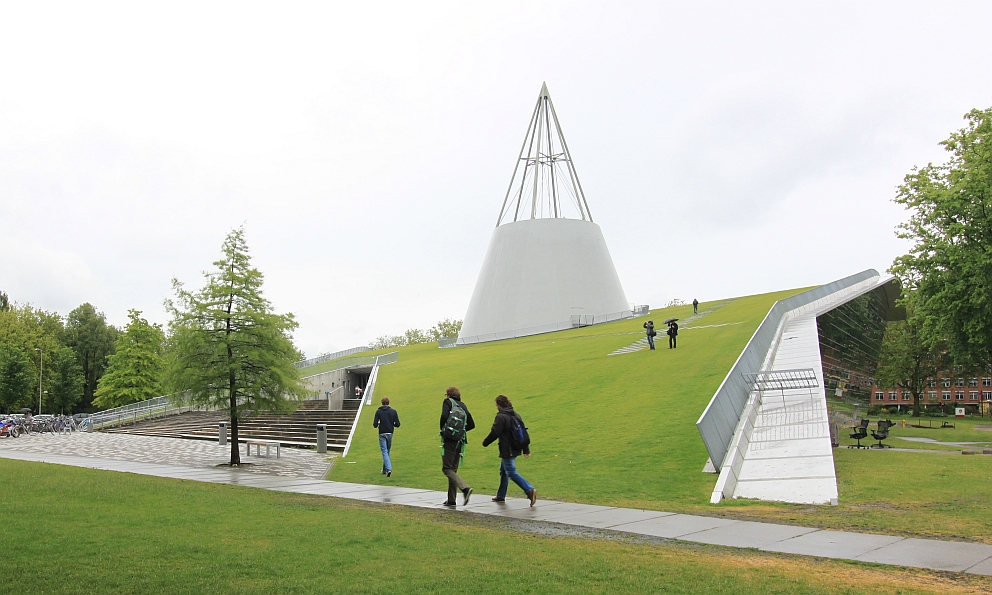
commonly used to contrast the “heat island” effect, which is the excessive accumulation of summer heat by certain urban buildings. In practical terms, the phenomenon is translated into a higher building energy consumption and maintenance cost, and a lower quality of life compared to other urban areas. By mitigating temperature changes both in summer and winter, green roofs are excellent means to oppose the “heat island” effect and allow significant energy savings. If a variety of species is included, green roofs can help local bird species and biodiversity, and reduce air and noise pollution. Finally, they can also become spaces for social aggregation and human wellbeing (Fig. 2).

Recently, a green roofs designing project was opened by the Institute for Renewable Energy of the Eurac Research Center [2]. The project aims to create new green roofs in the southern industrial area of Bolzano/Bozen, which is particularly affected by the “heat island” effect in summertime.

Let us keep on supporting projects like this one to create more buffer and transition zones both in our urban areas and farmlands.

Fig.2: The green roof of the TU Delft Library – Building No. 21. Delft, The Netherlands. Photo by Nol Aders on Wikipedia (Creative Commons BY-SA 3.0).

Bibliography

[1] Assandri, Giacomo & Ghidoni, Franca & Penner, Francesco & Bottura, M & Brambilla, Mattia & Bogliani, Giuseppe & Pedrini, Paolo. 2017. Importanza degli uccelli per la biodiversità del vigneto. Viti e Vino, supplemento a L’Informatore Agrario. 27. 19-22.

[2] Eurac Research, 2020. Tetti verdi per Bolzano sud [WWW Document]. URL http://www.eurac.edu/en/research/technologies/renewableenergy/newsandmedia/Pages/newsdetails.aspx?entryid=135488 (accessed 3.19.21).

The “Native Carbon Tree” Project Kick-off

The pandemic is still raging in several countries of the world, and the climate crisis effects are increasingly tragic. These two global problems are linked with each other, and thousands of non-governmental organizations, public institutions, and private companies are brainstorming ideas to tackle them together. Replanning a healthy, sustainable, and climate friendly post-Covid19 society is one of the possible ideas. Large Tech companies have already started setting medium and long-term goals to reduce their impact on the climate and to decarbonize their business. Both Microsoft, Apple, Google, Facebook, and Amazon have openly declared that they will become carbon neutral or negative by 2030, 2040, or 2050.

As a developing environmental private business, the GreenMarked Team must also strive to reduce the impact of its activities on the climate. Our blog, Telegram and social media accounts rely on third-party servers that drain electricity generated with fossil-fuels. Our detox camps in the mountains force dozens of participants to use their carbon-emitting vehicles to reach the destination. We must also do our part to help the environment. We have not set any 2030, 2040 or 2050 climate goals like Microsoft and Co., but our effort to reduce our ecological footprint has already started.

Last December 15, we signed a partnership with the Bolivian environmental Foundation AGRECOL Andes to support the plantation of local Bolivian trees in the city of Cochabamba (BO). The partnership aims to offset carbon emissions and fight the global climate crisis, and it officially marked the kick-off of our “Native Carbon Tree” project that will last the whole year.

Fig.1 & 2: Mark L. Miller, head of the GreenMarked Team, and German Jarro, Executive Director of the AGRECOL Andes foundation signing the letter of partnership (photo to the left). Mark L. Miller in the middle, Alexander Espinoza and Alberto Cárdenas, agronomists at the AGRECOL Andes Foundation, to the sides (photo to the right). Photo source: AGRECOL Andes Foundation, 2020.

For every GreenMarked member registered in 2021, a local and/or native Bolivian tree will be planted in the metropolitan area of Cochabamba, specifically in the farm parcels of the SPG-certified agroecological producers supervised by AGRECOL Andes. Both new GreenMarked members and Bolivian producers will be taught about the importance of planting local and/or native trees, every time a membership card is sold, and a seedling is delivered.

The selected tree varieties will contribute to clean-up the air of one of the most polluted areas of Bolivia and will sustain the already existing local agroecological production. As a matter of fact, we have chosen two fruit varieties and a native tree to kick-off the project: the cherimoya (Annona cherimola), avocado tree (Persea Americana), and the American false pepper (Schinus molle). We still must calculate the exact amount of carbon sequestrated by the three varieties, but taking other reforestation projects as reference, we estimated that each planted avocado tree can absorb up to 500 kg of carbon in 10 years, meaning approximately 50 kg of carbon per year. As each avocado fruit is then sold at local markets for at least 3 BOB (the Bolivian currency), the benefits of supporting the plantation of local fruit trees are easy to see even without the math.

Fig. 3: a newly planted cherimoya seedling. Photo source: AGRECOL Andes Foundation, 2020.

The tree seedlings are bought and consigned to the farming community leader, who redistributes them to those farmers who want to adopt them. Farmers are deliberately let free to decide where the tree should be planted on their property, as they will be the ones directly managing its growth and well-being. In fact, AGRECOL Andes will provide free technical assistance for the tree management and seed regeneration when needed. The GreenMarked Team, instead, will dedicate 10% of its 2021 membership card sales income to the “Native Carbon Trees” project and will consign it to AGRECOL Andes for the tree purchase, delivery, and supervision. In truth, the GreenMarked Team will deliver an additional 1€ per membership card sold to help covering the first-year project management costs.

To bridge the GreenMarked members to the local producers, each planted tree will be labelled with the membership card of the tree donator, and will be photographed at the beginning, middle and end of the year to monitor its growth.

Fig. 4 & 5: the labelled cherimoya seedling no. 5 (photo to the left). Seedlings planted on the edge of an agroecological parcel (photo to the right). Photo source: AGRECOL Andes Foundation, 2020.

On December 17, the first seven cherimoya seedlings were delivered to the farming communities of Taquiña and Tirani, in the north of Cochabamba. All trees were labelled with the membership card of the first seven GreenMarked members.

Today, the number of membership cards has risen to sixteen and we have also started selling individual trees for 10€: six were sold, so far. Consequently, fifteen new seedlings will be bought, delivered, and planted by the end of the month: one per each new sale.

Fig. 6: the first seven cherimoya seedlings delivered to the first seven agroecological producers on December 17, 2020. Photo source: AGRECOL Andes Foundation, 2020.

We cannot wait 2030, 2040 or 2050 to tackle the climate crisis. We must and will start now.

If you are interested in buying a Bolivian carbon tree (10€), click here to pay quickly on PayPal. Type in “Native Carbon Tree” project in the message box, as well as the preferred tree variety (cherimoya, avocado or American false pepper), and the name to write on the tree label. Text us at @greenmarked_info if you do not have a PayPal account, you want to pay through IBAN or need more info.

Telegram: @greenmarked
LinkedIn: @greenmarked
Instagram: @greenmarked.it

Facebook:  @greenmarked.it


© GreenMarked.it is managed by ECONTROVERTIA APS — Via Alcide De Gasperi 1, 38015 Lavis (TN), Italy — VAT IT02667560227