Ir al contenido principal

Etiqueta: pollution

La Batalla tras las Bombas: El Declive Ecológico de Gaza

Tras dos largos y destructivos años de guerra, la población palestina vive ahora en una frágil tregua, mientras las tropas israelís siguen ocupando la zona y continúan imponiendo restricciones y violencia sobre los civiles, como afirman las organizaciones por los derechos humanos [1].

En esta realdad tan trágica y tan profundamente desequilibrada – que parece no tener un fin, y hace que sea muy difícil hablar de reconstrucción – se ha realizado una primera evaluación de los daños. En octubre de 2025, el informe de Naciones Unidas estimó que reconstruir Gaza y hacerla segura de nuevo supondrá al menos 70 mil millones de dólares, incluyendo 20 mil millones tan sólo para los primeros tres años, esenciales para sacar adelante las primeras operaciones y para garantizar el acceso seguro a los trabajadores humanitarios [2].

Los escombros – restos de lo que alguna vez fue y ya no podrá ser – representan el principal obstáculo a superar. Más allá de los materiales inertes como el acero o el hormigón, el polvo normalmente contiene componentes peligrosos como asbesto, o incluso munición sin detonar y restos humanos [3].

“We’ve already removed about 81,000 tonnes. That is about…3,100 truckloads.”

(Jacom Cilliers, Representane especial de la Administración, UNDP/PAPP [2])

Para terminar de complicar todo,, muchas de las escombreras se han localizado dentro de áreas residenciales en las que la gente vive en tiendas de campaña, sin acceso a agua potable o higiene básica. Esta crisis logística y de salud solamente alimenta la dispersión de enfermedades como la malaria o la fiebre tifoidea,, y hace que las operaciones para remover escombros sean todavía más lentas, y extremadamente peligrosas [4].


Figura 1: Gaza – Palestine Children among the rubble of their house. Photo by Mohammed Ibrahim en Unsplash, published on February 18, 2025.

En este paisaje de devastación, el daño humano y el ambiental se transforman en dos caras de la misma moneda.

Una vez se retiran los residuos superficiales, lo que emerge es un medio ecológicamente devastado. El territorio está empapado de sustancias tóxicas y restos de la guerra, problemas que requieren de esfuerzos a largo plazo.

Algunos investigadores demostraron ya en 2024 que la guerra había transformado terrenos agrícolas y forestales en zonas estériles e incultivables. Imágenes satelitales, fotos y videos revelan que hasta un 50% de los campos y zonas agrícolas han sido eliminadas por completo por las bombas, y cerca del 23% de los invernaderos han sido destruidos o están inutilzados por la falta de electricidad [5].

“Han desaparecido plantaciones enteras, sólo queda la tierra, no se ve absolutamente nada.”

(Dr. He Yin, profesor asociado, Departamento de Geografía, Kent State University [5])

Más allá de los escombros de los edificios y las tierras de cultivo destruidas, quedan todavía restos de munición – inertes o todavía sin detonar – a lo largo de toda la franja de Gaza. Toda el área necesita de operaciones de descontaminación a gran escala que hacen que sea imposible en la actualidad cultivar o tener agua potable. No es sólo la tierra, también el agua de la superficie o el agua subterránea pueden estar contaminadas. El daño ecológico en Gaza es tan grave que se ha descrito como un “ecocidio” [5].

“Lo que está pasando es un ecocidio por supuesto. Se ha dañado de manera completa el medio ambiente de Gaza a largo plazo, no sólo a corto. El pueblo palestino tiene una fuerte conexión con su tierra – están ligados a su tierra y al mar.”

(Abeer al-Butmeh, coordinadora de Palestinian Environmental NGOs Network[5])

Sin embargo, “ecocidiono es todavía un término legal oficial. Es un concepto que aparece en política internacional: el estatuto de Roma puso los cimientos en 1998 y la Uniioón Europea lo reconoció como un crimen ambiental grave en sus leyes el año pasado [6] . Pese a ello, una definición global clara y común todavía no existe – una que hiciese posible determinar que actividades se considerarían ecocidio, y quién sería el responsable directo [7].

Mientras la guerra Israelí-Palestina se ha declarado de manera formal como “genocidio” por la Comisión de Investigación de las Naciones Unidas [8] ,llamarlo “ecocidio“ desde un punto de vista legal es mucho menos sencillo.

Una vez más, el medio ambiente es una de las víctimas escondidas y silenciadas de la guerra. Reconocer su destrucción va más allá de asignarle un nombre legal, significa entender que, sin proteger los ecosistemas, no hay ni seguridad ni futuro.

Gaza tiene que empezar a reconstruirse desde el suelo: restaurando los campos, descontaminando la tierra, asegurando el agua. Ignorar el daño ambiental condena a las generaciones futuras a vivir entre los restos visibles e invisibles que deja la guerra.

REFERENCIAS:

Pulse aquí para ampliar las referencias
  1. [1] BBC News. (2025). Gaza: Environmental destruction after the war.https://www.bbc.com/news/articles/c62e27j69q9o
  2. [2] UN Geneva. (2025, October). Gaza: 70 billion needed to rebuild shattered enclave, says UN.https://www.ungeneva.org/en/news-media/news/2025/10/111742/gaza-70-billion-needed-rebuild-shattered-enclave-says-un
  3. [3] Grist. (2024). From genocide to ecocide: After years of war, Gaza faces an environmental crisis above imagination.https://grist.org/international/from-genocide-to-ecocide-after-years-of-war-gaza-faces-an-environmental-crisis-above-imagination/
  4. [4] Bloomberg News. (2025). Gaza war environmental disaster.https://www.bloomberg.com/graphics/2025-gaza-war-environmental-disaster/
  5. [5] Holmes, O. (2024, March 29). Gaza’s environmental destruction raises fears of ecocide. The Guardian.https://www.theguardian.com/environment/2024/mar/29/gaza-israel-palestinian-war-ecocide-environmental-destruction-pollution-rome-statute-war-crimes-aoe
  6. [6] Geopolitica.info. (2024). L’Unione Europea introduce il crimine di ecocidio.https://www.geopolitica.info/unione-europea-introduce-il-crimine-di-ecocidio/
  7. [7] DirittoConsenso.it. (2025, August 25). Ecocidio: da crimine di guerra a sfida globale.https://www.dirittoconsenso.it/2025/08/25/ecocidio-da-crimine-di-guerra-a-sfida-globale/
  8. [8] United Nations. (2025, March 13). Report of the Commission of Inquiry on Israel: Gender-based violence.https://www.un.org/unispal/document/report-of-the-commission-of-inquiry-israel-gender-based-violence-13march2025/

Imagen de portada e de previsualización: Una columna de humo resultante del bombardeo israelí de la Franja de Gaza. Foto de Mohammed Ibrahim en Unsplash, published on March 05, 2023.

Limpiar el Aire: la Lucha de Italia Contra la Contaminación

El aire de las ciudades italianas sigue estando demasiado contaminado. Así lo confirma el último informe de Legambiente, Mal’Aria 2025, que subraya el retraso de Italia en la protección de la calidad del aire [1]. A pesar de las políticas medioambientales y los esfuerzos por reducir las emisiones, los niveles de partículas finas (PM10 y PM2,5) siguen estando por encima de los límites de seguridad..

En 2024, hasta 25 ciudades superaron el límite de 35 días al año con concentraciones de PM10 superiores a 50 µg/m³, el umbral establecido por la normativa europea. A la cabeza de la clasificación se encuentra Frosinone, al sur de Roma, con 70 días por encima del límite, seguida de Milán con 68, Turín con 55, Padua con 53 y Venecia con 52.

Annual average values also remain well above the limits the World Health Organization (WHO) recommended. In 2023, Milan and Cremona recorded an average of 31 µg/m³ of PM2.5, while the maximum level recommended by the WHO is just 5 µg/m³ [2].

Estas seis ciudades comparten factores comunes que afectan a la calidad del aire, como el tráfico de vehículos pesados y las actividades industriales, ambas fuentes importantes de emisiones, así como las condiciones geográficas y meteorológicas que dificultan la dispersión de los contaminantes. Sin embargo, esta discrepancia con respecto a los límites recomendados muestra lo lejos que está Italia de garantizar unos estándares de calidad del aire que protejan realmente la salud pública [1].

In this regard, the European Union has recently revised the maximum annual average concentration limit for PM10. Starting in 2030 — just five years from now — it will be lowered to 20 µg/m³, exactly half of the current limit of 40 µg/m³. The WHO’s recommended limit is even stricter, at 15 µg/m³ [2].

El verdadero desafío será garantizar que más de unas pocas ciudades se mantengan dentro de este nuevo umbral. Si incluso Trento, una ciudad sin grandes problemas de contaminación y con planes existentes para la movilidad sostenible y la energía renovable , registró una concentración media anual de PM10 de 29 µg/m³ en 2024, el camino hacia la mejora para otras ciudades será aún más empinado.

Para mejorar la calidad del aire y proteger la salud pública, la organización Legambientehace hincapié en la necesidad de replantearse la gestión del tráfico en las grandes ciudades, reduciendo el número de vehículos que funcionan con combustibles fósiles. Entre las soluciones clave se incluyen ampliar deas Zonas de Bajas Emisiones, promover la movilidad eléctrica y transformar los centros urbanos en "Ciudades de 30 km/h", donde los límites de velocidad más bajos fomentan una movilidad más segura y sostenible [1].

Sin embargo, la lucha contra la contaminación no se limita al transporte. La mejora de la eficiencia energética en los edificios y la modernización de los sistemas de calefacción también son pasos cruciales para reducir el consumo y las emisiones.

Por último, la educación medioambiental y la concienciación pública desempeñan un papel fundamental. Las políticas y las intervenciones estructurales por sí solas no son suficientes: es esencial involucrar a los ciudadanos, concienciar sobre los beneficios de un aire más limpio y promover comportamientos responsables tanto a nivel individual como colectivo [1].

Mejorar la calidad del aire es una necesidad urgente de salud pública. Las ciudades italianas aún están lejos de cumplir con los estándares europeos y de la OMS, pero el cambio es posible. Sin embargo, se necesitan acciones más firmes. Sin una aceleración de las políticas medioambientales y una mayor concienciación pública, la transición hacia un aire más limpio corre el riesgo de ser demasiado lenta.

Este artículo forma parte del proyecto "Quiz Ambientali per un Trentino Più Verde!" llevado a cabo por Econtrovertia APS y patrocinado por la Fondazione Cassa Rurale di Trento (Notificación de aprobación del 20 de diciembre de 2024).

REFERENCIAS:

Pulse aquí para ampliar las referencias
[1] Minutolo, A., Di Simine, D., & Laurenti, M. (2025). Mal’Aria di città: Luci ed ombre dell’inquinamento atmosferico nelle città italiane. In Legambiente. Retrieved February 15, 2025, from https://www.legambiente.it/wp-content/uploads/2021/11/MalAria-2025.pdf

[2] World Health Organization: WHO. (2019, July 30). Air pollution. https://www.who.int/health-topics/air-pollution#tab=tab_1

Imagen de portada: humo blanco de la chimenea de una fábrica. Foto de Pawel Czerwinski en unsplash.

Road to Zero Waste

El 30 de marzo será de nuevo el día de Cero residuos, que se celebró por primera vez en la Asamblea General de las Naciones Unidas en 2023 [1], habiéndose proclamado ya en diciembre de 2022. Este día tiene como objetivo recordar el notable impacto de los residuos en la salud humana, la economía y el medio ambiente, promoviendo una transición hacia la economía circular.

"La crisis de los residuos está socavando la capacidad de la Tierra para sustentar la vida en todas sus formas. Los residuos cuestan a la economía mundial miles de millones de dólares cada año"

Secretario General de las Naciones Unidas, António Guterres

Residuos tangibles

En el Italiacomo en el resto del mundo, todavía queda mucho por hacer, ¡pero algo bueno hay! De hecho, la cadena de reciclaje italiana es un sector industrial bien establecido, que alcanza porcentajes de residuos reciclados muy superiores a la media europea [2]. Sin embargo, podemos y debemos hacerlo aún mejor.

Figura 1: Waste treatment by type of recovery and disposal, 2022 (% of total treatment) Source: Eurostat (env_wastrt)

Los esfuerzos a nivel mundial, europeo, nacional, local y doméstico deben dirigirse ahora a reducir los residuos en origen. Como puede verse en el siguiente gráfico, que muestra cómo se tratan los residuos plásticos en Europa, la cantidad de plástico que se recicla va aumentando con los años, pero también aumenta la cantidad que se incinera. Por último, la que acaba en los vertederos no da señales de disminuir.

No solo nosotros, los ciudadanos de manera individual, debemos hacer todo lo posible en este campo, sino que los legisladores deben ser los primeros en perseguir el objetivo.. Por ejemplo, ¿cómo es legal comercializar un producto como el cigarrillo electrónico desechable? Si los cigarrillos clásicos son una fuente peligrosa de residuos, la adición de una batería de litio solo empeora la situación. Afortunadamente, en Europa, Bélgica ha tomado medidas bloqueando la venta de estos productos a partir del 1 de enero [3], esperemos que Italia y Europa también lo hagan lo antes posible.

Residuos invisibles

La reducción de residuos debe producirse en todos los sectores, no solo en aquellos que generan residuos muy tangibles, como los envases. El caso de las sustancias perfluoroalquílicas (PFAS), or ejemplo, es muy debatido, sobre todo gracias a los informes de Greenpeace. El último informe se publicó hace apenas unos días (22 de enero de 2025) [4] y destaca cómo estos contaminantes invisibles, que pueden considerarse residuos industriales, están presentes en toda Italia. Si quieres saber más sobre este tema, puedes ver el episodio de Presadiretta del 6 de octubre de 2024 (en italiano) haciendo clic aquí.

La campaña de muestreo de Greenpeace encontró estas sustancias en todas las regiones, puede comprobar los valores personalmente en el siguiente mapa interactivo (pie de figura disponible solo en italiano):

Incluso en la región montañosa de Trentino-Tirol del Sur, donde se supone que el agua debería estar más limpia gracias al flujo directo de las montañas,  se han encontrado esas sustancias. La cantidad no es alarmante y se mantiene por debajo de los límites, pero es importante actuar ahora para evitar que la situación empeore en el futuro. La provincia de Trento, en su SproSS (Estrategia Provincial para el Desarrollo Sostenible)[5] tiene previsto abordar explícitamente este punto con el objetivo número 18: Minimizar las cargas contaminantes en suelos, masas de agua y acuíferos, teniendo en cuenta los niveles de buen estado ecológico de los sistemas naturales.Esperamos que en los próximos años se adopten medidas importantes para limitar la introducción de contaminantes en el agua.

Por último, está claro lo complejo que es el tema de la gestión de residuos y desde cuántos puntos de vista diferentes se puede ver y tratar de abordar, pero es necesario tener en cuenta que podemos marcar una gran diferencia adoptando estilos de vida conscientes y apoyando a los investigadores y a las ONG que intentan concienciar, lo que conduce a nuevas normativas que nos protegen a nosotros y al medio ambiente en el que vivimos.

Este artículo forma parte del proyecto "Quiz Ambientali per un Trentino Più Verde!" llevado a cabo por Econtrovertia APS y patrocinado por la Fondazione Cassa Rurale di Trento (Notificación de aprobación del 20 de diciembre de 2024).

REFERENCIAS:

Pulse aquí para ampliar las referencias
[1] International Day of Zero Waste 2025. (n.d.). UNEP – UN Environment Programme. https://www.unep.org/events/un-day/international-day-zero-waste-2025

[2] Eurostat Waste Statistics (n.d.). EC – European Commission. https://ec.europa.eu/eurostat/statistics-explained/index.php?title=Waste_statistics

[3] Plazy, S., & Carlson, M. (2024, December 29). Belgium will ban sales of disposable e-cigarettes in a first for the EU | AP News. AP News. https://apnews.com/article/eu-belgium-vapes-cigarettes-health-environment-7726f7852994e9d4911ea9ce94b25e7a

[4] Ungherese, G. (n.d.). PFAS, le nostre analisi rivelano acqua potabile contaminata in tutta Italia  – Greenpeace Italia. Greenpeace Italia. https://www.greenpeace.org/italy/storia/26119/pfas-analisi-acqua-potabile-in-tutte-le-regioni-d-italia/

[5] Provincia Autonoma di Trento. (n.d.). Strategia provinciale | SproSS. Agenda 2030. https://agenda2030.provincia.tn.it/Trentino-2030/Strategia-provinciale-SproSS

Imagen de portada: Junkyard Campfire Moon Homeless by baggeb en Pixabay. Free image available under the Pixabay License.

A World of Plastic: Soon to an End?

Plastic production has sharply increased over the last 70 years: while in 1950, the world produced just two million tonnes, plastic is nowadays topping over 450 million tonnes [1]. Life without plastics would be difficult since it adds much value to our life:  it’s a cheap, versatile, and sterile material used in various applications, including construction, home appliances, medical instruments, and food packaging. While the material has been around since 1907, mass production began right after the Second World War and since then, plastics production has increased nearly 200-fold since today as we produce as much plastics globally as two-thirds of humanity’s total mass. This produces 400 million tonnes of plastic water each year [2].

However, when plastic waste is mismanaged – not recycled, incinerated, or kept in sealed landfills – it becomes an environmental pollutant. It is estimated that eight million tons of plastic waste and pollution enters the world’s oceans every year [3]. One to two million tonnes of plastic enter our oceans yearly, affecting wildlife and ecosystems.

A 2020 report found that should no action be taken, plastic pollution is set to grow to 29 million metric tons per year in less than 20 years from now [4]. This has a detrimental impact on marine wildlife and the health of ecosystems – animals can ingest plastic, get entangled in them, and plastic debris increases the risk of invasive species, to just list a few. Many marine animals accidentally ingest plastic waste or microplastics, in which larger plastic debris breaks down into smaller plastic particles that are invisible to the human eye. As plastic travels up the food chain and it reaches the top predator it is inevitable that top predators will end up consuming plastic.

It is estimated that humans ingest about five grams of plastic every week – a spoonful that weighs about as much as a bottle cap and equivalent to about half a rice bowl [5]. Combined throughout a year, the amount of plastic we ingest amounts to a full dinner plate. In 10 year’s time, we would have eaten five pounds of plastic and 44 pounds worth of plastics over the course of a lifetime.

But scientists in the same report say it is possible to slash 80% of that pollution: by reducing the growth of virgin plastic production, improving waste collection systems, and investing in recyclable plastics. These measures could be addressed with a wider angle, like it is conceived by EU Directive, 2019/904, the so-called “Single-Use Plastics Directive” (SUPD), which bans several single-use plastic products and addresses additional items with measures such as extended producer responsibility and obligatory requirements for product redesign.  Thanks to it, the use of certain disposable plastic products such as drinking straws, stirrers or EPS containers for take-away meals has since been banned.

However, there is an EU-wide plastic levy – orplastic tax – to reduce plastic consumption. But this implementation is also designed differently in different countries: for example, this directive has been implemented in Germany, Austria, Belgium, Portugal and Croatia while France and Spain have even stricter environmental laws that affect online trade. Among the European countries, Italy is postponing the introduction of the plastic tax to 2024 (after the original implementation was planned for 2020!) with the aim – analogous to the European directive – to achieve a reduction in the production and consumption of single-use plastic products (MACSI) and to support the sustainability of the circular economy.

Examples of MACSI are plastic bottles, bags and trays for food (e.g. yoghurt pots). Tetrapak containers used for liquid food products, such as milk and soft drinks. Containers for detergents, earphones, sweaters and any other good wrappers, but also the polystyrene used to protect the packaged appliances, the bubble wrap that wraps any online purchased item, the plastic films used to wrap the materials on the pallets and the caps of bottles or jams. The subjects obliged to pay the Plastic Tax are different: for MACSI manufactured in Italy, the manufacturer or the customer, which is the subject who requests the manufacture of MACSI for his work; for MACSI from other European Union countries, the subject who buys MACSI in the case of B2B sales, or the transferor in the case of B2C sales to private consumers in Italy; for MACSI coming from third countries, on the other hand, the importer.

The Plastic Tax has an impact on the entire corporate Value Chain. All operators in the supply chain will have to quantify the impacts of the new tax on their business and adapt the processes and the information systems to the compliance obligations that may arise for the obliged subjects. This is going to be an expensive process but it is going to make us all think about how the issue of plastics needs to be addressed in the fastest and best way possible to maintain biodiversity and sustainable development. As with all the other taxes and regulations aimed at dealing with environmental issues (e.g., carbon tax), the process will be delicate and controversial, but action is needed as soon as possible.

REFERENCIAS:

[1] Hannah Ritchie, Veronika Samborska and Max Roser (2023) – “Plastic Pollution” Published online at OurWorldInData.org. Retrieved from: https://ourworldindata.org/plastic-pollution [Online Resource] [2] Olivia Lai (2024)- “8 shocking plastic pollution statistics to know about” Published online at Earth.org. Retrieved from: https://earth.org/plastic-pollution-statistics/ [Online Resource] [3] Tim Kiessling, Mandy Hinzmann, Linda Mederake, Sinja Dittmann, Dennis Brennecke, Marianne Böhm-Beck, Katrin Knickmeier, Martin Thiel (2023)- “What potential does the EU Single-Use Plastics Directive have for reducing plastic pollution at coastlines and riversides? An evaluation based on citizen science data”. Waste Management, 164: 106-118.

[4] Leslie Kaufman (2020)- “Ocean plastic pollution is on track to triple by 2040” Published online at Blomberg.com. Retrieved from: https://origin.www.bloomberg.com/news/articles/2020-07-23/plastic-pollution-in-oceans-to-triple-by-2040-harming-climate?embedded-checkout=true [Online Resource] [5] Lina Zeldovich (2020)- “We consume a spoonful of plastic a week” Published online at Jstor.org. Retrieved from: https://daily.jstor.org/we-consume-a-spoonful-of-plastic-a-week/ [Online Resource]

The Dirty Water Dilemma

The health of our oceans and rivers is an indicator of the well-being of our planet. But beneath their serene surfaces, lie complex ecosystems threatened by pollution. In this blog post, we dive into the interwoven threads of sewage pollution, eco-activism and chemical pollution to understand the challenges facing our waterways today.

Surface water

Surface water in the Netherlands contains many chemical substance, in particular many flame retardants. Only 4% of Dutch streams and rivers meet European water quality standards. By 2027, every ditch, river and stream across Europe must comply with the European Water Framework Directive [1].

Sewage Spills

Also on the other side of the North Sea, a worrying development is emerging. Reports indicate a trend of sewage discharges into the rivers and seas of the United Kingdom (UK), raising concerns about the safety of waterways. England and Wales are the only countries in the world to have fully privatised its water and sewage system. Consequently, these companies discharged the equivalent of 450 years of untreated wastewater in 2023, an increase of 54% compared to 2022 [2].

“80% of the world’s sewage is dumped untreated into our oceans”[3]

Sewer overflow poses a serious risk to public health by contaminating drinking water, spreading pathogens through the air, transferring diseases through the food chain, and exposing people to polluted water during recreational activities [4].

There is an urgent need for better environmental monitoring, upgrading water treatment facilities, and improving infrastructure to reduce the spread of diseases, including the risk of Covid-19 transmission. Ensuring public safety requires a concerted effort to enhance the management of water and sewage systems [4]. However, upgrading wastewater treatment plants in England and Wales to remove the chemical pollution will cost roughly €50 billion, approx. 8% of the annual GDP of London [5].

Eco-activism

"The Dirty Protest” stated that they had “enough of all this shit”, and came up with a “petition against shit in our ocean signed with shit from our ocean” [3]:

Drugged fish

If human waste alone was not enough, researchers found a wide variety of prescription and illegal drugs plus a variety of pesticides in coastal waters and marine organisms [6]. Sewage treatment plants do not filter these chemicals out, as they were never designed for it [5]. Consequently, wildlife living in rivers and coastal waters where sewage is discharged are exposed to cocktails of drugs [6].

“In the marine life we’re finding they’re full of drugs, they’re full of contraceptive pills, anti-depressants, anti-anxiety medication, every single marine species we’ve looked at so far is full of cocaine.”

[Professor Alex Ford – University of Portsmouth]

Drug exposure affects not only the fish themselves but also their offspring. In fish, addiction can be inherited over several generations. This can have long-term effects on ecosystems even if the problem were to be solved now. However, the wider effects of those drugs remain largely unknown [5].

Regulation

UK law relating to sewage discharges largely derived from EU law, but its language is imprecise. Moreover, key legislation in this area has been costly and difficult to apply. As mentioned above, the Netherlands is among many EU countries failing to timely implement EU wastewater legislation [7].

The EU recognised that there are still sources of pollution that are not yet adequately addressed by the current regulation, including sewage spills. In March 2024, the Council and the European Parliament reached a provisional agreement to review the urban wastewater treatment directive. The directive is among the key deliverables under the EU’s zero-pollution action plan [8].

If we want to tackle the amount of drugs in our waterways, we need to do more to improve filtration in sewage treatment plants and force water companies to take more responsibility for ensuring that wastewater does not harm wildlife [5].

Energía verde: ¿solución definitiva o parche?

Para construir cualquier instalación (fábricas, explotaciones ganaderas, edificios, etc.), hay que realizar diversos procedimientos. Uno de ellos es el Estudio de Impacto Ambiental (EIA), que analiza los impactos sobre el medio ambiente de la instalación, así como propone medidas de protección y correctoras para los impactos.

Por poner un ejemplo: para construir una planta de quema de carbón, hay que analizar las variables ambientales afectadas, estudiando los efectos en el medio tanto de la construcción como de la actividad de dicha planta, y también como minimizarlos. Lo mismo sería necesario en un parque eólico, ¿no?

El pasado enero, el gobierno español hizo una propuesta para que las energías renovables quedasen exentas de una validación
con EIA[1], para promover la energía verde, de acuerdo a la Directiva de Energía Renovable del Parlamento Europeo [2]. Y esto despierta varias dudas.

Cuando se habla de energía verde, nuestra mente viaja automáticamente a imgenes de aerogeneradores, paneles solares, o presas hidroeléctricas, y nos enfocamos solamente en la cantidad de gases de efecto invernadero que se emiten a la atmosfera. Esto puede llegar a confundirnos y a hacernos pensar que 0 emisiones quiere decir 0 impactos, cuando no es cierto. Este tipo de instalaciones necesitan vastas extensiones de espacio, afectan al paisaje y a los ecosistemas que les rodean, y requieren metales raros y otros componentes que necesitan extractivismo.  Todo esto puede contar como impactos.

Otra consideración que hacer es qué consideramos como energía verde. De hecho, no hace tanto que la Comisión Europea consideró que la energía nuclear y el gas natural podrían etiquetarse como verdes. ¿Quiere esto decir que centrales nucleares o plantas de quema de gas pueden ser excluidas también de vigilancia ambiental? No parece ser necesario explicar los impactos que acarrean.

Estos hechos no quieren decir en absoluto que haya que abandonar las renovables. Tenemos que perseguir el producir un 100% de la energía mediante renovables, simplemente, no a cualquier precio.

Incluso si no hay emisiones, hay impactos que considerar y minimizar. Los macroproyectos suelen tener impactos negativosand, unless we are talking about economic benefits, they present more downsides than benefits [3]. Lo que se podría promover en su lugar, más idealmente, son edificios autosuficientes.

En 2019, el gobierno español eliminó el llamado “Impuesto al sol” [4], un cargo en la factura eléctrica para aquellos con paneles solares para autoconsumo. Desde entonces, el autoconsumo en España ha incrementado desde un 0.9% a un 4.5%  [5]. Queda mucho trabajo por hacer, pero facilitar a la gente el acceso a su consumo eléctrico en lugar de depender de energía no renovable o de macroproyectos, podría suponer una gran diferencia.

Nuestro estilo de vida depende de la energía, eso es inalterable llegados a este punto.

Podemos repensarlo, y cambiarlo. Ahora mismo, sabemos que nuestro estilo de vida está basado en consumir más de lo que es posible, haciendo de la energía un recurso sobreexplotado.

Mientras hablamos de promover la energía verde, también habría que hablar de decrecimiento [6]. It is since 1972 that it has been known that el crecimiento ilimitado es imposible[7]. Hemos incrementado nuestro consumo de todo, incluyendo la energía, sobre los límites del planeta, así que trabajar en reducir el uso de electricidad un poco parece algo justo.

La solución al problema energético no es simplemente una transición de no renovables a renovables, que es un buen comienzo. La solución es repensar
por completo nuestra necesidad de energía.Eso sí que tendría un impacto increíble.

The “Invisible” pollution in the building and construction industry

There are many problems related to materials that we use without knowledge, especially disposables. Every day we talk about the problems related to disposable packaging and possible solutions. They range from the simple replacement of plastic with another material – paper, cardboard or bioplastic -, the design from scratch of more efficient packaging in terms of used raw material [1] up to the complete reform of the supply chain through returnable goods [2].

The environmental damage cause by plastic is under everyone’s eyes, but the one of microplastics (or nanoplastics) is less evident. Recently, it has even been proven that there are traces of plastic in our blood! [3] In a previous article, we discussed about microplastics in the seas and oceans coming from our washing machines [4].

There are many other sectors in which the problem of disposable plastic is present: today we focus on the building and construction industry. These industries are riding the wave of post-Covid19 environmental bonuses for building renovation works [5], but there are cases in which companies operate without respecting the environment.

A key issue is caused by construction plastic fences (orange, yellow, green, etc.) used to delimit construction sites (Figure 1 and 2). An element that is typically forgotten until the work is completed. But until then, weathering will do its part. While in the beginning plastic seems indestructible, UV rays will degrade it until it becomes rigid and friable, ready to break at the first gust of wind. The wind will carry plastic pieces to the adjoining areas and beyond, polluting both land and water. Other times the vegetation will swallow it up, making its removal practically impossible.

Fig. 1: Example of a construction site delimited by a deteriorated plastic fence. Photo by author. Trento (Italy), March 2022.

Apart from plastic fences and plastic nets covering metal fencing grids, other waste is often buried when the works are terminated: Eye doesn’t see, heart doesn’t grieve! [6]

The “green” revolution must involve all economic sectors and we cannot simply turn away on these occasions. Even a single citizen can make a difference: I personally reported to the police the situation of the first photo and the deteriorated fences have been removed, but unfortunately replaced with new, but still plastic-made fences.

Fig. 2: Another example of plastic fencing at a larger construction site: the duration and its extent means that many plastic parts will break off from the metal grid end up in the environment before the site is closed. Source: Google Street View, July 2021.

According to Italian jurisdiction, it is difficult to distinguish what is a waste and what is not. In fact, the plastic fence becomes waste when it breaks apart and is dislocated from the place it was meant to occupy. How can you thus prove that the plastic pieces found on the road or a green area specifically came from the plastic fence of the nearby construction site? Is it even possible to find a responsible person or company and report for illegal waste abandonment? The procedure is lengthy and complicated and very few people have the time, competences and willingness to deal with it.

It is therefore necessary to push for the creation of ad-hoc sustainability guidelines for construction sites, promoting the use of reusable materials – such as the metallic temporary construction fences in Figure 3 – and preventing the use of cheap but polluting plastic materials.

Fig. 3: Example of delimiting a construction site without using plastic fences: plastic-free temporary (and reusable) construction fences. Source: author. Lavis (TN), December 2021.

Bibliography:

[1] https://www.carlsberggroup.com/sustainability/actions-towards-zero/case-stories/snap-pack-an-innovation-to-reduce-plastic/

[2] https://www.buonrendere.it/

[3] https://www.theguardian.com/environment/2022/mar/24/microplastics-found-in-human-blood-for-first-time

[4] https://greenmarked.it/stop-alle-microplastiche/

[5] https://www.governo.it/it/articolo/superbonus-110-case-pi-efficienti-e-sicure-costo-zero/15948

[6] https://greenmarked.it/2020-turning-a-personal-blog-into-a-business/

Eco-Battles: The TurmOIL Army

Chapter #5 – The Hellfire Business (part #2)

The battle in the Chain Factory is getting messy. Fido, the private jet of oil businessman Monsieur Fumée Noir, is quick, powerful and unstoppable. Ingeniously taking control over Fumée’s Engine Bots, Daisy the Bumblebee and Dr. Bacteria knock over Fido’s back-mounted fuel tank but cannot halt its fury. Triggering Green Wolf’s rage, Dr. Bacteria is thrown over Fido’s back in a dangerous fall.

Click the right arrow or scroll left to go to the next page.

Download the HQ version of “The Hellfire Business (part #2)” from our e-store!

Chapter #5 – The Hellfire Business (part #1)

In the final victorious battle against the turmOIL army, the Eco-Team remains trapped in one of Black Cargo’s containers and brought to the Chain Factory. What’s this Factory all about? Who’s behind it?

Click the right arrow or scroll left to go to the next page.

Download the HQ version of “The Hellfire Business (part #1)” from our e-store!

Chapter #4 – Gas Leak

With “Ice & Fire” the battle between the Eco-Team and the turmOIL army got more intense. After defeating Offshore P., Green Wolf, Mr. Maul, Daisy and Dr. Bacteria advance a new tactic to crush their enemies.

Click the right arrow or scroll left to go to the next page.

Download the HQ version of “Gas Leak” from our e-store!

Chapter #3 – A Banquet of Ice and Fire

While Green Wolf,  Dr. Bacteria and Daisy the Bumblebee attempt to sabotage the gas extraction field of the turmOIL army, Mr. Maul and the islanders are ambushed at the coral swamp basecamp. The enemy is strong and flaming. Will the Eco-Team manage to cool down the tremendous Offshore P.?

Click the right arrow or scroll left to go to the next page.

Download the HQ version of “A Banquet of Ice and Fire” from our e-store!

Chapter #2 – Twofold Sabotage

Understanding that their mission is far more than a reconnaisance, the Eco-Team studies new ways to protect the island natives and their slug village from the oil wells and barrels of the turmOIL army.

Download the HQ version of “Twofold sabotage” from our e-store!

Chapter #1 – The Dawn of the Eco-Team

Are you a Spidy or a Batman fan? Do you stand by Marvel or DC comics? Don’t you think that there should be a “greener” character than the Green Lantern?
Then, please welcome Green Wolf and its environmental “Eco-Team”. Follow the adventures of Green Wolf, Mr. Maul, Daisy the Bumblebee and Dr. Bacteria!

Click the right arrow or scroll left to go to the next page.

Download the HQ version of “The Dawn of the Eco-Team” from our e-store!

Trentino and its farming sector. Time to return the favor for cleaner water courses

Many City Plans have been blocked to secure farming zones and tamper industrial expansion, substantial incentives have been provided by the Province of Trento to increase the competitiveness and welfare of farming enterprises, and large-size social events focused on local agricultural goods and traditions have been favored and helped to grow thanks to public provincial funds. Strategic deals with neighboring networks have been opened to promote food & wine destinations, and huge amounts of money have been spent to launch attractive marketing campaigns that sponsor agricultural products from Trentino.

Trentino has done a lot for its farming sector. Can the people of Trentino now ask for help in return? The provincial environment and health need it. The water courses of Trentino need it.

Looking at the groundwater and surface waters geoportal of the National Institute for Environmental Protection and Research (Istituto Superiore per la Protezione e la Ricerca Ambientale – ISPRA), it is disturbing to see that several monitoring stations in the Adige and Non Valleydetected exceedances of the admissible contamination thresholds[1]. AMPA, glyphosate, and metolachlor-ESA are the most commonly detected contaminating substances in surface waters. Atrazine desis, flonicamid, and metolachlor-ESA, instead, are those that are most frequently detected in groundwater [2].

When related to the hectares of utilized agricultural area (“UAA”), the amount of active ingredients contained in plant protection products distributed in Trentino is much higher than the national one [3]. More than 9 kg/hectare compared to the national average of 4 kg/hectare! This environment liability compromises the ecological state of Trentino’s surface and groundwaters, harms public health, and thus represents a cost in the Provincial balance sheet.

We really need Trentino’s farming sector to look for strategic solutions to lower its environmental impact, especially on public waters and health. The Province and community of Trento have done so much to promote its farming sector. It would be fair if it now returned the favor.

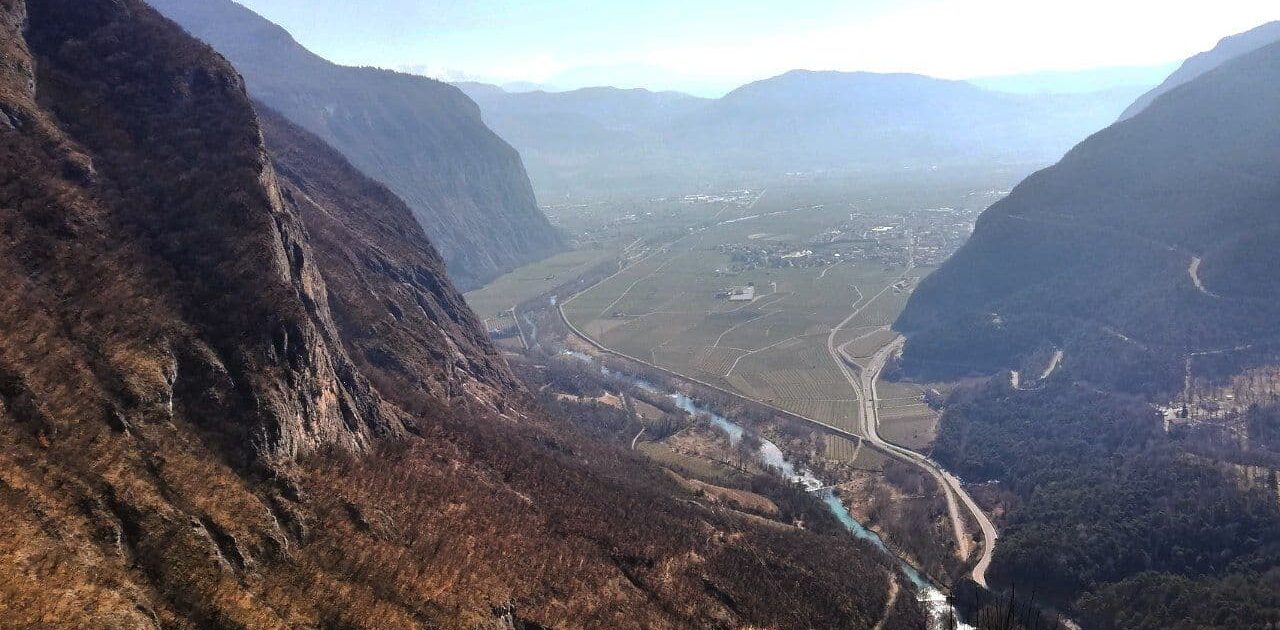
Fig. 1: vineyards and the irrigation channel “Fossa di Caldaro” in the rural area of Mezzocorona (Trento) Italy. (Author, September 21, 2021).
Fig. 2: a detail of the Natura 2000 site “La Rupe” in Mezzolombardo (Trento), Italy. Located along the Noce river, the site is one of the few left natural places in the contaminated Adige valley bottom. (Author, December 06, 2021).

Bibliography:

[1] ISPRA. (n.d.). Geoportale di monitoraggio ambientale [Map]. Retrieved December 10, 2021, from https://sinacloud.isprambiente.it/portal/apps/webappviewer/index.html?id=a38bab6b0aee4464ade50d6cbe2e3bbc

[2] Paris, P., Pace, E., Maschio, G., & Ursino, S. (2020). Rapporto nazionale pesticidi nelle acque—Dati 2017-2018 (2020th ed.). ISPRA. https://www.isprambiente.gov.it/files2020/pubblicazioni/rapporti/rapporto_334_2020.pdf

[3] Menapace, E., Ferrari, C., Mantoan, J., Dallafior, V., & Martinelli, R. (2020). Rapporto sullo stato dell’ambiente 2020—Agricoltura (No. 9). APPA. http://www.appa.provincia.tn.it/rapporto_ambiente_2020/rapamb_2020_pressioni/-Agricoltura/pagina19.html

This article is part of the project “Environmental Blogging Boost 4 Students”, aimed at increasing the spread of agroecology and sustainable water management in Trentino. The project is financed by the BIM Adige Water Catchments Consortium (grant approved by provision n. 100 of June 06, 2021).

Healthier agroecosystems for the whole community

A vineyard or an apple orchard in Trentino is not just a land of lot to exploit for food production or the livelihood and profits of farmers. Vineyards and apple orchards are actually AGROECOSYSTEMS, which means “anthropized ecosystems that, while aimed at the production of energy or biomass for economic purposes, include a biocenosis and a certain degree of biodiversity”. Forgetting that these spaces should not evolve into purely agroindustrial areas is a serious degradation of our perception of an agroecosystem identity and functionality.

The objection that agriculture must only think about the harvest and the economic viability of the farm business, and that protecting the landscape or preserving the biodiversity is a task of protected areas, is a clear evidence of a dramatically selfish view of the world and a total lack of the importance of the common good. This way of thinking and therefore of acting sacrifices thousands of animal and plant species that do not live in the habitats included in the present protected areas and threatens the health of the local community. Contaminating the agroecosystem abiotic factors affects the quality of the underlying soil, the purity of surface and groundwater, the health of the air above and, consequently, the health and quality of life of local citizens.

Just as any citizen must not contaminate or degrade a common good, be it a city square, a playground or a wooded area of public domain, also farmers and farm cooperatives have an ethical and legal obligation not to damage the environmental elements of the community. Otherwise, the “polluter pays” principle applies and should be enforced.

The establishment of a provincial organic district is a true chance to incentive the abandonment of the degradation of environmental elements by Trentino’s farming sector. While I remain skeptical that the 40 % quorum required by the referendum norms will actually be met, I am convinced that voting on September 26 in favor of the district will increase the relevance of environmental protection in many provincial economic sectors. It will also put pressure on farm cooperatives. Even though the farming sector is deeply consolidated and inclined towards extra-provincial and national markets, it will not be able to escape the public opinion of thousands of local citizens, including members of local banks and credit institutions, who are often strongly connected to the administrative and accounting offices of cooperatives.

Fig. 1:vineyards and apple orchards surrounded by steep tree-covered mountain slopes in Piana Rotaliana (Trento, Italy). River banks are among the few places in the Adige valley that agro-industrial farming could not occupy. At the bottom, the “Rocchetta” Natura 2000 site stretches along the Noce river (Author, March 2021).

This article is part of the project “Environmental Blogging Boost 4 Students”, aimed at increasing the spread of agroecology and sustainable water management in Trentino. The project is financed by the BIM Adige Water Catchments Consortium (grant approved by provision n. 100 of June 06, 2021).

Stop alle microplastiche dalla nostra lavatrice!

Il 20 maggio è divampato un incendio su una nave al largo dello Sri Lanka [1] provocandone l’affondamento e la dispersione nell’ecosistema marino di numerosissime sostanze tossiche, tra cui combustibili, oli, resine e plastiche. Le vicine spiagge e la costa sono state invase dalla plastica rilasciata nell’oceano e gli animali, tra cui le tartarughe [2], stanno già morendo a causa di questa massiccia contaminazione di inquinanti.

Cosa possiamo fare noi in questo caos? Abbiamo già parlato dell’importanza della protezione e conservazione degli ecosistemi marini in un precedente post ma oggi vorremmo presentare una nuova e concreta possibilità per ridurre ancora di più il nostro impatto su di essi.

Sapevate che anche fare la lavatrice contribuisce all’inquinamento dei mari? Ogni capo, lavandolo, si deteriora e rilascia delle fibre che finiscono “giù per il tubo”, che non costituirebbero un problema se i nostri vestiti fossero composti al 100 % di materiali biodegradabili come cotone, lana, lino, seta, canapa ecc. Purtroppo, gran parte dell’industria tessile utilizza fibre plastiche, come il poliestere. Il problema del poliestere riguarda quello che accade dopo la sua produzione, durante il suo utilizzo e il suo degradamento. Si stima infatti che il 35 % della plastica negli oceani provenga proprio dalle nostre lavatrici [3, 4], che ad ogni lavaggio scaricano moltissime fibre sintetiche.

Fig. 1: Il filtro per microplastice di PlanetCare. Autore, Giugno 2021.

Una start-up, Planet Care, sta cercando di risolvere questo problema con un filtro per lavatrice molto facile da installare. Selezionata da Amazon tra le cinque start-up più innovative dell’anno, è in corsa per raggiungere il primo posto e dunque un finanziamento di 100 000 €. Qui puoi votare per loro. Dal loro sito, potete trovare un kit composto da contenitore e cartucce filtranti di facile installazione; noi lo abbiamo già acquistato e testato! La loro politica di riutilizzo dei filtri permette di ridurre al minimo i rifiuti, poiché una volta rimandati (gratuitamente) al mittente verranno rigenerati e riutilizzati.

Fig. 2: Cartucce filtranti PlanetCare ed istruzioni per il montaggio, chiare ed efficaci. Autore, Giugno 2021.

Con la consapevolezza dell’impatto delle nostre azioni quotidiane possiamo adottare questa ed altre innumerevoli strategie per inquinare meno. Sta a noi capire come e fare ed iniziare ad agire!

Bibliografia:

[1] Sri Lanka: Burning ship coats beaches in oil and debris. (2021, May 28). BBC News. https://www.bbc.com/news/world-asia-57278473

[2] Mallawarachi, B. (2021, June 22). Turtle carcasses wash ashore in Sri Lanka after ship fire. SFGATE. https://www.sfgate.com/news/article/Turtle-carcasses-wash-ashore-in-Sri-Lanka-after-16264277.php

[3] Parlamento Europeo. (2020, December 29). L’impatto della produzione e dei rifiuti tessili sull’ambiente (infografica). https://www.europarl.europa.eu/news/it/headlines/society/20201208STO93327/l-impatto-della-produzione-e-dei-rifiuti-tessili-sull-ambiente-infografica

[4] Ocean Clean Wash. (n.d.). Microfiber Pollution: Our Clothes Pollute the Oceans. Ocean Clean Wash. Retrieved June 25, 2021, from https://www.oceancleanwash.org/

The Loneliness of Face Masks

At least once, the Covid-19 outbreak made everyone ask themselves: “Where did I put my face mask?”.There is who forgot it at home and who was just looking for it in the wrong pocket, there is who lost it somewhere without knowing and who threw it away in the closest trashcan or, in the worst case scenario, on the ground.

Face masks are hazardous for the environment in numerous ways when littered.

Face masks are made of plastics, which are not biodegradable and can persist in the environment up to hundreds of years as micro- and nanoplastics [1]. Laying in an open-air environment, “alone in a strange world under the light of a new sun, in their new home” (Nolan, 2014) – which may be a cornfield, a roadside, a riverbank, a bird’s nest, a beach, etc. – littered face masks lie at the mercy of abiotic and biotic factors, and slowly release chemicals into the surrounding areas [2].

As it is true for all other plastic materials, face masks can be mistakenly eaten by farm animals and wildlife, thus ending in their stomach and often in our meal. In other cases, face masks obstruct the airways and the poor animal chokes to death [3]. Furthermore, they are subject to weathering and after a short time, they start to crumble, releasing plastic fibres as well as heavy metal traces, such as lead, antimony, and cadmium, into the soil and nearby water courses [2].

This might seem a problem confined to the source of pollution, but considering the amount of littered face masks, it is in fact a widespread tragedy.

Before the beginning of the pandemic, plastic pollution was a well-known problem, clearly imprinted in our brains. The world was becoming more sensitive about the climate crisis and environmental breakdown and using (and throwing away) a plastic face mask every day was not even conceivable. However, now, after more than one year coping with the pandemic, the world uses and disposes about 3.4 billion single-use face masks every day [4]. They will not be gone for a very, very long time.

Since face masks are still compulsory in Europe and most parts of the world, it is unrealistic to think that this new source of pollution will be erased in a short time. Finding solution to reduce the number of littered face mask is imperative.

“So, what can I do about it?”

The National Geographic recommended three main points to fight against face masks pollution [5]:

  1. Do not be a litterbug
  2. Wear washable cloth masks, when possible
  3. Pack used PPE (i.e., “Personal Protective Equipment”) into a plastic bag, seal it, and put it out for the trash

And I would like to add one extra point:

  1. Talk about face masks pollution. Try to sensitize your friends and family and raise awareness.

Masks must be used. It is a matter of public health. But also the ocean and land health must be protected.

Face mask pollution and wrong disposal seems a minor problem now that the virus is still infecting and killing thousands of human beings, but it will slowly and steadily grow over time [2]. If we neglect it now, we will have to face a much larger face mask pollution crisis in the future.

(Author, May 2021)

Bibliography

[1] Weinstein, J. E., Crocker, B. K., & Gray, A. D. (2016). From macroplastic to microplastic: Degradation of high-density polyethylene, polypropylene, and polystyrene in a salt marsh habitat. Environmental Toxicology and Chemistry, 35(7), 1632–1640. https://doi.org/10.1002/etc.3432

[2] BBC News. (2021, May 4). Covid: Disposable masks pose pollutants risk, study finds. BBC News. https://www.bbc.com/news/uk-wales-56972074

[3] Di Todaro, F. (2020, August 27). Sempre di più le specie di pesci che mangiano la plastica. wisesociety.it. Retrieved May 14, 2021, from https://wisesociety.it/ambiente-e-scienza/pesci-plastica-ispra-mediterraneo/

[4] Benson, N. U., Bassey, D. E., & Palanisami, T. (2021). COVID pollution: Impact of COVID-19 pandemic on global plastic waste footprint. Heliyon, 7(2), e06343. https://doi.org/10.1016/j.heliyon.2021.e06343

[5] Parker, L. (2021, April 14). How to stop discarded face masks from polluting the planet. Environment. https://www.nationalgeographic.com/environment/article/how-to-stop-discarded-face-masks-from-polluting-the-planet

Nolan, C. (2014, November 5). Interstellar [Adventure, Drama, Sci-Fi]. Paramount Pictures, Warner Bros., Legendary Entertainment.

A case study on the success of The Ocean Cleanup

Etienne Hoekstra

29 January 2020

Plastic pollution around the world

The United Nations (UN) identified plastic pollution as one of the world’s biggest environmental challenges (UN Environment Programme, 2018), and embedded it in the Sustainable Development Goal 14: “Conserve and sustainably use the oceans, seas and marine resources” (UN, n.d.).

Plastic pollution in oceans was first documented in the 1970s. In 2010, Jambeck et al. (2015, p.768) estimated that “275 million metric tons of plastic waste was generated in 192 coastal countries […] with 4.8 to 12.7 million [metric tons] entering the ocean”, thus affecting all major ocean basins (Geyer et al., 2017). In addition, ocean currents can form extensive plastic fragments such as the Great Pacific Garbage Patch (GPGP), which is supposed to cover a surface area triple the size of France (Lebreton et al. 2018).

From the 6.3 million metric tons of plastic waste that had been created in 2015, “around 9% of which had been recycled, 12% was incinerated, and 79% was accumulated in landfills or the natural environment” (Geyer, Jambeck & Law, 2017, p.1). If the situation remains unchanged, the amount of plastic waste gathered in landfills or the natural environment will more than double by 2050 (Geyer et al., 2017).

The Ocean Cleanup

Tackling these issues requires social entrepreneurship, meaning the skill to seek changes and turn issues into opportunities (Dees, 2001). Boyan Slat, the initiator of The Ocean Cleanup (TOC) project, took the opportunity to create value from cleaning up parts of the ocean that are contaminated by plastic and other kinds of waste. His idea became a pioneer project and inspired hundreds of people around the world (TOC, n.d.A).

TOC has been developing a technology that could passively collect half of the Pacific Ocean plastic waste within ten years. “Passively” means that the heavy work is delegated to ocean currents, while an artificial, floating coastline actively captures the plastic. Marine life fishes can swim under the floating barriers placed in a V-shape. The barriers carry the collected plastic to a central point where ships are able to remove the plastic from the water, and transport it to the mainland for recycling. (Rijksoverheid, 2016; TOC, 2020A).

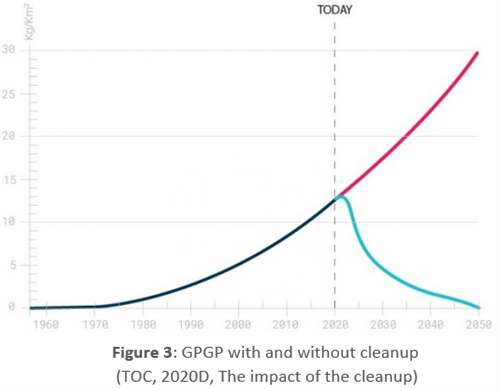
The aim of the project is to clean-up half of the GPGP before 2025, and the remaining half before 2050. The aim can be visualized in Figure 3, together with a scenario of no-action. Although the figure is limited to the GPGP, TOC has equal long-term goals for other ocean garbage patches. For example, TOC aims to reduce the amount of ocean plastic with 90% by 2040 (TOC, 20202D; TOC, n.d.C). If TOC’s operations were complemented by a considerable reduction of plastic sources on land, a plastic-free ocean could be accomplished by 2050 (TOC, 2020C). However, this requires “radical changes at the individual, corporate, and governmental levels of society” (TOC, n.d.C).

Criticism

Despite the ambition to accomplish a plastic free ocean and the received recognition, the TOC project has received criticism as well. Van Franeker & Kühn (2018) reviewed the impact of TOC operations and concluded that if TOC indeed managed to clear half of the GPGP by 2025, it would only remove about 0.1% of the plastic that ends in the ocean every year. Likewise, many scientists stressed that the plastic sources reduction is in fact the most effective mitigation strategy (Rochman; Sherman & Sebille, 2016). Although TOC acknowledges source reduction as important, it does not see it as the solution to current ocean plastic pollution issues (TOC, 2015).

Furthermore, Sherman & Sebille (2016, p.2) declared that “ocean plastic removal might be more effective […] closer to shore than inside the plastic accumulation zones in the centers of the gyres”, like the GPGP. TOC, instead, focuses on ocean garbage patches in high seas gyres “because the plastic floating outside of these ocean garbage patches either naturally removes itself from the ocean by beaching onto a coastline, or eventually also ends up in an ocean garbage patch” (TOC, n.d.B).

Moving forward

To move beyond its first testing and 2015 prototype phase, TOC conducted a feasibility study. Costs were covered with a crowdfunding campaign that raised $100,000. The study included topics such as engineering, oceanology, ecology, maritime law, finance and recycling, and was conducted by a voluntary collaboration of more than a hundred private citizens, organizations and institutions (Slat et al., 2014). The favorable outcome illustrated the sustaining aspect of the innovation.

The positive media coverage that came with the favorable feasibility study was used for the second crowdfunding campaign. This campaign raised over 2 million dollars, becoming the most successful crowdfunding campaign opened by an NGO, so far (TOC, 2015; ABN AMRO, 2014). It allowed TOC to develop and test different prototypes in different locations (TOC, 2020A).

In late 2016 TOC initiated another fundraising round. In May 2017, it issued a press release stating that it “successfully raised 21.7 million USD in donations since last November [bringing TOC’s] total funding since 2013 to 31.5 million USD, [which enables TOC] to initiate large-scale trials of its cleanup technology in the Pacific Ocean” (TOC, 2017). The fact that this latter funding round comprised solely on donations demonstrates the legitimacy perceived by the initial investors that supported the project.

Eventually, after “hundreds of scale-model tests, a series of prototypes, research expeditions and multiple iterations”, a first full-scale clean-up system was ready in 2018 (TOC, 2018). The unique business approach of TOC, however, also created legal complications that had to be solved before the full-scale system could be launched. To overcome these hurdles, TOC signed a covenant with the Dutch Ministry of Infrastructure and Water Management (MIW, 2018). With an applicable legal framework and support from the Dutch government, TOC was ready to launch its first full-scale clean-up system. The aim of the operation was to test the system and collect relevant data while cleaning up the GPGP (TOC, 2018). Nevertheless, the operation was prematurely terminated because the system was not able to actually capture the plastic due to “an inconsistent speed difference between the system and the plastic” (TOC, 2020A, p.17). This led to a systematic failure (TOC, 2020A).

Thanks to a cooperation with two other organizations, TOC later came with an updated prototype, the “System 001/B”. After one year of testing, TOC stated on 3 October 2019 that its self-contained prototype succeeded in passively capturing and concentrating plastic from the GPGP using the natural forces of the ocean. This was the first true success since Boyan Slat presented his ideas in 2012 (TOC, 2019).

Additionally, TOC recycled the captured plastics into valuable goods: it turned them into sunglasses, a durable and useful product. This entrepreneurial activity is crucial to ensure future operations, as potential profit will be fully reinvested and, thus, completed the infinite circle (TOC, 2020B).

The adjustments in the prototype were incorporated in the newly designed system (002), that requires  comprehensive  examination  and  modelling  before  becoming  the  next  full-scale clean-up system (TOC,  2020). Ultimately, “a fleet of systems” would be necessary to be able to clean up the entire GPGP and smaller plastic patches” (TOC, 2020A).

Furthermore, TOC is “looking to expand [its] operations all over the globe to help tackle the 1000 most polluting rivers, five years from the commencement of the scale-up phase” (TOC, 2020A, p.8). Replying to the criticism, TOC not only acknowledges plastic source reduction as important, but also strives for action.


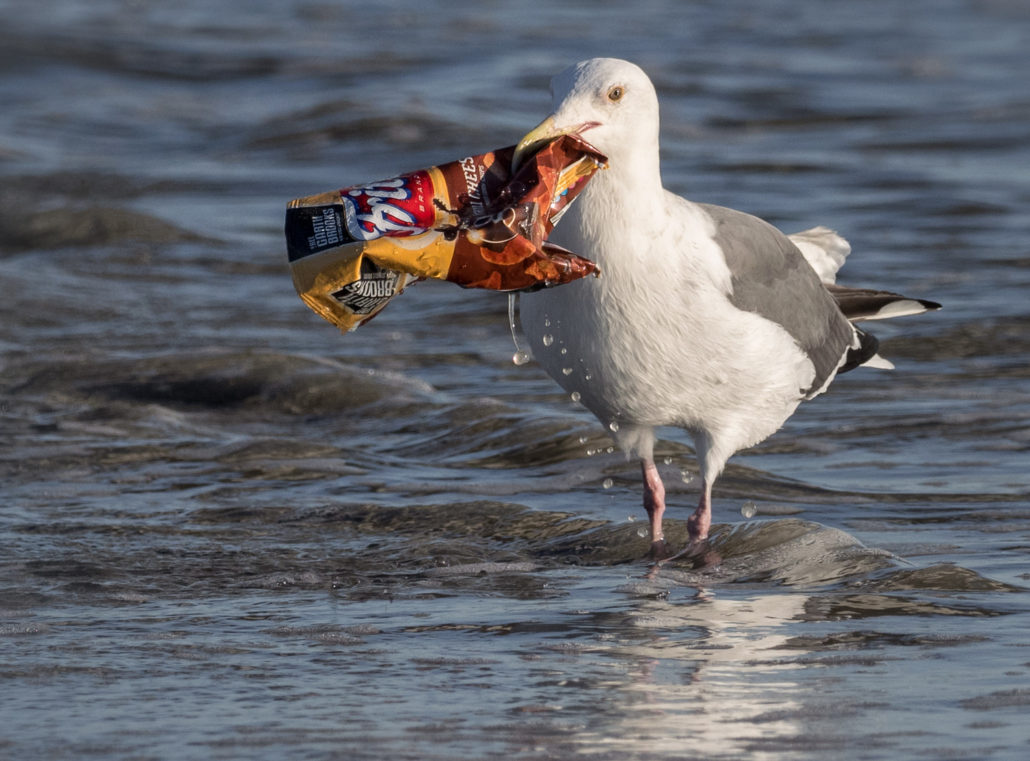
Fig. 2: A seagull holding a plastic package in its peak (Ingrid Taylar, 2016).

Bibliography

ABN AMRO (2014, 11 July). Seeds faciliteert succesvolste crowdfunding voor non-profit organisatie. Retrieved 30 November 2020, from https://www.abnamro.com/nl/newsroom/nieuws/2014/seeds-faciliteert-succesvolste-crowdfunding-voor-non-profit-organisatie.html

Dees, J.G. (2001, 30 May). The Meaning of Social Entrepreneurship. Downloaded 7 December 2020, from https://centers.fuqua.duke.edu/case/wp-content/uploads/sites/7/2015/03/Article_Dees_MeaningofSocialEntrepreneurship_2001.pdf

Franeker, J.A. van & Kühn, S. (2018, 13 September). The Ocean Cleanup. Downloaded 6 November 2020, from https://www.wur.nl/upload_mm/0/0/a/3f5469b5-3e79-423f-a947-80b5a5b06c1a_FAQ-OceanCleanup2018_finalNL_CH-JAF.pdf

Geyer, R., Jambeck, J.R. & Law, K.L. (2017). Production, use, and fate of all plastics ever made. DOI: 10.1126/sciadv.1700782

Jambeck, J.R., Geyer, R., Wilcox, C., Siegler, T.R., Perryman, M., Andrady, A., Narayan, R. & Law, K.L. (2015). Plastic waste inputs from land into the ocean.Science, 347(6223), pp.768-771. DOI: 10.1126/science.1260352

Lebreton, L., Slat, B. […] Brambini, R. & Reisser, J. (2018, 22 March). Evidence that the Great Pacific Garbage Patch is rapidly accumulating plastic. Retrieved 6 November 2020, from https://www.nature.com/articles/s41598-018-22939-w

Ministry of Infrastructure and Water Management of the Netherlands (2018, 6 June). Convenant tussen de Minister van Infrastructuur en Waterstaat en The Ocean Cleanup betreffende de inzet van systemen bedoeld om plastic op volle zee, dat drijft in de bovenste waterlagen, op te ruimen.Retrieved 6 December 2020, from https://zoek.officielebekendmakingen.nl/stcrt-2018-31907.html#d17e790

Rijksoverheid (2016, 29 November). Waterinnovaties in Nederland.Downloaded 6 November 2020, from https://www.rijksoverheid.nl/binaries/rijksoverheid/documenten/brochures/2016/11/29/waterinnovaties-in-nederland/Waterinnovaties-2016.pdf

Rochman, C. M. (2016). Strategies for reducing ocean plastic debris should be diverse and guided by science. Environmental Research Letters, 11(4), 041001. DOI: http://dx.doi.org/10.1088/1748-9326/11/4/041001

Sherman, P. & Sebille, E. van (2016). Modeling marine surface microplastic transport to assess optimal removal locations. Environmental Research Letters, 11(1), 014006. DOI: http://dx.doi.org/10.1088/1748-9326/11/1/014006

Slat, B.D., Arens, E. […] Zuijderwijk, N. & de Sonneville, J. (2014, 3 June). How the oceans can clean themselves. A feasibility study. Downloaded 30 November 2020, from https://ds1.static.rtbf.be/article/pdf/toc_feasibility_study_lowres-1401893379.pdf

The Ocean Cleanup (2015, 30 June). Annual Report 2014.Downloaded 30 November 2020, from https://assets.theoceancleanup.com/app/uploads/2019/04/TOC_2014_Annual_Report.pdf

The Ocean Cleanup (2017, 3 May). THE OCEAN CLEANUP RAISES 21.7 MILLION USD IN DONATIONS TO START PACIFIC CLEANUP TRIALS. Retrieved 12 December 2020, from https://theoceancleanup.com/press/press-releases/the-ocean-cleanup-raises-217-million-usd-in-donations-to-start-pacific-cleanup-trials/

The Ocean Cleanup (2018, 8 September). THE WORLD’S FIRST OCEAN CLEANUP SYSTEM LAUNCHED FROM SAN FRANCISCO. Retrieved 6 December 2020, from https://theoceancleanup.com/press/press-releases/the-worlds-first-ocean-cleanup-system-launched-from-san-francisco/

The Ocean Cleanup (2019, 2 October). THE OCEAN CLEANUP SUCCESSFULLY CATCHES PLASTIC IN GREAT PACIFIC GARBAGE PATCH.Retrieved 13 December 2020, from https://theoceancleanup.com/press/press-releases/the-ocean-cleanup-successfully-catches-plastic-in-great-pacific-garbage-patch/

The Ocean Cleanup (2020A, 9 June). Annual Report 2019.Downloaded 6 November 2020, from https://assets.theoceancleanup.com/app/uploads/2020/06/Annual_Report_2019.pdf

The Ocean Cleanup (2020B, 24 October). THE OCEAN CLEANUP INTRODUCES FIRST PRODUCT MADE WITH OCEAN PLASTIC POLLUTION.Retrieved 13 December 2020, from https://theoceancleanup.com/press/press-releases/the-ocean-cleanup-introduces-first-product-made-with-ocean-plastic-pollution/

The Ocean Cleanup (2020C). About – The impact of the cleanup.Retrieved 13 December 2020, from https://theoceancleanup.com/about/

The Ocean Cleanup (n.d.A). THE FIRST PRODUCT MADE WITH PLASTIC FROM THE GREAT PACIFIC GARBAGE PATCH. Retrieved 7 December 2020, from https://products.theoceancleanup.com/

The Ocean Cleanup (n.d.B). FAQ –
How will you clean up 50% of the plastic in 5 years?Retrieved 16 December 2020, from https://theoceancleanup.com/faq/

The Ocean Cleanup (n.d.C). Can you provide an overall solution to ocean plastic pollution?  Retrieved 17 December 2020, from https://theoceancleanup.com/faq/can-you-provide-an-overall-solution-to-ocean-plastic-pollution/

United Nations (n.d.). Goal 14: Conserve and sustainably use the oceans, seas and marine resources.Retrieved 7 December 2020, from https://www.un.org/sustainabledevelopment/oceans/

Join our Telegram channel

Telegram: @greenmarked
LinkedIn: @greenmarked
Instagram: @greenmarked.it

Facebook:  @greenmarked.it


© GreenMarked.it is managed by ECONTROVERTIA APS — Via Alcide De Gasperi 1, 38015 Lavis (TN), Italy — VAT IT02667560227