Tag: policies

Sustainability at a Crossroads between Resistance and Resilience

For more than a decade, sustainability has held a prominent place on the global agenda. From the signing of the Paris Agreement to the rise of Fridays for Future strikes, which inspired us to start this GreenMarked blog. The world seemed to be moving steadily toward a greener, fairer future. But today, the story is more complex.

Is sustainability losing momentum, or are we seeing a quieter, deeper rooting in politics, business and everyday life?

Resistance

Across Europe and beyond, signs of resistance are hard to ignore. Political leaders have scaled back or postponed important environmental commitments, often in response to public protests and pressure from industries concerned about their competitive position [1]. Targets once considered non-negotiable have been watered down or postponed. At the same time, the way business talks about sustainability has changed. Where sustainability was once praised as a source of innovation and growth, it is now often seen as an additional regulatory burden.

In the United States, Donald Trump’s renewed political influence has led to renewed resistance to environmental regulation and climate policy. This shift was also evident during the most recent shareholder meeting season, when investors did not support a single climate resolution, a clear signal that investor pressure has eased [2]. Meanwhile, global attention is focused primarily on war, energy shocks, inflation, and migration, pushing sustainability further down the political and media agenda.

Omnibus

The EU’s Green Deal Omnibus Regulation captures the crossroads sustainability faces. Framed as a way to streamline rules and ease business burdens, it has been widely perceived as a political compromise that weakened environmental goals [3]. It reveals both the Green Deal’s resilience and its vulnerability, not a complete withdrawal, but a recalibration, with sustainability still on the agenda, yet filtered through the lens of political feasibility and short-term economics.

Nevertheless, under the CSRD, large companies have already reported on 2024, with thousands more due from 2026 onward. In parallel, the Due Diligence Directive adds obligations on human rights and environmental risks in their supply chains, while the EU Deforestation Regulation – although controversial and subject to delays – is moving forward and set to reshape global procurement. Beyond Europe, the United States has launched record levels of clean energy investment through the Inflation Reduction Act [4], while China and India are pushing ahead with massive expansions in solar, batteries, and electric vehicles [5].

Resilience

Technology and society are also driving the shift. Renewable energy is no longer an expensive alternative; in many places, it is the cheapest option, even without subsidies [6]. Solar panels, batteries, and heat pumps are breaking records year after year, making the transition to cleaner energy harder to reverse. Financial markets, despite political debates, are still channeling huge amounts into green bonds and sustainable finance [7]. Citizens remain engaged as well. Eurobarometer surveys from the European Commission consistently show that Europeans continue to view climate change as one of the most pressing global challenges [8].

Figure 1: A group of people holding signs at a climate parade. Photo by Markus Spiske on Unsplash.

“84% of companies globally are maintaining or accelerating their climate action goals, despite political and economic headwinds”.

PwC, Annual State of Decarbonization 2025

The business world is also a crucial part of this picture. While some companies are slowing their public messaging, more are embedding sustainability into strategy. As of mid-2025, more than 7,000 companies worldwide have validated science-based climate targets through the Science Based Targets initiative, directly linking their decarbonization goals to science [9]. And according to PwC, 84 percent of companies worldwide are either maintaining or accelerating their climate action goals [10]. This shows that despite political pushback, most businesses see climate commitments as central to their long-term competitiveness.

Looking Ahead

The reality is not simply a story of setback or victory, but of resistance and resilience co-existing. Political theater and financial skepticism may suggest a step backwards, but beneath the surface, deeper forces of legislation, corporate strategy, technology, and public concern are weaving sustainability more deeply into the systems that shape our economies and societies.

The task ahead is less about chasing rapid breakthroughs than about consolidating gains, closing gaps, and ensuring that ambition survives political cycles. If the past decade was defined by raising awareness and sparking momentum, this one is about institutionalization.

Progress will be slower, but also harder to reverse. At this crossroads, sustainability is no longer just a movement; it is becoming infrastructure, quietly shaping the foundations of our future, even when the spotlight fades.

References

Click here to expand the references
  1. Carnegie Endowment for International Peace. (2025, September). Confronting backlash against Europe’s green transition. Carnegie Endowment. https://carnegieendowment.org/research/2025/09/climate-backlash-europe-green-transition-farmers-protests
  2. Nijssen, T. (2025, September 2). Investors do not support any climate resolutions during US earnings season [Translated by author]. NRC. https://www.nrc.nl/nieuws/2025/09/02/beleggers-steunen-geen-enkele-klimaatresolutie-tijdens-amerikaans-cijferseizoen-a4904724
  3. Finance Watch. (2025, June 20). How the Omnibus proposal sets the foundation for a deregulation agenda. Finance Watch. https://www.finance-watch.org/blog/how-the-omnibus-proposal-sets-the-foundation-for-a-deregulation-agenda
  4. Rhodium Group & Massachusetts Institute of Technology Center for Energy and Environmental Policy Research. (2025). U.S. clean investment monitor. Rhodium Group. https://rhg.com/research/u-s-clean-investment-monitor
  5. International Energy Agency. (2025). India – World energy investment 2025. IEA. https://www.iea.org/reports/world-energy-investment-2025
  6. International Renewable Energy Agency. (2024). Renewable power generation costs in 2024. IRENA. https://www.irena.org/-/media/Files/IRENA/Agency/Publication/2025/Jul/IRENA_TEC_RPGC_in_2024_2025.pdf
  7. Climate Bonds Initiative. (2025). Sustainable debt market update Q1 2025. Climate Bonds Initiative. https://www.climatebonds.net/resources/reports/sustainable-debt-q1-2025
  8. European Commission. (2025, June). Climate change: Special Eurobarometer survey. European Commission. https://europa.eu/eurobarometer/surveys/detail/3472
  9. Science Based Targets initiative. (2025). Ambitious corporate climate action. SBTi. https://sciencebasedtargets.org/companies-taking-action
  10. PwC. (2025). Annual state of decarbonization 2025. PwC. https://www.pwc.nl/nl/themas/sustainability/documents/annual-state-of-decarbonization-2025.pdf

Cover image: A Man standing in the middle of the woods. Photo by Vladislav Babienko on Unsplash.

Spain’s Wetlands at Risk: We need different Agricultural Practices to Ensure Conservation

In its last annual report, the Copernicus Climate Change Service has stated that in 2022, Europe suffered records on extreme events such as wildfires, floods, temperature rising and drought. It is estimated that last year Europe had the worst drought episode in the last 500 years [1]. Some countries in the south of Europe are more sensitive to droughtand increase of temperatures, due to the Mediterranean climate [2]. Periodic droughts are nothing new for several ecosystems that thrive in this climate, for example, according to the Convention on Biological Diversity (CBD), Spain is one of the most biodiverse countries in Europe [3]. The success of said ecosystems depends on water dynamics properly functioning. In the Ramsar convention, wetlands are recognized as key regulators of the water cycle.

The Ramsar Convention is an agreement signed already by 172 countries, which main objectives are to recognize the importance of wetlands and to protect them [4]. The text defines a wetland as “areas of marsh, fen, peatland or water, whether natural or artificial, permanent or temporary, with water that is static or flowing […].” Wetlands are thus critical in water regulation and providing for biodiversity as well as human consumption.

Humans, as any other form of life in Earth, are dependent on water. But water is not an unlimited resource to use at will. Wetlands, lakes, and aquifers have concrete dynamics of discharge and recharge, and once these dynamics get altered, the ecosystem and the species that inhabit it – humans among them –, will suffer the consequences. The wetland situation in Spain has come to a critical point [5].

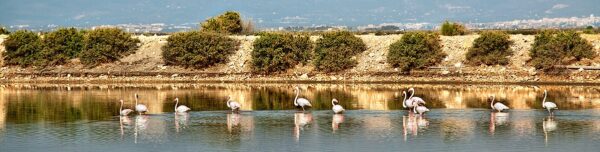
Spanish wetlands have many ecological functions. Not only they help with the regulation of the water cycle, but in many other processes. Birds are highly dependent on these places, as they are the last resting point in migration routes to Africa. Wetlands are also refuges for many species reliant on water during dry summer seasons, characteristic of the Mediterranean climate. Amphibians, for example, which are also one of the animal groups most affected by global warming.

Fig. 1: Flamingos resting in Delta de l’Ebre Natural Park. Photo by Mikipons on Wikimedia Commons.

Wetlands are also sources for human water consumption, either for drinking, irrigation, or industrial use. A sensible human use could be compatible with natural water dynamics, but alas, this is not the case. One of the most known and iconic wetlands in Spain is Doñana, of crucial importance for bird migration, or threatened species as the Iberian lynx or the Imperial Eagle. The wetland is recharged thanks to a subjacent aquifer, which has also been used for irrigation of near crops. However, over the last decades, the aquifer is getting worse and worse [6]. The most urgent threats are the impending drought and global warming, yes, but also the lack of responsibility with regard to water usage.

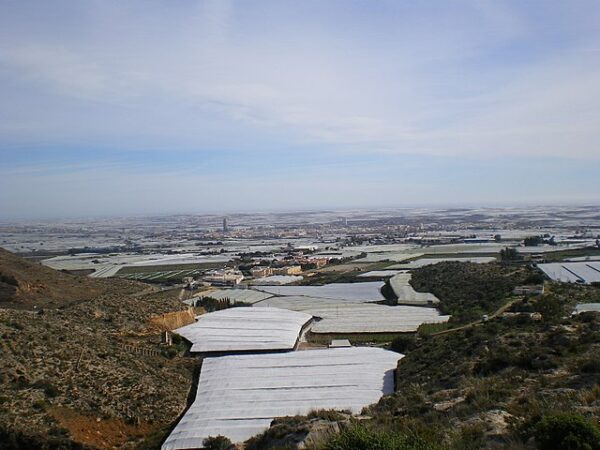
Spain is known as the “kitchen garden of Europe”, providing up to 5.7 million tons of vegetables [7]. Vegetable production requires intensive irrigation farming in a naturally dry land, and this production level needs considerable amounts of water. Until 1990, there were approximately 1.08 million hectares of irrigation farming in the country. During the last decades, with help of the Spanish government and EU’s Common Agricultural Policy, the number has gone up to 3.45 million hectares [8]. Most of the country’s vegetables production is focused on the south, see Andalucía or Murcia.

“It is no longer sustainable – it never was, to start with – to subsidize monocultures, or help planting rice fields in dry lands, forcing farmers to use extra water from aquifers”

Fig. 2: Plastic sea” or vegetable greenhouses in El Ejido, Almería, Spain. Photo by ANE on Wikimedia Commons.

It is urgent to rethink our need to have any vegetable or fruit we want available all year long. This is very recent, and until not so long ago, people respected the seasonality of food. The fact that we can get mangos or avocados at will seem innocuous, but it has serious consequences, especially for southern Europe landscapes, ecosystems and biodiversity. But this kind of actions, although helpful, have to be accompanied by bigger scale ones.

The CAP takes one third of the European budget. Its first objective is to help farmers improve productivity, but this cannot be done at any cost. But other objective is to make a reasonable and sustainable use of natural resources [9]. What is proposed here is a shift in the way of seeing the agricultural production in the UE.

The first step would be creating a map database of all the agricultural landscapes, their climate, water and soil resources, biodiversity, … And then, another estimate of the consumption needs of each country. With this information, the UE can estimate what has to be produced, and distribute the different crops that are needed over the map, considering where each crop is going to be adequate without overexploiting the ecosystem. It is no longer sustainable – it never was, to start with – to subsidize monocultures, or help planting rice fields in dry lands, forcing farmers to use extra water from aquifers. Now we intend to solve it with water transfers from one watershed to another – terrible in biodiversity terms, due to invasive species – in order to keep afloat something unsustainable.

Dry-land crops in dry lands, irrigation crops in humid lands. Laws, policies, and programs have to be done from the start following an ecological perspective, that pays attention to sustainability and ecosystem needs. The Earth needs society to be engaged with its preservation that will stop focusing on the economic perspective that overexploits the land. Wetlands, among other ecosystems, are suffering our greed. Their degraded state affects biodiversity, but also us, and we can, and must adapt our lifestyle in order to protect them.

This article is part of the project “PILLOLE D’ACQUA PIANA: seminari itineranti, blog e podcast per una gestione sostenibile delle risorse idriche in Piana Rotaliana” carried out by ECONTROVERTIA APS and supported by Fondazione Caritro (Prot. no. U445.2023/SG.386 of April 23, 2023).

The Provincial Environmental Energy Plan 2021-2030 of the Autonomous Province of Trento.

The energy issue is in the forefront of all the news. Trentino, too, is discussing what solutions should be put in place to make the Province’s energy demands as sustainable as possible.

To this end, the Environmental Energy Plan of the Autonomous Province of Trento 2021-2030(“PEAP“), approved by Resolution No. 952 of June 11, 2021, plays a relevant and strategic role because it aims to identify the essential and necessary guidelines, and priority strategies to decarbonize the whole region. The general goal is to reduce the emissions of gases that contribute to the climate crisis by 55 % compared to 1990, thus exceeding the current 50 % cut target set by Provincial Law 19/2013. The number should not be frightening: An analysis of energy consumption in 2016 shows that Trentino has already reduced emissions by 20.6 % compared to 1990. And yet there is still a lot of work to do [1].

For this reason, the Autonomous Province of Trento has proposed the PEAP, recognizing some technological and socioeconomic trends, outlining a future energy system that cuts climate-changing emissions, introduces new efficient technologies and maintains the effective existing ones.

Specifically, the PEAP is an energy plan aimed at defining actions to save energy, make homes and industries more efficient, and increase electricity generation from renewable sources (solar, hydroelectric, fuelwood, and wind). The Plan implements many global-scale environmental goals, namely the 2030 Agenda – covering as many as 6 of the 17 Sustainable Development Goals – and the 2015 Paris Agreement, which aims to contain the global average temperature increase below 2°C compared to pre-industrial levels. Ambitious provincial-level goals also comply with the Plan: The Provincial Strategy for Sustainable Development, which defines Trentino’s position in relation to strategic sustainability goals [2], and the Provincial Urban Plan, which looks at the territory as an environmental, landscape, social and productive setting. There are also numerous references to other Provincial Plans such as the Water Protection Plan, the Waste Management Plan, and the Provincial Electric Mobility Plan.

Fig. 1: A visit to Santa Massenza lake hydropower plant (Trentino). GreenMarked. December 05, 2021.

The Plan draft was anticipated by a detailed collection of energy consumption data. In Trentino, households consume 40-43 % of the share, transportation 30-33 % and industries 24-25 %. Currently, transportation uses almost entirely oil by-products, whereas industries mostly natural gas (about 60 %) and electricity. The Autonomous Province of Trento imports about 40 % of the energy consumed (mainly in the form of natural gas and oil by-products) and exports 25 % of its hydropower-derived energy. The data thus helped define some key actions reported in the Plan:

1. Real estate energy efficiency upgrading. Insulating buildings, replacing gas and LPG-fueled boilers with natural gas-fueled condensing systems, replacing windows and doors, and replacing winter air conditioning systems with heat pumps will decrease energy consumption by more than 35 %, and considerably increase the number of solar panel systems.

2. More sustainable mobility. Reducing the need of internal combustion engine vehicles, promoting bike/pedestrian mobility, increasing transportation efficiency, and expanding the electric fleet of vehicles will go a long way toward reducing the huge non-renewable energy demand of the transportation sector. In this regard, the Plan calls for the installation of 283 fast and ultrafast electric charging points and an additional 707 “accelerated mode” charging points.

3. To encourage local renewable energy production and increase self-consumption, the Plan considers implementing a number of energy communities – that is a group of citizens who agree to produce and consume renewable energy together. Through a shared photovoltaic system, such communities can share energy and have more ways to adapt to different energy loads through collective storage systems.

These are just a few of the PEAP actions, which actually comprises 12 strategic guidelines (i.e., objectives) and 83 environmental actions, each of them belonging to a specific guideline. They will lead to a significant reduction in carbon dioxide emissions and improvement in air quality. Through biannual monitoring it will be possible to assess the Plan effectiveness and thus obtain another evidence of Trentino’s commitment to becoming a sustainable land, where man and the environment can coexist in harmony.

Telegram: @greenmarked
LinkedIn: @greenmarked
Instagram: @greenmarked.it

Facebook:  @greenmarked.it


© GreenMarked.it is managed by ECONTROVERTIA APS — Via Alcide De Gasperi 1, 38015 Lavis (TN), Italy — VAT IT02667560227