
Tag: people

Football World Cup and Massive Events’ Environmental Effects

“In 2030, three continents – Africa, Europe and South America – and six countries – Argentina, Morrocco, Paraguay, Portugal, Spain, and Uruguay – will welcome and unite the world while celebrating together the beautiful game, and the centenary of the World’s Cup” [1].

With these words, FIFA announced how the World Championship for 2030 is planned to be held. 6 countries, 3 different continents, they affirm. On the other hand, they also maintain that this World’s Cup will be the “first neutral carbon emissions world’s event”. These two ideas do not seem to be compatible. Have you ever wondered what implies these kinds of events? Let’s take a quick look at it.

Hosting a World event in just one country is already a handful. First and most obvious, at least one stadium is needed. Some countries may already have stadiums with the required characteristics, but some others have to build them from scratch. Let’s skip for the moment the hydric consumption, just thinking about materials transportation and the building process, emissions-free?

Forgetting the stadium, let’s just take a look at the competition. There will be national teams from lots of countries that will have to move around in planes (private, of course). Each of the 48 national teams will play several matches [2]. Again, emissions-free?

And last, the most important thing in football is the fans. They are not staying at home, people would love to go and cheer for their teams [3]. In their case, the flights would probably be commercial, but the question remains, emissions free?

There were already some humanitarian doubts regarding the last world championship that have been talked about. If we only focus on the environmental part, it seems obvious that organizing an event with these proportions and characteristics while maintaining it at a zero-emissions level would be titanic. Even without flights, or buildings, what about the hydric impact? The grass of a football field needs to be daily watered, and it needs about 20000L of water each day per stadium [4]. Now, have we to multiply this value by at least six?

Once more, the criticism is not toward the event or football itself. It is toward a system that intends for events to be bigger, more massified … More profitable.

Because preparing for the World’s Cup just in one country is “too small” nowadays.
However, would it be that bad? Football started as a part of popular culture, and it is used to transmit values. They may not be the most sustainable or friendly – in this case, environmentally – now, but they could come to be. Consider the impact that the national teams could have taken a commercial flight, or even a bus or a train instead of a private plane. Not only the picture itself would be positive, and fans could take some examples, but if the team is taking those transports, it would mean that there have been some previous measures taken such as improvement of train infrastructure and other public transport services.

Ultimately, we need to rethink, just like so many other things, how our leisure model works if we want it to be compatible with a healthy planet and nature. we know it’s possible to change this kind of massive events such as football matches or concerts.

Coldplay took a 6-year-long break in which they tried to re-design their concerns and their tour to make them as sustainable as possible. After their last tour, they managed to drop their emissions by up to 50% [5]. And they can do more, they said.

A 6-year-long break is not a realistic thought for the football world, but we should give thought to re-designing how to make things, it seems more feasible. It is urgent to stop having as a goal to create the biggest and most impactful event, because even though some organizations like to think that impact – in the public’s eyes – is the most important, they tend to forget other impacts: environmental or social.

8 billion. Are we not too many?

World population studies tell us that we had continuous growth from the end of the 14th century’s notorious Black Death to the present. In the early 1900s, global population was about 1.65 billion, while in June 2022, we nearly touched 8 billion despite two world wars [1].

Since it is estimated that in 2050 human population will potentially reach 10 billion [2], will we not be too many on this planet?Are ordinary citizens aware of this massive increase?

There are various life forms on Earth. We, humans, consider ourselves the most intelligent species, flaunting our civilization and puffing out our chests in high esteem. Yet, do our actions correspond to that intelligence?

On these hot summer days, TV news programs do not give us much optimism. Journalists tell us about extreme heat, droughts, fires, wars, Covid, smallpox, locusts in Sardinia, and heavy immigration from poorer countries: tragedies only.

We should ask ourselves where our reason has gone. If in 120 years the world population has reproduced about 4.8 times, our wisdom has not thought of long-term plans for agricultural development, water recycling, seawater desalination, and waste reuse. If the energy humans wish for their pleasures and duties is not enough, why has no thought been given to its clean regeneration?

“Come on, it’s just the TV”, I told myself.

I dropped the TV news and looked for reassurance in the newspapers but found nothing. I abandoned the newspapers as well, and landed on social media, where “Keyboard Lions” are found in abundance.

“Not this one: It is the baby boomers’ favorite. This one has just post of holiday photos. This one only polemical tweets. Certainly, this one is mostly used by the young people: I will find something positive … No, not even here”. So, I asked myself, “If man conquered outer space and now wants to build a neat space station for human beings, will we really be able to fit all of them, all eight billion of them?”

I better go to sleep. Some good rest will erase all the bad thoughts.

It is hot. I woke up early and decided to go for a bike ride – normal bycicle, not electric. Let’s save a little coal or oil. I cut through the farm fields of the beautiful Po Valley until I stopped at the top of a highway overpass. It is just 08:00 AM and I can already see a long line of cars, halted on their way to the Adriatic sea. “What is a line of cars?”, was my first thought.

I run away from the smell. The cars are still but their engine is running to supply their “inhabitants” with the coolness from the air conditioner. Far away I see a large sunflower field. At last something beautiful.

The Po Valley has always hosted hardworking people. Sunflowers must be oxygen for our agricultural economic sector. My thoughts immediately go to my grandma’s fried zucchini blossoms.

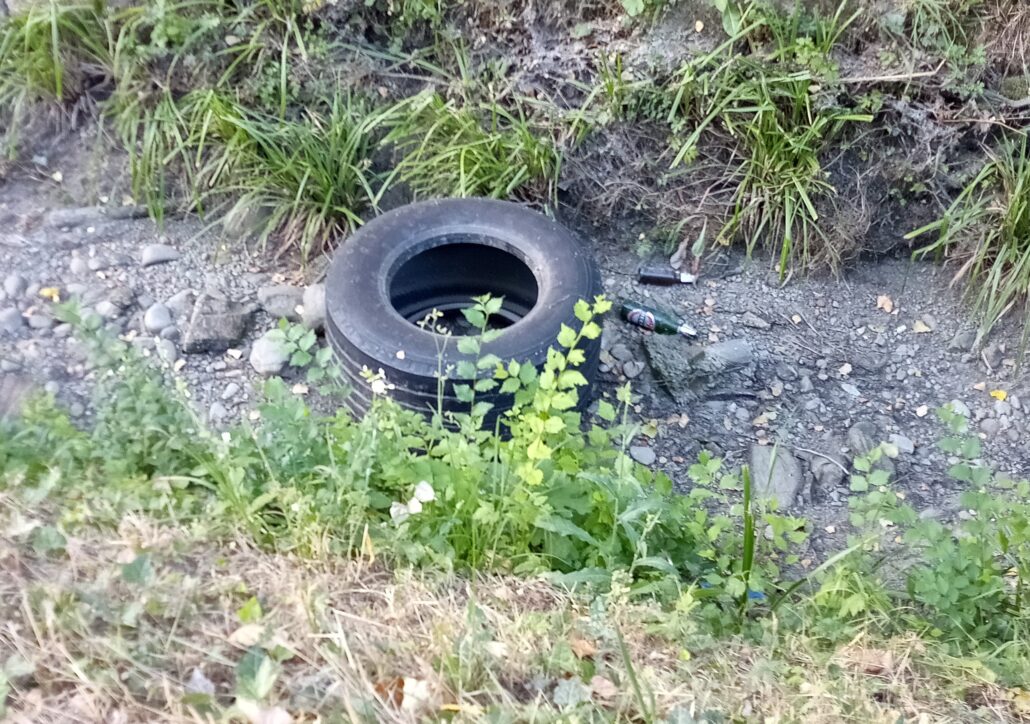
I reach the fields and stop to shoot a couple photos. “They cleaned the ditches”, I notice. “It will be good in case of thunderstorms”. Then, I have a closer look at the ditch and see big tires, glass and plastic bottles, and bags full of garbage. “What a shame for our exceptional intelligence. Will my fried zucchini blossoms now taste of tire?”

Fig. 1: A tire and glass bottles found in a typical ditch of the Po Valley. Author, 2022.

Only a few kilometers from here, there is an inter-municipal landfill where everyone can bring their waste [3]. Not only is the service free, but one also receives a tax discount at the end of the year. We are really smart beings.

On my way home, I pass close to a carwash. There is a line of cars – no, sorry, a line of human beings with their car – waiting for their turn. With the news announcing severe droughts and possible water rationing [4], is it really necessary to clean our car
these days?

If car washing needs about 10-15 liters of water and a man drinks about 2-3 liters a day, each cleaned car would be equivalent to a week of drinking.

Looking at these insightful actions and acknowledging that there are 8 billion of us, are we not too many?

Telegram: @greenmarked
LinkedIn: @greenmarked
Instagram: @greenmarked.it

Facebook:  @greenmarked.it


© GreenMarked.it is managed by ECONTROVERTIA APS — Via Alcide De Gasperi 1, 38015 Lavis (TN), Italy — VAT IT02667560227