Ir al contenido principal

Etiqueta: viticulture

Running in the usual direction

They’re running at this time of night.

The empty ones on the tractors, return to the family depots, the full ones are loaded onto trucks to the warehouses of the whole of Europe and beyond. Apple crates that make the economy of Trentino run.

They’re still moving at this time of night.

Lights lit both in the cellars of the cooperatives and the independent winemakers. The production of prosecchi and wines has begun. The smell of must is in the air of the entire Adige Valley.

While we wish all Trentino farmers occupied in this busy period a prosperous grape- and apple harvest, we hope that the wealth generated is also used to make those courageous choices that the Trentino environment needs.

Examples? Drastic reduction of synthetic fertilizers and plant protection products, optimization of water resources, especially groundwater, increase in crop diversity, maintenance of green hedges and creation of buffer zones in the vicinity of forests, increase of biodiversity in the field, placing beehives onsite to encourage pollination, promotion of sustainable practices such as green manure and green pruning, etc. The possibilities are countless and fall within the range of possibilities addressed by the proposal to establish a provincial organic farming district.

Yet, the Provincial Council prefers mere modernization to revive agriculture in Trentino. With an tender notice of € 3 million, the Province aims to redevelop existing structures in the wine and wine tourism sector of Trentino that have been affected by the effects dictated by Covid 19. A very fragile justification to legitimize a substantial support to operations of “renovation, modernization, extension, renewal of furniture and equipment, qualification or construction of outdoor spaces, tasting and didactic rooms, product sales points, energy and technological improvements” [1] in a sector that has suffered very little from the effects of the pandemic. Is it possible that the only intervention to improve the environmental sustainability of the winery industry is hidden behind the “energy improvement”?

At both the political and business levels, Trentino’s agriculture remains on the conventional approach. It runs but continues to run in the usual direction, not caring about all the environmental objectives provided for by the European Directives, the Paris Agreement, the provincial strategic objectives regarding the conservation of environmental heritage.

Fig. 1:Manual wine harvest on Guyot wine training system (free-source photo by Lasseter Winery on Unsplash).
Fig. 2:view of the Piana Rotaliana (Trento), famous for its vineyards and wine culture (free-source photo by Yerpo – Own work, CC BY-SA 3.0, https://commons.wikimedia.org/w/index.php?curid=25796670).

Web references:

[1] Infotn. (2021, September 17). In arrivo 3 milioni di euro per il settore vitivinicolo ed enoturistico. Ufficio Stampa Provincia Autonoma di Trento.

Imagen de portada: free-source photo by Lasseter Winery on Unsplash.

This article is part of the project “Environmental Blogging Boost 4 Students”, aimed at increasing the spread of agroecology and sustainable water management in Trentino. The project is financed by the BIM Adige Water Catchments Consortium (grant approved by provision n. 100 of June 06, 2021).

Healthier agroecosystems for the whole community

A vineyard or an apple orchard in Trentino is not just a land of lot to exploit for food production or the livelihood and profits of farmers. Vineyards and apple orchards are actually AGROECOSYSTEMS, which means “anthropized ecosystems that, while aimed at the production of energy or biomass for economic purposes, include a biocenosis and a certain degree of biodiversity”. Forgetting that these spaces should not evolve into purely agroindustrial areas is a serious degradation of our perception of an agroecosystem identity and functionality.

The objection that agriculture must only think about the harvest and the economic viability of the farm business, and that protecting the landscape or preserving the biodiversity is a task of protected areas, is a clear evidence of a dramatically selfish view of the world and a total lack of the importance of the common good. This way of thinking and therefore of acting sacrifices thousands of animal and plant species that do not live in the habitats included in the present protected areas and threatens the health of the local community. Contaminating the agroecosystem abiotic factors affects the quality of the underlying soil, the purity of surface and groundwater, the health of the air above and, consequently, the health and quality of life of local citizens.

Just as any citizen must not contaminate or degrade a common good, be it a city square, a playground or a wooded area of public domain, also farmers and farm cooperatives have an ethical and legal obligation not to damage the environmental elements of the community. Otherwise, the “polluter pays” principle applies and should be enforced.

The establishment of a provincial organic district is a true chance to incentive the abandonment of the degradation of environmental elements by Trentino’s farming sector. While I remain skeptical that the 40 % quorum required by the referendum norms will actually be met, I am convinced that voting on September 26 in favor of the district will increase the relevance of environmental protection in many provincial economic sectors. It will also put pressure on farm cooperatives. Even though the farming sector is deeply consolidated and inclined towards extra-provincial and national markets, it will not be able to escape the public opinion of thousands of local citizens, including members of local banks and credit institutions, who are often strongly connected to the administrative and accounting offices of cooperatives.

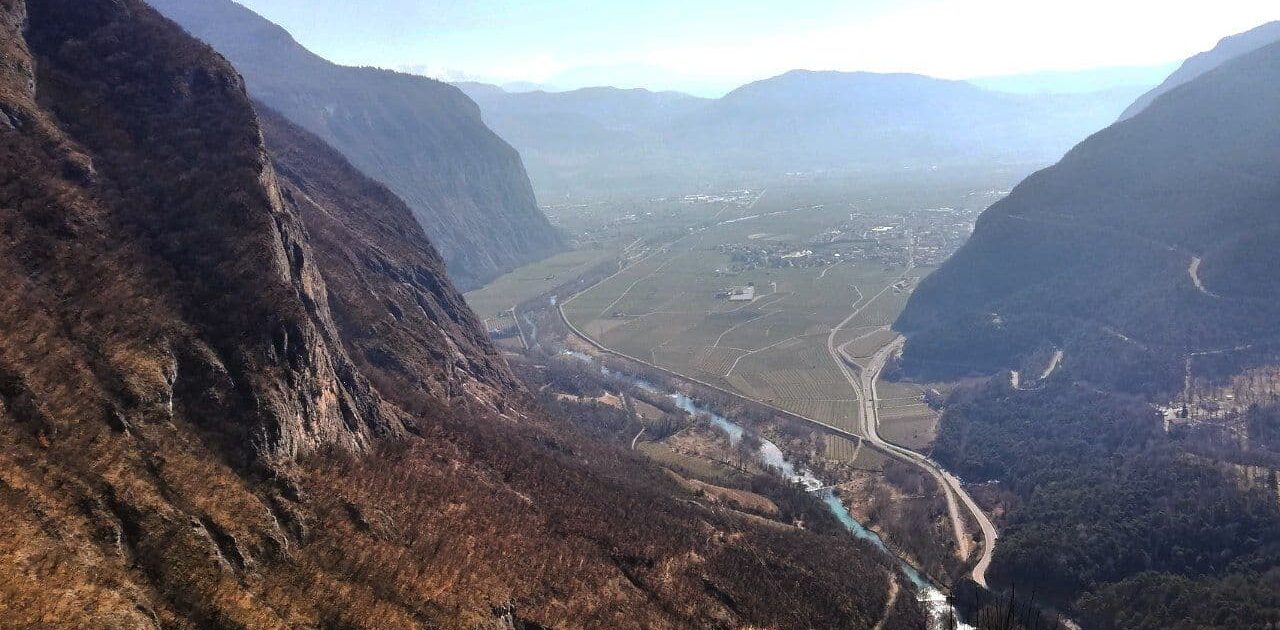
Fig. 1:vineyards and apple orchards surrounded by steep tree-covered mountain slopes in Piana Rotaliana (Trento, Italy). River banks are among the few places in the Adige valley that agro-industrial farming could not occupy. At the bottom, the “Rocchetta” Natura 2000 site stretches along the Noce river (Author, March 2021).

This article is part of the project “Environmental Blogging Boost 4 Students”, aimed at increasing the spread of agroecology and sustainable water management in Trentino. The project is financed by the BIM Adige Water Catchments Consortium (grant approved by provision n. 100 of June 06, 2021).

La sensibilità ambientale dell’agricoltura trentina

Di certo l’agricoltura trentina non spicca per la sua eco-sostenibilità.

Tralasciando per ora la letteratura scientifica, gli esempi di danni e noncuranza verso l’ambiente naturale trentino e le specie che lo abitano sono lampanti. Quasi trenta trattamenti fitosanitari all’anno nei meleti, nitrificazione dei corsi d’acqua adiacenti i vigneti, disboscamento di foreste di montagna di protezione.

La sensibilità media di un agricoltore trentino verso dell’ambiente è relativa quanto la teoria di Einstein: esiste nelle chiacchiere in piazza e scompare appena varcato il confine del campo. Un vedo/non-vedo incredibile quanto il mantello regalato a Harry da Silente. Entrando alle 7:30 del mattina nella prima tessera o nel primo filare, s’indossa il mantello dell’invisibilità che vela completamente quella scomoda sensibilità all’ambiente e si mette in mostra l’efficiente produttività agro-industriale. Una pratica frutto dell’ammirevole e brusca operosità trentina che purtroppo impatta notevolmente sull’ambiente.

Eppure alcuni agricoltori trentini provano a imbastire azienda agricole più eco-friendly. In viticoltura, la potatura Simonit-Sirch allunga la durata della vite, il sovescio interfilare riduce l’utilizzo di Nitrophoska e altri concimi sintetici, la confusione sessuale abbassa l’utilizzo di fitosanitari, così come un’adeguata sgarzatura e sfogliatura pre-vendemmia. Questi agricoltori lungimiranti sono quattro gatti, e tre di loro applicano pratiche rispettose dell’ambiente principalmente per motivi economici o di marketing. Poco importa, l’importante è che le applichino: in un modo o nell’altro bisogna convincere tutti i trentatré gatti trentini a fare lo stesso. Bisogna convincere sia i dirigenti aziendali sia i “comuni agricoli”. Difatti non stupisce che tra i 46 comuni convenzionati con l’iniziativa Spighe Verdi per valorizzare l’agricoltura sostenibile, neanche uno sia trentino [1].

Convincere agricoltori, dirigenti e comuni, sarà un’impresa ardua; complicata persino per Saul Goodman con la sua dialettica manipolatrice. Nessuno verrà manipolato, ad ogni modo. Si discuterà invece a più livelli: con gli operai agricoli, i manager delle aziende agricole, i dirigenti delle cooperative, i direttori delle associazioni agricole e i rappresentanti politici comunali e provinciali di settore. Alcuni spartani della Piana Rotaliana già hanno iniziato a discutere a livello politico, portando avanti la proposta di referendum per un bio-distretto provinciale.

La discussione dovrà tenere contro dell’importanza dell’agricoltura trentina per la Provincia di Trento (“PAT”). Essa incide fortemente sul PILprovinciale, fornisce impiego per migliaia di residenti e vicini est-europei,
influenza significativamente le dinamiche socialidi innumerevoli comunità, preserva tradizionali paesaggi del territorio montano, alimenta le competenze locali e conserva storici valori culturali. Sono punti che non solo gli agricoltori e i decision makers dovranno considerare, bensì anche gli ambientalisti promotori di sistemi di produzione eco-sostenibili.

Invito tutti gli “ambientalisti da ufficio” a fare un’immersione nel mondo contadino per comprendere meglio le sue basi ed essere maggiormente preparati ai tavoli di discussione venturi. Comprendere meglio chi siede sull’altro lato del tavolo, migliorerà l’incisività delle proprie argomentazioni e aiuterà al raggiungimento di difficili compromessi. Invito tutti i simpatizzanti ambientali trentini e italiani a fare un’esperienza di lavoro stagionale nelle campagne provinciali. Un’esperienza che può aiutare ad individuare le caratteristiche motivo di orgoglio e di vergogna di questo settore, rispetto alla cura del territorio. Una stagione in campagna sporcandosi le mani di terra, allenando la propria resistenza fisica sotto il sole di agosto e rinforzando la propria resilienza mentale contro la ripetitività degli incarichi. Un lavoro che ti permette di costruire nuove relazioni autentiche, che ti richiede di aiutare i colleghi anche in situazioni di stress e stanchezza, che ti obbliga a mostrare senza filtri quanto vali.  La persistenza a settimane di duro lavoro tempra sia il fisico che il carattere. Per lo meno ti fa guadagnare un’invidiatissima abbronzatura estiva.

Registrati al portale dell’Agenzia del Lavoro della PAT
e dai la tua disponibilità a lavorare come operaio agricolo durante questa stagione di raccolta. Registrati anche se non hai esperienze pregresse e non hai molta manualità. Ti basta essere in forma e in grado di stare otto ore in piedi all’aperto. Provaci perché quest’anno la vendemmia e la raccolta di mele in trentino è carente di numerosi braccianti agricoli bulgari e rumeni [2], a cui è stato imposto uno sconveniente periodo di quarantena di 14 giorni dall’entrata in Italia. Provaci e quando avrai finito raccontaci la tua esperienza e tutte le tue scoperte sulla sensibilità ambientale dell’agricoltura trentina.

Clicca qui per registrarti all‘Agenzia del Lavoro della PAT per lavorare nell’agricoltura trentina

Fig. 1: Viticoltura in Piana Rotaliana, Trentino. Mark L. Miller, 2019.

Bibliografia e sitografia:

Immagine copertina: vigneto in Valle di Cembra, Trentino. Mark L. Miller, 2019.

  1. Redazione ANSA. (2020, July 28). Agricoltura virtuosa, Spighe verdi a 46 Comuni—Terra & Gusto. it. https://www.ansa.it/canale_terraegusto/notizie/mondo_agricolo/2020/07/28/agricoltura-virtuosa-spighe-verdi-a-46-comuni_7cd3a256-f254-46d0-92be-6590f91c6bfc.html
  2. L’Adige. (2020, July 25). Quarantena per Rumeni e Bulgari L’allarme della Coldiretti: «vendemmia e mele a rischio». l’Adige.it.

Telegram: @greenmarked
LinkedIn: @greenmarked
Instagram: @greenmarked.it

Facebook:  @greenmarked.it


© GreenMarked.it is managed by ECONTROVERTIA APS — Via Alcide De Gasperi 1, 38015 Lavis (TN), Italy — VAT IT02667560227