Ir al contenido principal

Etiqueta: Ukraine

A hungry game: climate change, COVID-19, and the Ukraine war

Even before the Ukraine war, the World Food Programme (WFP) had warned that 2022 would be a terrible year for food security. China, the largest wheat producer declared that last year’s rains delayed planting, and this-year crop may be its worst ever. Moreover, the extreme temperatures in India, the second-largest producer, and the drought in America’s wheat belt and Europe contributed to rising food insecurity [1].
If in 2021 the global levels of hunger were alarmingly high as a consequence of the COVID-19 economic shock, they would be expected to grow further in 2022, because of the repercussions of the Ukraine war on food, energy and fertilizer prices and supplies.
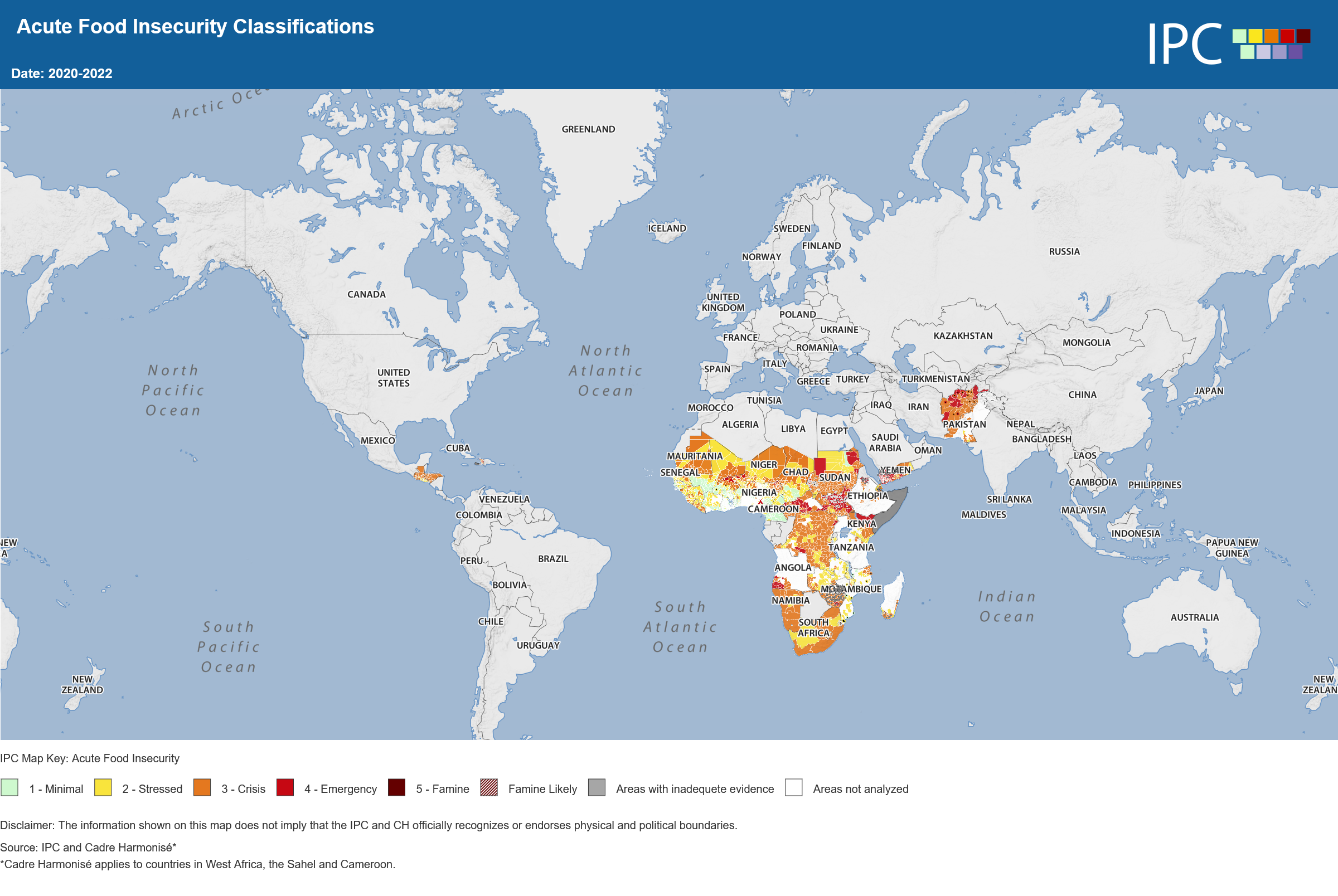
The most at-risk economies are the undeveloped ones, such as the African and the Middle-East countries, which have been struggling to grow food because of local conflicts or economic crises and cannot afford a further recession [2].
THE WORLD IS THIRSTY

According to NASA, the average global temperature on Earth has already increased by at least 1.1° Celsius [3]. As a consequence, the number of extreme events such as storms, heatwaves, floodso forest fires has raised, coming along with all the related damages to urban and natural ecosystems.
Food production is highly dependent on the climate. Climate change could make it difficult to grow crops, raise animals, and catch fish. Different temperatures and more frequent extreme events harm plants, reduce yields and bring always new invasive species. Up to now, the most concerning issue is chronic water scarcity, especially in semi-arid and arid areas where water is likely to become limited and farmers will deal with drought [4]. In Italy, we are having a real taste of drought. The Po river bed is quite empty, and summer is not started yet. On the other coast of the Mediterranean Sea, however, countries have experienced water scarcity for a long time

THE COVID AFTERMATH

COVID-19 caused an immediate break in the global transportation systems and in all the connections among countries. At the end of 2020, it was clear that those that would have suffered the most from this crisis would have been Middle-East and Africa. There, a stop in trading would have meant further physical and ideological walls.

It is critical that commercial trade continues to flow regardless of anything else taking place around it.

warned the WFP chief economist Arif Husain.

If that stops, the humanitarian work cannot happen. Quite simply, millions of people’s lives depend on the flow of trade, and the impact of disruption on people’s food security is hugely concerning. [5].

Countries with large public debt have struggled to respond to the COVID-19-induced financial crisis. In the Middle East, Yemen, Iran, Iraq, Lebanon and Syria faced severe economic problems, worsening the local food shortage. In Africa, in the Demographic Republic of Congo, Zimbabwe, Mozambique, Malawi, and the Central African Republic are the most at risk, for a total of 45.56M starving people [2].

THE WORLD BREADBASKET

For a long time, Ukraine has been named the Europe Breadbasket. Actually, Ukraine is the 8th exporter of wheat worldwide, the 1st of sunflowers and derivates, and the 4th of barley and corn. Ukraine is one of the most important players in the global agriculture market, not in Europe only [6].
Stopping the agro-food chain of Ukraine would mean threatening the global economy, and that is what is happening right now. In Ukraine, the (few) undamaged silos have been already overfilled with cereals and are just waiting to be moved abroad. However, in the Black Sea, Russian patrols and Ukrainian minefields make the course impossible for mercantile ships, and there is no humanitarian corridor going to the western border.
While Europe and Turkey have been trying to unlock this situation for days, on June 3rd, Macky Sall, the President of the African Union, met the Russian President asking to guarantee food and fertilizers in Africa to avoid a catastrophe. There, most of the countries there have not already overcome the COVID economic slowdown and a further rise in the cost of food could be fatal for them [7].

A falling food production, broken commerce and tons of grains trapped in the warzone waiting to go bad is a lot to deal with.
If developed countries can survive this series of shots, the same might not happen for developing and undeveloped ones, where people are paying for food and water scarcity with their own life. Releasing Ukrainian food can be the first achievement, but it cannot be the only one. Cooperation and investments must be ensured to save lives and fight climate change [2].

Imagen de portada e de previsualización: Free-source photo by Raphael Rychetsky on Unsplash (Meisenheim, Germany, 8 July 2017)

Bibliography:

[1] The Economist. (2022, May 20). The coming food catastrophe. https://www.economist.com/leaders/2022/05/19/the-coming-food-catastrophe

[2] World Food Programme. (2022). Global Report on Food Crises. https://docs.wfp.org/api/documents/WFP-0000138913/download/

[3] World of Change: Global Temperatures. (n.d.). https://earthobservatory.nasa.gov/world-of-change/decadaltemp.php

[4] Climate Impacts on Agriculture and Food Supply | Climate Change Impacts | US EPA. (n.d.). https://climatechange.chicago.gov/climate-impacts/climate-impacts-agriculture-and-food-supply

[5] Risk of hunger pandemic as coronavirus set to almost double acute hunger by end of 2020 | World Food Programme. (n.d.). https://www.wfp.org/stories/risk-hunger-pandemic-coronavirus-set-almost-double-acute-hunger-end-2020

[6] G. (2022, April 23). La ricca Ucraina e’ il granaio d’Europa -Dalle pallottole di Kiev alle bollette degli Italiani – Minaccia nucleare da non sottovalutare. Newsfood – Nutrimento e Nutrimente – News dal mondo Food. https://newsfood.com/dalle-pallottole-di-kiev-alle-bollette-degli-italiani-questo-e-leffetto-certo-dellattacco-di-putin-allucraina/

[7] R. (2022b, June 17). Rassegna stampa africana: l’incontro tra Macky Sall e Putin e le tensioni nella regione dei Grandi laghi. Affari Internazionali – Politica ed economia estera. https://www.affarinternazionali.it/rassegna-stampa-africana-lincontro-tra-macky-sall-e-putin-e-le-tensioni-nella-regione-dei-grandi-laghi/

War in Ukraine. What about the environment?

War means uncertainty of tomorrow. It is tragic, terrifying and disastrous for humans but – no matter who wins – it is also a loss for the natural environment: the invisible third side of a war.

The natural environment is affected locally both in and out of warzones, but in war times nobody takes care of local environmental crises anymore. Since they are usually managed by the national army, they remain in stand-by because soldiers are busy elsewhere [1]. The environment is also affected globally because the climate crisis inevitably slides into the background of governments’ agendas.

ENVIRONMENTAL EFFECTS IN THE WARZONE

Areas that once were crowded with people and animals become empty shredded ruins after a battle. Cities collapse and forests burn. Fires and explosions are the most common environmental war-related disasters, along with debris and waste accumulation on roadsides [2]. Since last February 24, this has become the situation in Ukraine. And yet, it represents just the tip of the iceberg of the environmental impact caused by the war in Ukraine.

Ukraine received from the Soviet Union a heavy industrialized but strongly polluted inheritance. The Donbas area is indeed rich in quarries and mines. Up to the second half of the XX century, it was a rich mining hub of coal, salt, potassium, and rare-earth-metals [3]. Between 2014 and 2022, the conflict in Donbas has presented significant risks to the environment and the public health of local people. Now, with the full-scale Russian invasion of Ukraine, it is more difficult to understand and keep monitoring the real environmental risks.

Even before the beginning of the 2022 war, abandoned coal mines in Donbas were flooding with toxic substances. Cuts in electricity supplies and disruption from the conflict, which in Donbas started in 2014, led to the breakdown of water pumps in coal mines. This caused flooding and groundwater pollution, and an increasing risk of contamination for the Siverskyi Donets River, a source of drinking water for most locals [4].

Since the invasion started, the number of environmental hazardous accidents has raised. On 13 March a shelling damaged the coke plant – mainly for industrial purposes – and the thermal power plant in Avdiivka risking the release of harmful substances. In Sumy, another shelling led to ammonia leakage. Many other heavy industry factories have been suffering from war damage all over Ukraine.

Por otro lado breakdown of the waste management system raised a dilemma about all the waste storage and recycling facilities containing toxic waste. It was estimated that in Ukraine there are 465 storage facilities with over six billion tons of hazardous waste. Around 60 % of them are old and abandoned. Their proximity to water bodies and towns could lead to polluting Ukraine’s major rivers, which flow through Russia, Moldova, and Belarus [5].

Eventually, battles close to nuclear sites, like the ones of 9-10 March close to the dismissed Chornobyl Power Plant or Zaporiz’ka Nuclear Power Plant, raised concern of another nuclear disaster after 1986. Even if nuclear plants are under the protection of the Geneva Convention and they may not be made the object of a deliberate attack [6], there is still a high risk of incidental damage when these plants happen to be near the front line [5].

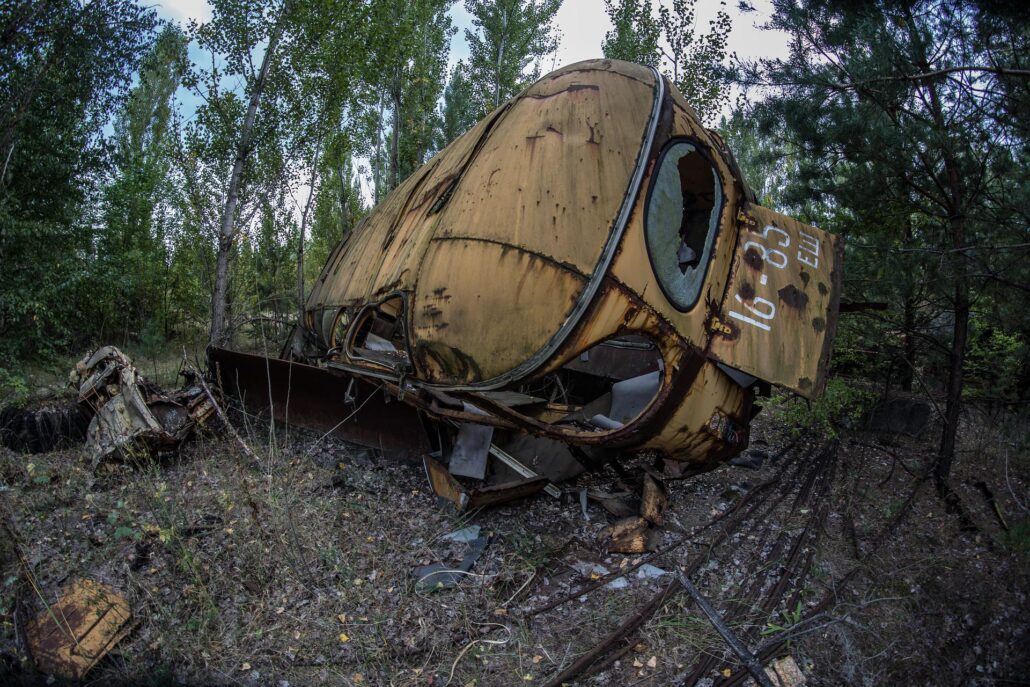
Fig. 1:Wreck in the woods close to Chernobyl’s nuclear plant. Image by Wendelin Jacober en Pixabay.

GLOBAL ENVIRONMENTAL EFFECTS OF WARS

The global climate impact of the Ukrainian war is linked to the relations between Russia and Western countries. Here, the main actors are the energy and fuels markets, crucial for the economies of Europe and Russia, as well as for the climate crisis.

The decreasing flow of Russian gas into European pipelines provoked an initial period of concern among European countries. At that time, it stroke that the energy independence and the Paris Agreements could be reached hand in hand.

On May 18, the European Union accelerated the REPowerEU plan, attempting to stop its reliance on Russian gas and, at the same time, promoting the energy transition towards a decarbonized economy. The program aims to increase energy savings, diversify supplies, and accelerate the roll-out of renewables that can replace fossil fuels [7].

Can this be actually the time of renewables?

War comes along with change, but solar and wind power still need critical and hard-to-retrieve materials and technologies, such as rare earth metals and smart grids. Being able to access and transform them is an ambitious goal that must be reached as soon as possible to guarantee energy independence and net-zero emissions to Europe [8].

Ban Ki-moon, the former Secretary-General of the UN, affirmed that the environment is the silent casualty of war [5]. War destroys and pollutes the environment in the fighting areas and there is not much civilians and institutions can do, other than keeping the situation monitored and sending humanitarian aid.

On February 24, 2022, Western countries woke up suddenly from their sweet dream of globalized peaceful cooperation. With the world order moving towards a chaotic situation, it seems quite useless to worry about the environment instead of rearmament. But this can be the right opportunity for nations’ leaders to really act for the climate at a global level.

Cover photo:View of Mariupol’s harbor, Ukraine (May 2021). Photo by Viktor Hesse en Unsplash.

Preview photo:Wreck in the woods close to Chernobyl’s nuclear plant. Image by Wendelin Jacober en Pixabay.

REFERENCES:

[1] https://www.independent.co.uk/climate-change/siberian-wildfires-climate-crisis-russia-b2063988.html

[2] https://ceobs.org/how-does-war-damage-the-environment/

[3] https://it.wikipedia.org/wiki/Donbass

[4] https://ceobs.org/country-brief-ukraine/

[5] https://www.greeneuropeanjournal.eu/the-environmental-cost-of-the-war-in-ukraine/

[6] https://ihl-databases.icrc.org/customary-ihl/eng/docs/v1_rul_rule42

[7] https://www.affarinternazionali.it/repower-eu-autonomia-energetica-europea/

[8] https://www.limesonline.com/autori/fabrizio-maronta

With the Russian-Ukrainian war natural gas is out of the game. Is the European Union’s Green Deal derailing?

In January we wrote about the European Commission’s proposal to label certified nuclear power and natural gas as clean energy sources, thus causing anger among plenty environmental associations who accused Europe of greenwashing [1].

Today, as a consequence of the Russian-Ukrainian conflict, the situation has radically changed and it is no longer certain that Russian natural gas will keep flowing into Europe in the near future. Since Russia is the EU’s main natural gas provider, the leaders of some European countries decided to reopen coal power plants to be more energy-independent. Such move strongly collides with Glasgow’s COP26 objective to phase down from coal [2].

Unfortunately, renewable energies are not yet able to satisfy Europe’s energy needs [3]. Currently, Europe’s only way to guarantee its energy independence and respect the climate agreements seems to rely on nuclear power.

Is nuclear power clean energy?

The answer is controversial and must be analyzed with caution, starting from the beginning. There are two atomic interactions that liberate energy: nuclear fusion and fission. Nuclear fusion happens occurs with hydrogen. Deuterium and tritium (two heavy forms of hydrogen with two and three neutrons respectively), merge forming helium and liberating large amounts of energy. Nuclear fission, instead, occurs with larger and heavier atoms, mainly uranium, but also plutonium and thorium. When they split, they liberate energy. While nuclear fusion for energy production is still at its experimental stage, nuclear fission is the basis process of today’s nuclear power plants[4].

The most recent scientific literature agrees that nuclear fission is a low greenhouse gas (“GHG”) emissions process. Since the process does not include any type of combustion, no carbon dioxide is produced. The only waste product released into the atmosphere is water vapor, which is the result of the large amount of water used to cool the fuel bars of II- and III-generation reactors [4].

The most critical environmental and health issues arise from the highly invasive processes used for mining and milling uranium. Current techniques involve the use of explosives and solvents (e.g., sulfuric acid, ammonia, nitric acid) that highly affect local ecosystems. Indeed, the excessive use of solvents can change the soil pH and cause heavy metal contamination in the soil. Uranium leaching, instead, can increase the concentration of radon in the areas adjoining the extraction site [5]. The U.S. Environmental Protection Agency (“EPA”) provides a detailed account of what possible risks workers, the surrounding environment, and neighboring communities may be subjected to [6].

A Life Cycle Assessment of all energy production types deployed in the old continent was carried out by the Joint Research Centre (“JRC”) and the United Nations Economic Commission for Europe (“UNECE”). According to the assessment, nuclear power seems to be one of the least impactful solutions in terms of GHG emissions, water eutrophication, land use and toxicity.Dangerous radioactivity levels close to the mining and milling sites was the only significant issue reported by the evaluation [5].

The most recent JRC study states that “the analyses did not reveal any science-based evidence that nuclear energy does more harm to human health or to the environment than other electricity production technologies already included in the Taxonomy as activities supporting climate change mitigation” and that “the impacts of nuclear energy are mostly comparable with hydropower and the renewables, with regard to non-radiological effects”.

In terms of exposure to radioactive waste, however, “management of radioactive waste and its safe and secure disposal is a necessary step in the lifecycle of all applications of nuclear science and technology. [The] disposal of high-level, long-lived radioactive waste in deep geologic formations is, at the state of today’s knowledge, considered as an appropriate and safe means of isolating it from the biosphere for very long time scales” [7].

So, is nuclear power really clean energy?

The most recent scientific literature finally declares that nuclear energy is clean and classifies it as low-GHG emissions energy source. The climate crisis, however, is not limited to the atmosphere, and a relevant environmental impact is caused by the highly invasive extraction methods, which have very little of “green” or “sustainable”. Keeping in mind that every energy production method has a large environmental impact [5], one can admit that nuclear energy in itself is clean. Nonetheless, the origin of its energy source, at least for the moment, makes its dirty and darkens its color.

Bibliography:

[1] Barbieri, L. (2022, January 19). A European proposal: Nuclear and natural gas labeled as “green energy”. Is it greenwashing? GreenMarked. https://greenmarked.it/it/nuclear-and-natural-gas-labeled-as-green-energy/

[2] ANSA. (2022, February 25). Ucraina: Draghi, ipotesi riapertura centrali carbone. ANSA. https://www.ansa.it/canale_ambiente/notizie/energia/2022/02/25/ucraina-draghi-ipotesi-riapertura-centrali-carbone_99a9396b-3bdf-4cef-9532-a7c34b69fa9c.html

[3] European Environmental Agency. (2017, September 25). L’energia in Europa: Situazione attuale. https://www.eea.europa.eu/signals/signals-2017/articles/l2019energia-in-europa-situazione-attuale

[4] Nuclear power. (2022). In Wikipedia. https://en.wikipedia.org/w/index.php?title=Nuclear_power&oldid=1074182432

[5] United Nations Economic Commission for Europe (2021). Life Cycle Assessment of Electricity Generation Options.  https://unece.org/sites/default/files/2021-10/LCA-2.pdf

[6] US EPA, O. (2018, November 28). Radioactive Waste From Uranium Mining and Milling [Overviews and Factsheets]. https://www.epa.gov/radtown/radioactive-waste-uranium-mining-and-milling

[7] European Commission, Joint Research Centre, Konings, R., Van Winckel, S., Rondinella, V. (2021). Technical assessment of nuclear energy with respect to the ‘do no significant harm’ criteria of Regulation (EU) 2020/852 (‘Taxonomy Regulation’), Publications Office. https://data.europa.eu/doi/10.2760/207251

Imagen de portada y vista previa ISAR nuke plant in Bayern (Germany). Free-source photo by Ulrike Leone en Pixabay.

Telegram: @greenmarked
LinkedIn: @greenmarked
Instagram: @greenmarked.it

Facebook:  @greenmarked.it


© GreenMarked.it is managed by ECONTROVERTIA APS — Via Alcide De Gasperi 1, 38015 Lavis (TN), Italy — VAT IT02667560227