Ir al contenido principal

Etiqueta: renewables

De las Minas de Carbón a los Parques Eólicos: ¿Quién Paga el Precio de la Transición en Colombia?

La conferencia de Santa Marta, Colombia, celebrada a finales de abril de 2026, fue la primera conferencia internacional dedicada íntegramente al abandono de los combustibles fósiles.

Organizada por Colombia y los Países Bajos, con la participación de más de cincuenta países (excluidos los grandes actores como Estados Unidos, China, Rusia, India y los países del Golfo), la conferencia nace con el objetivo de proponer acciones concretas para continuar el camino hacia la salida de los combustibles fósiles, recuperando el componente práctico que las más conocidas COPs (Conferences of the Parties) ya no logran garantizar.

Colombia aporta al debate una doble identidad: es un país líder en la producción y exportación de carbón, pero también un territorio con uno de los mayores potenciales de energías renovables de América Latina. En ambos frentes, la propia Colombia presenta tanto promesas como contradicciones.

Colombia se encuentra históricamente entre los seis principales exportadores mundiales de carbón y es el segundo de América, después de Estados Unidos [1]. Por sus características químicas, el carbón colombiano es especialmente adecuado para la generación de electricidad. Por ello, la evolución de las exportaciones sigue la de la demanda mundial de energía a partir del carbón, en descenso en los últimos diez años, frenada por las políticas climáticas europeas (Europa es uno de los principales importadores de carbón colombiano) y por los mecanismos del RCDE (Régimen de Comercio de Derechos de Emisión), que hacen que el carbón sea cada vez menos competitivo. El paréntesis de crecimiento de las importaciones europeas de carbón como consecuencia de la crisis del gas ruso ya ha concluido, sustituido por la aceleración de las energías renovables [2].

Del carbón a las energías renovables

El Gobierno colombiano ha optado por acompañar el declive del mercado del carbón y ha decidido no conceder nuevas licencias de exploración y extracción. La semana pasada, el Gobierno solicitó formalmente a Glencore (empresa suiza que opera en la mina de Cerrejón, una de las minas de carbón a cielo abierto más grandes del mundo) que se sentara a la mesa con las autoridades regionales y las comunidades para debatir el cierre anticipado de la mina, cuya concesión expiraría en 2034 [3]. La transición, en regiones colombianas como Cesar y La Guajira va más allá de la cuestión medioambiental: sin un plan de reconversión que integre empleo, formación y nuevas inversiones, comunidades enteras corren el riesgo de pagar el precio del cambio.

La Guajira es la primera región del país en extracción de carbón, pero también es la que cuenta con mayor potencial de energías renovables. Entre la energía fotovoltaica y la eólica, las estimaciones apuntan a una capacidad potencial de 32 GW [4], y precisamente por eso, en los últimos años, ha atraído la atención de los principales gigantes energéticos mundiales.

Las comunidades indígenas frente a la industria energética

Sin embargo, también aquí el primacía tiene un precio. La Guajira alberga la comunidad indígena más numerosa de Colombia, la de los Wayuu [5], para quienes el viento y el sol son entidades vivas, con un espíritu y un temperamento que forman parte de la propia comunidad. La idea de que empresas privadas puedan construir parques eólicos para obtener beneficios choca con la visión del mundo de quienes viven en esos mismos territorios y los protegen por cultura y vocación social.
A esto se suma un recuerdo reciente: décadas de extracción de carbón han desviado ríos, modificado la morfología del territorio y liberado partículas que han tenido consecuencias para la salud de las poblaciones locales. La nueva era de las energías renovables se percibe como una amenaza más, y los Wayuu se han opuesto con firmeza a los principales proyectos eólicos de la región.

Varios gigantes internacionales, entre ellos Enel, tras haber invertido millones de euros, han vendido sus carteras y se han retirado [6]. En su lugar ha entrado una empresa colombiana, Ecopetrol, vinculada históricamente al petróleo, que se presenta como facilitadora del diálogo entre las comunidades y las instituciones, a pesar de que su reputación se ve empañada por acusaciones de contaminación ambiental en otras zonas del país.

La disputa entre los Wayuu y los gigantes de las energías renovables ha sido bautizada por muchos como la “guerra del viento”. Es una expresión que corre el riesgo de transmitir una idea errónea: que los pueblos indígenas se oponen a la transición. La verdad es que las comunidades piden formar parte de ella, y no sufrirla.

Una transición justa: el tema de Santa Marta

Colombia demuestra que la transición energética no es solo un proceso de sustitución tecnológica. Se trata de un cambio que exige a regiones enteras reconvertir su economía y que afecta a comunidades que obtienen de esos territorios su identidad y su sustento. Si se pasa por alto este aspecto, existe el riesgo real de que las energías renovables acaben reproduciendo las mismas dinámicas extractivas del carbón, en los mismos territorios y sobre las mismas poblaciones, simplemente explotando un recurso diferente.

En el fondo, este es el sentido del concepto de “transición justa“, que ocupa un lugar central en los debates de Santa Marta: una transición que aúne los aspectos medioambientales y sociales, y que reconozca a quienes pagan el precio más alto un papel activo, y no solo de espectadores.

La mesa redonda celebrada en Santa Marta tiene valor precisamente por eso: aborda un tema en un mundo que corre el riesgo de confundir la transición energética con la mera lógica del mercado. Sin justicia social, la transición pierde una oportunidad.

Es precisamente desde La Guajira, desde el viento de los Wayuu y las minas de carbón, de donde nos llega este recordatorio: la transición debe ser justa para todos; de lo contrario, no es más que un cambio tecnológico.

REFERENCIAS:

Pulse aquí para ampliar las referencias
  1. [1] IEA Country&Regions, Colombia
  2. https://www.iea.org/countries/colombia/coal
  3. [2] The Coal Hub, 2024, Colombian coal exports https://thecoalhub.com/colombian-coal-exports-2.html
  4. [3] Mining Technology, 2026, Colombia pushes Glencore talks on Cerrejon mine closure https://www.mining-technology.com/news/colombia-glencore-talks-cerrejon-mine-closure/?cf-view
  5. [4] SER Colombia Revista, 2022, SER RENOVABLE 10ma ediciòn https://ser-colombia.org/2022/revista/ser-renovable-diciembre-2022/
  6. [5] DANE, 2019, Resultados del censo nacional de población y vivienda 2018 https://www.dane.gov.co/files/censo2018/informacion-tecnica/presentaciones-territorio/190816-CNPV-presentacion-Resultados-Guajira-Pueblo-Wayuu.pdf
  7. [6] US News, 2025, Big Firms Abandon Wind Energy Plans in Colombia Amid Regulatory Shifts, Social Issues and Grid Gaps https://www.usnews.com/news/business/articles/2025-06-03/big-firms-abandon-wind-energy-plans-in-colombia-amid-regulatory-shifts-social-issues-and-grid-gaps

Imagen de portada e de previsualización: Playa en La Guajira, Colombia. Autor, 2025

Revolución Renovable en la UE


Nunca antes se había dado el caso en el que la Unión Europea dependiese tan poco en los combustibles fósiles como en la primera mitad de 2024, incluso con la demanda global de energía aumentando y los precios del combustible volviendo a niveles pre-guerra. Este logro es en gran medida gracias al rápido crecimiento de la energía solar y eólica. Por primera vez, las fuentes de energía renovable han generado más electricidad que los combustibles fósiles en la UE, llegando a un 30% del mix energético frente al 27% que ocupan los combustibles fósiles [1].

Esta transición ha estado impulsada por un máximo alcanzado en capacidad solar y eólica, que juntas han conseguido ser un porcentaje significativo del mix energético europeo. La energía solar se ha incrementado hasta el 21%, y la eólica hasta el 9%, haciendo así que las renovables tengan un repunte que hace que los combustibles fósiles lleguen a mínimos históricos. Sin embargo y a pesar de este éxito, el cambio no se ha dado sin dificultades [1].


Fig 1:Un aerogenerador frente a una planta de quema de carbón holandesa, resaltando la transición hacia una energía verde. Foto de Tim van der Kuip en Unsplash.

La Paradoja de los Países Bajos

The Netherlands, despite being a leader in solar adoption and having the highest number of solar panels per capita in Europe, faces unique issues that highlight the complexity of integrating renewables into the grid [2]. Con un clima que hace fluctuar la producción de energía solar debido a patrones meteorológicos irregulares, el país lucha por gestionar eficazmente tanto la oferta como la demanda. ¡ En días particularmente soleados Holanda experimentó precios de electricidad negativos durante casi el 4% de 2023!

Se trata de una situación en la que el exceso de generación desborda la demanda y los productores de energía se ven obligados a pagar para descargar el excedente de electricidad. Este problema se exagera con el copado de la red, en la que la infraestructura de transmisión existente no puede con el influjo de energía, generando una distribución ineficiente [3].

“Bienvenido al mercado de energía holandés, donde podrás generar dinero dejando el frigorífico abierto” [4]

This dynamic contrasts sharply with countries like Spain, where energy supply and demand align more predictably. Spain’s electricity demand peaks during hot summer days when air conditioning use is high, directly coinciding with maximum solar output. In the Netherlands, however, peak solar production often occurs during spring and summer months, when overall energy demand is lower, creating a mismatch that complicates grid management and results in inefficiencies [4].

El Futuro

Pese a todos estos retos, el cambio sigue siendo positivo para la trayectoria del sistema energético de la UE. Con casi la mitad de los Estados miembros de la UE generando más electricidad con energías renovables en vez de mediante combustibles fósiles, hemos alcanzado un punto de inflexión. Sin embargo, mantenernos en esta dirección requerirán nuevas estrategias para evitar tropezar con piedras como las que estamos viendo en regiones ricas en renovables como los Países Bajos, donde el foco debería estar en gestionar cuándo y dónde se produce y usa la energía, en lugar de simplemente incrementar la capacidad de energía verde [3].

En general, el éxito de la UE integrando renovables va a depender de su capacidad para equilibrar la oferta y la demanda de manera efectiva, mejorar las comunicaciones entre fronteras, e incentivar el desarrollo de soluciones para el problema del almacenaje. La rápida transformación del mercado energético nos ofrece un vistazo a lo que podría ser el futuro, pero también es un recordatorio de todas las complejidades que tiene construir un sistema energético verdaderamente sostenible y resiliente [3].

REFERENCIAS:

Pulse aquí para ampliar las referencias

[1] Graham, E., & Fulghum, N. (2024, July 30). Wind and solar overtake EU fossil fuels in the first half of 2024. Ember Climate. Retrieved from https://emberclimate.org/app/uploads/2024/07/Report_Wind-and-solar-overtake-EU-fossil-fuels-in-the-first-half-of-2024.pdf

[2] Dutch Statistics: Centraal Bureau voor de Statistiek (CBS). (2023, 19 June). 46 percent more solar energy production in 2022. Retrieved from https://www.cbs.nl/en-gb/news/2023/24/46-percent-more-solar-energy-production-in-2022

[3] Çam, E., Hungerford, Z., Schoch, N., Pinto Miranda, F., & Yáñez de León, C. D. (2024, January). Electricity 2024: Analysis and forecast to 2026. International Energy Agency. Retrieved from https://iea.blob.core.windows.net/assets/18f3ed24-4b26-4c83-a3d2-8a1be51c8cc8/Electricity2024-Analysisandforecastto2026.pdf

[4] Frederik, J. (2024, October 8). Welcome to the Dutch electricity market, where you can now earn money by leaving your refrigerator door open [Translated by Author]. De Correspondent. Retrieved from https://decorrespondent.nl/15595/welkom-op-de-nederlandse-stroommarkt-waar-je-nu-geld-kunt-verdienen-door-je-koelkast-open-te-laten/ac43d35e-ef7b-06fc-0474-2204e3842168

The (Long) Way to Recycle Photovoltaic Panels

Renewable energy is finally becoming normality. Global energy production from photovoltaic (“Pv”) panels was about 400 GW in 2017 and it could reach 2500 GW in 2050 [1]. The boom of the solar energy industry, which nowadays generates 22 GW of energy only in Italy [2], is yet called to answer a crucial question. What happens to the panels once they get to their end of life? How are they disposed?

According to the International Energy Agency, Pv panels must comply to the “End-of-life” regulation in force. The best “End-of-Life” process, however, may not be the most convenient one due to high costs and low profits obtained from recycling panels in countries where solar energy is still unpopular [3].

In Europe, recycling Pv panels is mandatory since 2012. The Electronic Waste Directive (Waste from Electric and Electronic Appliances) decrees that “long life-cycle goods […], like photovoltaic panels, should be reused in the best way possible in existing recycling and disposal centers”  [4].

In 2050, 78 million tons of worn panels are expected worldwide [5]. Reusing and recycling their single components has become crucial and indispensable.

Good news come from Australia. A convincing study from the University of New South Wales suggested a new way to recycle solar panels and better handle an increasing volume of photovoltaic cells. The research offers companies a different process to extract and collect precious metals contained in solar panels. After panels are collected and their aluminum frame is removed, cells are chopped, metals are separated through an electrostatic process and finally collected. Overall, the original panel weight is reduced by 2 % – 3 %. The recycled material is then sent to the refinery for further purification and treatment [6].

An interesting solution also comes from Italy. Compton Industriale patented some systems that are capable of recycling Pv panel components, by separating all welded materials and dividing glass. Once the frame is removed, the panel is split in two parts and the surface is sent through a delamination process, which allows to separate and remove the glass without contaminating it. In short, glass can be completely removed and collected. The rest of the panel is chopped, and the metals contained in it are separated.

The process advanced by Compton Industriale allows to recycle more than 90 % of the panel weight. For an average 22 kg panel, 0.1 kg of circuit boards, 0.2 kg of metals, 2.8 kg of silicon, 2.9 kg of aluminum and 13.8 kg of glass can be collected an recycled. Recyclable materials can be reused in several sectors: in manufacturing activities, in the building industry, and in the IT sector, as hardware elements. What cannot be used again is instead burned to generate energy [5].

Very similar from a non-expert eye but different for those of the field, these two approaches represent the first steps to develop a consolidated technology that can reuse and recycle as many existing solar panels as possible. Investing in research and development is the only way to avoid troublesome environmental and social controversies on solar panels disposal and solar energy in general.

A hungry game: climate change, COVID-19, and the Ukraine war

Even before the Ukraine war, the World Food Programme (WFP) had warned that 2022 would be a terrible year for food security. China, the largest wheat producer declared that last year’s rains delayed planting, and this-year crop may be its worst ever. Moreover, the extreme temperatures in India, the second-largest producer, and the drought in America’s wheat belt and Europe contributed to rising food insecurity [1].
If in 2021 the global levels of hunger were alarmingly high as a consequence of the COVID-19 economic shock, they would be expected to grow further in 2022, because of the repercussions of the Ukraine war on food, energy and fertilizer prices and supplies.
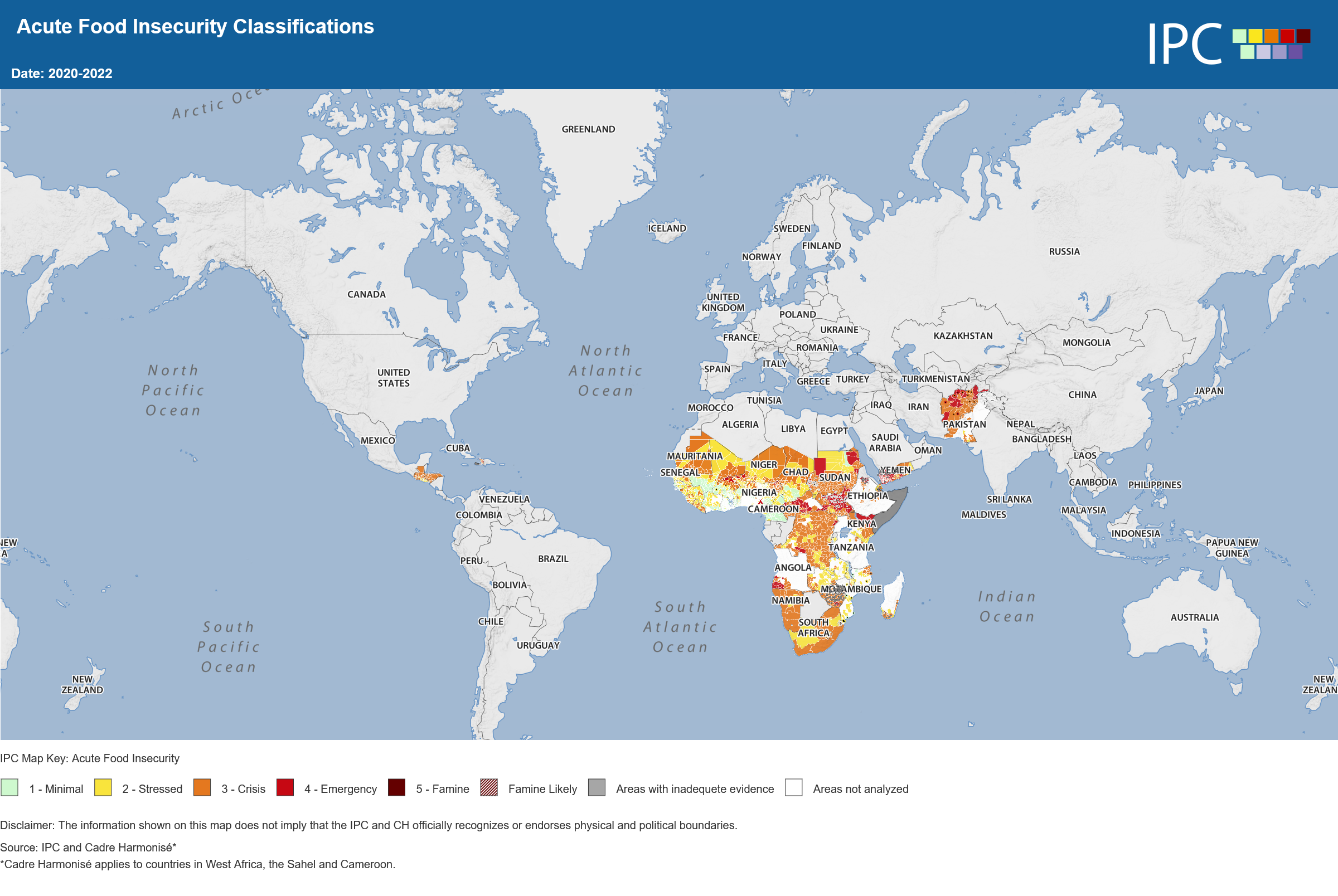
The most at-risk economies are the undeveloped ones, such as the African and the Middle-East countries, which have been struggling to grow food because of local conflicts or economic crises and cannot afford a further recession [2].

THE WORLD IS THIRSTY

According to NASA, the average global temperature on Earth has already increased by at least 1.1° Celsius [3]. As a consequence, the number of extreme events such as storms, heatwaves, floodso forest fires has raised, coming along with all the related damages to urban and natural ecosystems.
Food production is highly dependent on the climate. Climate change could make it difficult to grow crops, raise animals, and catch fish. Different temperatures and more frequent extreme events harm plants, reduce yields and bring always new invasive species. Up to now, the most concerning issue is chronic water scarcity, especially in semi-arid and arid areas where water is likely to become limited and farmers will deal with drought [4]. In Italy, we are having a real taste of drought. The Po river bed is quite empty, and summer is not started yet. On the other coast of the Mediterranean Sea, however, countries have experienced water scarcity for a long time

THE COVID AFTERMATH

COVID-19 caused an immediate break in the global transportation systems and in all the connections among countries. At the end of 2020, it was clear that those that would have suffered the most from this crisis would have been Middle-East and Africa. There, a stop in trading would have meant further physical and ideological walls.

It is critical that commercial trade continues to flow regardless of anything else taking place around it.

warned the WFP chief economist Arif Husain.

If that stops, the humanitarian work cannot happen. Quite simply, millions of people’s lives depend on the flow of trade, and the impact of disruption on people’s food security is hugely concerning. [5].

Countries with large public debt have struggled to respond to the COVID-19-induced financial crisis. In the Middle East, Yemen, Iran, Iraq, Lebanon and Syria faced severe economic problems, worsening the local food shortage. In Africa, in the Demographic Republic of Congo, Zimbabwe, Mozambique, Malawi, and the Central African Republic are the most at risk, for a total of 45.56M starving people [2].

THE WORLD BREADBASKET

For a long time, Ukraine has been named the Europe Breadbasket. Actually, Ukraine is the 8th exporter of wheat worldwide, the 1st of sunflowers and derivates, and the 4th of barley and corn. Ukraine is one of the most important players in the global agriculture market, not in Europe only [6].
Stopping the agro-food chain of Ukraine would mean threatening the global economy, and that is what is happening right now. In Ukraine, the (few) undamaged silos have been already overfilled with cereals and are just waiting to be moved abroad. However, in the Black Sea, Russian patrols and Ukrainian minefields make the course impossible for mercantile ships, and there is no humanitarian corridor going to the western border.
While Europe and Turkey have been trying to unlock this situation for days, on June 3rd, Macky Sall, the President of the African Union, met the Russian President asking to guarantee food and fertilizers in Africa to avoid a catastrophe. There, most of the countries there have not already overcome the COVID economic slowdown and a further rise in the cost of food could be fatal for them [7].

A falling food production, broken commerce and tons of grains trapped in the warzone waiting to go bad is a lot to deal with.
If developed countries can survive this series of shots, the same might not happen for developing and undeveloped ones, where people are paying for food and water scarcity with their own life. Releasing Ukrainian food can be the first achievement, but it cannot be the only one. Cooperation and investments must be ensured to save lives and fight climate change [2].

Imagen de portada e de previsualización: Free-source photo by Raphael Rychetsky on Unsplash (Meisenheim, Germany, 8 July 2017)

Bibliography:

[1] The Economist. (2022, May 20). The coming food catastrophe. https://www.economist.com/leaders/2022/05/19/the-coming-food-catastrophe

[2] World Food Programme. (2022). Global Report on Food Crises. https://docs.wfp.org/api/documents/WFP-0000138913/download/

[3] World of Change: Global Temperatures. (n.d.). https://earthobservatory.nasa.gov/world-of-change/decadaltemp.php

[4] Climate Impacts on Agriculture and Food Supply | Climate Change Impacts | US EPA. (n.d.). https://climatechange.chicago.gov/climate-impacts/climate-impacts-agriculture-and-food-supply

[5] Risk of hunger pandemic as coronavirus set to almost double acute hunger by end of 2020 | World Food Programme. (n.d.). https://www.wfp.org/stories/risk-hunger-pandemic-coronavirus-set-almost-double-acute-hunger-end-2020

[6] G. (2022, April 23). La ricca Ucraina e’ il granaio d’Europa -Dalle pallottole di Kiev alle bollette degli Italiani – Minaccia nucleare da non sottovalutare. Newsfood – Nutrimento e Nutrimente – News dal mondo Food. https://newsfood.com/dalle-pallottole-di-kiev-alle-bollette-degli-italiani-questo-e-leffetto-certo-dellattacco-di-putin-allucraina/

[7] R. (2022b, June 17). Rassegna stampa africana: l’incontro tra Macky Sall e Putin e le tensioni nella regione dei Grandi laghi. Affari Internazionali – Politica ed economia estera. https://www.affarinternazionali.it/rassegna-stampa-africana-lincontro-tra-macky-sall-e-putin-e-le-tensioni-nella-regione-dei-grandi-laghi/

War in Ukraine. What about the environment?

War means uncertainty of tomorrow. It is tragic, terrifying and disastrous for humans but – no matter who wins – it is also a loss for the natural environment: the invisible third side of a war.

The natural environment is affected locally both in and out of warzones, but in war times nobody takes care of local environmental crises anymore. Since they are usually managed by the national army, they remain in stand-by because soldiers are busy elsewhere [1]. The environment is also affected globally because the climate crisis inevitably slides into the background of governments’ agendas.

ENVIRONMENTAL EFFECTS IN THE WARZONE

Areas that once were crowded with people and animals become empty shredded ruins after a battle. Cities collapse and forests burn. Fires and explosions are the most common environmental war-related disasters, along with debris and waste accumulation on roadsides [2]. Since last February 24, this has become the situation in Ukraine. And yet, it represents just the tip of the iceberg of the environmental impact caused by the war in Ukraine.

Ukraine received from the Soviet Union a heavy industrialized but strongly polluted inheritance. The Donbas area is indeed rich in quarries and mines. Up to the second half of the XX century, it was a rich mining hub of coal, salt, potassium, and rare-earth-metals [3]. Between 2014 and 2022, the conflict in Donbas has presented significant risks to the environment and the public health of local people. Now, with the full-scale Russian invasion of Ukraine, it is more difficult to understand and keep monitoring the real environmental risks.

Even before the beginning of the 2022 war, abandoned coal mines in Donbas were flooding with toxic substances. Cuts in electricity supplies and disruption from the conflict, which in Donbas started in 2014, led to the breakdown of water pumps in coal mines. This caused flooding and groundwater pollution, and an increasing risk of contamination for the Siverskyi Donets River, a source of drinking water for most locals [4].

Since the invasion started, the number of environmental hazardous accidents has raised. On 13 March a shelling damaged the coke plant – mainly for industrial purposes – and the thermal power plant in Avdiivka risking the release of harmful substances. In Sumy, another shelling led to ammonia leakage. Many other heavy industry factories have been suffering from war damage all over Ukraine.

Por otro lado breakdown of the waste management system raised a dilemma about all the waste storage and recycling facilities containing toxic waste. It was estimated that in Ukraine there are 465 storage facilities with over six billion tons of hazardous waste. Around 60 % of them are old and abandoned. Their proximity to water bodies and towns could lead to polluting Ukraine’s major rivers, which flow through Russia, Moldova, and Belarus [5].

Eventually, battles close to nuclear sites, like the ones of 9-10 March close to the dismissed Chornobyl Power Plant or Zaporiz’ka Nuclear Power Plant, raised concern of another nuclear disaster after 1986. Even if nuclear plants are under the protection of the Geneva Convention and they may not be made the object of a deliberate attack [6], there is still a high risk of incidental damage when these plants happen to be near the front line [5].

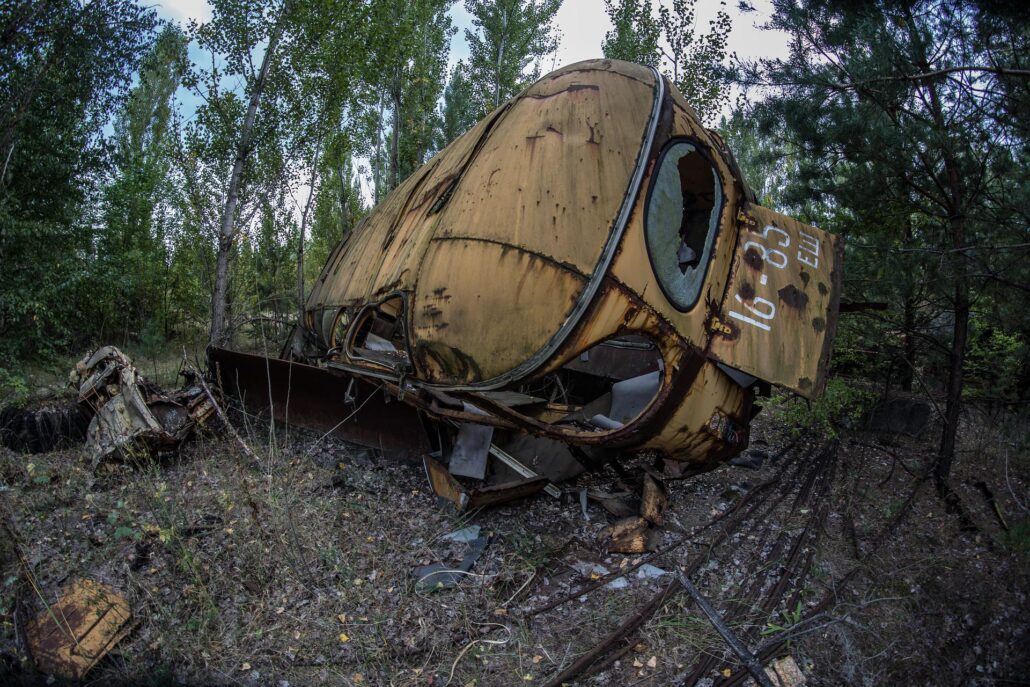
Fig. 1:Wreck in the woods close to Chernobyl’s nuclear plant. Image by Wendelin Jacober en Pixabay.

GLOBAL ENVIRONMENTAL EFFECTS OF WARS

The global climate impact of the Ukrainian war is linked to the relations between Russia and Western countries. Here, the main actors are the energy and fuels markets, crucial for the economies of Europe and Russia, as well as for the climate crisis.

The decreasing flow of Russian gas into European pipelines provoked an initial period of concern among European countries. At that time, it stroke that the energy independence and the Paris Agreements could be reached hand in hand.

On May 18, the European Union accelerated the REPowerEU plan, attempting to stop its reliance on Russian gas and, at the same time, promoting the energy transition towards a decarbonized economy. The program aims to increase energy savings, diversify supplies, and accelerate the roll-out of renewables that can replace fossil fuels [7].

Can this be actually the time of renewables?

War comes along with change, but solar and wind power still need critical and hard-to-retrieve materials and technologies, such as rare earth metals and smart grids. Being able to access and transform them is an ambitious goal that must be reached as soon as possible to guarantee energy independence and net-zero emissions to Europe [8].

Ban Ki-moon, the former Secretary-General of the UN, affirmed that the environment is the silent casualty of war [5]. War destroys and pollutes the environment in the fighting areas and there is not much civilians and institutions can do, other than keeping the situation monitored and sending humanitarian aid.

On February 24, 2022, Western countries woke up suddenly from their sweet dream of globalized peaceful cooperation. With the world order moving towards a chaotic situation, it seems quite useless to worry about the environment instead of rearmament. But this can be the right opportunity for nations’ leaders to really act for the climate at a global level.

Cover photo:View of Mariupol’s harbor, Ukraine (May 2021). Photo by Viktor Hesse en Unsplash.

Preview photo:Wreck in the woods close to Chernobyl’s nuclear plant. Image by Wendelin Jacober en Pixabay.

REFERENCES:

[1] https://www.independent.co.uk/climate-change/siberian-wildfires-climate-crisis-russia-b2063988.html

[2] https://ceobs.org/how-does-war-damage-the-environment/

[3] https://it.wikipedia.org/wiki/Donbass

[4] https://ceobs.org/country-brief-ukraine/

[5] https://www.greeneuropeanjournal.eu/the-environmental-cost-of-the-war-in-ukraine/

[6] https://ihl-databases.icrc.org/customary-ihl/eng/docs/v1_rul_rule42

[7] https://www.affarinternazionali.it/repower-eu-autonomia-energetica-europea/

[8] https://www.limesonline.com/autori/fabrizio-maronta

Renewable energy at what price?

Worldwide the production of #renewableenergy (RE) is increasing. This, of course, is necessary to catch up with the Paris Agreement. The purchases increase of windmills and solar panels makes RE more competitive than fossil fuel energy.

Yet, the environmental impact from the production process of renewables seems to completely overshadow its gains. Renewables require base metals like nickel and cobalt (Kas, 2018). In line with the purchases increase, the global demand for cobalt grew by approx. 13% annually between 2010 and 2017, whereas the demand for nickel grew by approx. 7% annually between 2015 and 2018. Actually, the demand growth of these #basemetals is greater because they are used to maintain battery efficiency, thus overcome production fluctuation (Statista, 2018a; 2018b).

As a result, vast natural areas have been replaced by mines that extract such base metals (Statista, 2018; 2018B). Sadly, new #mines are also opened in areas of high biodiversity in countries that had stopped licensing mining permits, like the #Philippines. The Philippines have been suffering from this kind of corruption for many years. Despite the stop of licensing mining permits, the number of mines in the country has strongly increased in the last decade. Natural areas around the mines have been destroyed and biodiversity brutally cut down. Rivers have become so polluted that drinking and fishing is now impossible. Obviously, public authorities did not intervene to protect local people, who did not get anything in return for the destruction of their habitats (Kas, 2018).

Renewables producers seem to be the only one gaining profits from this unsustainable business. To remain competitive in the market, they ignore the origin of the base metals (Kiezebrink, 2018). On the contrary, renewables producers and governments of countries issuing RE parks should be aware of the corruption issues behind mining licensing procedures and should act accordingly (Kas, 2018).

From the experience I gained while writing my bachelor thesis about RE, I can claim that RE is business-as-usual. It is not making the world a better place. As soon as RE suppliers obtain a permit for the construction of a RE park, they know that millions of euros will be earned. At the end, the return on investment (ROI) is the only thing that matters them, just like any other business.

If nothing changes, more and more nature will be destroyed because of RE in an attempt to move away from #fossilfuels and save the world from climate change. Nature is far more valuable than just its metals alone. The profits gained by the extraction of metals for RE cannot offset the multitude of drawbacks caused by the mining sites: loss of fertile soils and biodiversity, local unemployment, damage to the local economy and to ecotourism, loss of purpose, meaningfulness and joy by the local people, cost increase of healthcare, value decrease of surrounding property (Ferwerda, 2017; Kas, 2018).

Both governments exploiting RE parks and consumers purchasing RE can be the game changers. They can force RE suppliers to only use products from renewables producers and manufacturers that respect human rights and care about the environment (Kiezebrink, 2018).

Let us be aware of our #energy consumption and its origin. Let us pay the real price!

Telegram: @greenmarked
LinkedIn: @greenmarked
Instagram: @greenmarked.it

Facebook:  @greenmarked.it


© GreenMarked.it is managed by ECONTROVERTIA APS — Via Alcide De Gasperi 1, 38015 Lavis (TN), Italy — VAT IT02667560227