Ir al contenido principal

Etiqueta: protection

Que Viene el Lobo: La Relación Entre Humanos y Lobos

Hace unos meses se registró una propuesta para modificar el estatus de protección del lobo (Canis lupus) en la Unión Europea (UE) [1]. La propuesta finalmente no tuvo éxito, pero no fue ni el principio ni será el final de la polémica que acompaña a este animal. Vamos a sumergirnos un poco en la historia de los lobos y nuestra relación con ellos.

La mayoría hemos escuchado hablar acerca del lobo como ese animal cuyas poblaciones están creciendo lentamente, y que se están convirtiendo en un peligro, pero, ¿es ese realmente el caso? Por extraño que suene, los lobos han llegado a estar presentes en todo Europa hasta no hace tanto tiempo.

Antes del año 1800 se podía encontrar lobos en todos los países del sur de Europa, y también en una gran parte de Centroeuropa (Francia, Alemania, Austria, Polonia, Eslovenia). También tenían presencia en la península escandinava y en Europa del este. Los lobos fueron sistemáticamente perseguidos en todo el continente, puesto que eran vistos como un grave peligro para el ganado, siendo cazados y exterminados en muchos lugares y obligados a retirarse en otros tantos. En 1960, el lobo alcanzó un mínimo histórico en Europa[2]. Quedaron algunos reductos de población en el noroeste de la península Ibérica, algunos en los Apeninos y en los Balcanes, y otros en los Cárpatos. Tan sólo a partir de 1970 se empezó a revertir esta tendencia a la desaparición, y las poblaciones dejaron de disminuir, se estabilizaron, y comenzaron a crecer de nuevo lentamente.

Fig 1: Historical distribution map for the Wolf population in Europe. Figure by Rewilding Europe.

Los estimados más recientes hablan de unos 20 300 lobos en todo Europa, casi el doble que los 11 200 que se contaron en un análisis en el 2012 [3]. En términos de recuperación de las poblaciones de lobo, la tendencia es positiva y los números son buenos. Sin embargo, no todo el mundo opina igual. Los lobos son un tema polémico, como también lo es su reintroducción. ¿O deberíamos decir su recuperación?

Seguro que todos estamos familiarizados con los debates acerca de estos animales. Han estado presentes desde nuestra infancia, primero como villanos en los cuentos de hadas y más tarde como villanos en las noticias. Se dice que se alimentan principalmente de ganado y que destruyen los rebaños de animales domésticos porque se están “introduciendo en nuevos territorios”. Lo cierto es que simplemente están regresando allá a donde un día los echaron. Y los humanos hemos olvidado como coexistir con ellos.

Wolves are mainly predators or scavengers, whichever works better for them. This means they will hunt or, if they find some fresh carcass, they will eat from there. Scientific literature indicates that when de tener que elegir, en igualdad de condiciones en cuando a abundancia de presas, los lobos tienden a preferir presas salvajes sobre el ganado[4]. Este es un hecho quizás no tan conocido y que probablemente se ponga en duda en los países más del sur. ¿Por qué pasa esto?

In Spain and Italy, wolves are attacking cattle more frequently. There, red and roe deer are the main preys for wolf packs. Also there, deer populations are quite low, leading wolves to turn towards cattle when they don’t find enough wild prey. Wolves also turn towards livestock when packs are not strong enough to hunt wild species. Years and years of targeting both the wolf packs and the ungulates has created a critical situation: not enough prey, and weak packs that cannot hunt them.

Para gestionar los conflictos que surgen de esta situación en la que el lobo recupera su tierra, necesitamos recuperar las poblaciones de ciervos. Con su recuperación, los lobos tendrán de vuelta su principal fuente de alimento, reduciendo ataques al ganado. Sumando eso a detener los ataques al propio lobo, las manadas se reforzarán y podrán pasar a atacar a las presas salvajes, en lugar de tener manadas débiles – por ser el blanco de cazadores y ganaderos –.

Así pues y por extraño que parezca, los ataques del lobo a ganado se podrían reducir con un refuerzo de las manadas actuales, siempre que vaya acompañado por una mayor disponibilidad de presas en estado salvaje. Por supuesto, es un proceso que necesita de tiempo, las poblaciones de animales en los ecosistemas no adquieren un estado ideal de un día para otro. Mientas tanto, hay trabajo por hacer en cuánto a la gestión de la recuperación de estos animales.

Hay numerosas medidas de protección de ganado que no tienen nada que ver con “eliminar al lobo”[5] Son medidas que tradicionalmente ya se han usado, como pueden ser la recogida de los animales domésticos por las noches, sobre todo en las épocas del año en las que los lobos están más activos, pastoreo colectivizado – en lugar de que cada pastor se dedique a su rebaño –, vallados anti-depredadores, o el uso de perros guardianes.

Otra técnica que parecen reducir los ataques es dejar las estrategias defensivas del ganado doméstico intactas, en lugar de, por ejemplo, limar o retirar los cuernos. Los lobos tienden a atacar a los animales de su tamaño o menores, por lo tanto, mezclar el ganado de mayor tamaño (vacas o caballos) con el de menor (ovejas) también hace que los depredadores de mantengan alejados.

El lobo es un tema sensible, especialmente en las áreas que está recuperando. Son vistos como una amenaza para los pastores que pierden el ganado, los cazadores los ven como su competición, y la gente de la zona tiene que coexistir con ellos. Para los últimos, aunque hayamos crecido con cuentos de lobos malvados, los ataques a humanos no son para nada comunes. de hecho, harán lo que sea para evitar el contacto con nosotros. Para los dos primeros, con un adecuado manejo del ganado, una recuperación de sus presas naturales, y el refuerzo de las manadas, los ataques se podrían minimizar bastante..

A veces parece que las leyes se hacen desde despachos en los que no entienden las particularidades de cada situación, pero la solución no es, desde luego, reducir la protección para el lobo. Hay mucho desconocimiento procedente del miedo a un animal que tiene el mismo derecho que nosotros a vivir aquí. Necesitamos – lobos y humanos por igual – una gestión adecuada del ecosistema, del medio ambiente, que nos permita aprender a coexistir..

REFERENCIAS:

Pulse aquí para ampliar las referencias
[1] Hodgson, R. (2023, 21 December). Brussels proposes lighter protection for Europe’s growing wolf population. Retrieved on 8 May, from https://www.euronews.com/green/2023/12/20/brussels-proposes-lighter-protection-for-europes-growing-wolf-population 

[2] Rewilding Europe (2023, 14 September). Living with wolves. Retrieved on 7 May, from https://rewildingeurope.com/rewilding-in-action/wildlife-comeback/wolf/

[3] Elcacho, J. (2023, 25 December). El lobo reconquista Europa: cifras y mapas del retorno de una especie emblemática y conflictiva. Retrieved on 6 May, from https://www.lavanguardia.com/natural/20231225/9469966/lobo-reconquista-europa-cifras-mapas-retorno-especie-emblematica-conflictiva.html 

[4] Janeiro-Otero A., Newsome T.M., Van Eeden L.M., Riple W.J., Dormann C.F. (2020, March). Grey wolf (Canis lupus) predation on livestock in relation to prey availability. Retrieved on 7 May from https://www.sciencedirect.com/science/article/pii/S0006320719316003 

[5] Tack J., Mulier A., Van Hecke B., Jarý J. (2019) Assessment of current knowledge on wolves in Europe with a view to their effective conservation and management – A partial review of the scientific literature on the wolf in Europe. Retrieved on 9 May, from https://op.europa.eu/en/publication-detail/-/publication/b11a6cd5-bd90-11e9-9d01-01aa75ed71a1/language-en

From prevention to action. Causes and consequences of forest fires in Italy

The forest fires situation in Italy has been exceptionally dramatic last year and these first months of 2022, both in winter and (especially) in summer [1]. The data is clear and unequivocal but what are the true causes of this situation? And what can we do to limit tragic environmental, social and economic damages?

BEFORE

Right after the fire is extinguished, or typically, when it is still on, public opinion always seems to focus on the anthropic responsibility of the fire. «[…] And it is now clear that it is an arson that is blocking the [provincial road] Sp251» [2]. And yet, identifying the responsible and the spark that triggered the fire is often an arduous task. Simply labelling it as “arson” is often not enough because the anthropic conditions that can lead to a fire ignition are countless: either voluntary or involuntary, evident or doubtful, or natural. And what does “natural” really mean? Are “natural” conditions intended as “ordinary” or “naturally related to climate factors”, such as the climate crisis and the rising temperatures? The discussion is huge and often solved by using “natural conditions” in a way that comprises all the mentioned definitions.

An (old) document of the former Corpo Forestale dello Stato (Italy’s former National Forestry Agency) provides a detailed description of all the causes that may trigger forest fires [3]. Although 21 years old, the study has laid a foundation to determine and classify fires that is still largely valid today. Nonetheless, the document undoubtedly lacks the link between climate and fires. Perhaps not yet perceived as determinant at the beginning of the 2000s, the climate factor is now seen as a key element in forest fire studies and, considering the current climate crisis, the biggest challenge of our time [4].

Whether intentional or unintentional, anthropogenic fires, have been predominant in recent years. Completed after the dramatic 2020 forest fires season, a study by the Carabinieri’s Command of the Forest, Environmental and Agri-food units (“CUFAA”) has shown that natural causes – and especially lightning – causes only 2 % of the total forest fires. Instead, fraudulent causes are «[…] linked to pasture establishment, hunting and social unrest». Traditional burning of plant residues in farming and forestry activities is also a main cause of unintentional fires [5].

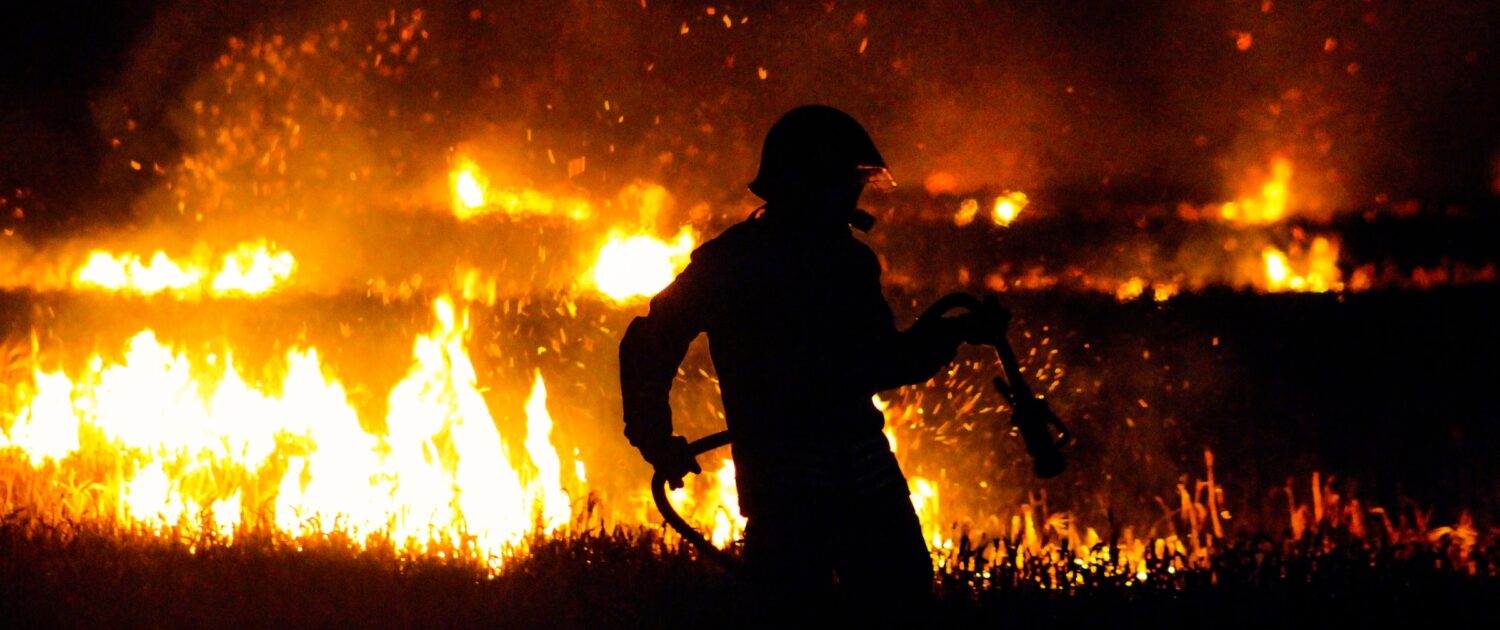
Fig. 1:Rapidly securing the affected areas immediately after the fire beginning is a key factor to limit the damage severity to the natural environment and the local people. Photo by Fabian Jones (February 2021).

AFTER

Similarly to forest fire causes analysis, fire consequences study is complex and must consider several factors that may seem quite different from each other at first glance. While emergency response is not always decisive and effective, prevention and proper management of forests and adjacent areas are crucial for limiting fires [1]. Yet, fire departments and rescue teams are indispensable when the fire is in action.

Damages from forest fires are several and of different nature because fires harm both the environment and the safety of the people living in the affected areas. In their post-fire management analysis, the Italian Society of Forestry and Forest Ecology (“SISEF”) stresses the need to promptly monitor the damage severity and quickly secure the affected areas [6].

These measures are undertaken in the very first weeks after the fire occurs. They must be activated as soon as possible and before the fire is totally extinguished. Indeed, the most urgent danger to tackle is the hydrogeological instability. Many times, a fire can destroy the roots of trees and compromise the stability of the plant-soil-rock system. Moreover, it deposits light ashes on the ground, which can temporarily create a condition of soil impermeability. When the first late summer – early Fall rainfalls and storms arrive, water runoff is stronger and soil erosion cases more frequent [7].

The real fire management happens in the years and decades after the fire. As with other disturbances (windthrows, insect outbreaks, etc.), the most pressing question is whether to act or leave it to nature. To intervene, and if so, for what purpose? These questions can only be answered only through an in-depth understanding of the landscape and forest ecosystem. Finally, city and land planning must also be considered when choosing the right fire recovery, protection and prevention measures. In the end, prevention and correct management are still the best and most effective solutions.

Cover- and preview photo: Smokey bear illustration and wildfire prevention sign. Bakersfield, California (July 26, 2021). Free-source photo by Brian Wangenheim en Unsplash.

Figura 1:Silhoutte of a fireman working on a burning grass field (). Free-source photo by Fabian Jones en Unsplash.

Bibliography:

[1] Gecchelin, M. (2022, March 15). Adapt or burn. A look at the dramatic increase of wildfires in Italy to get ready for summer 2022. GreenMarked. https://greenmarked.it/adapt-or-burn-the-2021-wildfire-season-italy/.

[2] il Dolomiti. (2022, March 23). Le fiamme divorano il bosco fra Longarone e Zoldo. Arrivano i Canadair e gli elicotteri: Chiusa la provinciale. il Dolomiti. https://www.ildolomiti.it/cronaca/2022/le-fiamme-divorano-il-bosco-fra-longarone-e-zoldo-arrivano-i-canadair-e-gli-elicotteri-chiusa-la-provinciale.

[3] Corpo Forestale dello Stato. (2001). Le cause degli incendi boschivi. https://www.sistemaprotezionecivile.it/allegati/140_Cause_degli_incendi_boschivi.pdf.

[4] Greenpeace Onlus. (2020). Un paese che brucia: Il report sui cambiamenti climatici e gli incendi boschivi in Italia a cura di GREENPEACE e SISEF (p. 33). Greenpeace Onlus. https://www.greenpeace.org/static/planet4-italy-stateless/2020/08/1e5628b6-report_incendicc_finale.pdf.

[5] Rositi, A., Lovreglio, R., & SISEF, G. (2021, December 10). Il 2020 in incendi: Il rapporto EFFIS. SISEF. https://sisef.org/2021/12/10/il-2020-in-incendi-il-rapporto-effis/.

[6] Marzano, R. (2021, August 19). La gestione post-incendio inizia prima che le fiamme siano spente. SISEF. https://sisef.org/2021/08/19/la-gestione-post-incendio-inizia-prima-che-le-fiamme-siano-spente/.

[7] Ortolani, F. (n.d.). Gli incendi boschivi? Premesse di catastrofi idrogeologiche. Università degli Studi di Napoli Federico II. Retrieved April 11, 2022, from http://www.unina.it/-/1326892-gli-incendi-boschivi-premesse-di-catastrofi-idrogeologiche.

Telegram: @greenmarked
LinkedIn: @greenmarked
Instagram: @greenmarked.it

Facebook:  @greenmarked.it


© GreenMarked.it is managed by ECONTROVERTIA APS — Via Alcide De Gasperi 1, 38015 Lavis (TN), Italy — VAT IT02667560227