El aire de las ciudades italianas sigue estando demasiado contaminado. Así lo confirma el último informe de Legambiente, Mal’Aria 2025, que subraya el retraso de Italia en la protección de la calidad del aire [1]. A pesar de las políticas medioambientales y los esfuerzos por reducir las emisiones, los niveles de partículas finas (PM10 y PM2,5) siguen estando por encima de los límites de seguridad..
En 2024, hasta 25 ciudades superaron el límite de 35 días al año con concentraciones de PM10 superiores a 50 µg/m³, el umbral establecido por la normativa europea. A la cabeza de la clasificación se encuentra Frosinone, al sur de Roma, con 70 días por encima del límite, seguida de Milán con 68, Turín con 55, Padua con 53 y Venecia con 52.
Annual average values also remain well above the limits the World Health Organization (WHO) recommended. In 2023, Milan and Cremona recorded an average of 31 µg/m³ of PM2.5, while the maximum level recommended by the WHO is just 5 µg/m³ [2].
Estas seis ciudades comparten factores comunes que afectan a la calidad del aire, como el tráfico de vehículos pesados y las actividades industriales, ambas fuentes importantes de emisiones, así como las condiciones geográficas y meteorológicas que dificultan la dispersión de los contaminantes. Sin embargo, esta discrepancia con respecto a los límites recomendados muestra lo lejos que está Italia de garantizar unos estándares de calidad del aire que protejan realmente la salud pública [1].
In this regard, the European Union has recently revised the maximum annual average concentration limit for PM10. Starting in 2030 — just five years from now — it will be lowered to 20 µg/m³, exactly half of the current limit of 40 µg/m³. The WHO’s recommended limit is even stricter, at 15 µg/m³ [2].
El verdadero desafío será garantizar que más de unas pocas ciudades se mantengan dentro de este nuevo umbral. Si incluso Trento, una ciudad sin grandes problemas de contaminación y con planes existentes para la movilidad sostenible y la energía renovable , registró una concentración media anual de PM10 de 29 µg/m³ en 2024, el camino hacia la mejora para otras ciudades será aún más empinado.
Para mejorar la calidad del aire y proteger la salud pública, la organización Legambientehace hincapié en la necesidad de replantearse la gestión del tráfico en las grandes ciudades, reduciendo el número de vehículos que funcionan con combustibles fósiles. Entre las soluciones clave se incluyen ampliar deas Zonas de Bajas Emisiones, promover la movilidad eléctrica y transformar los centros urbanos en "Ciudades de 30 km/h", donde los límites de velocidad más bajos fomentan una movilidad más segura y sostenible [1].
Sin embargo, la lucha contra la contaminación no se limita al transporte. La mejora de la eficiencia energética en los edificios y la modernización de los sistemas de calefacción también son pasos cruciales para reducir el consumo y las emisiones.
Por último, la educación medioambiental y la concienciación pública desempeñan un papel fundamental. Las políticas y las intervenciones estructurales por sí solas no son suficientes: es esencial involucrar a los ciudadanos, concienciar sobre los beneficios de un aire más limpio y promover comportamientos responsables tanto a nivel individual como colectivo [1].
Mejorar la calidad del aire es una necesidad urgente de salud pública. Las ciudades italianas aún están lejos de cumplir con los estándares europeos y de la OMS, pero el cambio es posible. Sin embargo, se necesitan acciones más firmes. Sin una aceleración de las políticas medioambientales y una mayor concienciación pública, la transición hacia un aire más limpio corre el riesgo de ser demasiado lenta.
Este artículo forma parte del proyecto "Quiz Ambientali per un Trentino Più Verde!" llevado a cabo por Econtrovertia APS y patrocinado por la Fondazione Cassa Rurale di Trento (Notificación de aprobación del 20 de diciembre de 2024).
We will remember the summer of 2023 for many things, but one of them is surely the extreme hailstorms that hit all of northeastern Italy in July. Hail of this size (the record at Azzano Decimo, in the province of Pordenone, with a diameter of 19 cm) had never been seen, much less had such frequent hailstorms been recorded (four consecutive days with hailstones larger than 10 cm in diameter, in Lombardy, Emilia-Romagna, Veneto, and Friuli-Venezia Giulia). Damage to property and homes was very extensive in all the provinces of northeastern Italy.
Trentino, too, is not exempt from this phenomenon, with 70 percent of the provincial territory affected: many farmers saw a year’s harvest lost in a matter of seconds despite anti-hail nets and a Civil Defense prevention and defense service.
Fig. 1: An apple orchard equipped with anti-hail nets. Recently many farmers saw a year’s harvest lost in a matter of seconds despite anti-hail nets. Free source photo by adege downloaded from Pixabay.
One wonders whether such phenomena should be considered the new normal and, in general, whether climate change will cause new situations that are completely unexpected and inevitable.
Whatever the reason, it is worth understanding the reasons why hail forms. Hail comes with thunderstorms: the triggering mechanism thus needs warm, moist air that rises upward when it is found to be lighter than the surrounding air. When this process occurs intensely or for a long time, the clouds that are generated can become very high (as much as 12,000 meters) and turn into what meteorologists call cumulonimbus. As it rises upward, the air drags along with it water droplets that, at a certain altitude, freeze: that’s when the hailstone is born.
The different size of the hailstones lies in the presence of supersaturated water inside the cloud that remains liquid even at subzero temperatures (this is possible due to the fact that the water is pure and the droplets are very small). In cases like these, the hailstone that is moving upward bumps into the supersaturated droplets causing them to instantly freeze on its surface. In July 2023, the high temperatures recorded throughout northeastern Italy accentuated this phenomenon. These phenomena allow the hailstone to get wet but rise again by re-icing in a cycle that can occur countless times. This is why the operation of cutting a hailstone, would show that the hailstone has growth layers like an onion.
The European Severe Storm Laboratory (ESSL) investigates the most intense weather phenomena and states that hailstorms with hailstones larger than 2 cm in diameter have more than tripled in the past 16 years across Europe. A study by the same laboratory simulated 24 different climate scenarios between now and 2100, and all projections show a substantial increase (from 47 to 139 %) in large hailstorms (hailstones greater than 5 cm in diameter) between now and 2100 [1]. So it is obvious that we will have to get used to phenomena of this magnitude: global warming, which favors the formation of extreme weather phenomena because it increases evaporation of moist air, shows no sign of letting up. The problem is global, but northeastern Italy has already been one of the most hail-prone areas in Europe for years because it naturally, by its very morphology, retains heat and is surrounded by mountains [2].
Italy is within a hail hotspot that is the Mediterranean so we need to find ways to mitigate the deleterious effectsthat a phenomenon of this magnitude, will inevitably cause.
This article is part of the project “PILLOLE D’ACQUA PIANA: seminari itineranti, blog e podcast per una gestione sostenibile delle risorse idriche in Piana Rotaliana” carried out by ECONTROVERTIA APS and supported by Fondazione Caritro (Prot. no. U445.2023/SG.386 of April 23, 2023).
The National Climate Change Adaptation Strategy has been adopted in Italy since 2015 [1]. And already in the Strategy documents, scientific knowledge about the Country’s impacts and vulnerabilities to climate change are outlined with evident clarity and an analysis of the relevant national and EU regulations on the subject.
The Plan of the same name, currently undergoing Strategic Environmental Assessment (SEA), aims to implement the Strategy in order to provide a guiding tool for planning more effective adaptation actions for Italian territory [2]. However, the critical issues and shortcomings of the Plan appear to be numerous, particularly regarding the real effectiveness, pragmatism and feasibility of the proposed actions [3].
But let us go in order. The conceptual innovativeness of the Plan (and even before, of the Strategy) is evident right from the title. Traditionally – to be clear, at the time of the Earth Summit (1992) [4] – the fight against climate change sees only one action: mitigation. And indeed, by the early 1990s, the consideration is not incorrect. And nothing else mitigation provides for what precisely we have been trying to implement for the past 30 years: reduction of anthropogenic greenhouse gas emissions, that is, actions aimed at combating the very causes of climate change, which are clearly man-made.Instead, the novelty present in the Plan and Strategy sees the introduction of the concept of adaptation, which – from my personal naturalistic-forestry perspective – I certainly like.
Adaptation
Adaptation involves – just as animals and plants themselves do in nature – the realization that climate change is happening, exists, and persists. If it is not possible to undo them or at least reduce their triggers through mitigation actions, it is necessary to cope with them by adapting to them, in a world that is certainly different (and warmer, trivializing) but still livable.
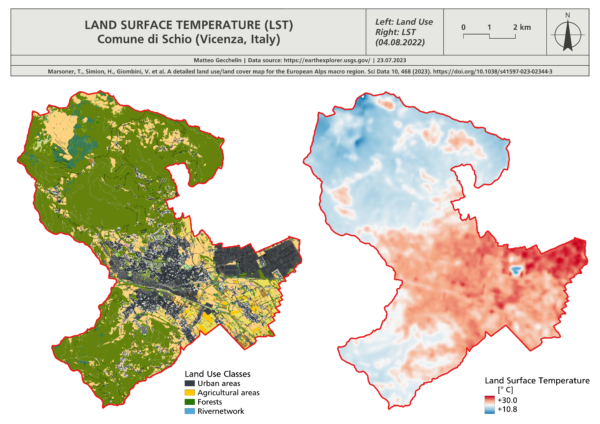
Let’s start with a simple yet effective example. The images in Figure 1 refer to the territory of the Municipality of Schio (Vicenza, Italy) and show the land use (on the left) and the corresponding Land Surface Temperature (LST, on the right) measured on August 04, 2022, by the Landsat 9 Satellite. A detailed image of the territory of Schio, colored by LST value, can also be seen in the cover image.
There is no doubt that for the areas of the territory occupied by man-made surfaces (industrial, residential, commercial areas: in grey and yellow on the map) the LST is clearly higher. On the contrary, the forested and grassland areas (in green) show lower temperatures, with a maximum of even 20 °C difference measured between the mountainous forested areas in the northwest in comparison with the industrial area in the east of the territory. A quick analysis of the data reveals the following average LST values by land use category:
Even taking into account a significant altitudinal difference between urban areas (predominantly developed in the valley) and forests (prevalent in the hilly and mountainous areas), the differences in terms of temperature are evident.
In addition, when analyzing the average temperature for urban green areas alone, a value of 24.3 °C emerges, which, albeit minimally, is lower than the average value for entire urban areas.
Fig. 1: Land Surface Temperature (LST) and Land Use Map, Municipality of Schio (Vicenza, Italy). Author.
These urban green areas perfectly represent the concept of adaptation. It may seem trite to state it, and, unquestionably, we are all aware of it, but where there is greenery, especially in the city, measured and perceived temperatures are also lower than in otherwise man-made areas.And indeed, such a concept of “green adaptation” also emerges among the strategies proposed by the Plan under the name of “nature-based solutions.” And yet, as already remarked [3], such green strategies seem lacking and underestimated in the Italian context, although strongly encouraged and recommended by European strategies [5].
Among the latter, are at least to be cited the so-called “integrated solutions” involving the development of spatial connectivity by means of green infrastructure (two plus points: ecological connectivity for animal and plant species and climate change adaptation measure) and all other solutions based on ecosystem services (forestry and agro-forestry, river, coastal, and marine), even if not better specified.
In addition, equally noteworthy are the actions defined in the Governance macro-category, Plans and Strategy category, where the following are at least taken into consideration: (1) Protected Areas Management; (2) Fire Risk Management; (3) Forestry Planning; (4) Hydrographic District Planning; and (5) Hydrogeological Structure Plans. These are all subjects that have a very strong connection with the territory, not only in terms of urban and territorial planning, but also in terms of the development of the local economy and the safeguarding and safety of the population, and yet they are often disregarded or taken into consideration only after the occurrence of extreme and disastrous phenomena, in response always to the consequences and almost never to the triggering causes nor with a view to prevention [6]. What specifically these actions pertaining to sector planning entail is not known from the Plan. However, it is already a first step that at least these actions are remembered and mentioned as being of interest to the legislature.
Finally, it is good to remember how any strategic action to be activated on a nationwide scale cannot be separated from collaboration both among all stakeholders for the sector and among all funding and planning instruments at the national and local levels. The challenge for mitigation or, in this case, for adaptation to climate change sees us all as key players. The local scale (as demonstrated by the heatwave example for the small provincial municipality reported here) is not beyond the scope of global dynamics, and strategic directions at every level must be aware of this, giving rise to actions and incentives that are truly capable of influencing (positively) the development of effective and resilient adaptation in the face of expected adversity.
This article is part of the project “PILLOLE D’ACQUA PIANA: seminari itineranti, blog e podcast per una gestione sostenibile delle risorse idriche in Piana Rotaliana” carried out by ECONTROVERTIA APS and supported by Fondazione Caritro (Prot. no. U445.2023/SG.386 of April 23, 2023).
Still reminding of this winter drought, in Italy, we are approaching summer with a low level of water severity throughout the peninsula. It means that in the short term, we will not have problems with drinking water shortages [1]. However, waiting and hoping for a change, that the waterways will fill up again following the same dynamics as in the past, is unacceptable. Real and tangible solutions are needed to address the water crisis.
What technological solutions are available?
There are two systems for recycling water from the sea, and industrial and public wastewater to date: distillation and hyperfiltration, also known as reverse osmosis desalination.
Distillation splits salts and water by boiling the solution and then condensing the vapor. In other words, the saline solution boils in large tanks, and by condensing the water vapor in a different tank, clean water is produced.
In reverse osmosis desalination, on the other hand, salty or seawater pass through membranes that act as filters, separating the salt molecules from the water molecules. Therefore, making it suitable for agricultural, industrial or even drinking uses [2].
While with the former technique the process is thermal, with the latter it is mechanical and the purity of the water produced depends on the cross-section of the filters. However, both methods are extremely expensive because they require massive amounts of energy [2]. In fact, desalinating 1 cubic meter of seawater requires about 1 kWh or more of energy [3].
In addition, hyperfiltration presents some risks to the environment. First and foremost, the wastewater must be disposed of appropriately because it is hypersaline. Then, small fish and plankton, often get trapped in the pores of filters. The result is damage to the local trophic chain [2].
Where are these technologies already a reality?
Reverse osmosis desalination is already a widely used method, especially in Middle Eastern countries, where it is the most widely used drinking water supply method, given the scarcity of freshwater supplies.
Saudi Arabia holds the largest global desalination capacity with more than 5.5 million m³ of drinking water produced daily. Follows the United Arab Emirates, where the drinking water supply agencies of Abu Dhabi and Dubai produce 3.9 million m³ and 2.3 million m³ per day, respectively [4].
This technology is also widely used in the United States, particularly in California and Florida. But also in Pacific countries, such as Japan, South Korea, and Hong Kong.
Although little known, this process is also an affirmed reality in Europe. Spain is the leading producer of drinking water from hyperfiltration, producing 1.6 million cubic meters daily. In second place there is Italy, extracting about 200,000 cubic meters per day. Follow Cyprus, Malta and Greece [4].
New developments on the horizon?
The main focus of current research is to improve the efficiency of this process to reduce the prohibitive costs. Richard Muller, Professor of Physics at UC Berkeley, emphasizes a vital concept: “The world doesn’t have a shortage of water; it has a shortage of cheap water”. Only if the costs of desalination would fall down, this method will be considered a tangible way to solve the global shortage of drinking water [3].
Good news comes from the University of Texas. An article published on Science reveals that the density and mass distribution of the material used to make the osmotic membrane are the basis for more efficient filtration. A perfectly regular nanoscale membrane can purify a much higher amount of water, with a substantial cost advantage per liter of drinking water that would save up to 40 % of the energy required [5].
Another research, published on Nature Sustainability, proposes a type of metal-organic membrane (MOF, Metal-Organic-Framework), whose properties would allow seawater to be filtered mechanically, thanks to the porosity of the membrane, coupled with the added value of sunlight that allows water purification without the use of chemicals [6].
Technological development is certainly making great strides to make hyperfiltration an efficient process. Once the correct key is found, however, we will still keep in mind two things: the environmental risks that hypersaline wastewaters represent, and that drinking water – no matter how it is produced – remains a valuable resource that should not be wasted.
This article is part of the project “PILLOLE D’ACQUA PIANA: seminari itineranti, blog e podcast per una gestione sostenibile delle risorse idriche in Piana Rotaliana” carried out by ECONTROVERTIA APS and supported by Fondazione Caritro (Prot. no. U445.2023/SG.386 of April 23, 2023).
The drought, a consequence of the climate crisis we are experiencing, is real. In the previous article we talked about the current situation in Italy and how citizens perceive the problem. We should not despair but be aware of the problem and try to adapt as best we can.
In fact, the Italian government has recently issued a decree to set up a steering committee for the water crisis and the appointment of an extraordinary national Commissioner for the adoption of urgent interventions related to the water scarcity phenomenon. [1]
The information that the committee and the commissioner will have to evaluate regarding the state of water resources is often provided by regional bodies, which makes it complicated to have an overall picture of the situation updated quickly. For this reason, a permanent drought observatory (ADO) has been set up for the Alpine area, a project led by Eurac Research of Bolzano together with several national and international partners, funded by the Interreg Alpine Space Programme, co-funded by the European Union. [2]
The Alpine Drought Observatory (ADO) aims to create an online drought monitoring platform and develop policy implementation guidelines for proactive drought management in the Alpine Space region. [3]
Video 1: A video produced by the ADO, illustrating the drought issue from multiple point of views and why this cooperative project is necessary.
The ADO portal makes it possible to visually assess the current drought situation in the Alps via an interactive map. For each predefined area, various indicators are available.
Indices
We could start looking into the indices, numerical indicators computed starting from satellite data that describe:
Atmosphere: Precipitation Anomalies (%) and Standardised Precipitation Index (SPI)
Top-Soil: Standardized Precipitation-Evapotranspiration Index (SPEI) and Soil Moisture Anomalies
Vegetation Health: Normalized Difference Vegetation Index (NDVI) and Vegetation Health Index (VHI)
Surface- and Ground-Water: Standardized Snowpack Index (SSPI) and Hydrological Indices (SDI, SGI, ..)
The interactive map allows you to view the trend of these data over time by clicking on the area of interest, which allows us to evaluate the data in comparison to even 40 years ago!
Fig. 1: The interactive time series viewer on the ADO website, allowing you to analyse and compare data starting from 1980.
Impacts
Another set of indicators available on the platform are impacts. You could for instance check the reported impacts of drought during the previous years in a specific region just selecting “Reported Impacts” and then clicking the area of interest. Additionally you can as well investigate impact probabilities and related risks.
Fig. 2: The interactive impact reports on the ADO website.
Vulnerabilities
The vulnerability factor identifies factors contributing to agriculture’s vulnerability to drought. The factors are:
Farm size
Livestock density
High input farming
Production intensity
Utilised agricultural area
Share of permanent grassland
All the factors are described in details on the website, please have a look there if you would like to know more on a specific indicator.
Fig. 3: The vulnerability factors showed on the interactive map on the ADO website. You can choose from multiple factors and get all the details about them with one click.
Try it!
All the described functionalities are open to everyone visiting the website. If you would like to test all of this, you can also try it out directly in the embedded version of the website below, or visit the ado.eurac.edu webpage.
The correct information and dissemination of problems related to the climate crisis, such as that of drought, can certainly benefit from projects such as ADO, which make information that until recently remained confined to researchers and insiders more accessible and within everyone’s reach.
This article is part of the project “PILLOLE D’ACQUA PIANA: seminari itineranti, blog e podcast per una gestione sostenibile delle risorse idriche in Piana Rotaliana” carried out by ECONTROVERTIA APS and supported by Fondazione Caritro (Prot. no. U445.2023/SG.386 of April 23, 2023).
The word “drought” has recently returned to our vocabulary. First used sporadically, it is now becoming almost a daily recurrence. We hear it in news reports, social media posts, and exclamations and mutterings of people near lakes, rivers or streams. As GreenMarked, we have written about it in the past (The Aftermath of Exceptional Droughts; How much water does your 24-hours day consume?) and will continue doing it in the future.
Nonetheless, it seems that Italians’ awareness of droughts is not very high. In mid-2021, a poll by Ipsus reported that only 20 % of the Italian population is concerned about the state of water resources. Moreover, 70 % of respondents considered drought as an exclusive issue of specific areas or times of the year. The most significant number of concerned citizens was in Southern Italy, where 25 % of the population is aware of the problem. In the Northwest, the percentage is 16 %, 19 % in the Northeast, and 22 % in Center Italy [1].
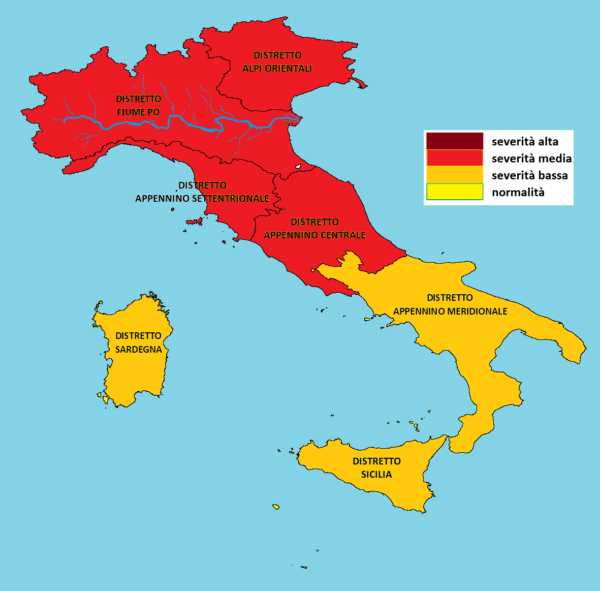
And yet, according to the Environmental Protection and Research Center (Istituto Superiore per la Protezione e la Ricerca Ambientale – “ISPRA”), the inhabitants of northern and central Italy are those who have to worry the most about droughts.Following a low precipitation winter, the Po River, Eastern Alps, and Northern and Central Apennines hydrographic districts are registering MEDIUM water severity levels. In other words, the seasonal flows are lower-than-average, water demands are higher-than-standard, and water reservoirs cannot guarantee a regular delivery rate. Consequently, there is a high risk of economic losses and impacts on the environment. Conversely, the hydrographic districts of the Southern Apennines, Sicily and Sardinia showed LOW water severity levels at the beginning of April, and water demand was still met [2].
The district water severity level is given by the level average of many water bodies in the district. The Po River district, for example, has a medium water scarcity level that has been calculated from average monthly flow values reporting a condition of “severe” and “extreme” drought [2]. The same happened in the Eastern Alps district this winter. The Adige, Brenta-Bacchiglione, Livenza, Piave and Tagliamento river basins have recorded water severity levels corresponding to “moderate and severe drought”, and yet, at the district level, the average value corresponded to “medium water severity level” [3].
Fig. 1: Map illustration of the water scarcity levels in Italy. Image by GreenMarked. Data by ISPRA [2].
The other side of the coin is extreme precipitation events. Especially in summer, droughts are characterized by high temperatures and long periods without rain, and they are interrupted by severe thunderstorms that cause extensive economic-social and environmental damage. Damages are related to the rainfall intensity and excessive runoff, which often causes flooding and hydrogeological disruptions.
The perception lack of droughts increases the danger related to hydrogeological risk, which affects 94 % of the Italian municipalities. “More than 8 million people live in areas of high danger, often not being aware of it”, reported the Director of the National Association for the Management and Protection of the Territory and Irrigated Waters (“ANBI”). “This lack of knowledge is often an exacerbating factor when it comes to emergencies” [4].
It is, thus, necessary to continue to talk about droughts, extreme events, and the climate crisis to increase people’s awareness and make citizens ready, trained, and able to deal with emergencies.
However, treating droughts as an emergency and merely considering it in the short term is a serious mistake. The models and data acquired by the authorities depicted a situation that needs to be addressed with a medium-to-long-term strategy. Only by doing so, we can adapt to the climate crisis, manage the available water resource to the best, and make the water network as efficient as possible [5].
This article is part of the project “PILLOLE D’ACQUA PIANA: seminari itineranti, blog e podcast per una gestione sostenibile delle risorse idriche in Piana Rotaliana” carried out by ECONTROVERTIA APS and supported by Fondazione Caritro (Prot. no. U445.2023/SG.386 of April 23, 2023).
The above are just a couple of the plenty definitions of Monumental Trees taken from the Italian Law no. 10/2013 of 14 January 2013 – Standards for the development of urban green spaces, comprising Art. 7, which precisely lists provisions for the protection and preservation of monumental trees.
As it is often the case with the Italian legislation, also the legal framework of Monumental Trees is complex. And defining, identifying and, consequently, protecting a Monumental Tree is not always a simple affair.
Why, then, is it called a “Monumental Tree”? The most straightforward answer might well be, “because it is big” or “because it is so old”. Yet, it is precisely the word “Monumental” that gives meaning to the whole story. Indeed, a monument as such may well be big and old, but it could also represent a historical symbol of collective memory, or tradition for a community, a country or even an entire nation. And all of this is particularly well defined in Italy’s legislation, which includes Monumental Trees in a law mainly dedicated to green spaces in urban areas.
Many of Italy’s Monumental Trees are very old, but not all of them. And their age alone is not enough to define them as monumental. Other defining parameters are their biological importance – therefore, whether the tree is a rare or threatened species – and their ecological importance, thus the importance of the tree in its surrounding landscape. The same may well be true for non-native species, if they represent a rarity, an example of beauty (or strangeness) in their surrounding context.
As a matter of fact, the profound importance of a Monumental Tree is given by its visibility, or relevance for a urban area or landscape, meaning by the latter “[…] a land extension, as perceived by populations, […] shaped by the action of natural and/or human factors and their interrelations” [2]. It is thus no coincidence that most Monumental Trees are found in historic parks and gardens, villas, city centers, tree-lined avenues, and very few times within forests (who could see them?).
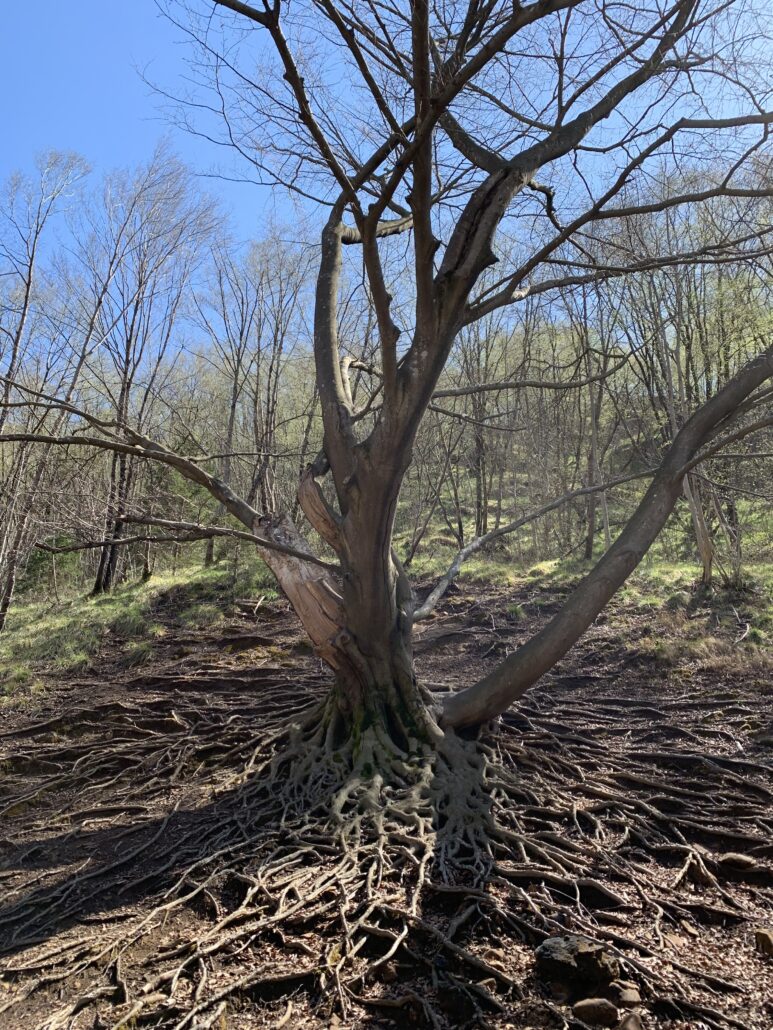
Fig. 1: Age and size are not the only and obligatorily features used to define a monumental tree. “Shape and bearing” (i.e., strangeness or beauty of the tree) also contribute to the definition. A great beech, non-monumental tree in Cison di Valmarino (Treviso, Italy). Photo by Author (April 10, 2022).
But then, is the large cedar tree that stands in the city square a Monumental Tree?
If someone ever asks you the same question, be well assured of the answer, “It depends!”. It depends, because that cedar may be as big, tall and old as you want, but if no one has ever declared it as Monumental, it is not.
Yes, it is always the law that rules over everything. And the definition of “Monumental Tree” is only a legal definition. Something for technicians, city administrations, foresters and regional public agencies.
And yet, everybody can at least inquire if a big tree is a Monumental Tree or not, and if it should be protected by the municipality that houses it. Reporting a potential Monumental Tree to the city offices will often push them to conduct a census and update the Monumental Trees database together with the competent regional authorities.
To date (last update: July 2022), the National Italian Monumental Trees Register counts more than 4000 trees [3]. In the Veneto region, there are 244 Monumental Trees, in the Autonomous Province of Trento, 85 and in the Autonomous Province of Bolzano, 40.
What do monumental tree species tell us about the history of our communities?
From a quick analysis of the tree species included in the register, one can understand the anthropological and cultural importance of specific trees for their territories.
En el Veneto, most Monumental Trees are beech trees (Fagus sylvatica), Himalayan cedars (Cedrus deodara) and common plane trees (Platanus acerifolia). All three tree species have been part of Veneto’s economy, culture and urbanization for centuries.
Just think of the economic importance of beech wood for pre-Alpine Mountain communities. In ancient times, they developed complex tree management systems such as the “ceduo a sterzo” system, and today’s forestry activities are still key for the local firewood market. It is no coincidence that we find the finest examples of monumental beech trees on the “Altopiano dei Sette Comuni” hihgland, the province of Vicenza, Verona’s Lessinia, the Grappa area and the Agno valley.
Por el contrario, cedar trees dominate in prominent locations of urban areas such as Parco Querini in Vicenza, Alessandro Rossi’s Villa in Piovene Rocchette, Villa Bolasco in Castelfranco Veneto, and Via Monte Grappa in Belluno. Indeed, the taste for beauty of the traditional Villa Veneta architectural style has often promoted cedar trees, a purely ornamental species imported for the purpose of beautifying parks, villas and gardens since the early decades of the 19th century.
Finally, the common plane tree: a rustic, leathery, imposing tree, resistant to pollution and … accidents! Hard to scratch, hard to die and, therefore, the perfect guardrail for the region’s roads. And even earlier, the perfect boundary marker to be placed along the ditches of different agricultural properties.
For Trentino, the matter is even simpler, with beech having the same historical reasons as in Veneto, and larch (Larix decidua) playing the leading role. Spruces and larches are the two major players in Trentino’s forests. While spruce has been considered for centuries a “disposable” species, to use and consume by alpine forestry, larches have always been spared and considered of precious value by mountain foresters. Additionally, larches grow where nothing else comes close. The most famous case? The staircase of monumental larches in the Rabbi valley, where trees (more than twenty and all gigantic) rise directly from a boulder field.
What about Bolzano? No, no firs or pines, but rather a dense presence of monumental chestnut trees, almost all of them located in non-urban settings. Why? “Shape and bearing”, again: These chestnut trees are often very large and acquire rather strange and twisted shapes because they are left on their own, without the pruning of a gardener.
Monumental Trees are the witnesses of our past, and in their silent presence they act as spokespersons for rural, urban culture and local traditions. As with our great elders, it is up to us to locate them, protect them, and why not… love them too!
The holiday season has also been archived for this winter. We all attended big lunches and dinners, bought and wrapped gifts for our loved ones and ourselves. Besides many good memories, what are we left with? A mountain of waste and packaging to dispose of! Not surprisingly, a recent analysis by Transport & Environment [1] reports how this Christmas brings a +133 % spike in pollution caused by the logistics of transporting goods.
Although we all try to pay attention to how to dispose of this packaging by sorting it as best we can, by now this is no longer enough: according to the April 2022 report by ECCO [2] in 2020 almost 100 kg per person of plastic was consumed in Italy: we are the second in Europe and that is nothing to be proud of. About 40 percent of this plastic is turned into packaging, which will end up in supermarkets and then in our homes especially at parties and banquets. Sadly, much of this plastic waste will never be recycled [3]. We have covered this issue previously, talking about how some packaging should be redesigned from scratch.
The European Union (“EU”) is trying to put a stop to this with the Circular Economy Package. The Circular Economy Package [4] and the new EU Packaging Regulation [5], approved in late November 2022, wants to improve the entire sector, from disposable to bioplastic packaging. Included in this regulatory package are targets related to reducing and reusing packaging, leading to limiting single-use as much as possible. Europe Direct’s Florence page has created an excellent list of questions and answers on the topic that we recommend reading.
In Italy, the legislation has been widely criticized by Stefan Pan [6], Confindustria’s delegate for Europe in an interview with Sole 24 Ore, who speaks of disastrous scenarios for Italy’s excellent recycling supply chain caused by this new legislation. FederDistribuzione and CONAI are also of the same opinion, expressing fears of the fallout on Italian industries.
Not surprisingly, during the press conference for the presentation of the circular economy regulatory package, European Commission Vice President in charge of the Green Deal Frans Timmermans spoke in Italian to reassure on the objectives of the legislation. You can listen to him in this excerpt from the press conference:
So on the one hand we have Europe trying to give clear directions on how to proceed and on the other the industrial lobbies struggling to adapt but will have to do so anyway.
“Reuse is not in competition with recycling” Frans Timmermans
But there are also other players on this chessboard: citizens, the media, associations and nongovernmental organizations (NGOs). Among all the environmental organizations, GreenPeace launched a major initiative together with ilfattoquotidiano.it called “Plastic Carts” [7]. This initiative sought to assess actions to reduce the packaging of the largest supermarket chains in Italy. The report draws a tragic situation for almost all the chains involved.
This survey highlights another important fact: Law No. 141 of 2019, also referred to as the Climate Decree, allows supermarket customers to “use their own containers as long as they are reusable, clean, and suitable for food use,” but both citizens and merchants are not informed and prepared for this possibility [8].
Did you know that in Italy, thanks to Law 141 of 2019, you can use your reusable bulk containers in all supermarkets?
We cannot forget to mention the initiative “A Buon Rendere – molto più di un vuoto” [9] launched by the Associazione Comuni Virtuosi and other partners, which “aims to facilitate the transition to a circular economy in the packaging sector” by introducing a national deposit deposit system (DRS). In exchange for a deposit on the packaging of the beverage purchased (plastic or glass bottle or can), this system would allow some containers to be reused or at least improve recycling collection and the quality of recyclable material. The deposit system on beverage packaging has existed and worked for decades in countries such as Austria and Germany, and other countries have since adopted it as well.
As we have seen, the situation is constantly evolving thanks to both the European Commission and nongovernmental organizations, but also thanks to citizens who are not simply adapting to the status quo and are reacting with ideas and pressure aimed at a better future for everyone.
Let us try to reason together: to make cheese you need milk, to make milk you need a cow, to farm a cow you need a farmer, to work, what does a farmer need? Passion, a barn, farm equipment, fields and… incentives! Brutally speaking, money.
But then, is it all that simple? As a South Tyrolean farmer would well answer: «Jein». Yes and no. In short, and as it often happens “it depends”.
The Society for the Study and Enhancement of Alpine Livestock Systems (“SoZooAlp”) defines the dissemination of «the productive, social, cultural, ecological, tourist and educational importance of livestock activities implemented in the Alpine Arc» as its first objective [3].
Connecting the two aspects of production diversification and energy crisis was well addressed at October’s “First Summit on Mountain Livestock” in Bergamo. Among other actors, Alleanza Cooperative Agroalimentari, which brings together most of the milk collection and processing cooperatives operating in mountain territories, joined the summit.
Fig. 1:Diversification of production ensures resilience and stability against market trends and consumers’ demand. In addition, a “multifunctional” farming, implementing both food production and a variety of collateral environmental, social, and cultural activities, can reinforce its agricultural income and competitiveness in the market. Free-source photo by Vane Monte en Pixabay.
The gathered data shows that in Trentino, milk production loss reached a peak of 15 %, with a total of 30 farms closed over the past year. And Veneto is not looking better: Lattebusche recorded a 6 % milk production loss in the province of Belluno [4]. And the explanation of this case is simple: milk – and therefore cheese – are decreasing because those who produce them are decreasing. And producers are no longer there because producing milk costs more than the profits that can be derived from it.
Some numbers? Just look at the national average price increase for energy (+60 %), fodder (+95 %), diesel oil (+110 %) and electricity bills (+500 %) [5]. Bingo!
The short-term and more than logical solution to pass on some of the increased costs to end-consumers was already tried by our farmers. However, those in the industry sector are not new to this either. In the past, the attempt of increasing butter prices resulted into a drastic drop of demand [4].
Other solutions to generate immediate cash and a secure the farm’s income can be the quick slaughtering of the least productive dairy cows or even the complete decommissioning of the barn [6].
And when a barn in the mountains shuts down, such action «is difficult to reverse, and has serious consequences, not only socioeconomic, but also for the maintenance of the delicate landscape and environmental balance of the mountain territory” [7].
In fact, if the energy crisis had not affected the sector, production differentiation would have been a winning and strategic choice for many agribusinesses, the data shows. The latest report (September 2022) from Veneto Agricoltura showed that the regional dairy sector performance for providing milk to produce certified dairy products decreased by 8.5 % compared to the previous five years [8]. This means that compared to 2011, less milk is dedicated to PDO (“Protected designation of origin”) products only. According to Venerto Agricoltura, this is a sign of a successful attempt of dairy farms to differentiate production aimed at increasing producers’ resilience against market demands and raw material trends.
And this interpretation was echoed in the Bergamo Summit. In response to the worrying market predictions, the Summit strongly recommended companies to invest in non-production business activities to secure the survival of farms with an unparalleled social, cultural, environmental and landscape value for their territory [4].
In this sense, a true “multifunctional farming”, which can directly or indirectly provide alternative social benefits to agricultural production alone [9], can prove to be a true shield against market trends and future economic crises. Especially in mountainous areas, where quantitative production – especially of milk and dairy products – cannot in any way compete with large farms in the plains, diversification incentives structured in the territory and shared with other stakeholders(tourism agencies, hotels, restaurants, mountain guides, traders, artisans, industries, etc.) can be good insurance against the blows of the commodity market. Additionally, multifunctional mountain farming can safeguard the livestock sector in the mountains. By locking dairy farms on the territory and making them become valuable garrisons of mountain traditions and culture they can prevent mountain abandonment.
What about in the short term?
One positive endnote from a more recent newspaper article:
Without any desire to emulate, I am pleased to take up the definition of “Forest Sovereignty” that journalist and forester Luigi Torreggiani of Compagnia delle Foreste gives. A term recently introduced by the new Italian government to rename the former Ministry of Agricultural Policies into “Ministry of Agriculture and Food and Forestry Sovereignty” (formerly MiPAAF).
“FOREST sovereignty is a model of forest resource management that does not prioritize and is not driven by profit maximization but the satisfaction of people’s need for ECOSYSTEMIC SERVICES. It promotes a sustainable type of forest production that respects the labor of those who produce FOREST-DERIVED GOODS AND SERVICES. It aims to encourage local FOREST-based economies by reducing the distance between suppliers and consumers, waste, and dependence on societies distant from the places where FOREST-DERIVED GOODS AND SERVICES are produced. Finally, FOREST sovereignty aims to enhance traditional knowledge about resource production and its transmission to future generation, and promotes the use of methods and means of managing FORESTS in an environmentally sustainable manner[1].”
From my point of view, such a description is of great quality. It describes in a concise, simple but not trivial, scientific and authoritative way the current will to action of forestry stakeholders as a whole.
In a period of crisis – energy, environmental and economic crisis – such as the one we are currently in, those involved in the forestry are crying out for solutions again and again. These, however, must combine with the solutions of other economic sectors, involve all productive bodies, consider the needs of private individuals and they must be adequately supported by public authorities. No one, least of all foresters, has a magic wand that can solve in one step all the problems we face. Yet, with everyone’s input and everyone’s will, results can be evident already today.
Today, Italy’s forestry sector suffers from a great deal of misinformation, followed by a more than trivial disinterest. Yet, all of Italy is a forested country. Forests cover approximately 11 million hectares, equivalent to 37 % of the national land [2]. So what do we do with these forests? Actually, many things: from simply doing nothing with them (yes, this is also contemplated among the “uses” of a forest) to tourism use, from edible mushrooms provision to timber production.
And here is our keystone: timber production through Sustainable Forest Management; “SFM” all together in one concept. SFM is a bit of a synthesis of many of the terms introduced in the description of Forest Sovereignty. SFM translates into local, scientific, economically viable use of wood.
The future – the bright one – sees all of us thinking globally and acting locally. And this must be as clear to us today as ever in the context of the energy crisis. A crisis caused by geopolitical tensions relatively far from our land, and yet, so penetrating in our daily life due to our energy requirements and imports. A disconnection from these imports has already begun in several mountain villages not supplied by natural gas. Where gas does not arrive, however, wood does. And wood can be rediscovered as an energy resource. The integration of woodchip boilers in district heating systems serving hundreds of private households and public agency buildings provides economic, social and ecological benefits.
Sustainable Forest Management takes into account the entire life cycle of wood processing – or in general, the forest as an ecosystem. In this case, energy needs do not determine extraction, as it has been done for years – and continues to be done – with fossil fuels. It is the possibility of energy revenue that determines the need. It represents a new concept of energy, part of a circular and nonlinear energy supply chain. All of this leads to a precise design (and implementation) of boilers and heating systems that minimize the thermal (and electrical) dispersion of the generated energy. And the same goes for the efficiency of buildings: same heating design and minimum of dispersion. Since the fuel (wood) is what it is, it must be… used parsimoniously. Because wood is indeed renewable but not endless. This is not an economic degrowth application, but rather a type of development plan that is designed in a way to ensure prosperity for us and the future generations, without taking anything away from anyone.
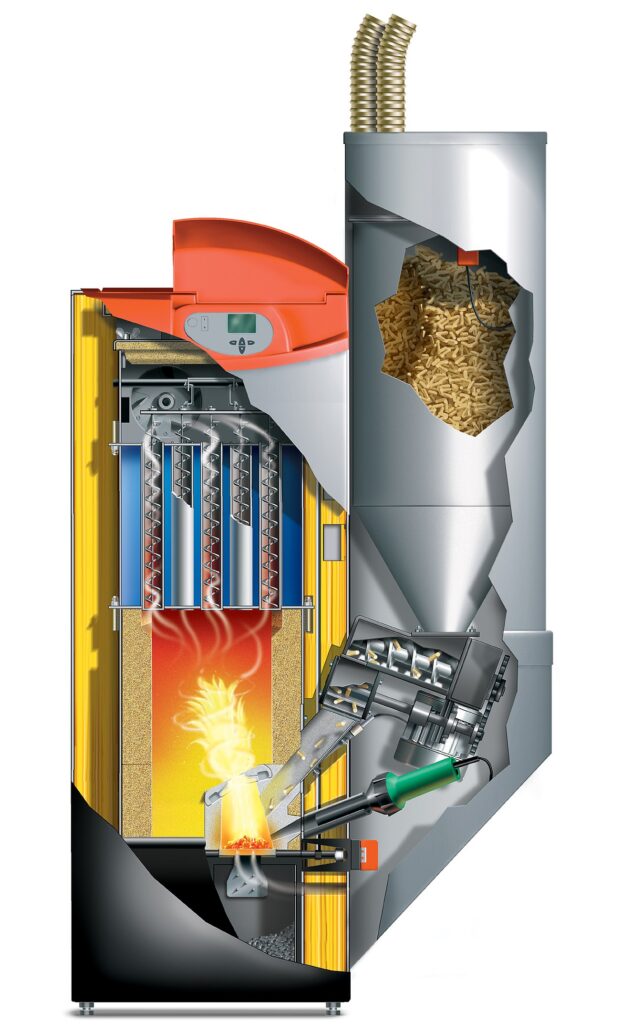
Fig. 1:Most Modern woodchip boilers and stoves ensure optimal combustion, minimize pollutants emissions and maximize energy efficiency. Free-source photo by GUNTAMATIC Heiztechnik GmbH – www.guntamatic.com, CC BY-SA 3.0, https://commons.wikimedia.org/w/index.php?curid=20200339
And thus, economic and environmental sustainability
ECONOMICALLY SUSTAINABLE because using wood ensures revenue, market, and economic prosperity for local and national companies on an otherwise unexploited product. In the view of a trickle-down economy, where the outputs of a process are the inputs of the following process, the wood supply chain “waste” material is a valuable source for energy production. From an ecological perspective, this is a perfect representation of a cycle. Where nothing comes by accident, nothing is simply thrown away and everything is exploited.
ENVIRONMENTALLY SUSTAINABLE because using wood is perfectly within the scope of the much discussed renewable energy. Obviously, in union and synergy with all the other renewable. Even though it is true that wood combustion pollutes – in terms of air pollutant emissions, emissions are easily controlled by modern combustion systems. Pollutant emission levels are nearly negligible in most energy efficient five-star certified boilers [3].
Considering CO2 emissions, which inevitably derive from the combustion process, wood combustion for energy purposes has a net zero carbon balance. The CO2 generated from the combustion of wood coming from properly managed wood production systems, where less wood is harvest than what is annually produced by the forest and where forest stands can thus regenerate, is stored in equal amounts in the new-growth plant. Furthermore, if the fuel is the waste of other wood uses, the balance can even be negative. Only part of the CO2 stored in the plant is actually burned while the rest is kept in the wood source.
In short, a small step for the lumberjack (or rather, a small forest cut), but a giant step for mankind toward the hope of an efficient and affordable future.
World population studies tell us that we had continuous growth from the end of the 14th century’s notorious Black Death to the present. In the early 1900s, global population was about 1.65 billion, while in June 2022, we nearly touched 8 billion despite two world wars [1].
Since it is estimated that in 2050 human population will potentially reach 10 billion [2], will we not be too many on this planet?Are ordinary citizens aware of this massive increase?
There are various life forms on Earth. We, humans, consider ourselves the most intelligent species, flaunting our civilization and puffing out our chests in high esteem. Yet, do our actions correspond to that intelligence?
On these hot summer days, TV news programs do not give us much optimism. Journalists tell us about extreme heat, droughts, fires, wars, Covid, smallpox, locusts in Sardinia, and heavy immigration from poorer countries: tragedies only.
We should ask ourselves where our reason has gone. If in 120 years the world population has reproduced about 4.8 times, our wisdom has not thought of long-term plans for agricultural development, water recycling, seawater desalination, and waste reuse. If the energy humans wish for their pleasures and duties is not enough, why has no thought been given to its clean regeneration?
“Come on, it’s just the TV”, I told myself.
I dropped the TV news and looked for reassurance in the newspapers but found nothing. I abandoned the newspapers as well, and landed on social media, where “Keyboard Lions” are found in abundance.
“Not this one: It is the baby boomers’ favorite. This one has just post of holiday photos. This one only polemical tweets. Certainly, this one is mostly used by the young people: I will find something positive … No, not even here”. So, I asked myself, “If man conquered outer space and now wants to build a neat space station for human beings, will we really be able to fit all of them, all eight billion of them?”
I better go to sleep. Some good rest will erase all the bad thoughts.
It is hot. I woke up early and decided to go for a bike ride – normal bycicle, not electric. Let’s save a little coal or oil. I cut through the farm fields of the beautiful Po Valley until I stopped at the top of a highway overpass. It is just 08:00 AM and I can already see a long line of cars, halted on their way to the Adriatic sea. “What is a line of cars?”, was my first thought.
I run away from the smell. The cars are still but their engine is running to supply their “inhabitants” with the coolness from the air conditioner. Far away I see a large sunflower field. At last something beautiful.
The Po Valley has always hosted hardworking people. Sunflowers must be oxygen for our agricultural economic sector. My thoughts immediately go to my grandma’s fried zucchini blossoms.
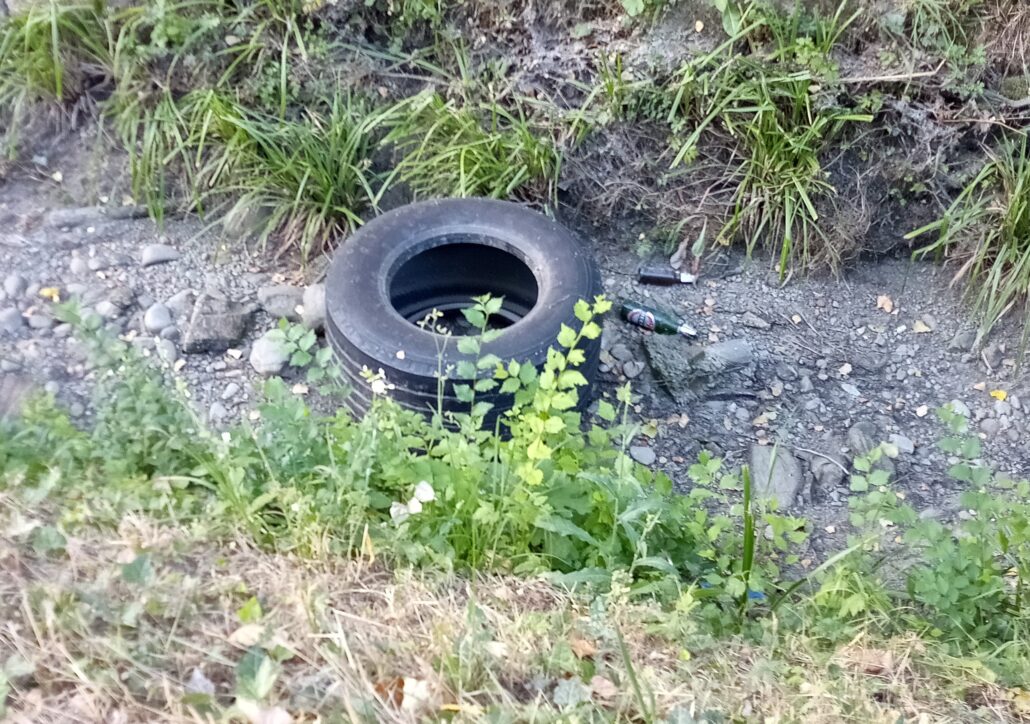
I reach the fields and stop to shoot a couple photos. “They cleaned the ditches”, I notice. “It will be good in case of thunderstorms”. Then, I have a closer look at the ditch and see big tires, glass and plastic bottles, and bags full of garbage. “What a shame for our exceptional intelligence. Will my fried zucchini blossoms now taste of tire?”
Fig. 1: A tire and glass bottles found in a typical ditch of the Po Valley. Author, 2022.
Only a few kilometers from here, there is an inter-municipal landfill where everyone can bring their waste [3]. Not only is the service free, but one also receives a tax discount at the end of the year. We are really smart beings.
On my way home, I pass close to a carwash. There is a line of cars – no, sorry, a line of human beings with their car – waiting for their turn. With the news announcing severe droughts and possible water rationing [4], is it really necessary to clean our car these days?
If car washing needs about 10-15 liters of water and a man drinks about 2-3 liters a day, each cleaned car would be equivalent to a week of drinking.
Looking at these insightful actions and acknowledging that there are 8 billion of us, are we not too many?
It ended in the best possible way on July 15, 2022 through a day of seminar and sharing of results at Valli del Pasubio (VI – Italy) the CAREGA project. In the strand of proposals on the topic of circular energy and biomass supply chains in Veneto and Trentino already inaugurated [1], the present project is, in its fullness, perfectly placed in that context. CAREGA: Local charcoal as a strategic tool for the bioeconomy of the Piccole Dolomiti Vicentine aims, in its capacity as an initiative funded by the Rural Development Program for Veneto 2014–2020, Measure 16 [2] to:
• The valorization of waste/zero value material by processing it into charcoal (forest-wood-energy supply chain). An innovative demonstration plant will be implemented, supporting the entire valorization of the subject “tree” (cascading);
• Aggregation of forest land through innovative contractual forms, following European examples, to increase active forest management (wood mobilization).
In this sense, the project addresses not only the purely technical and engineering problem of designing a machine suitable for the production of high-quality charcoal for culinary uses that is at the same time efficient, economical, easy to use and easy to transport but also fits strongly into the typically pre-alpine problem of forest land fragmentation.
And if, in fact, few doubts still remain at the end of the project about the functionality of the production machinery — at least at the experimental level — easily implemented with technical improvements in the near future, it is precisely with regard to the involvement of the territory, in its small woodland owners, of the few user firms that concerns become more pressing. An optimization of the forest–wood–energy supply chain is not yet a reality for the mountain areas of Vicenza to date. Absent or unknown forest owners, highly fragmented and small plots, often difficult to access and mechanize make, in many ways, the possibility of truly active and for productive purposes forest management of the resources stored here fatuous.
Not only that, non-marketable production waste such as firewood or — for the little present — opera wood, turn out to an important extent for these areas. Chestnut wood waste proposed for use in the CAREGA project is an excellent example.
Consider, in fact, how not only has the reduced utilization of the forest asset in recent decades led to an almost total abandonment of forests — with consequent risks related to afforestation of neighboring agricultural areas, increased fire risk as well as hydrogeological and landslide risk and the growth of allochthonous species — but, a far more worrying fact, has generated a breakdown of all supply chain relationships between owners, user companies and forest enterprises [3] .
In this sense, the project — on behalf of the partner ETIFOR, a spin-off of the Department of Territory and Agro-Forestry Systems (TESAF) of the University of Padua — proposes the study of new contractual forms suitable for the satisfaction, including economic satisfaction, of all the actors of the supply chain in the area.
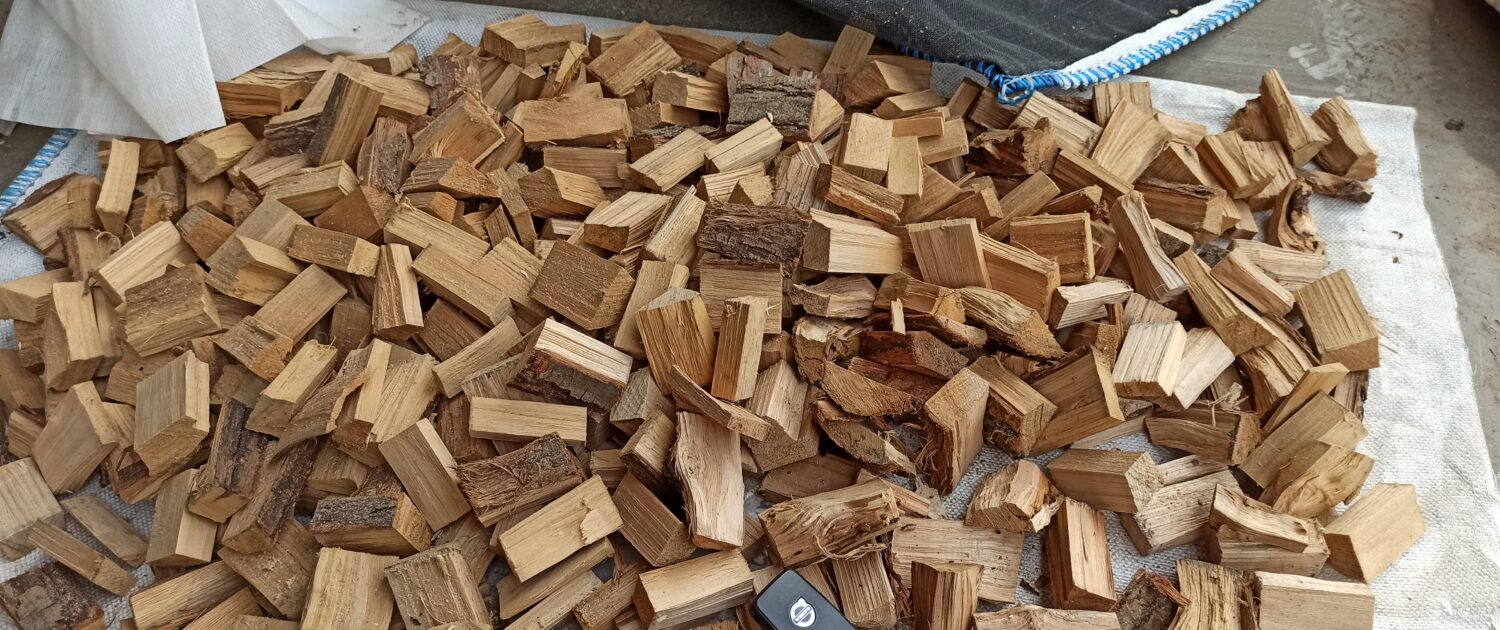
Fig. 1: The CAREGA project involves the use of chestnut waste products as biomass for the production of charcoal for culinary use. Photo Associazione Forestale Vicentina (July 12, 2022)
Valuable starting point and point of pride for the territory of the Piccole Dolomiti turns out to be, in this regard, the Vicenza Forestry Association.
Established in 2002 as part of PSR funding, it remains to this day one of only two Forest Associations still active in the Veneto region, out of the fourteen originated by funding two decades ago. Since its inception, the Association — made up of forest owners — has aimed to «organize members’ forest property to enable sustainable forest management» [2].
Contracts presented during the project’s concluding conference are, in this sense, effective tools for overcoming the problems associated with abandonment of forest management.
It is proposed, by way of non exhaustive list:
• The introduction of the figure of the “forest contractor“, who can take over the management of the entire supply chain even in multifunctional terms and with multi-year ad-hoc contracts, as well as provide for the management of various financing;
• The introduction of “Forest Agreements”, by force of law L. 29 luglio 2021, n. 108.
And it is precisely these Forest Agreements that could be an active tool for «valuing public and private land with agro-sylvo-pastoral vocation as well as for the conservation and delivery of the ecosystem services provided by forests» (As stated in art.3, comma 4 quinquies 1 of decreto legge n. 5 2009, converted with amendments into L.9 aprile 2009 n.33).
In this sense, in fact, such Forest Agreements — of which National Rural Network has edited an exhaustive analysis in [4] — represent an additional regulatory tool, in addition to those already existing, for “networking,” in the legal and negotiating sense, for the creation of economic chains — for the purpose referred to in Article 3 above — where there are rights and obligations for all contracting parties.
With this in mind and through the creation of a local ad-hoc market (for the CAREGA project, of charcoal for culinary use), one can truly hope for the reestablishment of an active and participatory forest management that can both create an economy and fit into the theme of bioenergy with reuse of production waste. It would benefit not only our forests, but also all those who live off them as well as the entire territory that revolves around them on a daily basis.
All roads lead to Rome, and African Swine Fever (“ASF”) has recently taken one of them, arriving in Italy’s capital city on May 5 [1]. We talked about ASF about three months ago [2] and, unfortunately, we have to talk about it again due to recent developments.
The presence of wild boars in Rome is nothing new, but the situation has worsened to such an extent that Lazio’s regional president of Coldiretti (the National Direct Farmers Confederation), David Granieri, declared that
“Roman citizens are a hostage of wild boars. The situation we have been denouncing for years is unacceptable and now out of hand” [3].
The statement came after a pack of wild boars attacked a Roman woman while she was throwing the trash away. African Swine Fever exacerbates men’s already complex coexistence with wild boars. On one hand, human pressure continues increasing, thus reducing animal species natural ecosystems. On the other hand, human activities offer animals many chances to find food with ease. For example, in pastures and crop fields but also in the trash laying around in several urban centers.
The problem is not only in Rome, Lazio, or Piedmont and Liguria (where the first cases of ASF in italy have been spotted), but wherever man has maximized the occupation and use of the land.
Unsurprisingly, even in the charming Trentino – South Tyrol, where human population size and density are significantly lower than in Rome, encounters with wildlife are the order of the day. Countless accidents have involved motorists and local wildlife. Even though solutions to mitigate the problem do exist (e.g., wildlife corridors), they have not yet been adequately adopted. [4]. In recent years, the population of large carnivores in Trentino has increased [5], thus adding another reason for urgently finding a new balance between “us” and “them.”
Human-animal coexistence is a serious problem that can be addressed in very different ways. Often, attempts are made to regulate populations through programmed culls. For example, those set to reduce deer numbers in the Stelvio Park, Trentino [6]. Other times, coexistence is perceived as possible and necessary. In South Tyrol, the Cultura della Pastorizia (“The Herding Culture”) workgroup, promotes prevention measures as a solution to large carnivore attacks on sheep flocks. The workgroup teaches members to choose the right livestock guardian dog, install effective fences against large carnivores, and tackle climate- and biodiversity-loss-related problems.
Quoting Philipp Bertagnolli, a Passiria Valley farmer,
“Bears and wolves test you; when they attack your herd, it is always too late” [7].
This way of thinking should also be applied to tackle the rampant African Swine Fever. Without prevention we will always be chasing problems without actually getting out of them.
Cover- and preview photo: Three hunters and two hunting dogs with their catch. Image by PublicDomainPictures en Pixabay (free for commercial use license).
There are many problems related to materials that we use without knowledge, especially disposables. Every day we talk about the problems related to disposable packaging and possible solutions. They range from the simple replacement of plastic with another material – paper, cardboard or bioplastic -, the design from scratch of more efficient packaging in terms of used raw material [1] up to the complete reform of the supply chain through returnable goods [2].
The environmental damage cause by plastic is under everyone’s eyes, but the one of microplastics (or nanoplastics) is less evident. Recently, it has even been proven that there are traces of plastic in our blood! [3] In a previous article, we discussed about microplastics in the seas and oceans coming from our washing machines [4].
There are many other sectors in which the problem of disposable plastic is present: today we focus on the building and construction industry. These industries are riding the wave of post-Covid19 environmental bonuses for building renovation works [5], but there are cases in which companies operate without respecting the environment.
A key issue is caused by construction plastic fences (orange, yellow, green, etc.) used to delimit construction sites (Figure 1 and 2). An element that is typically forgotten until the work is completed. But until then, weathering will do its part. While in the beginning plastic seems indestructible, UV rays will degrade it until it becomes rigid and friable, ready to break at the first gust of wind. The wind will carry plastic pieces to the adjoining areas and beyond, polluting both land and water. Other times the vegetation will swallow it up, making its removal practically impossible.
Fig. 1: Example of a construction site delimited by a deteriorated plastic fence. Photo by author. Trento (Italy), March 2022.
Apart from plastic fences and plastic nets covering metal fencing grids, other waste is often buried when the works are terminated: Eye doesn’t see, heart doesn’t grieve! [6]
The “green” revolution must involve all economic sectors and we cannot simply turn away on these occasions. Even a single citizen can make a difference: I personally reported to the police the situation of the first photo and the deteriorated fences have been removed, but unfortunately replaced with new, but still plastic-made fences.
Fig. 2: Another example of plastic fencing at a larger construction site: the duration and its extent means that many plastic parts will break off from the metal grid end up in the environment before the site is closed. Source: Google Street View, July 2021.
According to Italian jurisdiction, it is difficult to distinguish what is a waste and what is not. In fact, the plastic fence becomes waste when it breaks apart and is dislocated from the place it was meant to occupy. How can you thus prove that the plastic pieces found on the road or a green area specifically came from the plastic fence of the nearby construction site? Is it even possible to find a responsible person or company and report for illegal waste abandonment? The procedure is lengthy and complicated and very few people have the time, competences and willingness to deal with it.
It is therefore necessary to push for the creation of ad-hoc sustainability guidelines for construction sites, promoting the use of reusable materials – such as the metallic temporary construction fences in Figure 3 – and preventing the use of cheap but polluting plastic materials.
Fig. 3: Example of delimiting a construction site without using plastic fences: plastic-free temporary (and reusable) construction fences. Source: author. Lavis (TN), December 2021.
The forest fires situation in Italy has been exceptionally dramatic last year and these first months of 2022, both in winter and (especially) in summer [1]. The data is clear and unequivocal but what are the true causes of this situation? And what can we do to limit tragic environmental, social and economic damages?
BEFORE
Right after the fire is extinguished, or typically, when it is still on, public opinion always seems to focus on the anthropic responsibility of the fire. «[…] And it is now clear that it is an arson that is blocking the [provincial road] Sp251» [2]. And yet, identifying the responsible and the spark that triggered the fire is often an arduous task. Simply labelling it as “arson” is often not enough because the anthropic conditions that can lead to a fire ignition are countless: either voluntary or involuntary, evident or doubtful, or natural. And what does “natural” really mean? Are “natural” conditions intended as “ordinary” or “naturally related to climate factors”, such as the climate crisis and the rising temperatures? The discussion is huge and often solved by using “natural conditions” in a way that comprises all the mentioned definitions.
An (old) document of the former Corpo Forestale dello Stato (Italy’s former National Forestry Agency) provides a detailed description of all the causes that may trigger forest fires [3]. Although 21 years old, the study has laid a foundation to determine and classify fires that is still largely valid today. Nonetheless, the document undoubtedly lacks the link between climate and fires. Perhaps not yet perceived as determinant at the beginning of the 2000s, the climate factor is now seen as a key element in forest fire studies and, considering the current climate crisis, the biggest challenge of our time [4].
Whether intentional or unintentional, anthropogenic fires, have been predominant in recent years. Completed after the dramatic 2020 forest fires season, a study by the Carabinieri’s Command of the Forest, Environmental and Agri-food units (“CUFAA”) has shown that natural causes – and especially lightning – causes only 2 % of the total forest fires. Instead, fraudulent causes are «[…] linked to pasture establishment, hunting and social unrest». Traditional burning of plant residues in farming and forestry activities is also a main cause of unintentional fires [5].
Fig. 1:Rapidly securing the affected areas immediately after the fire beginning is a key factor to limit the damage severity to the natural environment and the local people. Photo by Fabian Jones (February 2021).
AFTER
Similarly to forest fire causes analysis, fire consequences study is complex and must consider several factors that may seem quite different from each other at first glance. While emergency response is not always decisive and effective, prevention and proper management of forests and adjacent areas are crucial for limiting fires [1]. Yet, fire departments and rescue teams are indispensable when the fire is in action.
Damages from forest fires are several and of different nature because fires harm both the environment and the safety of the people living in the affected areas. In their post-fire management analysis, the Italian Society of Forestry and Forest Ecology (“SISEF”) stresses the need to promptly monitor the damage severity and quickly secure the affected areas [6].
These measures are undertaken in the very first weeks after the fire occurs. They must be activated as soon as possible and before the fire is totally extinguished. Indeed, the most urgent danger to tackle is the hydrogeological instability. Many times, a fire can destroy the roots of trees and compromise the stability of the plant-soil-rock system. Moreover, it deposits light ashes on the ground, which can temporarily create a condition of soil impermeability. When the first late summer – early Fall rainfalls and storms arrive, water runoff is stronger and soil erosion cases more frequent [7].
The real fire management happens in the years and decades after the fire. As with other disturbances (windthrows, insect outbreaks, etc.), the most pressing question is whether to act or leave it to nature. To intervene, and if so, for what purpose? These questions can only be answered only through an in-depth understanding of the landscape and forest ecosystem. Finally, city and land planning must also be considered when choosing the right fire recovery, protection and prevention measures. In the end, prevention and correct management are still the best and most effective solutions.
Cover- and preview photo: Smokey bear illustration and wildfire prevention sign. Bakersfield, California (July 26, 2021). Free-source photo by Brian Wangenheim en Unsplash.
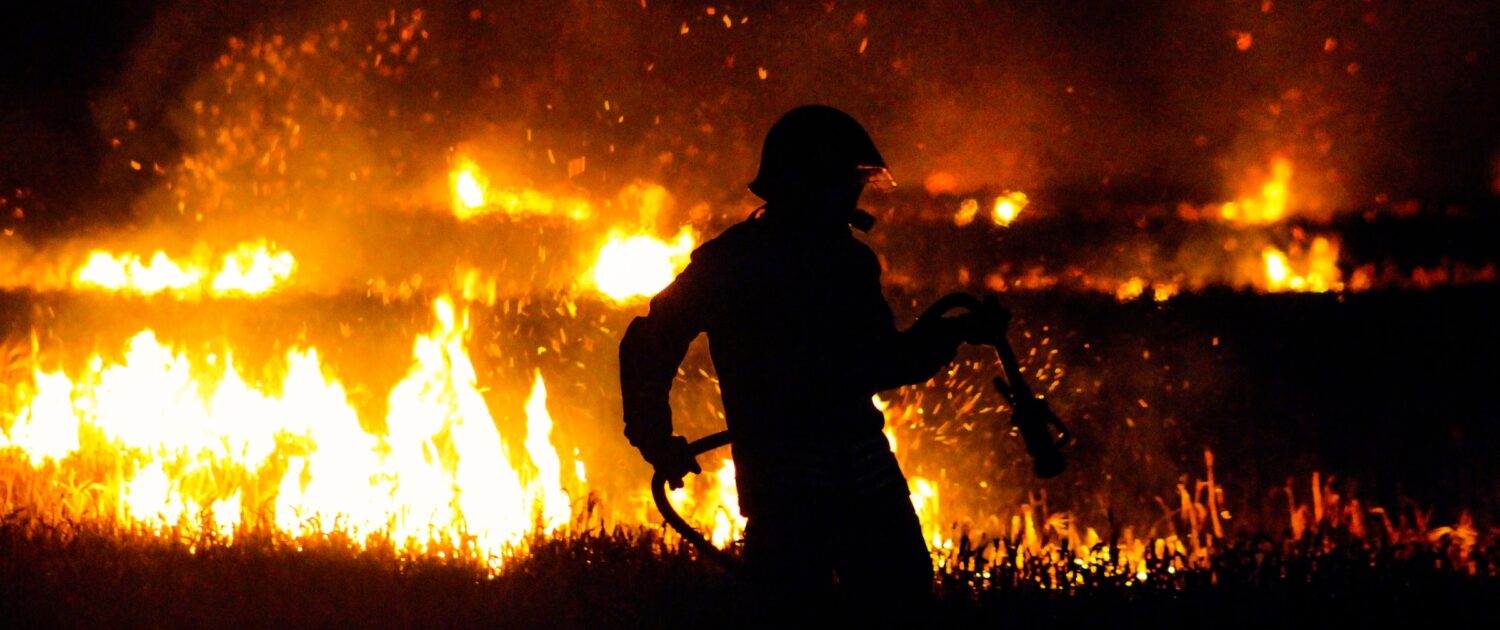
Figura 1:Silhoutte of a fireman working on a burning grass field (). Free-source photo by Fabian Jones en Unsplash.
To tackle this urgent issue, we will dedicate four weeks to wildfires. Two of the next four Friday articles will be published through a picture story!
Get ready for the new Eco-Battle and adventure of the Eco-Team: Red Skies.
Red Skies (Episode #2) – The Fiery Devil Sword
Green Wolf, Mr. Maul, Streamshot and Lead Feather encounter the true responsible of the Italian wildfires: the Scorching Pirates. A first victorious fight is not enough to stop them. The Eco-Team and the local firemen must think of a new strategy to defeat the ruthless arsonists and stop the spreading fires.
After defeating the turmOIL army, the Eco-Team is sent on another mission. Officer Green Wolf and his new colleagues are called to fight the raging wildfires of the Italian peninsula.
“The 2021 Italian wildfires firefighting campaign, which mobilized the Italian National Fire Department throughout the whole country, ended on September 30. Since June 15, a total of 79,796 firefighting interventions have been carried out. That means 24,842 more fire protection interventions than last year” [1].
“In the first two months of the year, there have been 13 forest fires in Trentino. This is the first data coming from the Province of Trento Forest Agency” [2].
And more: “Italy is burning in the middle of the winter season. Since the beginning of 2022 fires have more than quadrupled compared to the same period of last year” [3].
Looking at the eloquent headlines of the press agencies, the Ministry of the Interior and local newspapers, it is clear that the forest fires situation in Italy is currently anomalous and potentially disastrous. The numbers speak for themselves. With a staggering total of more than 150,000 burned hectares in a single year, the extension of fire-derived forest loss in 2021 has increased dramatically compared to the average of previous years. The data coming from other historically fire-susceptible Mediterranean countries confirms that the exceptional increase is not limited to Italy (Figura 1). In fact, it is not limited to the Mediterranean region or Europe only but all over the world. Wildfire pressure is increasing worldwide.
Fig. 1: Wildfires in Mediterrenean countries in 2021 compared to the 2008-2020 period. Author: Matteo Gecchelin. Data source: EFFIS [4].
The causes of such increase have been examined by many recent studies. The development of climate conditions that are favorable to the trigger and continuation of fires, such as droughts and high temperatures, is one of key factors explaining the fires increase.
This phenomenon is growing not only in traditional areas susceptible to fires, but also in areas that have never been exposed to fires. While Mediterranean vegetation has adapted to the passage of fires (in ecological terms, they do not cause destructive effects and favor plants reproduction or lifecycle), temperate climate vegetation is not used to fires at all. Fires in alpine forests, such as mountain beech forests, are a rare exception and can severely harm the ecosystem [5]. Indeed, the cool climate, good water availability and presence of understory litter and dead wood in these ecosystems prevent the ignition of fires. The fact that medium-size fires have hit these ecosystems in recent years indicates that the climate, ecological and land-use management situation is evolving.
If, on one hand, the change of climate and environmental conditions (which must be regulated by national and international climate policies) have determined the increase of fire risk, intensity and frequency, on the other hand, (unproper) forest fires management and prevention have affected fire risk exposure and vulnerability.
An eloquent quote that is in vogue among wildfires experts says that “fires are extinguished twenty years earlier”[6]. Paraphrasing it, the management of forests and forests heritage, the prevention and training of forest firefighters, the planning of forestry and silvicultural interventions, the definition of fire risk indices and maps and forest-ecology research studies play a crucial role for fire risk mitigation.
While it is true that climate conditions are increasing the fire risk, also socio-economic and cultural elements are contributing to it.
To understand this, it is enough to think of the dramatic increase of the national forested area and forest biomass: +587,000 hectares and +18.4 % of biomass approximately in the last ten years [7]. While acknowledging the environmental benefits of these overall 11 million forest hectares, we cannot forget that quantity is not the sole factor to consider. The quality and spatial distribution of the forest growth is also crucial. Spreading all over the Alpine area, unregulated forest growth is caused by mountain areas depopulation, marginal areas and mountain farming abandonment, lack of forest resources and infrastructures management, and a decreasing awareness of forestry issues by the citizens [8].
The true capacity to “adapt” to the altered climatic and territorial conditions lays in the practices connected to the new world where we live in. We must implement a series of bold actions aimed at improving forest management and wildfires risk prevention. We must stop treating wildfires as exceptional or as an emergency, and we must carry out planned forestry intervention to ensure a rapid and effective response. Doing so, we will be able to tackle the cause rather than the effect of the increased forest fire risk.
The new year brings many new good resolutions, but also all the problems that we neglected in the previous year. Our relationship with nature and the pressure on ecological systems is one of them. Not surprisingly, and as affirmed two years ago, it is most likely the cause of the current pandemic
[1].
On January 7, 2022, in Ovada (Piedmont, Italy), the first case of African Swine Fever (“ASF”) was found on the Italian “continent” [2]. (on the island of Sardinia it has been present since the 1970s but in an endemic and controlled form). The disease was first described in 1921 in Kenya as a fatal acute hemorrhagic fever in domestic pigs. It generates from the contact between farm pigs and wild warthogs. It arrived in 1957, in Portugal, and then spread to the rest of Europe and recently in Asia [3].
The ASF virus strain recently found in Piedmont presumably arrived from other European countries, through the import of contaminated pork products.
Looking at the numbers by the Italian National Institute of Statistics (“ISTAT”) for 2021, Italy is raising about 8.5 million pigs [4]. If the disease spread among them, they would have to be culled. By trying to make farms more “efficient”, housing more animals in less space, selecting faster growing species and providing enriched animal feed, we create the ideal conditions for an African Swine Fever outbreak. That is because animals have little living space, little genetic variety, and are stuffed with drugs.
At the end of the day, by trying to pull the most out of nature, we risk losing everything. We are practically doing ourselves in.
In 2021, the Italian Institute for Environmental Protection and Research (“ISPRA”) reported that farming represents the main threat to biodiversity in Italy, due to Italians’ increasing consumption of animal products (meat, eggs and dairy) from intensive production farms [5].
Figure 1: A pig in an artificial environment. Is this the right place for them?(Author: borevina on Pixabay)
“The real ecological transition passes through our plate. There is no way out.” WWF [6]
An interesting link between African Swine Fever and the Covid-19 pandemic was inserted in a research study published in 2021. The hypothesis is that the 2018 ASF outbreak in China may have facilitated the species jump (“spillover”) of the Sars-CoV-2 virus. The slaughter of millions of pigs resulted in a price increase of pork meat and consequently to an increased demand and consumption of meat from alternative sources [7].
Luckily, no ASF spillover on humans has yet occurred, based on current knowledge [8]. This is not true for avian influenza, which has already performed the species jump and has already affected some individuals severely. However, we will talk about this in a future article.
A direct consequence of the ASF outbreak to Italians’ daily life is the ordinance of the Italian Ministry of Agriculture and Health which prohibits outdoor activities in the infected areas of Liguria and Piedmont. The prohibited activities are hunting (except wild boar hunting), mushroom and truffle picking, fishing, trekking and mountain biking [8].
The lesson learned from the ASF outbreak in Italy is that our current approach to Nature, treating Her merely as a commercial product, is clearly not sustainable. It is up to all of us to try to value it in a far more respectful way.
“Non ne capisco un fico secco” penso, seduta e affranta nel mio giardino davanti al fico (ficus carica) enorme, immobile e pieno di ferite. Lui e il mio bisnonno devono essere stati giovani insieme. Durante la guerra il mio bisnonno alzava le tavole che coprivano i canali d’irrigazione e ci si nascondeva sotto, aspettando che passasse la ronda fascista che cercava gli anarchici. Poteva passarci ore lì sotto, a volte giorni. Lui non vedrà la fine della guerra e morirà di crepacuore poco dopo, distrutto da quella vita vissuta nel terrore, ma il fico no. Lui ne uscirà indenne per vedere la nascita di mia mamma in quella casa e poi ancora, il mio arrivo in fasce e le mie capanne sotto i suoi rami.
C’era la pandemia e tutti avevano problemi più seri del mio fico. Il lavoro che non ripartiva, compreso il mio, e poi il numero crescente di contagiati e il terrore di spostarsi, ammalarsi, infettare. Sarei dovuta partire il 9 marzo per una missione di un anno in Cambogia, ma la pandemia aveva bloccato anche me e adesso mi ritrovavo ad affrontare una strana primavera per la prima volta dopo anni, nel giardino di casa.
Il mio fico non è particolarmente bello né armonico. È storto e ritorto. È cresciuto in un angolo e si allunga verso il centro del giardino e, come tutti i fichi, sembra avere un innato attaccamento alla vita. Qualcuno della mia famiglia molti anni fa, per impedire che si espandesse troppo nel giardino, deve avergli piegato un ramo ancora tenero verso l’interno ed è cresciuto così, con una forma innaturale che poi ha trovato il suo equilibrio e ora si allunga verso l’alto.
È una pianta rustica dicono tutti, non ha bisogno di cure e dà frutti completamente “biologici” senza nessun bisogno di trattamenti. Difficilmente viene attaccata da malattie e parassiti e si cicatrizza con velocità. Sarà per quello che da anni sta nell’angolo del mio giardino senza che nessuno veramente si accorga di lui se non a settembre, quando ci riempie di piccoli succosissimi frutti dalla buccia viola.
Il fico sporca, il fico infesta, il fico ricresce anche se lo tagli cento volte, il suo latte è irritante e poi non ci salire sopra perché il fico è traditore. Lo sento ripetere da anni eppure non riesco a far finta di niente pensando che, anche se dovesse morire, ributterebbe. Gli ho visto quei buchi nel tronco e mi rendo conto che il ritardo nelle foglie non è dovuto ad un’annata un po’ infelice per tutti ma deve esserci qualcosa di più. Sarà per il mio attaccamento a lottare per quelle cause che alcuni definiscono perse o sarà perché mi rendo conto che quel fico ha assistito a tutta la mia vita e a buona parte di quella della mia famiglia che non riesco proprio a non fare niente, mentre so che qualcosa lo sta logorando da dentro.
A questo punto, come ogni umano disorientato e impaurito del nuovo millennio che si rispetti, chiedo aiuto a Google indicando i sintomi, l’area geografica e la problematica. Google si rivela un prezioso alleato, suggerendomi l’infestazione da punteruolo nero.
So di non essere una botanica, né un’agronoma e, a dirla tutta, so di avere una predilezione solo per le piante grasse che notoriamente non richiedono grandi doti a chi le cura. Penso che non so niente di entomologia e che al massimo ho letto dei pannelli informativi in un museo in Thailandia, che sono laureata in scienze politiche ed ho una specializzazione in storia delle religioni, e che tutto questo fa di me una completa inetta davanti ad un albero attaccato da una specie alloctona che lo divora da dentro. Dalla mia ho solo una forte attitudine a lottare contro le ingiustizie. Si, le ingiustizie, perché per me è di questo che si sta parlando.
Fig. 1: adulto di punteruolo del fico. Fonte: autrice.
Stando a quel poco che si sa, l’alees cribratus(per i nemici “punteruolo nero del fico”) arriva sui nostri lidi con un carico di fichi infetti al porto di Genova, trova un clima abbastanza gradevole per i suoi gusti e si insedia. Piano pianino, larva dopo larva, fico dopo fico esce dalla Liguria ed approda in Toscana. Dove arriva distrugge una coltura dopo l’altra e poi avanti nella sua conquista potenzialmente illimitata visto che al momento non ha antagonisti naturali (se non consideriamo me e qualche altro valoroso combattente chiaramente).
Il fico è completamente indifeso e questo lo rende, ai miei occhi, meritevole di tutti gli sforzi possibili. La femmina adulta del punteruolo depone una sola larva alla fine di un minuscolo forellino generalmente nel colletto dell’albero. La larva per nutrirsi e crescere comincia la sua lenta e inarrestabile risalita del tronco dove scava profondi cunicoli masticando e digerendo la polpa dell’albero. Il tutto avviene praticamente senza che dall’esterno si noti nulla, finché la larva non è ormai insetto e riemerge più in alto nel tronco per poi uscire e continuare il suo ciclo indisturbata. Nella maggior parte dei casi ci si accorge dell’infestazione quando l’albero è talmente svuotato da spezzarsi alla base.
Fig. 2: colature di segatura lasciate sul tronco dal punteruolo del fico. Fonte: autrice.
Dal poco che emerge da internet non ci sono grandi ricerche in merito e, ad oggi, non ci sono rimedi efficaci, ma solo qualche palliativo che ci si passa come raccomandazione tra un blog di agricoltura e l’altro. Vista la situazione penso che qualunque cosa possa fare la differenza e comincio con quello che mi suggerisce l’intuito. Tra i consigli più gettonati c’è quello di lavare l’albero con dei forti getti d’acqua per infastidire gli insetti adulti e farli uscire allo scoperto nel tentativo di catturali. È così che mi ritrovo faccia a faccia con il primo punteruolo nero. Ho delle reazioni simil-isteriche perché non so bene come comportarmi e non so bene quali siano le sue armi. Ci guardiamo sospettosi ma poi, mossa da disperazione, lo fermo tra pollice ed indice. Le sue zampe fortissime si attaccano e cercano di liberarsi dalla presa delle mie dita senza riuscirci. Mi rendo conto con gli esemplari successivi che non è dotato di particolare velocità, che non cerca di volare e che se si sente preso in trappola si lascia cadere fingendosi morto. In una giornata ne catturo 12, ma non basta perché le larve sono il mio vero problema.
Per cercare le larve parto dalle “colature di segatura” che trovo sul tronco e seguo il cunicolo che prosegue in profondità dentro il tronco con un pezzetto di fil di ferro.Procedo a tentoni svuotando pazientemente tutto il cunicolo senza sapere se arriverò mai a qualcosa finché la segatura non finisce e il fil di ferro riemerge umido e con della colatura bianca. Ho trovato la mia prima larva. La aggancio con l’estremità del fil di ferro e quando esce sento un pezzetto del peso che mi porto dentro staccarsi. Forse ce la possiamo fare.
In realtà in breve tempo mi rendo conto che le larve sono molto più di quello che si vede. È bastato scavare un po´attorno alle radici per accorgersi che sono tutte piene di cunicoli, martoriate e in alcuni punti già cicatrizzate. Il fil di ferro non mi basta più e allora prendo un cacciavite ed un martelletto e comincio a scavare dove il tronco è più morbido e questo mi permette di trovare una ventina di larve cicciotte, affamate e distruttrici. Ad ogni estrazione sento di alleviare un po’ il dolore dell’albero ma cresce anche la consapevolezza che le ferite sono molte più di quello che pensavo e l’infestazione più profonda.
In breve tempo l’albero diventa il luogo di un delitto efferato e attorno a lui la scena del crimine si sviluppa e gli oggetti d’indagine si moltiplicano: vasetti di alcool dove gettare le larve e gli insetti raccolti, pinzette, martelli, fil di ferro, guanti e pennelli. Le ferite vengono disinfettate con del verderame e la terra attorno alle radici smossa e ripulita per assicurarsi che non ci siano insetti interrati.
In breve, capisco che non solo quello che sto facendo ha un impatto ma che può essere anche utile ad altre persone che potrebbero avere lo stesso problema e magari può anche servire per creare una rete dove scambiarsi consigli. Così comincio a fare video di tutti i ritrovamenti, dell’estrazione delle larve, delle tracce che lasciano, dell’azione di scavare con un cacciavite al buio nel tronco di un albero e creo un canale YouTube “lalarvainseno”nel quale non tardano ad arrivare consigli, suggerimenti e richieste di aiuto. Fra i più utili quello di un signore che mi suggerisce di coprire il tronco con una rete per impedire a nuovi esemplari di raggiungerlo e ad eventuali adulti che nascano dalle larve di andare a nutrirsi di foglie e frutti sulla chioma.
Fig. 3: indagini e scene del crimine sul fico del bisnonno. Fonte: autrice.
Alla fine anche la mia laurea e i miei anni di esperienza nel mondo della cooperazione inaspettatamente si rivelano utili. Ho pensato di adattare un software che si usa per fare questionari nei villaggi sperduti dell’Africa, per creare una mappa locale degli esemplari infetti, di quelli morti e di quelli in salute cercando allo stesso tempo di classificarne la specie e l’età per creare una banca dati di quello che sembra stia andando perduto, nel tentativo di rallentarne il processo.
Ad oggi l’albero si presenta con un delizioso tutù verde attorno al tronco, e, come se dovessimo compensare anni di noncuranza, non passa giorno in cui non venga controllato ed ispezionato per intercettare il più velocemente possibile eventuali nuove larve. Non possiamo dire ancora se è salvo,
le radici e parte del tronco sono profondamente solcate ma non mostra ancora segni di cedimentoe nonostante tutto, come ogni settembre che si rispetti da cent’anni a questa parte, ha qualcosa in serbo per noi: viola, piccolino e succosissimo.
Sitografia:
‘Armonia Verde’: “Ecco i rimedi contro il punteruolo nero”. (2017, July 28). Luccaindiretta. https://www.luccaindiretta.it/in-azienda/2017/07/28/armonia-verde-ecco-i-rimedi-contro-il-punteruolo-nero/99224/
Gargani Elisabetta, & Benvenuti Claudia. (2017, February 14). Il punteruolo nero del fico: Un’emergenza in Toscana; si cercano soluzioni. Rivista di Agraria.org. https://www.rivistadiagraria.org/articoli/anno-2017/punteruolo-nero-del-fico-unemergenza-toscana-si-cercano-soluzioni/
Bibliografia:
Ciampolini, Farnesi, Scarselli, & Lorenzi. (2008). Contro il curculionide del fico decisiva la lotta agli adulti.
Ciampolini, M., Perrin, H., & Regalin, R. (2005). Aclees Cribratus, nuovo per l’Italia nocivo per il fico allevato in vivaio. 4.
Ciampolini, Regalin, R., Ivano, F., & Claudio, C. (2007). Prime osservazioni sulla bio-etologia di Aclees sp. (Curculionidae, Molytinae) esiziale a Ficus carica L. in Italia. ResearchGate.
A carnevale il bio-distretto provinciale crea il bio-scontro frontale.
Lo scorso 11 febbraio il Comitato promotore per il referendum per la creazione di un bio-distretto provinciale ha annunciato di aver già raccolto circa 6000-6200 firme. L’obbiettivo di raccoglierne 8000 entro fine marzo sembra dunque vicino. Trattandosi di referendum provinciale propositivo, la Provincia avrà l’obbligo di fissare una data in cui i trentini saranno chiamati a votare [1]. Il propositivo è un tipo di referendum presente in Trentino e finora assente in Italia. O meglio, in Italia si sta cercando di introdurlo proprio in questi giorni [2]. In Trentino un referendum propositivo è approvato quando viene raggiunto un quorum del 40% e la maggioranza (50% + 1) dei votanti esprime un parere positivo. A quel punto il verdetto diventa vincolante e la Provincia è costretta a legiferare verso tale scopo [1]. La proposta di un bio-distretto provinciale è quindi un’iniziativa che parte dal basso ma è di fatto un provvedimento top-down. Perché? Capiamolo mettendo alcuni punti del quesito sotto la lente.
La lente puntata sul quesito
“Volete che, al fine di tutelare la salute, l’ambiente e la biodiversità, la Provincia Autonoma di Trento disciplini l’istituzione su tutto il territorio agricolo provinciale di un distretto biologico, adottando iniziative legislative e provvedimenti amministrativi – nel rispetto delle competenze nazionali ed europee – finalizzati a promuovere la coltivazione, l’allevamento, la trasformazione, la preparazione alimentare e agroindustriale dei prodotti agricoli prevalentemente con i metodi biologici, ai sensi dell’articolo 13 del decreto legislativo 228/2001, e compatibilmente con i distretti biologici esistenti?”
“[…] la Provincia Autonoma di Trento disciplini l’istituzione su tutto il territorio agricolo provinciale di un distretto biologico”
Il soggetto della proposizione è la Provincia Autonoma di Trento. Sarà la Provincia a dover ideare e organizzare le modalità di attuazione e amministrazione dell’eventuale futuro bio-distretto. Per tale motivo, il referendum sul bio-distretto conduce a provvedimenti top-down, ovvero da chi è al potere.
Il bio-distretto è “un’area geografica naturalmente vocata al biologico dove agricoltori, cittadini, operatori turistici, associazioni e pubbliche amministrazioni stringono un accordo per la gestione sostenibile delle risorse, partendo dal modello biologico di produzione e consumo” [3].
“[…] nel rispetto delle competenze nazionali ed europee”
Premesso che il bio-distretto provinciale dovrà rispettare le competenze nazionali ed europee, quali sono gli attuali provvedimenti amministrativi provenienti dall’Italia e dall’UE?
Dall’Italia
Già approvato dalla Camera l’11 dicembre 2018, il disegno per la legge nazionale sul biologico è ora bloccato al Senato. Entrerà probabilmente in vigore nel 2020 [4]. La legge disciplinerà la produzione agricola, agroalimentare e dell’acquacoltura con metodo biologico nei seguenti punti:
Il sistema delle autorità nazionali e locali e degli organismi competenti
I distretti biologici e l’organizzazione della produzione e del mercato
Le azioni per la salvaguardia, la promozione e lo sviluppo delle produzioni biologiche
Un marchio nazionale per prodotti biologici realizzati con materie prime coltivate e allevate in Italia [5].
Dall’UE
Per la PAC 2021-2027 (i.e. Politica Agraria Comune) è prevista una riduzione del budget totale a causa della Brexit e della decisione di spostare alcuni fondi dall’agricoltura a tematiche strettamente ambientali. Anche all’interno della nuova PAC, ciò nonostante, accresce la spinta a favore dell’ambiente, tramite finanziamenti di supporto ad agricoltori e istituzioni agricole che s’impegnano a contrastare la crisi climatica, tutelare l’ambiente, preservare il paesaggio e la biodiversità [6].
[…] ai sensi dell’articolo 13 del decreto legislativo 228/2001
Il bio-distretto non coinvolgeràsolo gli agricoltorima anche tutti quegli attori che lavorano in attività agrituristiche,
elencati, appunto, nell’art. 13 del decreto legislativo 228/2001.
Ovvero, “[attività] svolte ancorché all’esterno dei beni fondiari,
l’organizzazione di attività ricreative, culturali e didattiche, di pratica sportiva, escursionistiche e di ippoturismo finalizzate ad una migliore fruizione e conoscenza del territorio, nonché la degustazione dei prodotti aziendali”.
[…] compatibilmente con gli altri distretti biologici esistenti
Alcuni risultati dal primo bio-distretto d’Italia: il bio-distretto del Cilento, nato nel 2004.
Coinvolgimento di 30 amministrazioni comunali
Coinvolgimento di 400 aziende agrarie iscritte al Registro Regionale degli Operatori dell’Agricoltura Biologica
Estensione totale della Superficie Agricola Utilizzata: 2000 ha (coltivazioni arboree – specialmente olivo, vite e fico: 32%; seminati/ortive: 22%; prati e pascoli: 46%)
Incremento di fatturato del 20% negli ultimi due anni delle aziende commercianti (mercatini del biologico, fiere, promozioni estive negli stabilimenti balneari)
Collocazione dell’intera produzione sul mercato del biologico anziché in parte o in toto sui mercati del convenzionale
Creazione di cooperazioni tra 20 ristoranti e 10 stabilimenti balneari
Apertura di Gruppi d’Acquisto Solidale nel bio-distretto
Creazioni di panieri contenenti eccellenze alimentari per commercializzare prodotti locali sinergicamente
Apertura di bio-sentieri e bio-spiagge
Assistenza tecnica e finanziaria gratuita da parte dell’Associazione Italiana per l’Agricoltura Biologica – Campania per tutte le aziende agricole biologiche del bio-distretto [9]
Il botta-risposta sul bio-distretto
Alla luce dell’assai probabile referendum venturo, sono innumerevoli gli incontri informativi organizzati in tutto il territorio provinciale. Il bio-distretto fa discutere. Fa discutere specialmente gli agricoltori locali, i quali sarebbero direttamente colpiti dal provvedimento. Il Comitato promotore è chiamato a rispondere alle numerose perplessità degli agricoltori, ammortizzare le accuse, difendere la propria tesi. Segue qui sotto il botta-risposta emerso durante la serata dell’11 febbraio, organizzata dall’assessore all’ambiente di Lavis, Franco Castellan.
Botta
Alcuni agricoltori locali tra il pubblico:
hanno mostrato rancore verso un’iniziativa che vuole screditare i benefici ambientali che l’agricoltura integrata già comporta (e.g. riduzione dei fitofarmaci grazie a pratiche ben consolidate quali la confusione sessuale)
temono che tale iniziativa comporterà l’obbligatorietà di effettuare la conversione al biologico
temono che il quesito nasconda obblighi aggiuntivi e che il bio-distretto non sia semplicemente un motore di sviluppo per chi sceglierà di passare al biologico (“Questa cosa mi puzza”)
criticano tale iniziativa perché inciterà lo scontro tra chi produrrà col metodo biologico e chi con quello integrato
hanno sottolineato che l’iniziativa non è partita dai contadini, ovvero chi verrà direttamente colpito dai provvedimento, qualora il quesito venisse accolto dal referendum
hanno sottolineato che non è giusto scaricare il peso della transizione verso un tipo di produzione agraria a minor impatto ambientale quando i consumatori stessi e i mercati non la promuovono: la produzione deve semplicemente seguire l’andamento del mercato.
Un amministratore locale tra il pubblico
ha evidenziato, citando protocolli locali e provinciali passati, che l’iniziativa non dà giusto peso a chi ha portato avanti azioni politiche per l’ambiente in agricoltura in passato.
I referenti di alcune istituzioni agrarie (cooperative frutticole, Coldiretti, ecc.)
si sono alterati perché non sono stati chiamati al confronto prima dell’apertura del Comitato per la proposta referendaria
hanno evidenziato che i trattamenti chimici non possono essere messi in croce. Servono a prevenire o guarire le piante (per esempio dalla cimice asiatica e drosophila suzukii), così come i farmaci [chimici] servono a prevenire o guarire una persona umana
sono disposti a sedersi a una tavola rotonda portando idee propositive qualora il referendum fosse approvato [10]
Risposta
Alcuni spettatori tra il pubblico:
hanno plaudito la presentazione e i contenuti dell’iniziativa
hanno firmato la proposta referendaria una volta terminato l’incontro
hanno sottolineato che con una produzione biologica inferiore al 4%, il Trentino esce largamente sconfitto da altri stati europei (per esempio l’Austria è al 20%)
hanno sottolineato che l’iniziativa è un bellissima opportunità per tutelare maggiormente l’ambiente. La Provincia dovrà aiutare gli agricoltori a sostenere (in termini di assistenza tecnica ed economica) la conversione al biologico.
Rispondendo agli interventi del pubblico, il Comitato promotore ha sottolineato che
il Trentino rimane il fanalino di coda in Italia per la produzione biologica
alcune mense scolastiche trentine sono state costrette a comprare prodotti biologici da regioni italiane limitrofe (e.g. mele biologiche dall’Emilia-Romagna)
il Consiglio della Provincia di Trento ha fatto davvero poco per l’agricoltura biologica e per il supporto all’ambiente negli ultimi anni
sarà lieto di partecipare a tavole rotonde con le istituzioni agricole una volta che saranno state raccolte le 8000 firme, ovvero quando avrà “qualcosa da portare al tavolo”
il bio-distretto non obbligherà gli agricoltori a convertirsi al biologico ma darà supporto a chi lo vorrà fare. Finora, gli agricoltori e le cooperative che producono con metodo biologico sono stati lasciati soli.
il bio-distretto permetterà al Trentino di iniziare un percorso di trasformazione culturale verso un modello di sviluppo più green. Con il tempo, un numero crescente di aziende e operatori economici confluirà nel bio-distretto e renderà il sistema produttivo più competitivo in Europa e pronto alle sfide del futuro
dietro il bio-distretto si celano ulteriori tipi di azioni per l’ambiente: la filiera corta, i gruppi di acquisto e le mense pubbliche bio
l’attuale sistema produttivo in Trentino, basato sui consorzi e sulle cooperative (“che con il sudore e la fatica i nostri padri sono riusciti a costruire in maniera lungimirante”) non è abbastanza forte per le nuove sfide del mercato globale
molti prodotti da agricoltura integrata già rispettano severi criteri ambientali. Tuttavia tale rispetto per l’ambiente non può essere promosso efficacemente perché non è “bio”. Tale mancanza sfavorisce la competitività dei prodotti trentini (e.g. le mele trentine contro quelle polacche) in un mercato sempre più globalizzato e attento all’ambiente e ai marchi ambientali
la conversione di alcuni prodotti trentini da integrato a biologico sarà molto semplice perché già rispettano numerosi criteri ambientali.
Riflessioni conclusive
Così come ogni settore della nostra società, l’agricoltura trentina farà il proprio dovere per proteggere e guarire l’ambiente. L’ha fatto in passato e lo sta facendo oggi. Così come ogni altro settore, tuttavia, dovrà fare molto di più in futuro. E’ l’urgenza della crisi climatica e del collasso ambientale a richiederlo. Sarà il bio-distretto provinciale la formula giusta che permetterà il Trentino di “fare di più”? Sarà il bio-distretto quel tassello che permetterà il Trentino di accelerare la propria conversione ad una società più attenta alla salvaguardia dell’ambiente? Certamente, quello che pareva essere uno scherzo di carnevale, è divenuto un grido di battaglia ambientale. Un lampo a ciel sereno in queste disperatamente torride e ventose giornate invernali.
Punti raccolta firme
In ogni Comune della Provincia durante gli orari d’apertura al pubblico
Nei negozi Natura Sì di Trento, Rovereto e Mezzolombardo, Pergine Valsugana
Nei punti vendita:La Minela – Cles, via Trento 76/A; Cuorebio Naturarco – Arco, via S. Caterina 49; Mandacarù– Lavis, Via Giacomo Matteotti 15
Durante le fiere e i mercati:Biocesta di Trento – Trento, via dei Solteri 41/2 (tutti i venerdì dalle 16.00 alle 19.00); Trento, via Milano 62/64 (tutti i sabato dalle 10.00 alle 13.00); Bio-Expo – Trento, via Torre Verde 52 (venerdì dalle 15:30 alle 19:00 e sabato dalle 9.00 alle 12.30); Bioladen– Riva del Garda, viale Rovereto 101; Mercato Biologico di Trento – Trento, Piazza S. Maria Maggiore (ogni giovedì mattina); Trento, Piazza Dante (ogni sabato mattina)
Sitografia:
[1] PAT, 2003. Legge sui referendum provinciali. Legge provinciale 5 marzo 2003, n. 3.
[2] La Repubblica, 2019. Riforme, primo sì della Camera al referendum propositivo. la Repubblica.
[3] Bio-distretto Trentino, n.d. BIO DISTRETTO TRENTINO [WWW Document]. BIO DISTRETTO TRENTINO. URL https://bio.trentino.it/ (accessed 2.23.20).
[4] Maresca, A., 2019. Legge nazionale sul bio all’ultimo miglio. Terra e Vita. URL https://terraevita.edagricole.it/biologico/legge-nazionale-sul-biologico-allultimo-miglio/ (accessed 2.23.20).
[5] Gadda, 2018. Disposizioni per la tutela, lo sviluppo e la competitività della produzione agricola, agroalimentare e dell’acquacoltura con metodo biologico. Disegno di Legge 988.
[6] European Commission, n.d. Future of the common agricultural policy [WWW Document]. European Commission – European Commission. URL https://ec.europa.eu/info/food-farming-fisheries/key-policies/common-agricultural-policy/future-cap_en (accessed 2.23.20).
[7] Portale dei Bio-distretti [WWW Document], n.d. URL http://biodistretto.net/ (accessed 2.23.20).
[8] Sturla, A., 2019. Biodistretti: nuova forma di governance territoriale per lo sviluppo locale. https://www.pianetapsr.it PianetaPSR.
[9] Basile, S., Cuoco, E., n.d. I BIO-DISTRETTI TERRITORIALI per potenziare le produzioni alimentari biologiche. IDEASS Italia.
[10] Grottolo, T., 2020. Referendum bio-distretto, il Comitato: “Nessun allarmismo sarà l’inizio di un percorso”. Coldiretti: “Al tavolo saremo propositivi.” il Dolomiti.
Così dice il famoso detto. Tutti sono coscienti che il cambiamento climatico sta diventando la priorità per le politiche future, ma con fatica, e con la paura di perdere voti, si sta cercando di ostacolare ogni possibile misura che aiuti l’ambiente. Coraggio, bisogna avere coraggio, niente di più. E così, in Italia, nelle ultime settimane, è arrivata nella scena politica il clamoroso dibattito sulla Plastic Tax. La Plastic Tax è la tassa sulla plastica monouso, una misura che esiste già in vari altri paesi europeicome la Francia e la Danimarca [1]. Oltre a cercare di ridurre l’uso di plastica nella vita quotidiana, e quindi di promuovere tipi di imballaggi più eco-friendly, la Plastic Tax permetterebbe di portare circa 3 miliardi nelle casse dello stato. Soldi che potrebbero essere utilizzati per incentivare la ricerca, la produzione di materiali biodegradabili e aiutare le aziende di settore ad ammortizzare il colpo [2]. Questa tassa recepirebbe la direttiva europea di questa primavera, che porta alla riduzione (e per alcuni prodotti all’eliminazione) della plastica monouso, con eccezion fatta per le siringhe. In più, la Plastic Tax incentiverebbe l’economia circolare, ridurrebbe la quantità di rifiuti e l’inquinamento, tutelando così l’ambiente.
Credo che la discussione politica sulla Plastic Tax sia stata ridicola [3]. Ancora più ridicola trovo la visione di certi politici, i quali perdono il coraggio per avere sicura la propria poltrona. Sì, coraggio; quello che ci vuole oggi per avere un mondo più green e più equo. Il coraggio di non fermarsi a previsioni economiche di breve termine, il coraggio di pensare alle generazioni future, ai giovani e al nostro pianeta. Quindi, tra dire e il fare c’è di mezzo il mare. Esatto, cari politici; prima di dire e metterci la bella faccia per far felice Greta (Fig.1), attivatemi! Noi giovani vogliamo solo questo: più coraggio.