Ir al contenido principal

Etiqueta: heatwaves

Extreme summer heat as the ‘new normal’?

Never such a hot day. Never such a hot week. Never such a hot month. World heat records keep falling – and by wide margins. The oceans are exceptionally hot, and the South Pole has never had so little sea ice. Big chance that 2023 will be the warmest year on record [1].

Hundreds of millions of people worldwide are being warned. Drink plenty of water, and do not go out at the heat’s peak. In the US, there are calls to include “smoke forecasts” in the weather forecast as the smoke from unprecedentedly fierce Canadian wildfires returned. It already enveloped New York in June in a toxic orange glow [2].

In July, Italy reported a settimana infernale (a week from hell) [3]. Greece evacuated 19,000 people because of ongoing fires in Rhodes. Cities in China opened their shelters so people could find refreshments. On the news, we see floods in India, the US, Japan, South Korea, Afghanistan, and closer to home, in Slovenia. The weather phenomenon El Niño is driving temperatures up further this year. However, behind that natural variation is a global trend: extremes will increase as long as we continue to emit greenhouse gases [1].

The link between climate change and extreme weather

Because weather is inherently inconsistent, climate scientists used to be cautious about directly connecting individual weather extremes and overall warming. The world is too complex; therefore, you can never say extreme weather is entirely and solely caused by climate change. For example, a heat wave is not just caused by high temperatures (more likely due to climate warming), but there must also be a high-pressure area. If an area dries out, a heat wave becomes more likely. So does if there is a lot of asphalt [4].

Coincidence and local conditions also play an important role in heavy rains, floods, droughts and fires. Who is most vulnerable is not determined by climate but by policy and poverty [4]. Nowadays, climate scientists can calculate for each extreme weather event what the contribution of global warming was and what role natural variation played. Their findings show that the world would not have looked so battered in the summers if we had not stoked the planet 1.2 degrees warmer [5].

Fig. 1: Attributing extreme weather to climate change. Source: Carbon Brief

We also know that some recent temperatures would have been downright impossible without human-caused warming. The trend is inevitable: climate warming is making disruptive outliers more likely and severe. Climate scientists sometimes cannot believe the extremes we now see in summer, even though they predicted that more unprecedented extremes would occur [1].

What can we expect?

We can expect more extreme heat, heavy rainfall and periods of unprecedented drought in the coming decades. When floods or droughts occur in the future, they will be more severe and damaging than today, thanks to climate change.

The summers of the future will resemble today’s, but more extreme and disruptive. People sheltering inside from heat and smoke or fleeing from water and fire, cities, fields and stables hit by floods. Outbreaks that are now expected once every three hundred years will be commonplace on 20 per cent of the earth’s surface by 2040 [1].

Humanity must adapt to the new climate reality, and we are already doing so. Better predictions, warnings, behavior modification, and air conditioning save lives but can never entirely remove the pain. Moreover, never forget poor communities that contributed least to the problem but are hit hardest. They cannot turn on the air conditioning. Neither can fish. Nor can crops. Without substantially reducing emissions and CO₂ in the atmosphere, we will continue mopping [1].

Hence, climate change is not an abstract or future problem – it is an accumulation of extremes and pulverized records, often with profound effects that continue for the coming years. Harvests become slimmer, and food supplies may be jeopardized. Care and education are disrupted, and people lose loved ones, homes, income and land. Not in the future, but now. Last summer in Europe, 61,000 people met an early death due to extreme heat [6]. In Pakistan, millions are still recovering from last year’s floods – while new floods and heat waves are already ravaging the country. And still, far from all the damage caused by warming is making the news [1].

With rapid, massive and far-reaching sustainability, we can ensure that warming does not get much further out of hand. Enough goals and ambitions have been set. What matters now is their implementation. And in the run-up to the next elections, voters can judge parties on this issue. We are not defenceless against global warming. Optimism about the sustainable revolution is justified, but warming only stops when emissions stop. Thus, no “new normal” for now. It will get worse before it gets better [1].

This article is part of the project “PILLOLE D’ACQUA PIANA: seminari itineranti, blog e podcast per una gestione sostenibile delle risorse idriche in Piana Rotaliana” carried out by ECONTROVERTIA APS and supported by Fondazione Caritro (Prot. no. U445.2023/SG.386 of April 23, 2023).

What time is it? It’s summer heatwaves time

The National Climate Change Adaptation Strategy has been adopted in Italy since 2015 [1]. And already in the Strategy documents, scientific knowledge about the Country’s impacts and vulnerabilities to climate change are outlined with evident clarity and an analysis of the relevant national and EU regulations on the subject.

The Plan of the same name, currently undergoing Strategic Environmental Assessment (SEA), aims to implement the Strategy in order to provide a guiding tool for planning more effective adaptation actions for Italian territory [2]. However, the critical issues and shortcomings of the Plan appear to be numerous, particularly regarding the real effectiveness, pragmatism and feasibility of the proposed actions [3].

But let us go in order. The conceptual innovativeness of the Plan (and even before, of the Strategy) is evident right from the title. Traditionally – to be clear, at the time of the Earth Summit (1992) [4] – the fight against climate change sees only one action: mitigation. And indeed, by the early 1990s, the consideration is not incorrect. And nothing else mitigation provides for what precisely we have been trying to implement for the past 30 years: reduction of anthropogenic greenhouse gas emissions, that is, actions aimed at combating the very causes of climate change, which are clearly man-made.Instead, the novelty present in the Plan and Strategy sees the introduction of the concept of adaptation, which – from my personal naturalistic-forestry perspective – I certainly like.

Adaptation

Adaptation involves – just as animals and plants themselves do in nature – the realization that climate change is happening, exists, and persists. If it is not possible to undo them or at least reduce their triggers through mitigation actions, it is necessary to cope with them by adapting to them, in a world that is certainly different (and warmer, trivializing) but still livable.

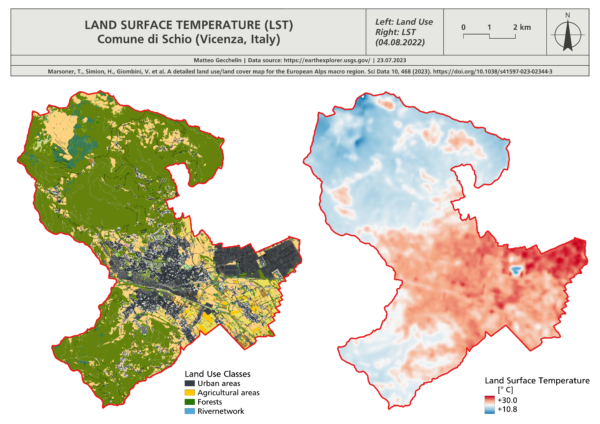
Let’s start with a simple yet effective example. The images in Figure 1 refer to the territory of the Municipality of Schio (Vicenza, Italy) and show the land use (on the left) and the corresponding Land Surface Temperature (LST, on the right) measured on August 04, 2022, by the Landsat 9 Satellite. A detailed image of the territory of Schio, colored by LST value, can also be seen in the cover image.

There is no doubt that for the areas of the territory occupied by man-made surfaces (industrial, residential, commercial areas: in grey and yellow on the map) the LST is clearly higher. On the contrary, the forested and grassland areas (in green) show lower temperatures, with a maximum of even 20 °C difference measured between the mountainous forested areas in the northwest in comparison with the industrial area in the east of the territory. A quick analysis of the data reveals the following average LST values by land use category:

⦁ Urban areas: 24.8 °C;
⦁ Agricultural areas: 23.0 °C;
⦁ Forests: 19.2 °C;
⦁ Rivers: 24.5 °C.

Even taking into account a significant altitudinal difference between urban areas (predominantly developed in the valley) and forests (prevalent in the hilly and mountainous areas), the differences in terms of temperature are evident.

In addition, when analyzing the average temperature for urban green areas alone, a value of 24.3 °C emerges, which, albeit minimally, is lower than the average value for entire urban areas.

Fig. 1: Land Surface Temperature (LST) and Land Use Map, Municipality of Schio (Vicenza, Italy). Author.

These urban green areas perfectly represent the concept of adaptation. It may seem trite to state it, and, unquestionably, we are all aware of it, but where there is greenery, especially in the city, measured and perceived temperatures are also lower than in otherwise man-made areas.And indeed, such a concept of “green adaptation” also emerges among the strategies proposed by the Plan under the name of “nature-based solutions.” And yet, as already remarked [3], such green strategies seem lacking and underestimated in the Italian context, although strongly encouraged and recommended by European strategies [5].

Among the latter, are at least to be cited the so-called “integrated solutions” involving the development of spatial connectivity by means of green infrastructure (two plus points: ecological connectivity for animal and plant species and climate change adaptation measure) and all other solutions based on ecosystem services (forestry and agro-forestry, river, coastal, and marine), even if not better specified.

In addition, equally noteworthy are the actions defined in the Governance macro-category, Plans and Strategy category, where the following are at least taken into consideration: (1) Protected Areas Management; (2) Fire Risk Management; (3) Forestry Planning; (4) Hydrographic District Planning; and (5) Hydrogeological Structure Plans. These are all subjects that have a very strong connection with the territory, not only in terms of urban and territorial planning, but also in terms of the development of the local economy and the safeguarding and safety of the population, and yet they are often disregarded or taken into consideration only after the occurrence of extreme and disastrous phenomena, in response always to the consequences and almost never to the triggering causes nor with a view to prevention [6]. What specifically these actions pertaining to sector planning entail is not known from the Plan. However, it is already a first step that at least these actions are remembered and mentioned as being of interest to the legislature.

Finally, it is good to remember how any strategic action to be activated on a nationwide scale cannot be separated from collaboration both among all stakeholders for the sector and among all funding and planning instruments at the national and local levels. The challenge for mitigation or, in this case, for adaptation to climate change sees us all as key players. The local scale (as demonstrated by the heatwave example for the small provincial municipality reported here) is not beyond the scope of global dynamics, and strategic directions at every level must be aware of this, giving rise to actions and incentives that are truly capable of influencing (positively) the development of effective and resilient adaptation in the face of expected adversity.

This article is part of the project “PILLOLE D’ACQUA PIANA: seminari itineranti, blog e podcast per una gestione sostenibile delle risorse idriche in Piana Rotaliana” carried out by ECONTROVERTIA APS and supported by Fondazione Caritro (Prot. no. U445.2023/SG.386 of April 23, 2023).
Extreme events happen. What can we do about it?

Heavy rains, storms, drought, and natural disasters seem to have become topics of everyday conversation in 2022. Because of their tremendous force and the socioeconomic damage they cause, it is impossible not to be shocked by similar tragedies. Unfortunately, there is still too much pointless chattering about them. We bounce faults to each other, claim that these occurrences are tragedies out of common, and we do not discuss enough about prevention measures and solutions.

2022’s boiling and arid summer, wildfires in Southern Europe, floods in Pakistan, Canada, and Italy, and the Fiona ex-hurricane in Greenland are all events related to the same source: the climate crisis [1].

Accepting that events like these will happen more frequently than in the past [2] is the first stepto safeguarding anthropic and natural ecosystems. Then, awareness and prevention measures must be adopted to reduce the natural risk.

Global guidelines to face natural disasters do exist. In 2015 the United Nations Office for Disaster Risk Reduction promoted the Sendai Framework outlining a series of targets to carry out an efficient risk assessment, prevention, mitigation, preparedness and response [3].

Awareness is crucial. Communities must have knowledge of natural disasters. The Sendai framework encourages the use of platforms to share data and risk-information maps at local and national levels to raise people’s awareness[3]. Being prepared for extreme events facilitates the success of disaster risk reduction strategies as well as rapid humanitarian aid responses if needed [4].

Moreover, the higher the environmental consciousness of a population, the more interest governments have in inserting the environment into proposals, policies, and laws aimed to face the climate crisis, thus creating a virtuous cycle, according to the International Energy Agency [5].

Data and risk-information maps allow the assessment of the need for prevention measures. Prevention is essential
to enhance
el
health
and the socioeconomic and cultural resilience of communities, as well as the environment [3]. It aims to keep the risk as low as possible. Prevention measures are highly time-dependent and site-specific.

There is no prevention measure covering all the climate-related hazards at the same time, if the green transition is not accelerated and nature-inclusive resilient societies are not created. Indeed, nature plays a key role in regulating natural risks. Flood risk along rivers, for instance, can be reduced by restoring the natural course of rivers and natural habitats in flood plains. Also, cities can be cooled during summer heatwaves thanks to parks and green areas.

However, relying on nature alone may not be enough. An overall increase in climate resilience requires a wide range of actions to reduce human-induced greenhouse gas emissions drastically and a second wide range of actions to move to a real sustainable development. Solutions must be deployed in the right places and with the right site-specific approaches to evaluate potential benefits and avoid harm [2].

It was a long time ago that scientists started to make people aware of the effect of the future climate crisis, with models and hypotheses at the beginning, and evidence later. The first work group of the IPCC stated that global warming would have hit with an increase in hot-temperature occurrences characterized by a longer duration, and higher maximum and average temperature peaks [6].

2022 has definitely shown that the future they predicted has come. Now it is time to act, not for climate, but for us, citizens of a globalized human society living in an ecosystem in transition: the Earth’s surface.

Green Rooftops: old-school solutions for today’s problems

On November 11, the auditorium of Lavis (Trentino, Italy) housed a conference on possible solutions to reduce the environmental impact of urban buildings, including green rooftops.

The initiative was organized in two sections. The first was mainly dedicated to urban greening experts and consisted of a technical lecture by Helga Salchegger of the Laimburg Research Center[1]. Salchegger described the steps for constructing green rooftops and explained which structural and static factors must be considered, which types of green roofs are already applied (extensive and intensive), and what benefits they bring. They are beneficial both for rainwater retention and building insulation (thermal and acoustic), but particularly for environmental purposes. The latest ongoing studies aim to set up green roofs that maximize biodiversity, mixing internsive and extensive roof greening methods, adding taller plants, boulders, non-vegetated areas, gravel knolls (where wild bees can nest) and logs (which provide food and shelter for various insects). The studies have shown that for many species, green rooftops can be an undisturbed oasis in the concrete ocean of highly urbanized cities.

In the second conference section, open to the whole community, Eurac researchers Silvia Croce and Sonja Gantioler presented their study on the possibility to increase the total urban green surface by exploiting the rooftops in Bolzano South[2]: a “concrete-sealed” industrial district of the size of approximately one third of the city. The two researchers first described the main problem in highly urbanized areas: the temperature rise caused by both the heat absorption (and return) of artificial surfaces, and poor ventilation in dense build-up areas. This can then generate the so-called heat islands.

In areas affected by heat island effect, the average temperature can be up to 1 °C higher than the average temperature in the surrouning areas.

Fig. 1: Eurac Researchers Sonja Gantioler (left) and Silvia Croce (right) during their presentation.

Can green rooftops and hanging gardens reduce the heat island effect and air pollution concentration level?What do plants, shrubs and grasses do?

1. They absorb solar radiation and polluting gases (nitrogen dioxide)

2. They stop particulate matter and fix carbon dioxide in the soil

3. They retain and slow down the damaging effects of heavy rainfall

4. Thanks to evapotranspiration, they have a cooling effect, which can be of some valuable degrees.

5. Even though it is rarely know, they can improve the performance of solar and photovoltaic panels (the reason is related to the optimal operating temperature range of the panels).

Several times the two speakers repeated that green rooftops are an extreme form of nature: they cannot be seen as a definitive but rather partial solution against high-urbanization. Green areas on the actual ground should always be prioritized in sustainable urban develompent plans.Given its importance in absorbing water, fixing carbon dioxide and housing biodiversity, the care of our soil must not be overlooked.

Another factor that must not be forgotten is the type of material used to create green rooftops. To insulate, retain and drain water plastic is typically adopted. The problem of how to dispose it in the future then arises.

All in all, the conference showed several points of interest for our territory both for the adopted methodology and for the suggested solutions. In the end, a greater attention to the quality of the environment means that the relationship between man and nature is healthy and properly managed.

Bibliography:

[1] Abram, Paolo and Salchegger, Helga (2017) Il verde pensile : tra tecnica e natura. Architettura, ingegneria e ambiente . Legislazione tecnica, Roma. ISBN 978-88-6219-237-8

[2] Silvia Croce et al (2019) A Systemic Approach for the Optimization of Urban Surfaces Usage
IOP Conf. Ser.: Earth Environ. Sci. 290 012113

Imagen de portada: An example of a living roof. Free-source photo by Peggychoucair downloaded from Pixabay.

This article is part of the project “Environmental Blogging Boost 4 Students”, aimed at increasing the spread of agroecology and sustainable water management in Trentino. The project is financed by the BIM Adige Water Catchments Consortium (grant approved by provision n. 100 of June 06, 2021).

Telegram: @greenmarked
LinkedIn: @greenmarked
Instagram: @greenmarked.it

Facebook:  @greenmarked.it


© GreenMarked.it is managed by ECONTROVERTIA APS — Via Alcide De Gasperi 1, 38015 Lavis (TN), Italy — VAT IT02667560227