Ir al contenido principal

Etiqueta: heatwave

Dutch Cities to Hit 50 Degrees?

As a delta country, climate plays an important role in the Netherlands. For an accessible, liveable and safe country, knowledge about the future climate is very important. With coastal defences, dykes and infrastructure projects, the Dutch became known for their gestión hidríca más sostenible. The large investments involved require foresight. This is why the Royal Netherlands Meteorological Institute (KNMI) provides
climate scenarios for a possible future climate in the Netherlands. In October, the KNMI scenarios for 2023 were published [1].

Future scenarios

Using the latest findings of the international climate panel IPCC on the situation in the Netherlands, KNMI’s future scenarios provide insight into the extent of heat, drought, precipitation and sea level rise in 2050, 2100 and 2300. All future scenarios reflect a changing climate in the Netherlands, with warmer temperatures in all seasons. Winter becomes wetter with fewer frost days, summer becomes drier with more tropical days, heavier showers occur, and the sea level continues to rise —the extent largely on the amount of (global) CO₂ emissions [1].

Dutch temperatures already increased by 2 degrees since the KNMI started measuring in 1901, while the amount of precipitation has increased by over 20%. Precipitation falls in more extreme showers and the likelihood of extreme heat has already increased [1].

Fig. 1: People attending a climate march to stand up against climate change. Copyright-free photo by Nicole Glass Photography en Shutterstock.

50 degrees

“In [Dutch] cities, we can no longer rule out 50 degrees”

KNMI climate scientist Karin van der Wiel [2].

When talking about the scenario in which the world has little or no success in reducing GHG emissions, el2019 Dutch heat record of over 40 degrees could occur every other year by the end of this century. Assuming a 2 to 4-degree temperature rise by the end of the 21st century, extreme conditions in the Netherlands would not be limited to 40 degrees as in 2019, instead Dutch cities could face temperatures up to 50 degrees (given that cities retain more heat due to urban asphalt and concrete) [1].

“Following the warm, dry scenario, an average summer around 2100 is about as dry as an extremely dry summer today.”

KNMI [1]

It should be noted that KNMI’s high scenario assumes the IPCC’s controversial emission pathway RCP8.5 (with an increase in emissions at the current rate until 2080 and then only level off), which is no longer considered plausible or realistic by many scientists. Although this is not considered “business as usual”, KNMI project leader Rob van Dorland argued the exceptional emissions scenario was chosen due to potential unforeseen events in the changing climate [2].

Water rise

When staying within the boarders of the Paris Agreement, the Dutch will see their North Sea risingbetween 26 and 73 centimetres, compared to 59 to 124 centimetres in a high scenario [1]. However, due to uncertainties about the stability of the Antarctic ice mass, sea level rise could accelerate. Some observations go faster than the climate models, up to 17 metres in 2300. This is why KNMI has assumed RCP8.5 [2].

In “An Increasing Blue Risk”, we already pointed out that the Delta North Sea Protection Works only anticipated a 40 cm rise in seawater, but the
KNMI no longer rules out a 2.5-metre rise when certain tipping points are exceeded [1].

According to KNMI’s chief executive Van Aalst, one conclusion is clear: “We must do all we can to reduce our greenhouse gas emissions as quickly as possible, even if the Netherlands contributes very little to global emissions. After all, per capita [the Dutch] still emit almost double the world average. Historically, too, we have a responsibility as Europe. And it is in our own interest as the Netherlands to push the world in the right direction” [2].

For more information, read the English report “KNMI National Climate Scenarios 2023 for the Netherlands”.

This article is part of the project “PILLOLE D’ACQUA PIANA: seminari itineranti, blog e podcast per una gestione sostenibile delle risorse idriche in Piana Rotaliana” carried out by ECONTROVERTIA APS and supported by Fondazione Caritro (Prot. no. U445.2023/SG.386 of April 23, 2023).

Creating Water in the Desert: An Innovation to Fight Water Shortages in Extreme Droughts

It is an image that plagues large parts of Europe: extreme drought. Even the Netherlands, known for its exceptional water management, is facing an official water shortage [1]. Research by Dutch newspaper NRC has shown that Western Europe hot temperatures have moved 500 kilometres north in the last 50 years, increasing summer air temperatures by more than 1°C [2].

The current Dutch summer now resembles a French summer of yesteryear. In the past decade, temperatures in the Netherlands were equivalent to those in large parts of central France in the 1970s. Instead, summers in central France are now roughly as warm as in northern Spain in the 1970s, which in turn now features southern Spain temperatures [2].

The climate crisis, severe droughts and population growth has put pressure on the scarce global freshwater resources and led to severe water shortages in many regions
of the world. At the same time, global water demand is expected to rise by 55 % by 2050, and 25 % of large cities already suffer from water stress [3]. Likewise, many municipalities in Spain and France had to cut off households’ drinkable water this summer.

To find a solution, we need a different approach. Crossovers between art and science allow to break through established patterns and can lead to radical innovations. This mentality enabled Dutch artist Ap Verheggen to develop SunGlacier, an innovative company specialized in solar-powered sculptures that can produce water from thin air [4]. His “counter-intuitive aim” [was] to create ice and water in the desert by making use of solar energy” [5]. “Sun, gravity and air are widely and freely available everywhere. They do the work.” [6].

SunGlacier is in fact a water multiplier. It blows outdoor air through an artificial cold rain shower. The water vapor of the outdoor air condenses against the cold falling water droplets and increases their volume. The result is a growing waterfall, as depicted in Figura 1. The air cooler and the water pump ensure that water is regularly pumped to the rain shower [6].

Fig. 1: SunGlacier’s Growing Waterfall Technology. Source: SunGlacier.

From the beginning, the company has focused on a portable size off-grid application, powered by solar energy. This led to the creation of an incredibly efficient system capable of producing large amounts of water with low energy consumption [5].

SunGlacier is planning to build an industrial prototype with a Dutch mechanical engineering corporation and have ongoing negotiations with a company supplying horticultural greenhouse system. With SunGlacier’s technology, they intend to make closed ecosystem greenhouses.

The potential impact of Verheggen’s water machine is immense. If his now patented invention can be applied worldwide, millions of people in arid regions could gain access to drinking water. It would also make farming possible in places where this is now unthinkable. Verheggen is however more cautious: “Hopefully, in five years, tens of thousands of SunGlaciers will have been sold. This will not solve any immediate global problems, but this invention can help take the pressure off drinking water and food supply problems in the long run” [6].

Our home is burning. But what the hell can we do about it?

Our Amazon has already been hit by more than 72,000 forest fires this year. Nothing special in the Southern Hemisphere’s winter, but the increase of fires is dramatic: +85% compared to winter 2018.

While Bolsonaro claims without any evidence, that NGOs are to blame [1], many International governments say it is his fault. His weak consideration of the Amazon and the indigenous minorities living in it, encouraged farmers and miners to cut down and burn more trees. As a matter of fact, Bolsonaro thinks that the Amazon can be the new frontier for agricultural development.

The destruction of the Brazilian Amazonian rainforest is nothing to take superficially. It represents the lungs of our planet, and killing it may give a deadly kick to our attempts to contrast climate change.

But what can we do about it? In the end, we’re not Brazilians and the Amazon is on the other side of the Ocean.

  1. Pray for the Amazon with your heart and your spirit. To pray, you can also use the hashtag #PrayForTheAmazon on Twitter.
  2. Spread your disappointment and concern to your friends and colleagues. If the issue becomes of national interest, it may reach politicians and decision-making people of your country.
  3. Ask your politicians to put market deals with Brazil into question (e.g. soy beans and beef steaks imports) and to stop financing the Brazilian government’s Amazon fund, like Norway and Germany did [2].
  4. Set “Ecosia” has default search engine on your phone, computer and tablet. Ecosia is an environmental friendly search engine that plants tree every time you browse the web. In response to the Amazonian fires, Ecosia decided to plant 1M trees in the Atlantic rainforest [3]. They don’t accept donation but their partners do [4].
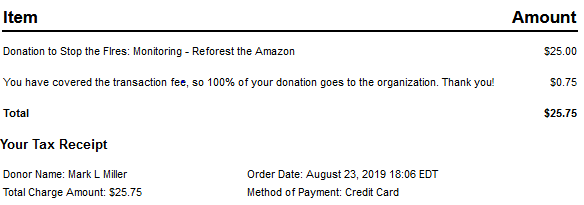
  5. Donate to environmental initiatives that support the Amazonian forest(e.g. Rainforest Foundation, PUR Project, etc.)

REFERENCIAS:

[1] Watss, J. (2019). Jair Bolsonaro claims NGOs behind Amazon forest fire surge – but provides no evidence. [online] Available at: https://www.theguardian.com/world/2019/aug/21/jair-bolsonaro-accuses-ngos-setting-fire-amazon-rainforest (Accessed 2019.08.24).

[2] Boffey, D. (2019). Norway halts Amazon fund donation in dispute with Brazil. [online] Available at: https://www.theguardian.com/world/2019/aug/16/norway-halts-amazon-fund-donation-dispute-brazil-deforestation-jair-bolsonaro (Accessed 2019.08.24).

[3] Ecosia. (2018). News from Brazil: Your trees, Bolsonaro and how you can help.[online] Available at: https://blog.ecosia.org/news-from-brazil-how-you-can-help/ (Accessed 2019.08.24).

[4] Ecosia. (2019). Does Ecosia accept donations?. [online] Available at: https://ecosia.zendesk.com/hc/en-us/articles/115002296049-Does-Ecosia-accept-donations- (Accessed 2019.08.24).

Eco-yoga villages to face future droughts

Heerlen (The Netherlands), 25 July 2019

Today was the hottest day ever measured in the Netherlands. Last year we already faced a severe dry summer, in which 1944’s heat record was broken. Normally, the Netherlands faces extreme drought once every three years. Today, half way through this year’s summer, many Dutch provinces surpassed the “magical forty” degree reaching an astounding 40,7 °C. When thinking about the Netherlands, you rather think of water reservoirs rather than droughts. However, the average Dutch landscape now looks more like Spain’s dry lands.

How can we face future droughts, then, if countries so rich in water resources, like the Netherlands, experience such severe water scarcities? What can we do to prepare ourselves? Is creating livable surroundings a potential solution?

Here is an example from my last year’s travel through South America, where I visited many places dealing with water scarcity issues. One of them was the desert of Peru, some miles north from the capital Lima. A former area full of sand and dust had been transformed in less than 25 years into a green oasis.

The name of the area was “Eco Truly Park”, and referred to the round eco-friendly buildings made from mud and locally recycled materials instead of cement. In addition, the Park truly strove for self-sufficiency, focusing on permaculture. Besides, the people who live there abide Hindu principles (i.e. Hare Krishna), which means that the food is vegetarian and mainly local.

The Park’s toilets used hay instead of water and residuals were used in the garden after some time. The small amount of water used was purified ocean water, as the park is located near the beach.

The Eco Truly Park is part of “Eco Yoga Villages“, a foundation with similar communities around South America and the world. Its aim is to protect the environment by promoting activities such as recycling, yoga, vegetarianism, sustainable farming, etc.

In Colombia, I visited another village fully surrounded by nature. There I could only hear the sound of a rough river in the background. I felt like time stood still for a moment, or like time did not exist in that moment. It was a place where one lived from sunrise to sunset, with electricity only available in the kitchen. A place where one used only what nature offered. That was life in its purest form, where everything related to capitalism seemed very far away. This form of life is a remedy for the materialistic world and allows you to fully disconnect from technology.

yes

Telegram: @greenmarked
LinkedIn: @greenmarked
Instagram: @greenmarked.it

Facebook:  @greenmarked.it


© GreenMarked.it is managed by ECONTROVERTIA APS — Via Alcide De Gasperi 1, 38015 Lavis (TN), Italy — VAT IT02667560227