Ir al contenido principal

Etiqueta: floods

DANA en Valencia: Eventos Extremos en la época del Cambio Climático

Las dinámicas del agua en el sureste de España tienen su propio ritmo. El cauce del río puede estar un tiempo casi sin agua, y de golpe, una tormenta fuerte lo transforma en un caudal potente. Esto está integrado en la cultura de la tierra, incluso en el lenguaje y el vocabulario, con palabras como rambla, que se define como “cauce natural del agua de lluvia cuando cae en abundancia”, o torrentee, una “corriente o avenida impetuosa de aguas que sobreviene en tiempos de muchas lluvias o de rápidos deshielos”. Con respecto a los trágicos sucesos de hace un par de semanas, un periodista en España recordaba la canción de un cantautor valenciano, Raimon, que decía que “en mi país la lluvia no sabe llover, llueve poco o llueve demasiado”.

“Al meu país la pluja no sap ploure/ O plou poc o plou massa”

By the time I am writing this article, 200 people have tragically lost their lives in Valencia [1]. Entire villages have been submerged, with water and mud destroying everything in their path. The devastation is truly heartbreaking.

Antes de entrar en más profundidad, me gustaría dejar aquí algunos recursos que se han ofrecido para quien quiera y pueda ayudar.

  • Teléfono de donaciones de Cruz Roja: +34 900 104 971
  • Banco de alimentos Caritas: ES19 3159 0078 5716 6338 6025
  • Asociación Española de Bancos de Alimentos: ES34 2100 6106 8813 0126 8072
  • GoFundMe para los afectadosAyuda Damnificados Por-El DANA en Valencia

Por pequeña que sea, toda contribución puede marcar la diferencia durante esta crisis.

Como ya hemos mencionado, las dinámicas del agua en esta región mediterránea se basan en un ciclo de sequía y lluvias abundantes. Es normal que los ríos tengan unos periodos de retorno en los que el cauce se inunda con fuertes lluvias. El periodo de retorno es un término que se usa en hidrología para referiré al número medio de años que pasan entre que se repite una inundación del cauce de cierto tamaño.

La mejor manera de verlo es en un mapa. En el Figura 1 podemos ver las áreas que se tienden a inundar cada 10 años (periodo de retorno de 10 años). En el Figura 2, podemos ver un periodo de retorno de 100 años, para comparar. Cuanto mayor el periodo de retorno, mayores sus efectos, pero menor su probabilidad.


Fig.1: 10-year return period map showing data in the Valencia area, Spain. Map from the Ministry for the Ecological Transition and Demographic Challenge (MITECO).


Fig.2: 100-year return period map showing data in the Valencia area, Spain. Map from the Ministry for the Ecological Transition and Demographic Challenge (MITECO).

Con el cambio climático, los eventos extremos se están haciendo cada vez más probables. Estamos empezando a ver sucesos que tienen periodos de retorno de 100 años ocurrir con más frecuencia de la esperada.

En este caso, una gota fría es una depresión aislada de aire frío en altos niveles de la atmosfera, o DANA (como acrónimo de Depresión Aislada en Niveles Altos) [2]. These air masses can span up to 2,000 kilometers in diameter. When they collide with warmer, more humid air currents, the result can be atmospheric destabilization and episodes of intense, heavy rainfall.

No siempre se da el caso de que una DANA termine en lluvia, pero cuando pasa, puede terminar así.

No podemos hacer nada para controlar el clima, pero lo que sí podemos controlar los humanos es nuestra forma de construir. En este caso, los factores naturales (distribución inusualmente alta de las precipitaciones, cauces de los ríos que multiplican su caudal en horas) son incontrolables. Pero otro factor de las graves consecuencias de esta DANA fue la impermeabilización del suelo.

In this river basin, a significant portion of the land—20% of its surface—has been rendered impermeable, meaning water cannot seep into the ground [3]. Industrial and urbanized areas lacking green spaces exacerbate the problem by preventing water infiltration. As a result, all the water—and its tremendous force—remains on the surface, intensifying the damage caused by flooding.

This issue is not new. In 1998, the Yangtze River in China overflowed, partly due to soil impermeabilization. Rapid urbanization and accelerated industrial development paved over fields and green areas with roads, industrial zones, and expanding cities. The combination of excessive urbanization, deforestation, and heavy rainfall led to a catastrophic flood that claimed 3,700 lives [4].

To address such events, nature-based solutions (NBS) offer a promising path forward [5]. One example is the implementation of sustainable urban drainage systems, which involve incorporating green spaces throughout cities and urbanized areas. Parks, gardens, and other vegetated areas act like natural sponges, absorbing excess water and easing the burden on artificial drainage systems.

Las soluciones basadas en la Naturaleza se basan en proteger, restaurar y gestionar de manera sostenible los ecosistemas, de manera que aumenten su resiliencia y capacidad para poder dar respuesta a situaciones como la vivida en Valencia hace un par de semanas.

To sum up, we urgently need policies that heed the warnings of scientists—policies grounded in ecological wisdom and logic, rather than driven by the pursuit of profit. Rising temperatures, particularly at the sea surface, lead to increased evaporation, putting more moisture into the atmosphere and making hot air currents more frequent.

We must not only adapt to a warming climate but also address its increasingly severe effects. That is why we need to start taking drastic measures now to keep warming to a minimum, while also creating new strategies and protocols for this kind of – always more common – events.

REFERENCIAS:

Pulse aquí para ampliar las referencias

[1] Tanno S., Paddison L. (2024, 1 November). Spain hit by deadliest floods in decades. Here’s what we know. Retrieved on 30 November 2024, from https://edition.cnn.com/2024/10/31/europe/spain-deadly-flash-flooding-wwk-intl/index.html

[2] Jansà Clar A. (2004, September). ¿Qué es la gota fría?. Retrieved on 01 December 2024, from https://repositorio.aemet.es/bitstream/20.500.11765/12418/1/AM_2004_36_59_62.pdf

[3] Boix Fayos C., Calvo-Cases A., Arnau Rosalen E., López Carratalá J., de Vente J. (2024, 6 December). ¿Qué hizo a la dana tan destructiva? Factores ambientales y humanos. Retrieved on 27 September 2023, from https://theconversation.com/que-hizo-a-la-dana-tan-destructiva-factores-ambientales-y-humanos-242858?utm_source=twitter&utm_medium=bylinetwitterbutton

[4] Xiubin H., Juren J. (2000, 9 March). The 1998 flood and soil erosion in Yangtze river. Retrieved on 2 December 2024, from https://www.sciencedirect.com/science/article/abs/pii/S1366701799000148

[5] WWF. (2024). ¿En qué consisten las soluciones basadas en la naturaleza y cómo pueden ayudarnos a enfrentar la crisis climática?Retrieved on 29 November 2024, from https://www.worldwildlife.org/descubre-wwf/historias/en-que-consisten-las-soluciones-basadas-en-la-naturaleza-y-como-pueden-ayudarnos-a-enfrentar-la-crisis-climatica

Even the Netherlands Faces Imminent Shortage of Drinking Water

The history of the Netherlands is inextricably linked to water. The country maintains an international reputation for innovative, integrated and inclusive solutions that protect people and infrastructure from flooding, prevent water scarcity and ensure clean and safe water [1]. For more than a century, it has been taken for granted that clean drinking water flows from the tap in Dutch households, but that time seems to be ending. What is happening in the water country per excellence?

According to a report by the Dutch National Institute for Public Health and the Environment (RIVM), the demand for drinking water in the Netherlands is expected to be much greater in 2030 than in 2020 [2]. On one hand, the Dutch economy and number of inhabitants continue to grow. On the other hand, the changing climate is causing more frequent and severe droughts, which are reducing the amount of drinking water available.

By 2030, the demand for freshwater in the Netherlands is likely to exceed the available supply by up to 30 %. Without immediate action by the national government, provinces, water boards and consumers, these extra cubic meters of water cannot be extracted, and drinking water shortages will arise, the RIVM warns. This shortfall could significantly affect the country’s economy, environment and public health [2].

Four Dutch provinces already struggle with insufficient water reserves to guarantee drinking water at peak times in the summer months. They would be powerless in the face of unexpected increases in drinking water demand. In other Dutch provinces, drinking water companies are called to find additional water sources within the next few years to continue satisfying the increasing demand of water [2].

Nonetheless, these water companies are already facing their own challenges. Often, they use all surface- or groundwater they are licenced to extract, thus resulting in insufficient reserves. And yet, recent nature protection agreements with the government should prevent extraction of the total quantity of water permitted under older licences [2].

Fig. 1: A sailing ship on the Dutch Ijsselmeer during sunset. Free source photo by Alfred Grupstra en Pixabay.

To tackle current and future shortages, the Netherlands needs a new water system that is able to cope with both drought and prolonged wet periods. Possible solutions include reducing rainwater run-off and building up larger water reserves in the dunes and the Ijsselmeer, a closed-off inland bay in the central Netherlands. Meanwhile, water stakeholders are working to raise public and industry awareness about water use and conservation. Work is also being done to find new extraction sites and expand the range of existing licences. For instance, new licences will include different source types, such as brackish groundwater, which is a hybrid water type between freshwater and seawater often found in river estuaries [2].

Besides these radical measures, the RIVM stressed the importance of raising awareness among consumers and industry that drinking water cannot be taken for granted [2]. Read How much water does your 24-hours day consume? on GreenMarked to learn how you can decrease your own water consumption.

This article is part of the project “PILLOLE D’ACQUA PIANA: seminari itineranti, blog e podcast per una gestione sostenibile delle risorse idriche in Piana Rotaliana” carried out by ECONTROVERTIA APS and supported by Fondazione Caritro (Prot. no. U445.2023/SG.386 of April 23, 2023).

Extreme events happen. What can we do about it?

Heavy rains, storms, drought, and natural disasters seem to have become topics of everyday conversation in 2022. Because of their tremendous force and the socioeconomic damage they cause, it is impossible not to be shocked by similar tragedies. Unfortunately, there is still too much pointless chattering about them. We bounce faults to each other, claim that these occurrences are tragedies out of common, and we do not discuss enough about prevention measures and solutions.

2022’s boiling and arid summer, wildfires in Southern Europe, floods in Pakistan, Canada, and Italy, and the Fiona ex-hurricane in Greenland are all events related to the same source: the climate crisis [1].

Accepting that events like these will happen more frequently than in the past [2] is the first stepto safeguarding anthropic and natural ecosystems. Then, awareness and prevention measures must be adopted to reduce the natural risk.

Global guidelines to face natural disasters do exist. In 2015 the United Nations Office for Disaster Risk Reduction promoted the Sendai Framework outlining a series of targets to carry out an efficient risk assessment, prevention, mitigation, preparedness and response [3].

Awareness is crucial. Communities must have knowledge of natural disasters. The Sendai framework encourages the use of platforms to share data and risk-information maps at local and national levels to raise people’s awareness[3]. Being prepared for extreme events facilitates the success of disaster risk reduction strategies as well as rapid humanitarian aid responses if needed [4].

Moreover, the higher the environmental consciousness of a population, the more interest governments have in inserting the environment into proposals, policies, and laws aimed to face the climate crisis, thus creating a virtuous cycle, according to the International Energy Agency [5].

Data and risk-information maps allow the assessment of the need for prevention measures. Prevention is essential
to enhance
el
health
and the socioeconomic and cultural resilience of communities, as well as the environment [3]. It aims to keep the risk as low as possible. Prevention measures are highly time-dependent and site-specific.

There is no prevention measure covering all the climate-related hazards at the same time, if the green transition is not accelerated and nature-inclusive resilient societies are not created. Indeed, nature plays a key role in regulating natural risks. Flood risk along rivers, for instance, can be reduced by restoring the natural course of rivers and natural habitats in flood plains. Also, cities can be cooled during summer heatwaves thanks to parks and green areas.

However, relying on nature alone may not be enough. An overall increase in climate resilience requires a wide range of actions to reduce human-induced greenhouse gas emissions drastically and a second wide range of actions to move to a real sustainable development. Solutions must be deployed in the right places and with the right site-specific approaches to evaluate potential benefits and avoid harm [2].

It was a long time ago that scientists started to make people aware of the effect of the future climate crisis, with models and hypotheses at the beginning, and evidence later. The first work group of the IPCC stated that global warming would have hit with an increase in hot-temperature occurrences characterized by a longer duration, and higher maximum and average temperature peaks [6].

2022 has definitely shown that the future they predicted has come. Now it is time to act, not for climate, but for us, citizens of a globalized human society living in an ecosystem in transition: the Earth’s surface.

An increasing blue risk – The Netherlands and the rising sea level

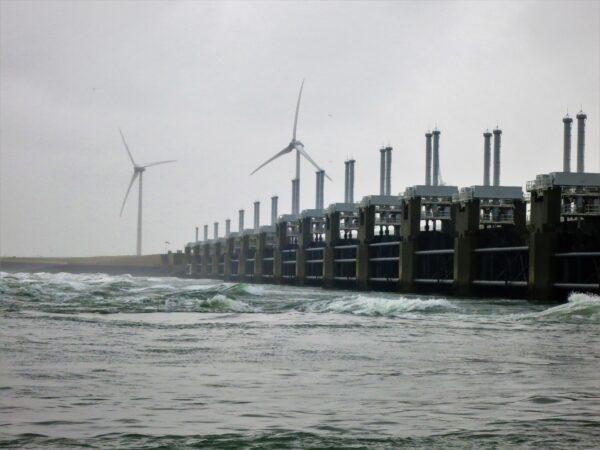
The Netherlands has always been known for its water management. Approximately 70 % of the Dutch people live in a flood-sensitive area[1], and the engineering works to make it all possible are looked with worldwide amazement. More international fame was gained through the construction of the Delta Works. Consisting of a series of dams, sluices and storm surge barriers [2], the Delta Works has been voted one of the seven modern world wonders.

Recognizing the need for such a defence system did not go without a struggle. Despite numerous warnings, a flood disaster had to occur before politicians approved the construction of the Delta North Sea Protection Works. The tragedy of 1953 took nearly two thousand people’s lives and flooded 1290 km², four times the size of Malta. In fact, also Amsterdam and the entire province of Zuid Holland (including cities such as The Hague and Rotterdam) were close to being flooded [3].

“The problem of the Dutch is that they are so self-effacing, so modest, that they no longer believe their own history.”

Johan van Veen (1893–1959)

The Delta Works defence system anticipated a 40 cm rise in sea-water, a value which is unfortunately much lower than the expected rise foreseen by the climate crisis. If the world’s greenhouse gas (“GHG”) emissions do not decline unprecedentedly, the sea level could rise by almost three meters within 2100. Even if the Paris Agreement target of keeping the average global temperature increase under 2 °C is met before the end of the century, the Royal Netherlands Meteorological Institute (KNMI) still predicts a sea-level rise of two meters [4].

Dutch scientists have considered a scenario where the next generation has to give up cities like Amsterdam, Rotterdam, and The Hague. Some even state that the Dutch newborns “will not be able to be Dutch anymore, because the country of the Netherlands will no longer be there” [3]. Is there still hope? In the end, Dutch people would not be Dutch if they did not fight water. Yet hope seems limited to engineers that believe in a makeable world while ecologists have given up already.

Rutger Bregman interviewed seven leading Dutch scientists for his book “Het water komt” (The water is coming). To deal with a sea-level rise up to two meters, they suggested extreme countermeasures which go far beyond the current Delta program. The country would need to build the world’s largest pumping stations to coninuously pump water from the low rivers into the high sea. Furthermore, it would require 25 times more sand to strengthen the coast and a permanent fleet of dredging ships to continuously spray sand upon the North Sea coast. And this would only be the beginning [3].

“If the earth warms by more than 2 degrees, sea levels will continue to rise, requiring us to think even bigger.” [3]

Bas Jonkman, professor of Hydraulic Engineering at Delft University, sees possibilities even beyond a 2 meters sea-level rise. He envisions the displacement of Amsterdam’s Schiphol Airport into the sea, and construction of artificial islands in front of beaches. Housing dozens of wind turbines, they will break the incoming waves. To boost their effect against an additional sea-level rise, the island could connected with one big ring dyke. Ecologists foresee environmental disasters, but Jonkman argued that “nature is dynamic, with the potential to restore. Despite the discrepancies, both ecologists and engineers agree that it is fundamental that a scenario of more than 2 meters sea-level rise must be avoided at all costs. That would require to push down GHGs to absolute zero (not net-zero) as soon as possible.

The Dutch Climate Agreement aims at a GHG reduction of 49 % by 2030 compared to 1990, followed by 95 % by 2050 [5]. To meet these targets, some eight million buildings must become gas-free, nine million cars must run on electricity or hydrogen, the electricity grid capability must become at least three times bigger, a quarter of the North Sea must be filled with wind turbines, 75 million solar panels must be connected, and 100 thousand hectares of forest must be planted [3]. The cost of the operation has been roughly estimated at € 500 to 700 billion, which is 70 to 100 % of the Dutch GDP, and five times as much as the Delta Works [6].

“This will be the largest reconstruction of our country. Ever.” [3]

To achieve the GHG objectives, everyone has to do their part but the government has a guiding and exemplary role. Its decarbonizing attempt must not lead to adverse effects elsewhere, but rather contribute to a more sustainable world as a whole. In Renewable energy at what price?, I explained that base metals mining needed for the Global North energy transition leads to ecological destruction in the Global South, destroying the habitat of the local population, often without compensation. The Dutch government should acknowledge this and act accordingly [7].

Estimates by PBL Netherlands Environmental Assessment Agency suggest that GHGs will be cut by only 38 to 48 % within 2030, much lower than the EU’s Fit for 55. The Dutch Council of State – the highest advisory body of the government and House of Representatives – concluded that Dutch climate policy is “not enough to meet the climate targets”, even though “the nature and extent of the climate crisis require immediate action” [8].

The coalition of the new Rutte IV cabinet has made the climate crisis fight a top priority. By earmarking € 35 billion over the next ten years and appointing a special Minister of Climate and Energy, Dutch climate policy should align itself with the EU’s directive of achieving a 55 % GHG reduction compared to 1990 by 2030. In addition, an independent scientific council will be established to evaluate and advise on the required new climate policy [9].

The Rutte IV coalition, however, has not specifically explained how it will tackle the climate crisis effects and especially the upcoming sea-level rise, which will hit hard on the Dutch coasts. It remains unclear how Dutch water engineers and managers are preparing for the outlined sea-level rise scenarios, as current policies are still too often focused on the short term. Both in the short and long term, the Netherlands must counteract the climate crisis not only to abide by European directives but to protect their coasts, their land, people and future.

Figura 1: Delta North Sea Protection Works (source: Deltawerken | 18 August 2015 | Mirko Tobias Schäfer | Flickr)

Bibliography:

[1] PBL. (2014). Small chances – big consequences: casualties and social disruption as a focus for water safety policy.[Translated by Author]. Retrieved 11 December 2021, from https://www.pbl.nl/publicaties/kleine-kansen-grote-gevolgen

[2] BenDor, T.K. (n.d.) Flood Control. Downloaded 11 December 2021, from https://todd.bendor.org/media/Flood_Control_BenDor.pdf

[3] Bregman, R. (2020). The water is coming: a letter to all Dutch people. [Translated by Author]. De Correspondent. Downloaded 6 December 2020, from https://decorrespondent.fetchapp.com/files/a8a80f35

[4] Haasnoot, M., Bouwer, L., […] Sloff, K. & Mosselman, E. (2018). Possible consequences of accelerated sea level rise for the Delta Programme: an exploration.[Translated by Author]. Downloaded 11 December 2021, from https://www.deltares.nl/app/uploads/2018/08/Deltares_Mogelijke-gevolgen-van-versnelde-zeespiegelstijging-voor-het-Deltaprogramma.pdf

[5] Klimaatakkoord. (2019). National Climate Agreement – The Netherlands.Downloaded 13 December 2021, from https://www.klimaatakkoord.nl/binaries/klimaatakkoord/documenten/publicaties/2019/06/28/national-climate-agreement-the-netherlands/20190628+National+Climate+Agreement+The+Netherlands.pdf

[6] Borst, T. & Keulemans, M. (2019, 10 October). Will climate policy really cost the Netherlands 1,000 billion euros?[Translated by Author]. Retrieved 13 December 2021, from https://www.volkskrant.nl/nieuws-achtergrond/gaat-het-klimaatbeleid-nederland-echt-1-000-miljard-euro-kosten~bd4fe21a/

[7] Hoekstra, E. (2019, 21 February). Renewable energy at what price?Retrieved 13 December 2021, from https://greenmarked.it/renewable-energy_price/

[8] Raad van State. (2021, 30 September). Advice on the Climate Memorandum 2021. [Translated by Author]. Downloaded 15 December 2021, from https://www.rijksoverheid.nl/binaries/rijksoverheid/documenten/brieven/2021/10/28/brief-raad-van-state-over-klimaatnota/Raad+van+State+Advies+op+Klimaatnota+2021.PDF

[9] Nijenhuis, H. (2021, 16 December). Will the new coalition agreement achieve the climate goals?[Translated by Author]. Retrieved 16 December 2021, from https://www.parool.nl/nederland/gaan-we-de-klimaatdoelen-nu-wel-halen-met-het-nieuwe-regeerakkoord~b51898b8/

Cover and preview image:inundated coast area. Free-source photo by Cobe68 en Pixabay.

This article is part of the project “Environmental Blogging Boost 4 Students”, aimed at increasing the spread of agroecology and sustainable water management in Trentino. The project is financed by the BIM Adige Water Catchments Consortium (grant approved by provision n. 100 of June 06, 2021).

The climate crisis and the floods in Central Europe

Summer 2021 will probably be remembered for the next years in Central Europe as “the summer of the floods”. From the 13th to the 18th of July, intense storms dropped 150-200 mm of rain in 24 hours, filling-up streams, overtopping riverbanks, washing away adjoining cars, houses and trees and even triggering destructive landslides.

According to the press, more than 200 people in Germany, Luxemburg, Belgium, and the Netherlands lost their lives in such a tragic event. Thousands more were injured and evacuated as well. Visiting one of the mostly damaged towns, Adenau, German Chancellor Angela Merkel called the event: “Terrifying, the German language can barely describe the devastation” [1]. Minor, but still relevant, damages caused by the same storm were also reported in Switzerland, Austria, Italy, France, Czech Republic and the UK [1].

The climate crisis is surely one of the main causes of such a great calamity.

The affected area

The rivers Rhein, Meuse, and their tributaries were responsible for most of the devastation. In Liège, a large Belgian city, people were asked to evacuate their homes even in the city center. The same request was made in the Dutch province of Limburg and in many other towns of the affected area.

Worse than in Benelux, the river Ahr – a tributary of the Rhine – destroyed 20 of the 35 bridges crossing its path
in Ahrweiler, northwestern Germany. Additionally, a series of flash floods completely swallowed the village of Schuld [2].  

For a long time after the event, international newspapers published tragic pictures of the effects of this huge natural disaster. Here the most suggestive.

Some satellite images by ESA (the European Space Agency) and NASA can perfectly describe the extraordinary power of this flood. Figure 1 shows the flooding in the area surrounding the city of Roermond, the Netherlands. The picture on the left was taken on the 16th of July. It could be named “the calm before the flood”. Instead, the view on the right shows the inundated area immediately after the occurrence: it was taken on the 18th of July.

Fig. 1: The area of Roermond, in the Netherlands, was completely inundated by the Meuse and the Roer Rivers [3].Picture: NASA, Earth Observatory, 2021.

The Climate Crisis role

Scientific literature stated that floods are not unknown events for Central European rivers. In a way, this last one resembles the floods of 2006 and 2013 that hit in Elbe and Danube basins [2]. Usually, events of such an intensity hit with a recurrence interval of 500 – 1000 years. However, the estimation of the recurrence interval lies in an analysis of historical records. Global warming is altering local weather conditions leading to a higher number of extreme events worldwide [4].

Summer 2021 floods seem to be a direct consequence of the extreme heatwaves that hit the Pacific Northwest and Northern Europe in June and early July 2021. The higher the temperature of the atmosphere, the higher the amount of absorbed water vapor, and hence, the higher the precipitation rate [1].

Additionally, global warming may also be affecting the northern hemisphere jet stream, leading to more frequent successions of long-time droughts and heavy rainfalls [2]. Although the correlation between global warming and the jet stream seems reasonable given the recent weather anomalies, it remains unproved.

Unproved does not mean inexistent. The remarks of Prof. Carl-Friedrich Schleussner, Head of the Climate Science at Climate Analytics and researcher at the Humboldt-Universität Berlin, on the summer 2021 floods perfectly explain why studying unassessed global warming effects is key nowadays [1]:

“The question is not whether climate change had contributed to the event, but rather how much”.

Bibliography:

[1] 2021 European floods. (2021). In Wikipedia. https://en.wikipedia.org/w/index.php?title=2021_European_floods&oldid=1054159466

[2] JBA. (n.d.). Summer Floods in Europe 2021. Retrieved November 12, 2021, from https://www.jbarisk.com/flood-services/event-response/summer-floods-in-europe-2021/

[3] Dauphin, L. (2021, July 19). Deadly Floods Surprise Europe [Text.Article]. NASA; NASA Earth Observatory. https://earthobservatory.nasa.gov/images/148598/deadly-floods-surprise-europe

[4] Becker, A., & Grünewald, U. (2003). Flood Risk in Central Europe. Science, 300(5622), 1099–1099. https://doi.org/10.1126/science.1083624

This article is part of the project “Environmental Blogging Boost 4 Students”, aimed at increasing the spread of agroecology and sustainable water management in Trentino. The project is financed by the BIM Adige Water Catchments Consortium (grant approved by provision n. 100 of June 06, 2021).

Telegram: @greenmarked
LinkedIn: @greenmarked
Instagram: @greenmarked.it

Facebook:  @greenmarked.it


© GreenMarked.it is managed by ECONTROVERTIA APS — Via Alcide De Gasperi 1, 38015 Lavis (TN), Italy — VAT IT02667560227