Tag: highlighted

The World’s Oldest Sip: Is Iceberg Water the Ultimate Luxury?

The world of high beverages is dotted with chimeras and spectacular drinks: from gold-flecked champagne to rare vintage teas passing through coffee beans foraged by wild civets, there is plenty of material for fascination. The latest trend, though, is next-level: it is iceberg water! It is more than just a hydration trend: it is a sip of history, harvested from ice that froze over 1o 000 years ago. But is it worth the premium price tag, or is it just “watered-down” marketing?

The origins of the idea of towing icebergs as a water source are uncertain: ice was definitely carried from Alaska to California in the 1850s for use as a refrigerant and small icebergs were apparently transported from southern Chile to Valparaiso and Laguna San Rafael, and even as far north as Callao, Peru, for that end [1]. Nowadays, the primary appeal of iceberg water is its age: most of the ice currently being harvested in regions like “Iceberg Alley” off the coast of Newfoundland, Canada or the fjords of Svalbard (Norwegian islands) and was formed long before the Industrial Revolution. Because this water was locked away as snow and compressed into glaciers millennia ago, it is thought to be entirely free from pesticides and nitrates but above all, from microplastics so when you drink iceberg water, you are essentially tasting the Earth’s atmosphere as it existed during the last Ice Age and this is fascinating indeed!

Iceberg water is not just water: the Total Dissolved Solids (TDS) contained (i.e minerals, salts and metals dissolved in the liquid) are giving the twist that could help discriminate iceberg water from non iceberg water. In general, the mineral content is low (around 10 mg/L, when regular waters range between 50 and 300) and professional water sommeliers—yes, they exist—often describe it as having an airy quality that doesn’t linger on the palate, making it a favorite for pairing with delicate foods like sushi or white truffles. Svalbarđi is the best-selling iceberg water at the moment: it is easily recognisable by its wooden stopper. Jamal Qureshi, a former Wall Street analyst with Norwegian roots, launched the luxury water in 2015, after a journey in the area. The Svalbarđi is advertised as the third most expensive water in the world: 166 $ for a liter!

But how exactly can we “pump” iceberg water? Harvesting is a labor-intensive, seasonal process that looks more like a fishing expedition than a bottling plant. Icebergs need to be spotted by satellite data to track “growlers” (small icebergs) that have broken off from glaciers then, using cranes and nets, the ice is hoisted onto specialized vessels and then brought to a shore facility where it is melted under strict sterile conditions to maintain its prehistoric purity. It is this last passage, among many, that opens many controversial points: the UAE Iceberg Project, for example, would like to transport icebergs from Antarctica for thousands of km to satisfy the need for water in the United Arab Emirates with consequential greenhouse gas emissions and plenty to discuss on environmental justice [2]. So, the elephant in the room—or rather, the iceberg in the ocean—is the environmental impact. Is it ethical to harvest ice while our polar caps are melting?

Interestingly, the industry argues that they are “upcycling” a wasted resource. Once an iceberg breaks off and enters the salt water, it is in fact destined to melt and raise sea levels. By capturing it just before it melts, brands claim they are utilizing freshwater that would otherwise be lost to the salty sea. After all, why should we not use icebergs since they are bound to become salted water in the ocean? The real environmental cost then lies in logistics. Shipping heavy glass bottles from the Arctic to luxury hotels in Dubai or New York carries a significant carbon footprint but many premium brands now offset this by using carbon-neutral shipping and 100% recyclable packaging as they are aware of the environmental footprint of this operation so they opt to reinvest the money in projects aimed at curbing down emissions [3].

In the meantime, legislation is not very clear on what is legit and what is not. In Canada, the territories of Terranova and Labrador were the first to regulate the matter: in 2016, they introduced a tax on it but it was not very effective so it got amended in the so-called Water Resources Act. While icebergs are technically frozen chunks of Greenland’s glaciers floating in the ocean, once they enter provincial waters, they fall under the Act that asserts that all water (including ice) in the province is property of the Crown, meaning you cannot simply pull a boat up to an iceberg and start chipping away for profit without permission but a Water Use license needs to be acquired. Licenses specify a maximum volume of water that a company can harvest annually and harvesters are often restricted to certain coastal zones to avoid interfering with shipping lanes or local fishing grounds. In addition, companies must submit annual reports detailing exactly how much ice they collected.

Norway’s approach instead to regulating “iceberg water” is less about a single “Iceberg Act” and more about a combination of environmental protection, strict food safety laws, and territorial water sovereignty. Any commercial extraction requires a permit from the Norwegian Water Resources and Energy Directorate (NVE) but since the majority of icebergs fall near the Svalbard islands, the Act prohibits any activity that significantly alters the natural environment: large-scale commercial harvesting is in fact viewed as a “disturbance” to the landscape and the marine ecosystem. Norway treats iceberg water as a “food product” from the moment it is harvested with the Norwegian Food Safety Authority (Mattilsynet) regulating the process for source traceability.

There is still a lot of confusion on the legislative side but also on the whole sustainability of the operation: water is of central importance for reaching the Sustainable Development Goals (SDGs) of the United Nations. With predictions of dire global water scarcity, attention is turning to resources that are considered to be unconventional but the regulation is fundamental before it is too late. In the last 20 years, according to the journal Maclean’s, in the areas around Terranova and Labrador, the number of icebergs is increasing: if in the past no more than 500 per year were counted on the commercial routes on the coast of Canada, nowadays they are more than a thousand [4]. These data come from the International Ice Patrol, an organisation funded the year after the Titanic disaster (1912) to monitor the presence of icebergs in the Atlantic Ocean. Iceberg water isn’t meant to replace our daily reusable bottle: it is a niche luxury product—a conversation piece for a dinner party or a gift for the person who has everything. It offers a rare opportunity to consume something completely untouched by the modern world.

References

Click here to expand the references
  1. [1] Weeks, W. F., & Campbell, W. J. (1973). Icebergs as a fresh-water source: An appraisal. Journal of Glaciology, 12(65), 207–233.
  2. https://doi.org/10.3189/S0022143000032044
  3. [2] National Advisor. (2026, April 23). UAE Iceberg Project. https://national-advisor.ae/uae-iceberg-project/
  4. [3] Svalbarði. (2026, April 23). The environment. https://svalbardi.com/pages/the-environment
  5. [4] Maclean’s. (2017, June 28). Why Arctic icebergs are heading south earlier than usual. https://macleans.ca/society/environment/why-arctic-icebergs-are-heading-south-earlier-than-usual/

Cover image: A boat near a glacier at daytime. Photo by Annie Spratt on Unsplash.

Baseball and Air Quality

Athlete performance and longevity, important calls made by referees and coaches, spectator health and satisfaction; all these factors are negatively affected by poor air quality. According to a study conducted by World Athletics, the international governing body of athletics, athletes of all disciplines are in fact a group disproportionately affected by worsening air pollution due to their higher respiratory rate during exercise and faster airflow [1].

The effect on professional sport is becoming all too apparent, but the fact that sporting events in general contribute significantly to worsening air quality, through traffic and fan activity, only exacerbates the problem.

Since research in this area is still in development and sports organizations addressing the problem are rare, what can the sports industry do to mitigate the negative impacts its athletes are exposed to?

First, it is important to define what air pollution is. According to the United States Environmental Protection Agency and the European Environment Agency, there are six common air pollutants: ground-level ozone (or smog), particulate matter (such as PM2.5 or PM10), NO2 (resulting from fuel combustion), carbon monoxide (from vehicles burning fossil fuels), lead pollution, and sulphur dioxide; all, to varying degrees, harmful to humans [2] [3].

Although research in this field is still in its early stages, a recent comprehensive study [4] published in the International Journal of Environmental Research and Public Health— an open-access scientific journal established in 2004 that focuses on all facets of environmental and public health sciences — examined the effects of air quality on athletic performance across various American sports disciplines.

The study considered health data from 632 observations of MLB (Major League Baseball) teams from 1999 to 2020. The main purpose was to determine whether air pollution, as measured by the Air Quality Index (AQI), had an effect on errors made by teams and umpires. Errors in a game were chosen as the main indicator, as they represent an objective measure of when players make physical or mental mistakes, which can be influenced by environmental factors such as pollution.

MLB is the oldest of America’s representative sports leagues, and at one time also the most watched, but since the 1960s it has been reached and then largely overtaken by football (NFL) and now shares with basketball (NBA) the title of the second national sport.

A series of very complicated rules, customs and traditions inherited over more than a century of history nevertheless make it a very popular sport in certain circumscribed areas of the world (Japan and Central America for example), but at the same time the least popular outside the United States among the big leagues made in the USA [5].

Coming back to paper [4], the results of the linear regression model produced by the authors showed that the AQI is a significant predictor of the errors committed: as the AQI increases (thus with worsening air quality), the number of errors also increases.

For every one-point increase in the AQI, errors per game increase by approximately 0.000993, a small but significant value when multiplied by the entire season [4]. For example, a team playing in a city with a significantly worse AQI than the national average, like Phoenix in Arizona for example, could accumulate up to 10 more errors over the course of the season [4]. These additional errors seem few in the face of a 162-game season, but they could greatly influence the overall ranking of the team in question.

The worsening air quality thus seems to directly affect the cognitive and physical performance of the players, who must rely on both capabilities to excel in the game. This suggests that the reduced ability to concentrate due to exposure to pollutants such as fine particulate matter (PM2.5) could lead to an increased likelihood of making mistakes, especially in high-pressure situations during a game [4].

The results of the analysis have profound implications for the management of baseball teams. Playing in areas with poorer air quality could therefore not only have negative effects on the long-term health of athletes, but also directly affect team performance. Additional mistakes in a season could jeopardies the achievement of league goals, with potential economic fallouts, especially for teams that regularly play in cities with poor air quality.

Fig. 1: Coors Field (Denver, Colorado, USA) during a Colorado Rockies game. Free image from Pixabay.

For this reason, it will be important for franchises to consider taking measures to improve air quality on game days, such as: measuring the air quality of the match venue before the event, formulating a plan to improve public transport to stadiums, and working closely with local authorities to implement concrete and lasting actions to improve air quality.

Providing this data and practical guidance to the public could also motivate fans and local communities to make concrete commitments to reduce air pollution in order to encourage better performances by their teams. Improving environmental conditions could result in fewer mistakes and better results for teams, demonstrating how environmental health and sports performance are closely linked.

References

Click here to expand the references
  1. https://sustainabilityreport.com/2020/04/23/air-pollution-tackling-sports-invisible-threat/
  2. https://www.epa.gov
  3. https://www.eea.europa.eu/it
  4. Heintz, E.C.; Scott, D.P.; Simms, K.R.; Foreman, J.J. Air Quality Is Predictive of Mistakes in Professional Baseball and American Football. Int. J. Environ. Res. Public Health 2023, 20, 542. https://doi.org/10.3390/ijerph20010542
  5. https://www.ilpost.it/2023/03/30/nuova-stagione-major-league-baseball-regole-divise/

Cover image: Ball and baseball glove on a green lawn. Free image from Pixabay.

The Air Conditioning Ethical Dilemma

It’s summer, and the northern hemisphere is experiencing intense heat once again. Temperatures peaked above 40°C in the Mediterranean and around 35°C in the southern USA and Mexico last month [1]. However, with the arrival of September and October, autumn will bring cooler, fresher air, while the southern hemisphere prepares for its approaching summer heat.

Air conditioning is the most common way to cope with heat waves. However, many people are unaware – or tend to forget – of its controversial impact: while it cools our indoor spaces, it also contributes to the increase in global temperatures.

The power needed and chemicals used in air conditioning are the main reasons for its downside. Mark Radka, Chief of the Energy and Climate Branch of the United Nations Environment Program (UNEP), explained that “Much of the existing cooling equipment uses hydrofluorocarbon refrigerants, which are potent greenhouse gasses, and use a lot of energy, making them a double burden for climate change” [2].

The UN’s 2030 Agenda for Sustainable Development does not explicitly address the demand for cooling. However, cooling is closely linked to health, well-being, and economic growth [3]. Extreme hot temperatures are not only dangerous to health but also affect the performance of students and workers by inhibiting learning ability and reducing productivity, especially when individuals are directly exposed to heat-related risks. This is a significant challenge, particularly in developing countries where extreme heat poses significant obstacles [4].

An even more complex challenge is managing the energy required for cooling systems (air conditioning systems and fans). According to the International Energy Agency, air conditioners’ power consumption accounts for 20% of global electricity use, and this demand is projected to triple by 2050, leading to increased emissions [2]. It is also estimated that by 2100, up to three-quarters of the global population will experience life-threatening heat and humidity [5], making air conditioning even more essential. Is there a way to break this escalating cycle?

Calling for Active Action

Calling for action to innovate cooling systems is the first step. Compared to other building technologies like LED lighting and solar panels, air conditioning is where research has made the least progress [6].

In 2018, the Global Cooling Prize was launched to address the threat posed by the growing demand for residential air conditioning. The competition aims to find the most efficient AC system with at least five times less climate impact (5X solution). Several emerging technologies in their prototype stages show potential for lower energy consumption and increased cost-effectiveness, providing an opportunity for reduced climate impact [6]. Eight teams from China, India, Japan, the UK, and the USA have been selected as the Global Cooling Prize finalists. They are currently working on further developing these technologies to make them more efficient and affordable [7].

In conclusion, as the demand for cooling continues to grow, even though this issue is not yet acknowledged in the Sustainable Agenda, air conditioning is increasingly necessary to ensure health and well-being.

Innovation must be the main focus for developing these technologies to balance personal comfort and global sustainability. Some initiatives have already been launched to promote rapid growth in AC system performance. The question remains whether these efforts will be adequate.

References

Click here to expand the references
  1. Team, P. W. (n.d.). Map room: GFS Weather Plots: NOAA Physical Sciences Laboratory. https://psl.noaa.gov/map/images/fnl/sfctmp_01.fnl.html
  2. United Nations Environment Programme. (n.d.). Air conditioners fuel the climate crisis. Can nature help? UNEP. https://www.unep.org/news-and-stories/story/air-conditioners-fuel-climate-crisis-can-nature-help
  3. Demand for cooling is blind spot for climate and sustainable development. (2020, October 21). World Economic Forum. https://www.weforum.org/agenda/2020/10/cooling-energy-use-electricity-climate-change-heat-waves-sustainability/
  4. Masuda, Y. J., Castro, B., Aggraeni, I., Wolff, N. H., Ebi, K., Garg, T., Game, E. T., Krenz, J., & Spector, J. (2019). How are healthy, working populations affected by increasing temperatures in the tropics? Implications for climate change adaptation policies. Global Environmental Change, 56, 29–40. https://doi.org/10.1016/j.gloenvcha.2019.03.005
  5. AR6 Synthesis Report: Climate Change 2023 — IPCC. (n.d.). IPCC. https://www.ipcc.ch/report/sixth-assessment-report-cycle/
  6. Why the air conditioning industry is key to solving the world’s rising temperatures. (2020, February 7). World Economic Forum. https://www.weforum.org/agenda/2018/11/revolutionizing-the-air-conditioner-industry-to-solve-the-cooling-challenge/
  7. Global Cooling Prize. (2020, November 5). About the finalists – Global Cooling Prize. https://globalcoolingprize.org/about-the-finalists/

A case study on the success of The Ocean Cleanup

Etienne Hoekstra

29 January 2020

Plastic pollution around the world

The United Nations (UN) identified plastic pollution as one of the world’s biggest environmental challenges (UN Environment Programme, 2018), and embedded it in the Sustainable Development Goal 14: “Conserve and sustainably use the oceans, seas and marine resources” (UN, n.d.).

Plastic pollution in oceans was first documented in the 1970s. In 2010, Jambeck et al. (2015, p.768) estimated that “275 million metric tons of plastic waste was generated in 192 coastal countries […] with 4.8 to 12.7 million [metric tons] entering the ocean”, thus affecting all major ocean basins (Geyer et al., 2017). In addition, ocean currents can form extensive plastic fragments such as the Great Pacific Garbage Patch (GPGP), which is supposed to cover a surface area triple the size of France (Lebreton et al. 2018).

From the 6.3 million metric tons of plastic waste that had been created in 2015, “around 9% of which had been recycled, 12% was incinerated, and 79% was accumulated in landfills or the natural environment” (Geyer, Jambeck & Law, 2017, p.1). If the situation remains unchanged, the amount of plastic waste gathered in landfills or the natural environment will more than double by 2050 (Geyer et al., 2017).

The Ocean Cleanup

Tackling these issues requires social entrepreneurship, meaning the skill to seek changes and turn issues into opportunities (Dees, 2001). Boyan Slat, the initiator of The Ocean Cleanup (TOC) project, took the opportunity to create value from cleaning up parts of the ocean that are contaminated by plastic and other kinds of waste. His idea became a pioneer project and inspired hundreds of people around the world (TOC, n.d.A).

TOC has been developing a technology that could passively collect half of the Pacific Ocean plastic waste within ten years. “Passively” means that the heavy work is delegated to ocean currents, while an artificial, floating coastline actively captures the plastic. Marine life fishes can swim under the floating barriers placed in a V-shape. The barriers carry the collected plastic to a central point where ships are able to remove the plastic from the water, and transport it to the mainland for recycling. (Rijksoverheid, 2016; TOC, 2020A).

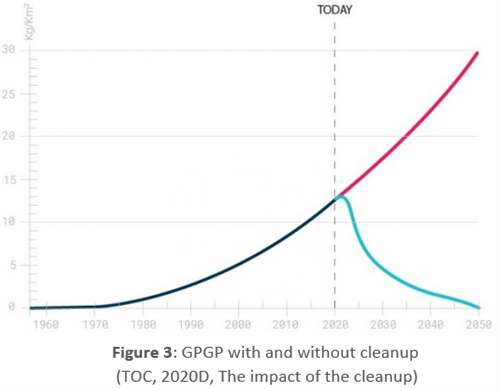
The aim of the project is to clean-up half of the GPGP before 2025, and the remaining half before 2050. The aim can be visualized in Figure 3, together with a scenario of no-action. Although the figure is limited to the GPGP, TOC has equal long-term goals for other ocean garbage patches. For example, TOC aims to reduce the amount of ocean plastic with 90% by 2040 (TOC, 20202D; TOC, n.d.C). If TOC’s operations were complemented by a considerable reduction of plastic sources on land, a plastic-free ocean could be accomplished by 2050 (TOC, 2020C). However, this requires “radical changes at the individual, corporate, and governmental levels of society” (TOC, n.d.C).

Criticism

Despite the ambition to accomplish a plastic free ocean and the received recognition, the TOC project has received criticism as well. Van Franeker & Kühn (2018) reviewed the impact of TOC operations and concluded that if TOC indeed managed to clear half of the GPGP by 2025, it would only remove about 0.1% of the plastic that ends in the ocean every year. Likewise, many scientists stressed that the plastic sources reduction is in fact the most effective mitigation strategy (Rochman; Sherman & Sebille, 2016). Although TOC acknowledges source reduction as important, it does not see it as the solution to current ocean plastic pollution issues (TOC, 2015).

Furthermore, Sherman & Sebille (2016, p.2) declared that “ocean plastic removal might be more effective […] closer to shore than inside the plastic accumulation zones in the centers of the gyres”, like the GPGP. TOC, instead, focuses on ocean garbage patches in high seas gyres “because the plastic floating outside of these ocean garbage patches either naturally removes itself from the ocean by beaching onto a coastline, or eventually also ends up in an ocean garbage patch” (TOC, n.d.B).

Moving forward

To move beyond its first testing and 2015 prototype phase, TOC conducted a feasibility study. Costs were covered with a crowdfunding campaign that raised $100,000. The study included topics such as engineering, oceanology, ecology, maritime law, finance and recycling, and was conducted by a voluntary collaboration of more than a hundred private citizens, organizations and institutions (Slat et al., 2014). The favorable outcome illustrated the sustaining aspect of the innovation.

The positive media coverage that came with the favorable feasibility study was used for the second crowdfunding campaign. This campaign raised over 2 million dollars, becoming the most successful crowdfunding campaign opened by an NGO, so far (TOC, 2015; ABN AMRO, 2014). It allowed TOC to develop and test different prototypes in different locations (TOC, 2020A).

In late 2016 TOC initiated another fundraising round. In May 2017, it issued a press release stating that it “successfully raised 21.7 million USD in donations since last November [bringing TOC’s] total funding since 2013 to 31.5 million USD, [which enables TOC] to initiate large-scale trials of its cleanup technology in the Pacific Ocean” (TOC, 2017). The fact that this latter funding round comprised solely on donations demonstrates the legitimacy perceived by the initial investors that supported the project.

Eventually, after “hundreds of scale-model tests, a series of prototypes, research expeditions and multiple iterations”, a first full-scale clean-up system was ready in 2018 (TOC, 2018). The unique business approach of TOC, however, also created legal complications that had to be solved before the full-scale system could be launched. To overcome these hurdles, TOC signed a covenant with the Dutch Ministry of Infrastructure and Water Management (MIW, 2018). With an applicable legal framework and support from the Dutch government, TOC was ready to launch its first full-scale clean-up system. The aim of the operation was to test the system and collect relevant data while cleaning up the GPGP (TOC, 2018). Nevertheless, the operation was prematurely terminated because the system was not able to actually capture the plastic due to “an inconsistent speed difference between the system and the plastic” (TOC, 2020A, p.17). This led to a systematic failure (TOC, 2020A).

Thanks to a cooperation with two other organizations, TOC later came with an updated prototype, the “System 001/B”. After one year of testing, TOC stated on 3 October 2019 that its self-contained prototype succeeded in passively capturing and concentrating plastic from the GPGP using the natural forces of the ocean. This was the first true success since Boyan Slat presented his ideas in 2012 (TOC, 2019).

Additionally, TOC recycled the captured plastics into valuable goods: it turned them into sunglasses, a durable and useful product. This entrepreneurial activity is crucial to ensure future operations, as potential profit will be fully reinvested and, thus, completed the infinite circle (TOC, 2020B).

The adjustments in the prototype were incorporated in the newly designed system (002), that requires  comprehensive  examination  and  modelling  before  becoming  the  next  full-scale clean-up system (TOC,  2020). Ultimately, “a fleet of systems” would be necessary to be able to clean up the entire GPGP and smaller plastic patches” (TOC, 2020A).

Furthermore, TOC is “looking to expand [its] operations all over the globe to help tackle the 1000 most polluting rivers, five years from the commencement of the scale-up phase” (TOC, 2020A, p.8). Replying to the criticism, TOC not only acknowledges plastic source reduction as important, but also strives for action.


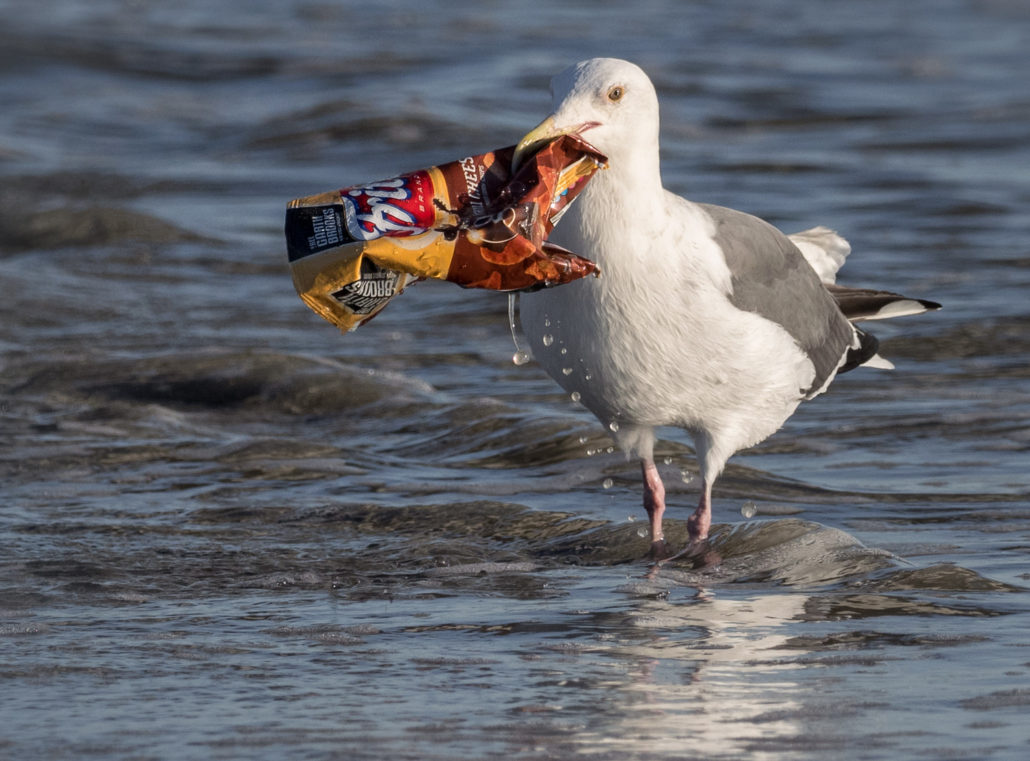
Fig. 2: A seagull holding a plastic package in its peak (Ingrid Taylar, 2016).

Bibliography

ABN AMRO (2014, 11 July). Seeds faciliteert succesvolste crowdfunding voor non-profit organisatie. Retrieved 30 November 2020, from https://www.abnamro.com/nl/newsroom/nieuws/2014/seeds-faciliteert-succesvolste-crowdfunding-voor-non-profit-organisatie.html

Dees, J.G. (2001, 30 May). The Meaning of Social Entrepreneurship. Downloaded 7 December 2020, from https://centers.fuqua.duke.edu/case/wp-content/uploads/sites/7/2015/03/Article_Dees_MeaningofSocialEntrepreneurship_2001.pdf

Franeker, J.A. van & Kühn, S. (2018, 13 September). The Ocean Cleanup. Downloaded 6 November 2020, from https://www.wur.nl/upload_mm/0/0/a/3f5469b5-3e79-423f-a947-80b5a5b06c1a_FAQ-OceanCleanup2018_finalNL_CH-JAF.pdf

Geyer, R., Jambeck, J.R. & Law, K.L. (2017). Production, use, and fate of all plastics ever made. DOI: 10.1126/sciadv.1700782

Jambeck, J.R., Geyer, R., Wilcox, C., Siegler, T.R., Perryman, M., Andrady, A., Narayan, R. & Law, K.L. (2015). Plastic waste inputs from land into the ocean.Science, 347(6223), pp.768-771. DOI: 10.1126/science.1260352

Lebreton, L., Slat, B. […] Brambini, R. & Reisser, J. (2018, 22 March). Evidence that the Great Pacific Garbage Patch is rapidly accumulating plastic. Retrieved 6 November 2020, from https://www.nature.com/articles/s41598-018-22939-w

Ministry of Infrastructure and Water Management of the Netherlands (2018, 6 June). Convenant tussen de Minister van Infrastructuur en Waterstaat en The Ocean Cleanup betreffende de inzet van systemen bedoeld om plastic op volle zee, dat drijft in de bovenste waterlagen, op te ruimen.Retrieved 6 December 2020, from https://zoek.officielebekendmakingen.nl/stcrt-2018-31907.html#d17e790

Rijksoverheid (2016, 29 November). Waterinnovaties in Nederland.Downloaded 6 November 2020, from https://www.rijksoverheid.nl/binaries/rijksoverheid/documenten/brochures/2016/11/29/waterinnovaties-in-nederland/Waterinnovaties-2016.pdf

Rochman, C. M. (2016). Strategies for reducing ocean plastic debris should be diverse and guided by science. Environmental Research Letters, 11(4), 041001. DOI: http://dx.doi.org/10.1088/1748-9326/11/4/041001

Sherman, P. & Sebille, E. van (2016). Modeling marine surface microplastic transport to assess optimal removal locations. Environmental Research Letters, 11(1), 014006. DOI: http://dx.doi.org/10.1088/1748-9326/11/1/014006

Slat, B.D., Arens, E. […] Zuijderwijk, N. & de Sonneville, J. (2014, 3 June). How the oceans can clean themselves. A feasibility study. Downloaded 30 November 2020, from https://ds1.static.rtbf.be/article/pdf/toc_feasibility_study_lowres-1401893379.pdf

The Ocean Cleanup (2015, 30 June). Annual Report 2014.Downloaded 30 November 2020, from https://assets.theoceancleanup.com/app/uploads/2019/04/TOC_2014_Annual_Report.pdf

The Ocean Cleanup (2017, 3 May). THE OCEAN CLEANUP RAISES 21.7 MILLION USD IN DONATIONS TO START PACIFIC CLEANUP TRIALS. Retrieved 12 December 2020, from https://theoceancleanup.com/press/press-releases/the-ocean-cleanup-raises-217-million-usd-in-donations-to-start-pacific-cleanup-trials/

The Ocean Cleanup (2018, 8 September). THE WORLD’S FIRST OCEAN CLEANUP SYSTEM LAUNCHED FROM SAN FRANCISCO. Retrieved 6 December 2020, from https://theoceancleanup.com/press/press-releases/the-worlds-first-ocean-cleanup-system-launched-from-san-francisco/

The Ocean Cleanup (2019, 2 October). THE OCEAN CLEANUP SUCCESSFULLY CATCHES PLASTIC IN GREAT PACIFIC GARBAGE PATCH.Retrieved 13 December 2020, from https://theoceancleanup.com/press/press-releases/the-ocean-cleanup-successfully-catches-plastic-in-great-pacific-garbage-patch/

The Ocean Cleanup (2020A, 9 June). Annual Report 2019.Downloaded 6 November 2020, from https://assets.theoceancleanup.com/app/uploads/2020/06/Annual_Report_2019.pdf

The Ocean Cleanup (2020B, 24 October). THE OCEAN CLEANUP INTRODUCES FIRST PRODUCT MADE WITH OCEAN PLASTIC POLLUTION.Retrieved 13 December 2020, from https://theoceancleanup.com/press/press-releases/the-ocean-cleanup-introduces-first-product-made-with-ocean-plastic-pollution/

The Ocean Cleanup (2020C). About – The impact of the cleanup.Retrieved 13 December 2020, from https://theoceancleanup.com/about/

The Ocean Cleanup (n.d.A). THE FIRST PRODUCT MADE WITH PLASTIC FROM THE GREAT PACIFIC GARBAGE PATCH. Retrieved 7 December 2020, from https://products.theoceancleanup.com/

The Ocean Cleanup (n.d.B). FAQ –
How will you clean up 50% of the plastic in 5 years?Retrieved 16 December 2020, from https://theoceancleanup.com/faq/

The Ocean Cleanup (n.d.C). Can you provide an overall solution to ocean plastic pollution?  Retrieved 17 December 2020, from https://theoceancleanup.com/faq/can-you-provide-an-overall-solution-to-ocean-plastic-pollution/

United Nations (n.d.). Goal 14: Conserve and sustainably use the oceans, seas and marine resources.Retrieved 7 December 2020, from https://www.un.org/sustainabledevelopment/oceans/

Join our Telegram channel

Telegram: @greenmarked
LinkedIn: @greenmarked
Instagram: @greenmarked.it

Facebook:  @greenmarked.it


© GreenMarked.it is managed by ECONTROVERTIA APS — Via Alcide De Gasperi 1, 38015 Lavis (TN), Italy — VAT IT02667560227