
Tag: restoration

L’importanza ambientale e culturale dei prati montani ricchi di specie e il loro restauro ecologico

L’importanza e la bellezza dei prati montani risiedono proprio nella loro alta naturalità, nell’essere perfettamente inseriti all’interno di un contesto di alto pregio, sia dal punto di vista naturalistico-ecologico che culturale. Le pratiche agricole tradizionali, infatti, hanno, nel corso dei secoli, modellato questi territori, creando habitat ideali per la vita di numerose specie animali e vegetali. Ed ecco che ritorna la componente umana. Perché proprio come l’uomo ha saputo modellare a suo favore e a favore di natura questi ambienti, così esso ha saputo distruggerli. L’affermarsi di un’agricoltura intensiva a partire dalla seconda metà del XX secolo, l’abbandono di molteplici superfici agricole svantaggiate e l’urbanizzazione, hanno favorito la perdita di tali habitat e la conseguente perdita degli organismi ad essi associati. Tuttavia, se il fenomeno risulta pressante e preoccupante per gli ambienti di pianura, tanto da risultare in una quasi completa scomparsa di siti caratterizzati da una vegetazione ad elevata naturalità, perlomeno per le zone collinari e montane non tutto ancora è perduto [1].

In particolare per il Trentino, elemento di fondamentale importanza negli ultimi decenni è risultato il mantenimento di un fiorente settore zootecnico, condizione primaria per la conservazione dei suddetti prati. E ancora, il mantenimento delle superfici prative è stato di lunga favorito, anche grazie ad ingenti finanziamenti pubblici conferiti tanto dalla Provincia quanto dall’Unione Europea [2].

In tal senso, una precisazione è d’obbligo sui termini. I prati sono tecnicamente distinti in (1) prati naturali: formatesi naturalmente e composti da specie autoctone; (2) prati semi-naturali: creati artificialmente con specie autoctone e (3) prati artificiali: creati artificialmente con varietà geneticamente selezionate.

Laddove la necessità di rinaturalizzazione spinge a cercare un modo per riportare alla luce questi ambenti prativi, la creazione di prati semi-naturali risulta spesso un’ottima opzione. Restano pur auspicabili una loro preservazione e tutela prima di ricorrere ai metodi di restauro.
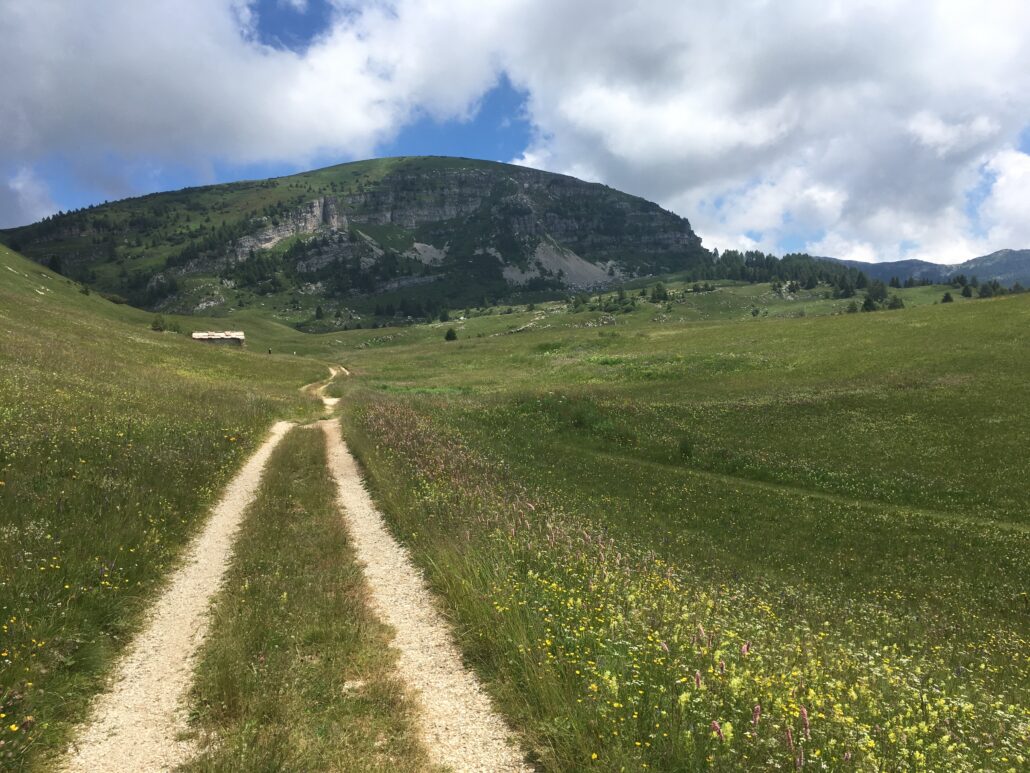
Figura 1:Safeguarding and protecting mountain meadow cenosis is essential to preserve landscape, farming and cultural features of the territory. (Author. Giazzera – Monte Pasubio (Province of Trento), July 05, 2020).

Il restauro ecologico di tali cenosi risulta particolarmente studiato per le zone alpine e, almeno in Trentino, anche attuato ormai su ampia scala [3]. Il processo avviene in tre fasi: (1) la scelta del sito donatore; (2) la raccolta e la preparazione del seme o del materiale di propagazione in forme diverse (erba verde, fieno, fiorume da spazzolatrice o da mietitrebbia); (3) la distribuzione del materiale presso il sito recettore; (4) il controllo a posteriori circa il successo o l’insuccesso del procedimento (Tabella 1).

La scelta del sito donatore deve necessariamente prendere in considerazione gli aspetti legati alla provenienza locale del seme, alla sua composizione floristica e alla sua fertilità nonché disponibilità di seme. Questa necessità si fa particolarmente importante allo scopo di favorire un’evoluzione sostenibile della vegetazione. Soprattutto laddove gli ambenti risultano difficili dal punto di vista pedologico e climaticoe dove dunque specie non native faticano ad insediarsi, la scelta di ecotipi nativi locali risulta l’unica soluzione.

In tal senso, si sono mossi negli ultimi decenni alcuni mercati centroeuropei, con agricoltori e cooperative svizzere, austriache e tedesche particolarmente specializzate nella produzione di miscugli di seme nativi. Tuttavia, il processo non ha visto lo stesso successo per il Trentino e per l’Italia in genere, laddove la necessità di scelta e raccolta diretta dai prati semi-naturali esistenti risulta ancora una delle poche strade percorribili.Tale metodo di reperimento del seme, inoltre, risulta spesso l’unico efficace per ambienti ad elevata diversità di specie e vegetazioni [4].

Tale raccolta può, dunque, avvenire direttamente sulla pianta in piedi o sulla banca del seme. In entrambi i casi risultano fattori di primaria importanza a valutarsi: la qualità e quantità dei fusti o dei semi nel suolo, la morfologia e fenologia delle piante, la disponibilità, distribuzione nel suolo e produzione in pianta del seme.

Procedimenti simili sono in ogni caso seguiti anche per la raccolta manuale del seme al fine di propagazione con tecniche agricole. Sussistono, in ogni caso, alcune differenze tra la raccolta e distribuzione diretta del materiale sul sito recettore e un passaggio con produzione agricola. I tempi per la produzione agricola allungano il processo anche di alcuni anni, essendovi la necessità di propagazione del seme attraverso diverse generazioni. Il prezzo del processo risulta comunque inferiore tramite propagazione agricola e ad oggi risulta il metodo più economico a fine di restauro ecologico di praterie ricche di specie su ampia scala. Una combinazione dei due metodi può risultare spesso utile, in quanto non tutte le specie possono essere propagate agevolmente mediante tecniche agricole e non tutte le specie desiderate possono essere agevolmente trovate e raccolte in campo.

La fase di distribuzione del seme presso il sito recettore chiude il processo di restauro. Anche in questo caso tecniche agricole tradizionali quali la semina meccanica o manuale fungono da promotrici del processo.

Una previa ricognizione circa la geografia del sito, il suo clima, il suolo e gli obiettivi di restauro è comunque d’obbligo in sede di valutazione del processo. Inoltre, la preparazione del sito al fine di diminuire la competizione della vegetazione esistente nei confronti delle specie da introdurre, se necessario una riduzione della fertilità, una decompattazione del terreno e la creazione, laddove risulti possibile, di siti sicuri per le specie da introdursi sono tutte azioni necessarie al fine di garantire il successo del restauro.

Tabella 1: un riassunto delle quattro fasi di ristauro ecologico di un prato di montagna.

Si consideri, infine, come per la Provincia Autonoma di Trento tali opere di restauro siano inserite nel prezziario pubblico alle voci L.07.10.0050 — SEMINA e L.07.10.0052 — INERBIMENTO CON FIENO O ERBA VER- DE LOCALE [5]. Con riferimento all’anno 2021, i prezzi per le opere effettuate con seme di specie erbacee native da propagazione agricola o raccolto direttamente sui prati esistenti risultano del tutto comparabili se non inferiori a quanto effettuabile con miscugli di varietà geneticamente selezionate.

Per gli anni a venire, oltre ad una sempre crescente attenzione da parte di tutti i portatori di interesse nei confronti di una tutela e di un ripristino ambientale volti alla salvaguardia del territorio e del patrimonio prativo, si auspica una completa collaborazione di mercato al fine di dare avvio anche per il nostro territorio ad un commercio degli ecotipi nativi fiorente e di facile accesso. I risvolti ambientali risulterebbero sicuramente positivi.

Riferimenti bibliografici:

[1] Scotton, M. & Cossalter, S. (2014). PRATERIE SEMINATURALI RICCHE DI SPECIE NELLA PIANURA VENETA. Distribuzione e valorizzazione negli interventi di inerbimento e restauro ecologico. Veneto Agricoltura.

[2] Scotton, M., Pecile, A. & Franchi, R. (2012). I tipi di prato permanente in Trentino: tipologia agroecologica della praticoltura con finalità zootecniche, paesaggistiche e ambientali. Fondazione Edmund Mach.

[3] Zenatti, S., Gottardo, L. & Scotton, M. (2016). Restauro ecologico di praterie seminaturali tramite distribuzione di erba verde: l’esempio di Canal San Bovo (TN). Dendronatura, 37 (1), 49–58.

[4] Scotton, M. (2009). Semi-natural grassland as a source of biodiversity improvement–SALVERE. Proceedings of the International Workshop of the SALVERE. Raumberg–Gumpenstein: Agricultural Research and Education Centre.

[5] Provincia Autonoma di Trento (2021). ELENCO PREZZI 2021 [Online; in data 15-febbraio-2022].

Immagine copertina e anteprima: prato di montagna sul Monte Pasubio - località Giazzera (TN). Autore, 05 luglio 2020.

Agroforestry In Peru And Its Potential For Ecosystem Restoration

Mark L. Miller

June 28, 2018

Last edit: July 18, 2024

Peruvian forests and their biggest threat: deforestation

Peru has a total area of 128.5M hectares divided in three main regions: a) the Coast region to the West; b) the Andean region in the center; c) the Amazon region to the East. It hosts 73.3M hectares of forests, of which 53.4M are of low jungle (selva baia) and 15.7M of high jungle (selva alta),which allow widespread forest activities. Indeed, 80.1% of the national area is covered by forests, while only 13.9% is covered by pastures and 5.9% by cultivated areas. Yet, forests contribution to the national GDP is very little (approx. 1.1%). That is because 70-90% of conceded forested areas are used by local populations for self-subsidence and because about 10M hectares of forested areas are used for illegal and untaxed activities [1] (MINAM, 2016).

The biggest threat of Peruvian forests is deforestation. Since 1995, deforestation rate has been around 100,000 ha/year in the Amazon region, which hosts 94% of the national forests, and has strongly hit the low jungle. Slash-and-burn farming, cattle farming and coca cultivation are the main reasons of deforestation, but the generic causes are deeper rooted in the Peruvian society. Poverty, overpopulation and migration in the Amazon are some of the social causes. Land use change, weak market regulation for the extraction of natural resources and the demand increase for industrial crops are some economic causes. Finally, a bad governance, including the incoherence of government [2], the lack of regional administrative bodies and poor institutional control and coordination is the third cause (MINAM, 2016). Meanwhile, the expansion of the global cocaine market, has increased Peru’s coca production, which raised from 43,900 hectares in 2016 to 49,900 hectares in 2017, and added additional pressure to Peruvian forests(United Nations, 2017).

In this scenario, agroforestry can be a potential solution to tackle deforestation, replace coca production and restore degraded land in Peru.

Agroforestry in Peru

There are multiple types of agroforestry systems in Peru and include 148 native species: 20 in the Coast region, 57 in the Andean region and 94 in the Amazon region. In the Amazon, most agroforestry species are used for timber, followed by food and multiple uses, agroecological service and medicine. In the Andes, most agroforestry species are used for multiple uses, followed by agroecological services, food, timber and medicine. In the Coast, most agroforestry species are used multiple uses, followed by agroecological services, food and medicine (Cherron-Macha et al. 2018).

Agroforestry systems in Peru

Multistrata, cacao and coffee are the most popular agroforestry systems in Peru.

A typical multistrata agroforestry system starts with a fast-growing and nitrogen-fixing fruit tree (Inga edulis)
combined with other native fruit and timber trees. During the first years, the trees are intercropped with staple crops. In subsequent years, tree-growth hinders many staple crops, so shade-resistant crops, like pineapple, are planted (Lojka, 2016).

In cacao agroforestry systems, is first planted as understory shade tolerant tree in thinned natural forests. Later, cover crops can be incorporated in the system. Best practices for a proper cultivation include adjusting light infiltration and moisture availability and reducing weed competition (PUR Project, 2015).

In coffee agroforestry system, coffee cultivations are first established under the cover of
Inga edulis. Coffee is sold and exported, while Inga edulisfruit and wood is harvested for either consumption or wood constructions. The system is generally two-layered but additional herbaceous or tree species (e.g. Ceroxylon echinulatum) can also be introduced to add biodiversity, provide fuelwood and protect the system from pests (Envolv-Vert, 2017).

A simple agroforestry farm in the Peruvian Andes. Photo taken by author (July 2019).

The environmental, social and economic benefits of agroforestry

All three types agroforestry systems provide several environmental, social and economic benefits.
Cacao agroforestry systems largely benefit the soil quality. Depending on the soil microbial structure, the agroforestry management system and the selected cover crop, they improve soil structure and texture, soil fertility, soil organic matter, soil microbial biomass and soil pH. They can suppress pathogens and weeds, reduce leaching losses of nutrients, control erosion, decrease soil acidity and compaction, reduce fertilizers inputs and pests, improve water holding capacity and nutrient cycling (Buyer et al. 2017). On the other hand, it is still unclear if it truly enhances biodiversity. It depends on the density of the cover crops (Lojka, 2016). On the socio-economic side, cacao agroforestry systems can replace coca cultivations, enhance the resilience of production systems and producers’ families and generate higher incomes for the farmers.
Coffee agroforestry systems reduce CO2 emissions of deforested areas, increase soil carbon stocks, which can be converted in carbon credits, thus attract Net Market Carbon investments. They also increase diversification of production and of potential revenue sources (e.g. FSC labelled timber, agricultural products). Following the abolition or minimal use of fertilizers and pesticides, coffee agroforestry system produce healthier food, provide education, and stimulate the engagement of local communities in environmental protection and forest management (Ferrari, 2018)

Agroforestry potential for ecosystem restoration

Agroforestry systems can restore land productivity of nutrient poor areas depleted by unsustainable agricultural practices and intensive exploitation of virgin forests. The first step is to install aggressive nitrogen-fixating species legumes (e.g. Makuna)or fruit trees (e.g. Inga edulis)to prepare the land for the future agroforestry system. At that point, full-sun or shadowed cacao or coffee agroforestry system can be installed. Alternatively, one can install an agroforestry system that includes a shadow component (e.g. banana or papaya), a main crop (e.g. cacao), a recovery crop (e.g. guava) and slow-growing timber species. In this case, not only land productivity is restored, but also nutrients and water are better retained in the soil, land is protected from erosion, carbon absorption is increased and the behavior of a real forest is mimicked (Ferrari, 2018).

Restoring forest connectivity is also possible through agroforestry, as they can function as ecological corridors between the remaining virgin forest patches. This can consequently benefit biodiversity.

Infine, agroforestry can nurse threatened Amazonian species, like mahogany. A recent study revealed that an Inga edulis-mahogany-pasturesystem is a good solution to fix nitrogen in depleted soil, restore degraded pastures and protect mahogany from predators (Fernandes et al. 2006).

Nevertheless, agroforestry solutions have issues to consider. Return on investment is slow, there are light, water, space and soil nutrients trade-offs between species to properly balance, restoration of pure stand agroforestry systems may not be possible in densely populated landscapes. One must therefore consider the option to install intercropping, bordering or clustered agroforestry systems (Erdmann, 2005). Yet, agroforestry systems are much more effective than fenced reforestations and can be considered extremely valid solutions to restore degraded ecosystems in Peru.

Family farms and agroforestry farms in the Peruvian Andes. Photo taken by author (July 2019).

Bibliografia:

Papers:

Buyer, J. et al. (2017). Soil microbial communities under cacao agroforestry and cover crop systems in Peru. Applied Soil Ecology. Science Direct. Vol. 120, 273-280.

Cerron-Macha, J. et al. (2018). Agroforestry species of Peru: annotated list and contribution to prioritization for genetic conservation. Working paper number 289. World Agroforestry Centre, Lima, Peru. DOI: http://dx.doi.org/10.5716/WP18029.PDF.

Erdmann, T. (2005). Agroforestry As a Tool for Restoring Forest Landscapes. Forest Restoration in Landscapes. Beyond Planting Trees (pp.274-284). DOI: 10.1007/0-387-29112-1_40.

Lojka, B. (2016). Multistrata agroforestry as an alternative to slash-and-burn farming in Peruvian Amazon.Agroforestry Research Developments, Chapter: 13, pp.383-398. ISBN-978-1-63485-094-0.

Fernandes, E. et al. (2006). Restoring Productivity to Degraded Pasture Lands in the Amazon through Agroforestry Practices. Biological Approaches to Sustainable Soil Systems. DOI: 10.1201/9781420017113.ch21.

Reports and websites:

Envolv-Vert (2017). Reforestation and agroforestry project in Peru. [online] Available at: http://envol-vert.org/en/projects/reforestation-and-agroforestry/reforestation-and-agroforestry-project-in-peru/ (Accessed 2019.06.01).

Ferrari, N. (2018) Investing in agroforestry in Peru’s Amazon: Good for the economy and the environment. Initiative 20X20. [online] Available at: https://initiative20x20.org/news/investing-agroforestry-perus-amazon-good-economy-and-environment (Accessed 2019.06.01).

MINAM (2016). La conservacion de bosques en el Peru (2011-2016). [online] Available at: http://www.minam.gob.pe/informessectoriales/wp-content/uploads/sites/112/2016/02/11-La-conservaci%C3%B3n-de-bosques-en-el-Per%C3%BA.pdf (Accessed 2019.06.01).

PUR Project (2015). Alto Huayabamba, Peru. Progress Report 2015. [online] Available at: https://www.purprojet.com/project/alto-huayabamba/ (Accessed 2019.06.01).

United Nations (2017). Coca cultivation area in Peru increased by 14 per cent during 2017.[online] Available at: https://www.unodc.org/unodc/en/frontpage/2018/December/coca-cultivation-area-in-peru-increased-by-14-per-cent-during-2017.html (Accessed 2019.06.01).

Background photo and embedded video

Background image: The Peruvian Andes landscape. Photo taken by author (July 2019).

Embedded video: PUR Project (2015). Alto Huayabamba – Agroforestry project in Peru (Eng) [online] Available at: https://www.youtube.com/watch?v=Ce4FPo3cOUIhttps://www.purprojet.com/project/alto-huayabamba/ (Accessed 2024.07.18).

Telegram: @greenmarked
LinkedIn: @greenmarked
Instagram: @greenmarked.it

Facebook:  @greenmarked.it


© GreenMarked.it is managed by ECONTROVERTIA APS — Via Alcide De Gasperi 1, 38015 Lavis (TN), Italy — VAT IT02667560227