Ir al contenido principal

Etiqueta: adaptation

Climate-Smart Forestry

Winnie the Pooh said that sometimes it is not enough to wait in a corner of the forest for others to come to you, but it is also necessary to get up and go directly to them. And they, this time, are the forests themselves [1].

The concept of Climate-Smart Forestry focuses precisely on forests, in a vision that is certainly anthropogenic, but aimed at fostering their vitality, productivity and well-being for present and future generations (of forests and humans). Climate-smart forestry, namely Mitigation, Adaptation, and Social Dimension, the three pillars of adaptive and sustainable forest management in the changing climate [2].

The link between forests and changing climate can be as trivial as effective: Forests absorb, store, and thus reduce carbon dioxide in the atmosphere. However, this stock can only be truly effective if forests survive, indeed super-live, that is, know how to adapt to the new climate by providing ecosystem services (the benefits humans derive from natural systems such as forests) of increasing quality and quantity.

Emblematic in this regard is the definition that describes “climate smartness” as the ability to manage current and future risks of climate change while taking advantage of them and opportunities [3].

Indeed, it is undisputed that climate change is happening, is altering the ecosystems around us and consequently our very lives. Actions to mitigate and slow down it are issues on the agenda. However, foreseeing the positive implications of the same, from which we can benefit, is equally important.

Fig. 1: Typical example of a multifunctional dolomite landscape. View of the Catinaccio/Rosengarten (Nova Levante/Welschnofen, Bolzano/Bozen , Italia). Photo: Author. 08.06.2022

Adaptation

What will the forests of the future look like? In silviculture, the study of forests always starts with three questions: who are you? where are you from? where are you going? That is, to study the forest’s structure, function, origin and purpose. Adaptation aims to create forests that maintain or strengthen their capacity to grow in present and future climatic conditions, ensuring resilience and resistance. This translates into a need for silviculture to foster forests that can also adapt to climate change-related disturbances, whether abiotic (landslides, avalanches, floods, fires) or biotic (diseases and pests).

In practical terms, all this means trying to predict where and what the future forests will look like. Will the same species that lives in hilly areas today still be there or will it rise to higher elevations? Or perhaps northward? Will it be more affected by rising temperatures or changing precipitation patterns? Will it be able to withstand an extreme wind event or the swarming of a beetle? Generally speaking, silviculture today must aim to have forests that are rich in diversity, heterogeneous and not monospecific by promoting genetic, compositional, structural and functional differences with a high degree of resilience, contemplating non-native species if necessary and encouraging the migration of those present through landscape connectivity.

Mitigation

How can forests mitigate the effects of climate change? Well-adapted forests result in viable forests that can store carbon for decades. However, the carbon cycle should not end in the forest but result in long-term storage through by-products, both in terms of wood for structural purposes and in terms of bioenergy and wood substitution to materials with a higher carbon footprint.

Social Dimension

What benefits do people derive from forests? This Social Dimension summarizes in anthropogenic terms everything that forests do. Compromised forest ecosystems result in negative economic and social consequences. In this sense, the economic dimension must not outweigh the social dimension, but rather they must become complementary to stimulate both forest productivity and ensure people’s well-being. Just as forests must adapt to sustain and survive the changing climate, people and all forest stakeholders must be able to cope with the new challenges that the climate presents.

Forests can maintain an assortment of ecosystem services if they are carefully managed, and this means that all stakeholders involved in forest management must be trained and informed about climate change and actions for adaptation to it and its mitigation. It is precisely the relationship between ecosystem services and economic-social factors that is the meeting point in supporting real Climate-Smart Forestry. Regulatory ecosystem services (such as water and erosion control) can mitigate the economic-social effects of climate change, such as floods and droughts. Similarly, supplying ecosystem services, such as food and fiber, can be alternative sources of revenue during extreme events. Finally, cultural ecosystem services contribute to good social adaptation in the face of climate change by promoting knowledge, enjoyment, and recreational use of forests.

REFERENCIAS:

Pulse aquí para ampliar las referencias
[1] A. A. Milne, Winnie-the-pooh, Simon and Schuster, 2023.

[2] A. Weatherall et al., «Defining climate-smart forestry,» in Climate-Smart Forestry in Mountain Regions, 2022, pp. 35-58

[3] T. Tanner e T. Mitchell, «Towards ‘Climate Smart’Organisations,» IDS in focus, 2007

REFERENCIAS:

Pulse aquí para ampliar las referencias
  1. A. A. Milne, Winnie-the-pooh, Simon and Schuster, 2023.
  2. A. Weatherall et al., «Defining climate-smart forestry,» in Climate-Smart Forestry in Mountain Regions, 2022, pp. 35-58
  3. T. Tanner e T. Mitchell, «Towards ‘Climate Smart’Organisations,» IDS in focus, 2007
A Battle in the Alps: A Story of Climate and Men

Today I want to tell you a story. A story that begins with the most classic of introductions:

Once upon a time, there was a high Mountain covered with meadows and forests, with pastures and bare rocks, and furrowed by countless clear, cool streams. And on its summit, he wore a great hat. A very pure white hat of solid, unshakable ice.

And the Mountain was happy, aware that it was home and mother to all the animals and plants that found refuge there.

However, on a fine summer day, suddenly there was a great commotion. The Mountain found itself shaken, awakened in great turmoil by an incessant uproar. A battle had begun on right above it. And never would the Mountain have expected it.

The challengers were its greatest guests: Mrs. Forest and Mr. Meadow. This battle soon took the name “Kampfzone” and, unexpectedly, was won not by either Forest or Meadow but by a third, unstoppable challenger: “Krummholtz”!

The main characters of the story introduce what happens incessantly in our mountains from an ecological point of view, particularly in the Alps. I have always been fascinated by the idea of a kind of battle between the different components of an ecosystem for survival and dominance over the “opponent”. Indeed, even in a romanticized way, the challenge between forest (present at lower elevations) and the natural high-altitude grasslands is a real fact, and theKrummholtz are none other than those twisted shrubs, shaped by the continuous action of wind and snow, that are established right on the margin line between the subalpine forest and grassland formations: the Kampfzone, or “battle zone”.

What does this have to do with the climate and the people who inhabit the mountains?

This Kampfzone is the most obvious surface that can be found in the alpine ranges. Difficult to interpret, but relatively easy to spot, even from aerial and satellite observations [1].

Moreover, this margin zone, which varies in width, density of shrubs and trees, and vegetation dynamics, is the most complex surface that can be found in the Alps from an ecological point of view, as it is governed by processes induced by delicate balances.

In the last two decades, the trend of this line is to migration. And the concauses are as much natural as anthropogenic. A migration that, to tell the truth, is not a new fact for this ecosystem, which has been shaped by human action for centuries.

As early as the 17th century, through intense deforestation actions, this margin line was lowered from its real natural elevation, thus artificially creating meadows and pastures for agriculture and livestock management. Subsequently, after World War II, the economic-social situation in the Alpine valleys changed, resulting in a rapid loss of interest in the care and exploitation of high-altitude pastures and meadows, triggering a process of gradual recolonization of the forest toward higher altitudes. In short, a revenge of nature over man [2].

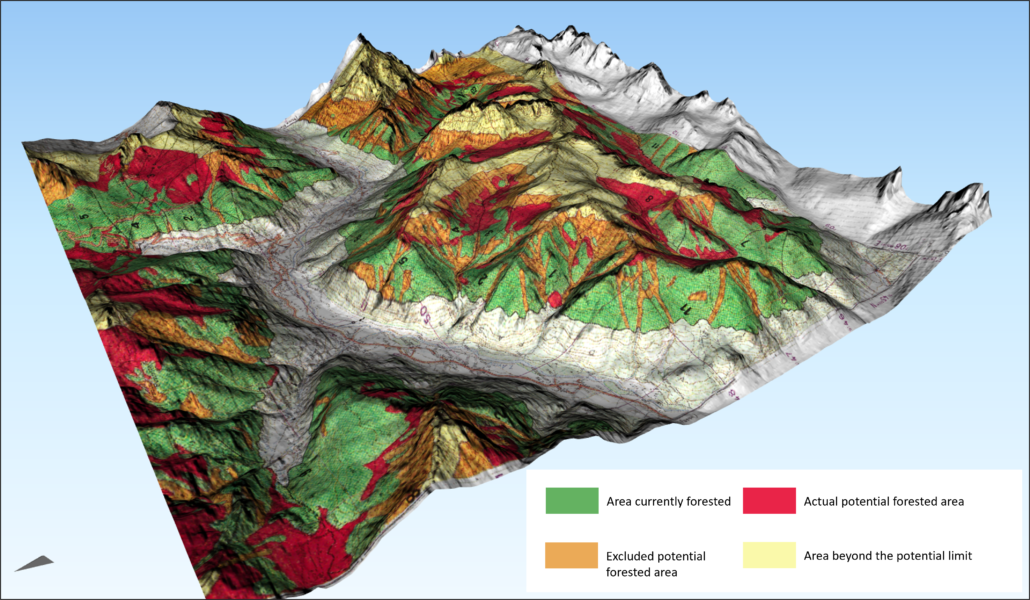
Fig. 1: Potential forest boundary. Sheet #12 – CANAZEI. Own 3D processing. Source: [2]

However, this revenge of nature, though constant since the 1950s, is actually turning out to be a little too pro-nature, especially in unexpected ways.

While it is true that forest growth is something positive, one must necessarily consider it at the expense of what this growth is taking place. The map in Fig 1 shows how the forest line (which we can understand here as the Kampfzone) appears to be highly variable as a function of the anthropogenic logging actions, with the areas in red and orange representing the surfaces that could potentially be occupied by the forest but is still not recolonized.

Such dynamics turn out to be very different to date. There is indeed a general increase of forest formations at the expense of high-altitude grasslands, but the key point is to understand how this elevation is or is not also followed by an elevation of the lower limit of the forest, i.e., that at the edge with the valley floor.

In short, where are these forests going?

The answer to this question – as usual for many ecological issues – is that it depends. It depends on the type of species characterizing the forest formations, the geographic area, the socio-cultural and economic dynamics of the territory, and the methods of analysis. In general, however, it can be considered how, for the Alps, the upward trend of spruce-fir forests, expanding to higher elevations but also shifting its presence from the lower limit, represents one of the dynamics of greatest impact on the reality of these territories, and not only in purely ecological terms.

The economic and cultural dependence established with this species over the past century [3] has meant that much of the forest land, at least in the Eastern Alps, is occupied by it. An increase in the elevation of the species, such that it is presented beyond the current (even potential) limit of the forest, and a simultaneous loss of the species at the lower elevations, which are more accessible, mechanizable, and therefore easier to use, also necessarily obliges a change of strategy towards harvesting and silvicultural techniques for the future. Just as with Spruce, this is also the case for many other species that modify, expand, and reduce their range of presence, making mobile and transformative what we have hitherto made and credit immutable [4].

In this, too, we are closely affected by climate change, which is as evident in the mountains as it is in the city and is forcing us to alter our plans for a future different from the one we had planned.

REFERENCIAS:

Pulse aquí para ampliar las referencias
[1] L. Dinca et al., “Forests dynamics in the montane alpine boundary: a comparative study using satellite imagery and climate data,” Climate Research,vol. 73, no. 1-2, pp. 97-110, 2017.

[2] P. Piussi, Carta del limite potenziale del bosco in Trentino, Trento: Provincia Autonoma di Trento. Servizio Foreste, Caccia e Pesca, 1992.

[3] M. Cerato, Le radici dei boschi. La questione forestale del Tirolo italiano durante l’Ottocento, Publistampa Edizioni, 2019.

[4] S. Noce, C. Cipriano and M. Santini, “Altitudinal shifting of major forest tree species in Italian mountains under climate change,” Frontiers in Forests and Global Change,vol. 6, 2023.

REFERENCIAS:

Pulse aquí para ampliar las referencias
  1. L. Dinca et al., “Forests dynamics in the montane alpine boundary: a comparative study using satellite imagery and climate data,” Climate Research, vol. 73, no. 1-2, pp. 97-110, 2017.
  2. P. Piussi, Carta del limite potenziale del bosco in Trentino, Trento: Provincia Autonoma di Trento. Servizio Foreste, Caccia e Pesca, 1992.
  3. M. Cerato, Le radici dei boschi. La questione forestale del Tirolo italiano durante l’Ottocento, Publistampa Edizioni, 2019.
  4. S. Noce, C. Cipriano and M. Santini, “Altitudinal shifting of major forest tree species in Italian mountains under climate change,” Frontiers in Forests and Global Change, vol. 6, 2023.

Adapt or burn. A look at the dramatic increase of wildfires in Italy to get ready for summer 2022

“The 2021 Italian wildfires firefighting campaign, which mobilized the Italian National Fire Department throughout the whole country, ended on September 30. Since June 15, a total of 79,796 firefighting interventions have been carried out. That means 24,842 more fire protection interventions than last year” [1].

“In the first two months of the year, there have been 13 forest fires in Trentino. This is the first data coming from the Province of Trento Forest Agency” [2].

And more: “Italy is burning in the middle of the winter season. Since the beginning of 2022 fires have more than quadrupled compared to the same period of last year” [3].

Looking at the eloquent headlines of the press agencies, the Ministry of the Interior and local newspapers, it is clear that the forest fires situation in Italy is currently anomalous and potentially disastrous. The numbers speak for themselves. With a staggering total of more than 150,000 burned hectares in a single year, the extension of fire-derived forest loss in 2021 has increased dramatically compared to the average of previous years. The data coming from other historically fire-susceptible Mediterranean countries confirms that the exceptional increase is not limited to Italy (Figura 1). In fact, it is not limited to the Mediterranean region or Europe only but all over the world. Wildfire pressure is increasing worldwide.

Fig. 1: Wildfires in Mediterrenean countries in 2021 compared to the 2008-2020 period. Author: Matteo Gecchelin. Data source: EFFIS [4].

The causes of such increase have been examined by many recent studies. The development of climate conditions that are favorable to the trigger and continuation of fires, such as droughts and high temperatures, is one of key factors explaining the fires increase.

This phenomenon is growing not only in traditional areas susceptible to fires, but also in areas that have never been exposed to fires. While Mediterranean vegetation has adapted to the passage of fires (in ecological terms, they do not cause destructive effects and favor plants reproduction or lifecycle), temperate climate vegetation is not used to fires at all. Fires in alpine forests, such as mountain beech forests, are a rare exception and can severely harm the ecosystem [5]. Indeed, the cool climate, good water availability and presence of understory litter and dead wood in these ecosystems prevent the ignition of fires. The fact that medium-size fires have hit these ecosystems in recent years indicates that the climate, ecological and land-use management situation is evolving.

If, on one hand, the change of climate and environmental conditions (which must be regulated by national and international climate policies) have determined the increase of fire risk, intensity and frequency, on the other hand, (unproper) forest fires management and prevention have affected fire risk exposure and vulnerability.

An eloquent quote that is in vogue among wildfires experts says that “fires are extinguished twenty years earlier”[6]. Paraphrasing it, the management of forests and forests heritage, the prevention and training of forest firefighters, the planning of forestry and silvicultural interventions, the definition of fire risk indices and maps and forest-ecology research studies play a crucial role for fire risk mitigation.

While it is true that climate conditions are increasing the fire risk, also socio-economic and cultural elements are contributing to it.

To understand this, it is enough to think of the dramatic increase of the national forested area and forest biomass: +587,000 hectares and +18.4 % of biomass approximately in the last ten years [7]. While acknowledging the environmental benefits of these overall 11 million forest hectares, we cannot forget that quantity is not the sole factor to consider. The quality and spatial distribution of the forest growth is also crucial. Spreading all over the Alpine area, unregulated forest growth is caused by mountain areas depopulation, marginal areas and mountain farming abandonment, lack of forest resources and infrastructures management, and a decreasing awareness of forestry issues by the citizens [8].

The true capacity to “adapt” to the altered climatic and territorial conditions lays in the practices connected to the new world where we live in. We must implement a series of bold actions aimed at improving forest management and wildfires risk prevention. We must stop treating wildfires as exceptional or as an emergency, and we must carry out planned forestry intervention to ensure a rapid and effective response. Doing so, we will be able to tackle the cause rather than the effect of the increased forest fire risk.

Bibliography:

[1] Ministero dell’Interno. (2021, October 1). Incendi boschivi: Conclusa la campagna 2021. Ministero dell‘Interno. http://www.interno.gov.it/it/notizie/incendi-boschivi-conclusa-campagna-2021

[2] Grottolo, T. (2022, February 22). In Trentino 13 incendi in soli due mesi: “Le concause climatiche sono state determinanti, nel Tesino la pioggia mancava da 54 giorni.” il Dolomiti. https://www.ildolomiti.it/ambiente/2022/in-trentino-13-incendi-in-soli-due-mesi-le-concause-climatiche-sono-state-determinanti-nel-tesino-la-pioggia-mancava-da-54-giorni

[3] Agenzia Giornalistica Italia. (2022, February 3). Aumentano gli incendi in pieno inverno, colpa del vento e della siccità. AGI. https://www.agi.it/cronaca/news/2022-02-03/aumento-incendi-italia-15455455/

[4] European Forest Fire Information System. (2022). EFFIS –Estimates for EU Countries. EFFIS. https://effis.jrc.ec.europa.eu/apps/effis.statistics/estimates

[5] Maringer, J., Ascoli, D., Gehring, E., Wohlgemuth, T., Schwarz, M., & Conedera, M. (2020). Ecologia del fuoco delle faggete in ambiente montano. Servizi ecosistemici e misure selvicolturali post-incendio. Notizie per la pratica -WSL, 65, 12.

[6] Antincendio-Italia. (2017, July 19). Incendi boschivi: L’intervista a Luca Tonarelli. Antincendio Italia. https://antincendio-italia.it/incendi-boschivi-lintervista-a-luca-tonarelli/

[7] Conterio, M. (2021, September 29). AMBIENTE: FORESTE PER IL CLIMA – DATI NUOVO INVENTARIO NAZIONALE FORESTALE E DEI SERBATOI DI CARBONIO CARABINIERI – ALL4CLIMATE – MILANO 29-30 SETTEMBRE. Ufficio stampa del Consiglio per la Ricerca in agricoltura e l’analisi dell’Economia Agraria (CREA). https://www.crea.gov.it/-/ambiente-foreste-per-il-clima-dati-nuovo-inventario-nazionale-forestale-e-dei-serbatoi-di-carbonio-carabinieri-all4climate-milano-29-30-settembre

[8] Gecchelin, M. (2022, February 16). The environmental and cultural importance of species-rich mountain meadows and their ecological restoration. GreenMarked. https://greenmarked.it/restoration-of-species-rich-meadows/

Imagen de portada y vista previa forest fire. Free-source photo by Ylvers en Pixabay.

Telegram: @greenmarked
LinkedIn: @greenmarked
Instagram: @greenmarked.it

Facebook:  @greenmarked.it


© GreenMarked.it is managed by ECONTROVERTIA APS — Via Alcide De Gasperi 1, 38015 Lavis (TN), Italy — VAT IT02667560227