Ir al contenido principal

Aguas de Mi*rda: El Escándalo de Las Aguas Fecales en Reino Unido

Con la última ola de calor que ha golpeado a Europa a finales de mayo, darse un baño en el río, el lago o el mar, parece en principio una muy buena idea. Sin embargo, aquellos que se nadan regularmente en el Reino Unido saben bien lo necesario que es comprobar el mapa online de los vertidos fecales antes de salir – un reflejo trágico de la situación de contaminación en la que se haya el agua de este país. En todo el país se cometen crímenes ambientales con regularidad, conforme las empresas vierten sus aguas residuales a las vías fluviales. Activistas y organizaciones ambientales como Surfers Against Sewage, The Rivers Trust, y grupos locales que pertenecen a la Sewage Campaign Network luchan para exigir responsabilidades a las compañías de tratado de agua y a los gobiernos, y para proteger la salud humana y de la vida salvaje. Pese a que el escándalo de las aguas residuales en el Reino Unido haya captado la atención pública durante los últimos años, queda todavía mucho por hacer para limpiar las aguas del país y eliminar esta crisis medioambiental.

El vertido de aguas residuales es básicamente echar el agua fecal sin tratar a ríos, lagos, canales y océanos. Cuando grandes volúmenes de agua saturan el sistema de alcantarillado, los aliviaderos sacan todo el residuo hacia las vías fluviales [1].

Pese a que el uso de aliviaderos está permitido legalmente en situaciones de emergencia, para evitar que las aguas residuales vuelvan a salir por las casas o fábricas, hay investigaciones que destacan que las compañías de tratado están usándolos de manera sistemática, más allá de “circunstancias excepcionales”, incluso cuando llueve poco o nada [2]. Esta práctica se conoce como “vertido seco”, y pese a ser estrictamente ilegal, está muy extendida. En 2025, hubo 386466 vertidos en las vías fluviales de Inglaterra y Gales, durante un total de 2,5 millones de horas [3[. Pese a que los números parecen reflejar una disminución en el número de vertidos en relación a años anteriores, esta reducción podría responder al hecho de que 2025 fue un año más seco que el 2024 [4]. Es más, esto es una desventaja ecológica – un tiempo más seco implica que los vertidos se diluyen menos al entrar en los ríos con el cauce bajo, generando mayores impactos en los ecosistemas y en los bañistas desprevenidos [3].

Figura 1:A combined sewer overflow outlet used to discharge raw sewage into waterways. By Kate Boicourt (2010). Licensed under CC BY 2.0.

Incluso las aguas tratadas pueden llegar a tener efectos considerables en los ecosistemas [5]. Pueden quedar nutrientes que causan eutrofización, lo cual da lugar a proliferaciones de algas que pueden acabar con los peces y el resto de la vida acuática al acabar con las reservas de oxígeno. También existen químicos de origen farmacológico que pueden alterar las hormonas de las especies acuáticas. Por ejemplo, la combinación de microplásticos y químicos que afecten al sistema endocrino – como los que se encuentran en fármacos o productos de higiene personal – pueden alterar la función reproductiva de los peces, al alterar sus niveles hormonales y evitar el desarrollo de sus gametos [6]. Un estudio en elFundulus heteroclitus, ha revelado que la exposición a estrógenos sintéticos (como los de las pastillas de control de natalidad, que entran al sistema de aguas residuales a través de la orina humana) pueden alterar el desarrollo y la determinación del sexo en estos peces, generando una feminización de los peces macho [7].

¿Qué se puede hacer para reducir nuestra dependencia en estos aliviaderos y evitar el vertido de aguas residuales?

El rendir cuentas y ser transparentes están poniendo en marcha los mecanismos necesarios para garantizar que las empresas de tratamiento de aguas asuman las consecuencias. El seguimiento del alcantarillado se ha incrementado desde 2024, y ahora cada aliviadero en Inglaterra cuenta con un seguidor de la duración de los eventos de lluvia [4]. Instalar sistemas separados, en lugar de los actuales sistemas combinados, de alcantarillado y aguas pluviales on new developments would also help to reduce our reliance on CSOs. Soluciones basadas en la Naturaleza – como el desellado de áreas urbanas para un mejor drenaje, la recuperación de humedales, o la instalación de sistemas de drenaje sostenibles – podrían aumentar la capacidad de almacenaje de agua del suelo, para evitarle esa carga al sistema [2].

La Agencia del Medio Ambiente de Iglaterra está tomando medidas contra las compañías de tratamiento de agua contra las que hay evidencia de vertido en seco ilegal [4[. No obstante, y pese a que estos esfuerzos han resultado en multas a estas compañías por el valos de 6.9 millones de libras, este castigo no es más que una gota de agua en mitad del océano, ya que, desde la privatización del sistema de tratado de aguas en 989, se ha obtenido la vergonzosa cifra de 85.2 miles de millones de libras en beneficio para inversores privados y fondos de inversión[8]. Al priorizar los beneficios corporativos sobre la actualización de una infraestructura obsoleta y asumir esa multa medioambiental, el sistema en realidad está priorizando el beneficio económico sobre la salud pública y la seguridad del medioambiente.

Figura 2:Sewage pipe on beach. By Eric Jones (2011). Licensed under CC BY 2.0.

El uso ilegal de los sistemas con aliviaderos está ensuciando las aguas del Reino Unido. Esto no solo pone en peligro la salud pública, también afecta a la biodiversidad acuática a través de la eutroficación o los efectos a largo plazo de los químicos y plásticos que se encuentran en las aguas residuales.

Se está generando un impulso para mejorar la situación con un aumento del seguimiento de los aliviaderos, la instalación de sistemas separados para aguas pluviales y residuales, y soluciones basadas en la naturaleza como la recuperación de humedales y el desellado urbano. Aun así, mientras los beneficios económicos y los dividendos de los inversores sigan siendo una prioridad sobre la actualización de las infraestructuras, las multas seguirán siendo una gota en el océano.

Al final, la limpieza de las aguas nacionales dependerá de una presión pública constante que obligue a las compañías privadas a rendir cuentas, de una aplicación estricta de la ley, y de la mejora de las infraestructuras.

REFERENCIAS:

Pulse aquí para ampliar las referencias
  1. Clark, A. (2025, April 15). Constituency data: Sewage discharges in England. House of Commons Library. https://commonslibrary.parliament.uk/constituency-data-sewage-discharges-in-england/
  2. Surfers Against Sewage. (2026). Combined sewer overflows. https://www.sas.org.uk/water-quality/water-quality-facts-and-figures/combined-sewer-overflows/
  3. The Rivers Trust. (2026, March 26). Sewage discharges: England and Wales’ 2025 annual summary data released. https://theriverstrust.org/about-us/news/sewage-discharges-2025-annual-summary-data
  4. Department for Environment, Food & Rural Affairs, Environment Agency, & Hardy, E. (2026, March 27). Fewer and shorter storm overflow spills in 2025, new monitoring data shows. GOV.UK. https://www.gov.uk/government/news/fewer-and-shorter-storm-overflow-spills-in-2025-new-monitoring-data-shows
  5. The Rivers Trust. (2025). 5 things the sewage map can tell you about your river. https://theriverstrust.org/about-us/news/5-things-the-sewage-map-can-tell-you-about-your-river
  6. Yang, Z., & Wang, J. (2025). From gonads to generations: Mechanistic insights into reproductive disruption by polystyrene nanoplastics and co-contaminants in fish. Environmental Chemistry and Ecotoxicology, 7, 1871–1883. https://doi.org/10.1016/j.enceco.2025.08.018
  7. Chehade, I., Sing-Judge, C., Corrigan, E., Lister, A., Van Der Kraak, G., & MacLatchy, D. (2025). Effects of 17α‐Ethinylestradiol on development and gonadal differentiation in the estuarine mummichog, Fundulus heteroclitus. Journal of Experimental Zoology Part A: Ecological and Integrative Physiology. Advance online publication. https://doi.org/10.1002/jez.70045
  8. Dearbail, J. (2024). Water industry investors have withdrawn billions, claims research, BBC News. https://www.bbc.co.uk/news/articles/cw4478wnjdpo

Imagen de portada: Seven Sisters cliff, East Sussex, England. Foto de Luca Upper en Unsplash.

Road to Zero Waste

El 30 de marzo será de nuevo el día de Cero residuos, que se celebró por primera vez en la Asamblea General de las Naciones Unidas en 2023 [1], habiéndose proclamado ya en diciembre de 2022. Este día tiene como objetivo recordar el notable impacto de los residuos en la salud humana, la economía y el medio ambiente, promoviendo una transición hacia la economía circular.

"La crisis de los residuos está socavando la capacidad de la Tierra para sustentar la vida en todas sus formas. Los residuos cuestan a la economía mundial miles de millones de dólares cada año"

Secretario General de las Naciones Unidas, António Guterres

Residuos tangibles

En el Italiacomo en el resto del mundo, todavía queda mucho por hacer, ¡pero algo bueno hay! De hecho, la cadena de reciclaje italiana es un sector industrial bien establecido, que alcanza porcentajes de residuos reciclados muy superiores a la media europea [2]. Sin embargo, podemos y debemos hacerlo aún mejor.

Figura 1: Waste treatment by type of recovery and disposal, 2022 (% of total treatment) Source: Eurostat (env_wastrt)

Los esfuerzos a nivel mundial, europeo, nacional, local y doméstico deben dirigirse ahora a reducir los residuos en origen. Como puede verse en el siguiente gráfico, que muestra cómo se tratan los residuos plásticos en Europa, la cantidad de plástico que se recicla va aumentando con los años, pero también aumenta la cantidad que se incinera. Por último, la que acaba en los vertederos no da señales de disminuir.

No solo nosotros, los ciudadanos de manera individual, debemos hacer todo lo posible en este campo, sino que los legisladores deben ser los primeros en perseguir el objetivo.. Por ejemplo, ¿cómo es legal comercializar un producto como el cigarrillo electrónico desechable? Si los cigarrillos clásicos son una fuente peligrosa de residuos, la adición de una batería de litio solo empeora la situación. Afortunadamente, en Europa, Bélgica ha tomado medidas bloqueando la venta de estos productos a partir del 1 de enero [3], esperemos que Italia y Europa también lo hagan lo antes posible.

Residuos invisibles

La reducción de residuos debe producirse en todos los sectores, no solo en aquellos que generan residuos muy tangibles, como los envases. El caso de las sustancias perfluoroalquílicas (PFAS), or ejemplo, es muy debatido, sobre todo gracias a los informes de Greenpeace. El último informe se publicó hace apenas unos días (22 de enero de 2025) [4] y destaca cómo estos contaminantes invisibles, que pueden considerarse residuos industriales, están presentes en toda Italia. Si quieres saber más sobre este tema, puedes ver el episodio de Presadiretta del 6 de octubre de 2024 (en italiano) haciendo clic aquí.

La campaña de muestreo de Greenpeace encontró estas sustancias en todas las regiones, puede comprobar los valores personalmente en el siguiente mapa interactivo (pie de figura disponible solo en italiano):

Incluso en la región montañosa de Trentino-Tirol del Sur, donde se supone que el agua debería estar más limpia gracias al flujo directo de las montañas,  se han encontrado esas sustancias. La cantidad no es alarmante y se mantiene por debajo de los límites, pero es importante actuar ahora para evitar que la situación empeore en el futuro. La provincia de Trento, en su SproSS (Estrategia Provincial para el Desarrollo Sostenible)[5] tiene previsto abordar explícitamente este punto con el objetivo número 18: Minimizar las cargas contaminantes en suelos, masas de agua y acuíferos, teniendo en cuenta los niveles de buen estado ecológico de los sistemas naturales.Esperamos que en los próximos años se adopten medidas importantes para limitar la introducción de contaminantes en el agua.

Por último, está claro lo complejo que es el tema de la gestión de residuos y desde cuántos puntos de vista diferentes se puede ver y tratar de abordar, pero es necesario tener en cuenta que podemos marcar una gran diferencia adoptando estilos de vida conscientes y apoyando a los investigadores y a las ONG que intentan concienciar, lo que conduce a nuevas normativas que nos protegen a nosotros y al medio ambiente en el que vivimos.

Este artículo forma parte del proyecto "Quiz Ambientali per un Trentino Più Verde!" llevado a cabo por Econtrovertia APS y patrocinado por la Fondazione Cassa Rurale di Trento (Notificación de aprobación del 20 de diciembre de 2024).

REFERENCIAS:

Pulse aquí para ampliar las referencias
[1] International Day of Zero Waste 2025. (n.d.). UNEP – UN Environment Programme. https://www.unep.org/events/un-day/international-day-zero-waste-2025

[2] Eurostat Waste Statistics (n.d.). EC – European Commission. https://ec.europa.eu/eurostat/statistics-explained/index.php?title=Waste_statistics

[3] Plazy, S., & Carlson, M. (2024, December 29). Belgium will ban sales of disposable e-cigarettes in a first for the EU | AP News. AP News. https://apnews.com/article/eu-belgium-vapes-cigarettes-health-environment-7726f7852994e9d4911ea9ce94b25e7a

[4] Ungherese, G. (n.d.). PFAS, le nostre analisi rivelano acqua potabile contaminata in tutta Italia  – Greenpeace Italia. Greenpeace Italia. https://www.greenpeace.org/italy/storia/26119/pfas-analisi-acqua-potabile-in-tutte-le-regioni-d-italia/

[5] Provincia Autonoma di Trento. (n.d.). Strategia provinciale | SproSS. Agenda 2030. https://agenda2030.provincia.tn.it/Trentino-2030/Strategia-provinciale-SproSS

Imagen de portada: Junkyard Campfire Moon Homeless by baggeb en Pixabay. Free image available under the Pixabay License.

A World of Plastic: Soon to an End?

Plastic production has sharply increased over the last 70 years: while in 1950, the world produced just two million tonnes, plastic is nowadays topping over 450 million tonnes [1]. Life without plastics would be difficult since it adds much value to our life:  it’s a cheap, versatile, and sterile material used in various applications, including construction, home appliances, medical instruments, and food packaging. While the material has been around since 1907, mass production began right after the Second World War and since then, plastics production has increased nearly 200-fold since today as we produce as much plastics globally as two-thirds of humanity’s total mass. This produces 400 million tonnes of plastic water each year [2].

However, when plastic waste is mismanaged – not recycled, incinerated, or kept in sealed landfills – it becomes an environmental pollutant. It is estimated that eight million tons of plastic waste and pollution enters the world’s oceans every year [3]. One to two million tonnes of plastic enter our oceans yearly, affecting wildlife and ecosystems.

A 2020 report found that should no action be taken, plastic pollution is set to grow to 29 million metric tons per year in less than 20 years from now [4]. This has a detrimental impact on marine wildlife and the health of ecosystems – animals can ingest plastic, get entangled in them, and plastic debris increases the risk of invasive species, to just list a few. Many marine animals accidentally ingest plastic waste or microplastics, in which larger plastic debris breaks down into smaller plastic particles that are invisible to the human eye. As plastic travels up the food chain and it reaches the top predator it is inevitable that top predators will end up consuming plastic.

It is estimated that humans ingest about five grams of plastic every week – a spoonful that weighs about as much as a bottle cap and equivalent to about half a rice bowl [5]. Combined throughout a year, the amount of plastic we ingest amounts to a full dinner plate. In 10 year’s time, we would have eaten five pounds of plastic and 44 pounds worth of plastics over the course of a lifetime.

But scientists in the same report say it is possible to slash 80% of that pollution: by reducing the growth of virgin plastic production, improving waste collection systems, and investing in recyclable plastics. These measures could be addressed with a wider angle, like it is conceived by EU Directive, 2019/904, the so-called “Single-Use Plastics Directive” (SUPD), which bans several single-use plastic products and addresses additional items with measures such as extended producer responsibility and obligatory requirements for product redesign.  Thanks to it, the use of certain disposable plastic products such as drinking straws, stirrers or EPS containers for take-away meals has since been banned.

However, there is an EU-wide plastic levy – orplastic tax – to reduce plastic consumption. But this implementation is also designed differently in different countries: for example, this directive has been implemented in Germany, Austria, Belgium, Portugal and Croatia while France and Spain have even stricter environmental laws that affect online trade. Among the European countries, Italy is postponing the introduction of the plastic tax to 2024 (after the original implementation was planned for 2020!) with the aim – analogous to the European directive – to achieve a reduction in the production and consumption of single-use plastic products (MACSI) and to support the sustainability of the circular economy.

Examples of MACSI are plastic bottles, bags and trays for food (e.g. yoghurt pots). Tetrapak containers used for liquid food products, such as milk and soft drinks. Containers for detergents, earphones, sweaters and any other good wrappers, but also the polystyrene used to protect the packaged appliances, the bubble wrap that wraps any online purchased item, the plastic films used to wrap the materials on the pallets and the caps of bottles or jams. The subjects obliged to pay the Plastic Tax are different: for MACSI manufactured in Italy, the manufacturer or the customer, which is the subject who requests the manufacture of MACSI for his work; for MACSI from other European Union countries, the subject who buys MACSI in the case of B2B sales, or the transferor in the case of B2C sales to private consumers in Italy; for MACSI coming from third countries, on the other hand, the importer.

The Plastic Tax has an impact on the entire corporate Value Chain. All operators in the supply chain will have to quantify the impacts of the new tax on their business and adapt the processes and the information systems to the compliance obligations that may arise for the obliged subjects. This is going to be an expensive process but it is going to make us all think about how the issue of plastics needs to be addressed in the fastest and best way possible to maintain biodiversity and sustainable development. As with all the other taxes and regulations aimed at dealing with environmental issues (e.g., carbon tax), the process will be delicate and controversial, but action is needed as soon as possible.

REFERENCIAS:

[1] Hannah Ritchie, Veronika Samborska and Max Roser (2023) – “Plastic Pollution” Published online at OurWorldInData.org. Retrieved from: https://ourworldindata.org/plastic-pollution [Online Resource] [2] Olivia Lai (2024)- “8 shocking plastic pollution statistics to know about” Published online at Earth.org. Retrieved from: https://earth.org/plastic-pollution-statistics/ [Online Resource] [3] Tim Kiessling, Mandy Hinzmann, Linda Mederake, Sinja Dittmann, Dennis Brennecke, Marianne Böhm-Beck, Katrin Knickmeier, Martin Thiel (2023)- “What potential does the EU Single-Use Plastics Directive have for reducing plastic pollution at coastlines and riversides? An evaluation based on citizen science data”. Waste Management, 164: 106-118.

[4] Leslie Kaufman (2020)- “Ocean plastic pollution is on track to triple by 2040” Published online at Blomberg.com. Retrieved from: https://origin.www.bloomberg.com/news/articles/2020-07-23/plastic-pollution-in-oceans-to-triple-by-2040-harming-climate?embedded-checkout=true [Online Resource] [5] Lina Zeldovich (2020)- “We consume a spoonful of plastic a week” Published online at Jstor.org. Retrieved from: https://daily.jstor.org/we-consume-a-spoonful-of-plastic-a-week/ [Online Resource]

Waste Management: State of the Art and Future Emergencies

Waste production is nowadays one of the main pressures on the environment. This is because of its many drivers (including economic and domestic activities) and its connected impacts, like the pollution of soil, emissions in the atmosphere, and exhaustion of energetic resources [1]. Waste reduction is therefore a priority and as such, it needs to focus on waste management but also on the overall lower waste production: using the principles of circular economy to inspire the future, is fundamental.

Many territories have worked in the past years with these goals in mind: one of them, is Trentino. In the recently published Report on Waste [2], it is stated how Trentino has reached a high standard for the quantity of waste sorting (average 79.1% in 2021) with some areas doing better than others (see Figure 1). Even if the quantity of recycled waste was high, the quality was not as much. The study has in fact shown how organic waste contained almost 6% of materials that should not have been there (like glass, metals, textile and non-biodegradable plastics).

The Report on Waste also shows how in the last years, sorting has increased from 16.3% in 2001 to 79.1% in 2021 (see Figure 1): the ambitious goal settled by the Law 152/2006 (65% of waste sorted) is long surpassed in the provincial territory. The non-recyclable waste component represents a little more of 18% of the waste while organic waste accounts for almost 19% and paper for 14%.

These important results show how in twenty years, thanks to the education and information of the citizens along with an efficient collecting system, Trentino has reached an excellent standard even if some work can still be done (as stated, in particular on the quality of the waste which is sometimes not appropriate). Sustainable waste management includes the integration of the circular economy: it is in fact necessary that each of us makes an effort to change their routine. The consumeristic society and the need for things “here- and – now” have increased the use of non-disposable items and our neglect for where the raw materials come from. The principles of circular economy invite us to reuse items and objects, to fix them when broken to not buy new ones unless we really need them. This will make us more aware of the impact they have and therefore that each of us has [2].

Fig 1: Waste Management in Trentino. Data from Rapporto Rifiuti Trentino 2022. Photo by GreenMarked, 2024.

The Report evaluates the environmental cost of E-commerce highlighting how buying online is an advantage for the environment only if the item cannot be found within 15 km from the consumer. It is obvious how E-commerce is posing a detrimental effect because of packaging: the global value of it is going to reach 28.6 billion dollars in 2027 (it was 9.62 in 2019). In Italy, Corepla (the Italian consortium for the recycling of plastics packaging) claims that E-commerce takes up 15% of the whole plastics in the market, which accounts for almost 300,000 tons [3]. The Scuola Superiore San’Anna di Pisa has calculated that our online purchases generate a packing effect which is ten times higher than the classic plastic bag of the shops (182 kg of carbon dioxide instead of 11).

There has been an increase of +300% in online purchases on the global scale and +70% in Trentino (for the year 2020) so we need to find alternatives to these major challenges.

One of these could mock La Poste (the largest French mailing company), which has recently signed an agreement with the Finnish start-up RePackthat has created a virtuos model of circular economy. Once the consumer receives their item, the envelopes, thanks to a pre-paid label, are sent back to the company to be re-used, after being cleaned. RePack is collaborating with more than 150 brands and has already circulated more than 250thousand packages in Europe. It has recently won the German Design Award in the “Excellent Communication Design Packaging” category.

Waste management is surely one of this century’s major challenges, and many of the Sustainable Development Goals focus on it, making it a worldwide emergency. It has a cascade effect on the biodiversity of our ecosystems, and the quality of our waters and soils therefore it affects food production: it is a challenge we need to win, for our future generations.

REFERENCIAS:

Pulse aquí para ampliar las referencias
[1] Jones M. & Jones G., 2014- Biology. Cambridge University Press: 345 pp. 

[2] Agenzia Provinciale per la Protezione dell’Ambiente, 2023- Rapporto sullo stato dell’ambiente del Trentino, approfondimento 2022 (Rifiuti). Provincia Autonoma di Trento: 132 pp.

[3] Escursell S., Llorach-Massana P., Roncero M, 2021- Sustainability in e-commerce packaging: A review

[4] Leon, N. F. (2022, March 10). Quanto costa comprare con un click? Il peso ambientale e sociale dell’e-commerce. Economia Circolare. https://economiacircolare.com/impatto-ambientale-e-sociale-e-commerce/

Less for More: the Shrinkflation

In recent times, inflation has been on the rise and the cost of living has increased in all areas. Price increases are everywhere, but we would like to focus on one particular phenomenon plaguing supermarket products: the shrinkflation. [1] The neologism comes from the fusion of two English terms such as “to shrink” and “inflation”. This marketing move makes it appear to the less careful consumer that prices have not increased or have increased only slightly, while the packages get smaller or their contents get lighter. Personally, I’m finding this more and more often, but it is easier when it comes to products we are used to buying. An example would be Elmex toothpaste, which went from 100ml packs to 75ml, same box and almost identical tube but with a quarter less product! To top it off, you can now find “bargain” formats with two 75ml toothpastes together.

Fig. 1: The Elmex toothpaste, which reduced in quantity from 100ml to 75ml.

Plenty of other products are suffering the same fate, even beer! In fact, Peroni Nastro Azzuro “national” beer is now sold in 62cl format, when usually all beers of that format are 66cl.
The tools to understand the phenomenon and try to defend ourselves are there. For example, it is advisable to always refer to the price per kg or liter of the products, to have a comparable indication with others brands or formats. The Internet then, with some discernment, helps us understand if the product previously had a different format. For example, the Italian web page shows that Nastro Azzurro beer is available in 62 cl format while the English version still shows 66 cland not 62 cl.

In France, the supermarket chain Intermarchè recently went a step further in defense of consumers with an advertising campaign pointing the finger at the giant Uniliver, pointing out that some of its products such as Magnum ice creams have shrunk for no reason.
Uniliver responded by taking Intermarché to court for defamation.[2] Even Carrefour started a similar campaign: they will identity products affected by the shrinkflation and mark that clearly. [3]

Fig. 2: Ads from the Intermarchè campaign against the shrinkflation.

The harm is not only to us consumers, who are being bypassed. The environment also pays the cost of this malpractice, because packaging that is nearly the same but with less product content means more waste to dispose of for the same amount of product.
Not surprisingly, packaging waste has increased from 66 million tons in 2009 to 78.5 million tons in 2019, an increase of more than 10 percent in 10 years. In terms of virgin material, 40% of the plastic and 50% of the paper used in Europe is for packaging [4]. We cannot afford to increase this amount by one percentage point every year. To get an idea of the absurdity of certain food packaging, check out this article from GreenMe.

March 30, exactly two months from now, will be International Zero Waste Day [5], let’s not be caught unprepared and keep our attention level high to avoid scamming and waste!

A Deposit Return System for Single-Use Plastic: What Are We Waiting For?

The other night I was in downtown Bologna. After an ice cream with friends, I took away the water bottle I had bought but I had not finished—a plastic half-liter bottle.
Once I drank all of my water, I faced an important moral dilemma: should I have looked for a plastic bin or thrown it in one of the many roadside trash cans?

Apart from the shortage of publicly accessible recycling bins in downtown Bologna, Italy lacks a system for valuing waste, and the ability to sort is just an ethical issue left to citizens’ common sense and morals.

What would happen if we switched from an ethical issue to an ethical and economic issue, placing a concrete value on waste?

“A Buon Rendere – molto più di un vuoto”

The initiative “A Buon Rendere – molto più di un vuoto“ (lit. “In Return- much more than an empty space”) is a campaign launched by the “Associazione Comuni Virtuosi” to encourage the transition to a circular economy in the packaging sector by introducing a collection system for beverage containers based on a Deposit Return System, or DRS.

The idea is that the consumer pays a deposit for the container (€0.10 to €0.25) in addition to the sale price of the good. This, however, will be refunded when the empty packaging is returned. In other words, the consumer actually buys only the contents and borrows the packaging [1].

A similar system is already in use in Italy for glass bottles. Some beverage companies give the option of using a returnable service, thus reusing the glass bottle for about 20 cycles.
What makes DRS different from returnable glass, however, is the material for which it is designed and its durability: single-use plastic and aluminum packaging. However, the key difference is that the returnable glass is a voluntary service, while the DRS is mandatory by law in countries where it is active [2].

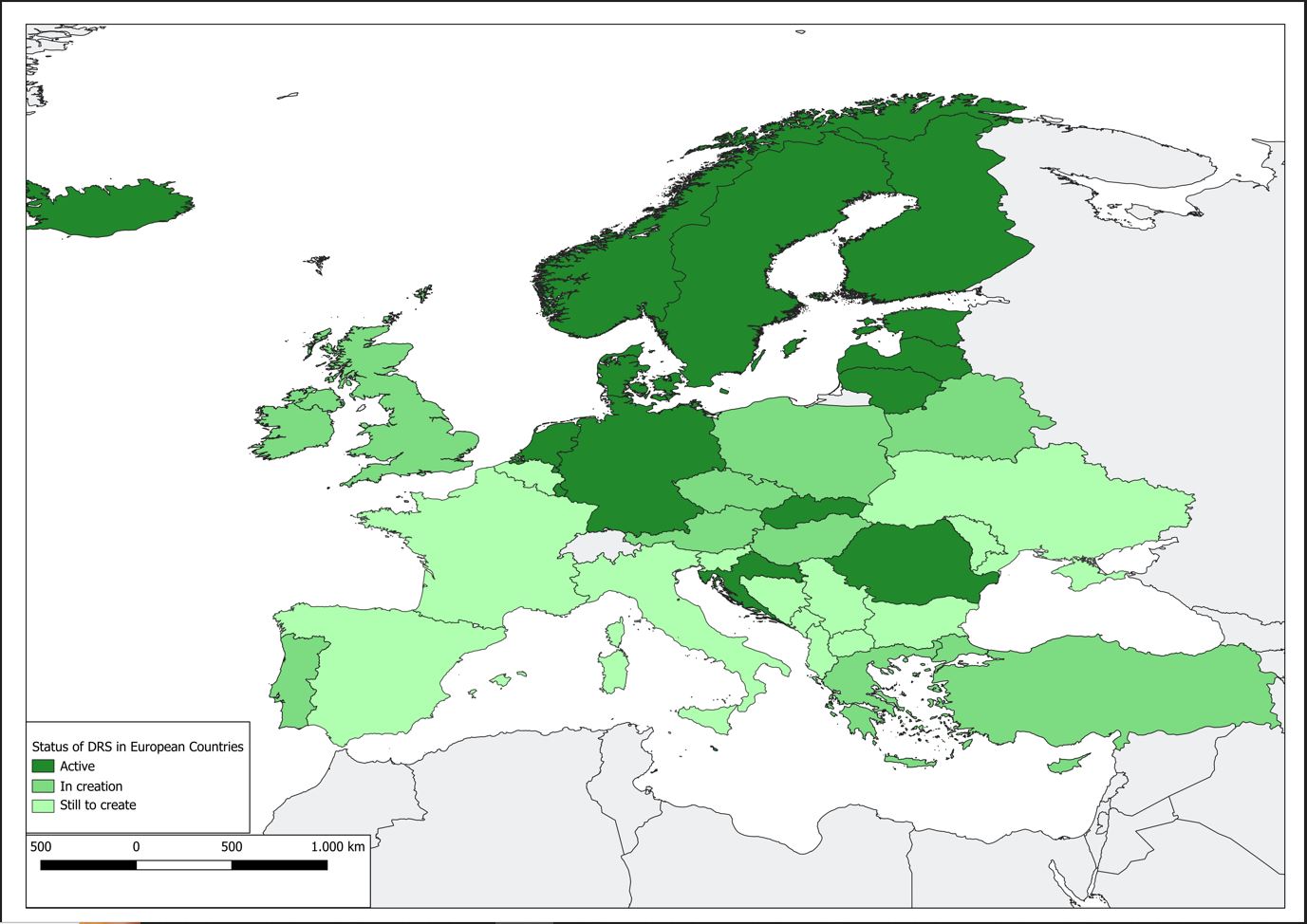
In Europe, 13 countries already have an active DRS and as many will introduce it by 2025. Among them, however, is not Italy [2]. Yet, the DRS could be a solution to align with the European Green Deal directives on waste recycling, particularly plastic packaging.

Fig. 1: Status of DRS in European countries. Author, 2023. Data source: A Buon Rendere

The benefits are not only for the environment

The main goal of the European Green Deal’s Circular Economy Action Plan is for each member state to reduce packaging waste by 15 % compared to 2018 by encouraging reuse, recycling, and banning unnecessary forms of packaging [3]. A DRS could help in the achievement of this goal.

Indeed, a factsheet by the NGO Reloop, highlights the positive impacts of DRSs, pointing out that in the United States and Australia, the introduction of these systems has reduced the amount of plastic bottles and other beverage packaging abandoned in the environment by up to 84 % and 54 %, respectively. The most successful example cited in the review is, however, Germany where, prior to the introduction of DRS, plastic beverage packaging accounted for about 80 % of trash. Then, after the introduction of the “Pfandsystem“, this value was reduced to ‘almost zero’ [4].

However, the benefits are not only for the environment. Public Administrations, the commercial sector, and the beverage companies also benefit.

PAs have lower operating costs from removing abandoned waste and cleaning up their territory. The large-scale retail and commercial sector gains from hosting take-back systems. In addition to receiving compensation for the distributor’s presence in the stores, it has been shown that people tend to visit stores more frequently to leave empty packaging and then take the opportunity to make purchases.
Finally, beverage companies have access to large quantities of high-quality raw materials that can be recovered at low cost. They also improve their environmental profile and image to the public [1].

What about us, in Italy, are we ready for a DRS? Since the different kinds of waste management and treatment systems we have across the whole peninsula, it is first necessary to succeed in harmonizing the diversity among the various municipalities. Meanwhile, we must continue to educate citizens about reuse and recycling and talk about differentiating, whether there is an economic payoff or whether it remains an ethical and moral issue.

By the way, in the end, I found a plastic bin to leave my bottle in.

12 Years Later: the Ghost of Fukushima’s Water

On the morning of August 24, 2023, the release of water from the Fukushima Power Plant into the Pacific Ocean officially began.

Although the news did not resonate much in Western countries, all the headlines were shouting: “Is it safe?”. In Asia, the news made much more of an uproar. Numerous protests arose in Japan and neighboring countries such as South Korea and China, which, together with Hong Kong, banned the import of fish from Japan [1].

March 11, 2011 – The Nuclear Disaster

2:46 P.M.– a magnitude 9.0 earthquake hits the Miyagi prefecture in Japan. The safety systems at the Fukushima-Daiichi plant are then activated: the reactors are shut down, nuclear fission is stopped and emergency pumps lower the temperature.

3.36 P.M. – waves 10 to 20 meters high begin to hit the coast of Tōhoku, the region to which Fukushima prefecture belongs. The plant’s tsunami wall is 9 meters high and a 13 m wave rushes over it, flooding the inner perimeter and knocking out the secondary generators of the cooling pumps. The tertiary generators are then activated, batteries that last 6h.

Around 10 P.M. – the batteries have exhausted their life. The secondary diesel generators have not been repaired because the site is still inaccessible due to the damage to the infrastructure throughout the region. The fuel rods begin to heat up. Seawater is then used to cool them quickly [2].

Fig. 1: Nuclear Power Plant. Free source photo by Ajay Pal Singh Atwal en unsplash.com

August 24, 2023 – Is It Safe?

The International Atomic Energy Agency (IAEA) has approved the plan to release Fukushima’s Power Plant cooling water into the Pacific Ocean.

These, after cooling down the temperature of the reactor, rest in special tanks where radioactive nuclei are removed. The only radionuclide that is not removed is tritium (hydrogen with three neutrons) because it is bound to oxygen within the water molecule itself. Here, only 20 g of water contains tritium, out of a total volume of 1.34 million cubic meters, this is the level of dilution [3].

However, the point of view of Greenpeace experts is slightly different from the one of the IAEA. They only recognise the safety of the operation in the short term, worrying about the long-term effects.

When asked by a reporter from the Guardian if it was safe to swim in the Fukushima sea in September at the surf festival, the answer was that ‘the problem was not going for a swim there,but “organically bound tritium – over the years, when it gets into seaweed, shellfish or fish and then consumed by humans over a long period. What does that do to human health? It’s difficult to say.” [4].

This last thought, on the other hand, does not concern Japan only. The Fukushima spill is just an opportunity to shed light on a phenomenon that has already been happening for a while. Nuclear plants in general, including those in China and South Korea, continuously spill diluted radioactive water into the ocean [4]. It would be a good idea to stop using the oceans as a receptacle for everything from solid to liquid waste.

Back to the original question: is what is happening in Fukushima safe? Yes, or at least it is not causing more damage than is already being done, neither to humans nor to the flora and fauna that inhabit Japan’s shores. We will continue to eat sushi, at least in the near future [5].

This article is part of the project “PILLOLE D’ACQUA PIANA: seminari itineranti, blog e podcast per una gestione sostenibile delle risorse idriche in Piana Rotaliana” carried out by ECONTROVERTIA APS and supported by Fondazione Caritro (Prot. no. U445.2023/SG.386 of April 23, 2023).

Imagen de portada: Sea Wave, Free Licensed Photo by Todd Tuner en  unsplash.com

Imagen previa: Nuclear Power Plant. Free source photo by Ajay Pal Singh Atwal en unsplash.com

Circular Economy: Waste as a Secondary Raw Material

It is now a well-known fact that the linear economic model, oriented toward developing and consuming raw materials to make a profit, is now unsustainable for the environment. According to the linear economy model, in fact, the life of any product is essentially marked by five stages: extraction, production, distribution, consumption and disposal. This means that industry extracts virgin raw materials, transforms them to produce consumable goods using labor and energy, distributes the products to the consumer, who, after using them, proceeds to dispose of the “waste” and, therefore, of the products themselves that have now become “waste” [1]. This model of economy is no longer functional because the demand for raw materials is increasing and they are available in limited quantities. In addition to this, there is the need to limit the environmental impact of raw material production and extraction processes [2].

The change is implemented with the transition to the circular economy: a production and consumption model that involves sharing, lending, reusing, repairing, reconditioning and recycling existing materials and products. This extends the life cycle of products by contributing to a reduction in waste but also recovery and reuse that lead to “keeping products alive” for as long as possible and minimizing waste generation. In the circular economy, products are part of an integrated business model because the good is considered a service: it is inevitable that the benefits will not only be environmental but also economic and social.
Thanks to the Directives issued in recent years by the European Union (the so-called “Circular Economy Package”) numerous efforts have been made in the direction of the paradigm shift between linear and circular economy, and there have been numerous companies and start-ups from Trentino that have approached this new concept.

Antifemo, for example, is a company in Rovereto that wants to transform agribusinesses into zero-waste businesses through a biocatalyst that can transform waste materials that do not ferment (such as, for example, sewage sludge formed during the extraction of juice from fruit) into compost. This exemplary circular economy project has even attracted the attention of the European Commission, which has listed it as a good circular economy practice in the European Circular Economy Stakeholder Platform [3]. The benefits of this innovation accrue to the company, which will actually be able to save money on the disposal of its waste, and at the same time, the environment will benefit since there will be a substantial reduction in pollution in addition to energy savings.

Fig. 1: Food source products that can become a resource through the circular economy. Free source photo by FinjaMdownloaded from Pixabay.

Another best practice is that of Biodermol Ambiente, a Lavis company that has been working for years on the implementation of new solutions aimed at water purification, odor abatement, soil decontamination, and the treatment of waste and biomass. Together with startup Symbiargo, the company has launched a project aimed at treating waste products from tanneries in such a way that it can become a secondary raw material for the fertilizer and biostimulant industry in agriculture. In this way, what is expensive to dispose of, as well as a waste, for tanneries becomes a starting material to close the circular transition of production cycles.

These are just two of the many projects that can be completed with the circular economy: a business model with enormous potential, capable of generating competitiveness by combining innovation and sustainability. To implement this model, however, it is necessary to change the traditional approach: a radical change to market dynamics, customer habits, and the way raw materials are exploited in order to reduce costs, use energy efficiently, decrease CO2 emissions, and optimize the supply chain.

How to Change the Status Quo of Packaging

The holiday season has also been archived for this winter. We all attended big lunches and dinners, bought and wrapped gifts for our loved ones and ourselves. Besides many good memories, what are we left with? A mountain of waste and packaging to dispose of! Not surprisingly, a recent analysis by Transport & Environment [1] reports how this Christmas brings a +133 % spike in pollution caused by the logistics of transporting goods.

Although we all try to pay attention to how to dispose of this packaging by sorting it as best we can, by now this is no longer enough: according to the April 2022 report by ECCO [2] in 2020 almost 100 kg per person of plastic was consumed in Italy: we are the second in Europe and that is nothing to be proud of. About 40 percent of this plastic is turned into packaging, which will end up in supermarkets and then in our homes especially at parties and banquets. Sadly, much of this plastic waste will never be recycled [3]. We have covered this issue previously, talking about how some packaging should be redesigned from scratch.

The European Union (“EU”) is trying to put a stop to this with the Circular Economy Package. The Circular Economy Package [4] and the new EU Packaging Regulation [5], approved in late November 2022, wants to improve the entire sector, from disposable to bioplastic packaging. Included in this regulatory package are targets related to reducing and reusing packaging, leading to limiting single-use as much as possible. Europe Direct’s Florence page has created an excellent list of questions and answers on the topic that we recommend reading.

In Italy, the legislation has been widely criticized by Stefan Pan [6], Confindustria’s delegate for Europe in an interview with Sole 24 Ore, who speaks of disastrous scenarios for Italy’s excellent recycling supply chain caused by this new legislation. FederDistribuzione and CONAI are also of the same opinion, expressing fears of the fallout on Italian industries.

Not surprisingly, during the press conference for the presentation of the circular economy regulatory package, European Commission Vice President in charge of the Green Deal Frans Timmermans spoke in Italian to reassure on the objectives of the legislation. You can listen to him in this excerpt from the press conference:

So on the one hand we have Europe trying to give clear directions on how to proceed and on the other the industrial lobbies struggling to adapt but will have to do so anyway.

“Reuse is not in competition with recycling” Frans Timmermans

But there are also other players on this chessboard: citizens, the media, associations and nongovernmental organizations (NGOs). Among all the environmental organizations, GreenPeace launched a major initiative together with ilfattoquotidiano.it called “Plastic Carts” [7]. This initiative sought to assess actions to reduce the packaging of the largest supermarket chains in Italy. The report draws a tragic situation for almost all the chains involved.

This survey highlights another important fact: Law No. 141 of 2019, also referred to as the Climate Decree, allows supermarket customers to “use their own containers as long as they are reusable, clean, and suitable for food use,” but both citizens and merchants are not informed and prepared for this possibility [8].

Did you know that in Italy, thanks to Law 141 of 2019, you can use your reusable bulk containers in all supermarkets?

We cannot forget to mention the initiative “A Buon Rendere – molto più di un vuoto” [9] launched by the Associazione Comuni Virtuosi and other partners, which “aims to facilitate the transition to a circular economy in the packaging sector” by introducing a national deposit deposit system (DRS). In exchange for a deposit on the packaging of the beverage purchased (plastic or glass bottle or can), this system would allow some containers to be reused or at least improve recycling collection and the quality of recyclable material. The deposit system on beverage packaging has existed and worked for decades in countries such as Austria and Germany, and other countries have since adopted it as well.

As we have seen, the situation is constantly evolving thanks to both the European Commission and nongovernmental organizations, but also thanks to citizens who are not simply adapting to the status quo and are reacting with ideas and pressure aimed at a better future for everyone.

The (Long) Way to Recycle Photovoltaic Panels

Renewable energy is finally becoming normality. Global energy production from photovoltaic (“Pv”) panels was about 400 GW in 2017 and it could reach 2500 GW in 2050 [1]. The boom of the solar energy industry, which nowadays generates 22 GW of energy only in Italy [2], is yet called to answer a crucial question. What happens to the panels once they get to their end of life? How are they disposed?

According to the International Energy Agency, Pv panels must comply to the “End-of-life” regulation in force. The best “End-of-Life” process, however, may not be the most convenient one due to high costs and low profits obtained from recycling panels in countries where solar energy is still unpopular [3].

In Europe, recycling Pv panels is mandatory since 2012. The Electronic Waste Directive (Waste from Electric and Electronic Appliances) decrees that “long life-cycle goods […], like photovoltaic panels, should be reused in the best way possible in existing recycling and disposal centers”  [4].

In 2050, 78 million tons of worn panels are expected worldwide [5]. Reusing and recycling their single components has become crucial and indispensable.

Good news come from Australia. A convincing study from the University of New South Wales suggested a new way to recycle solar panels and better handle an increasing volume of photovoltaic cells. The research offers companies a different process to extract and collect precious metals contained in solar panels. After panels are collected and their aluminum frame is removed, cells are chopped, metals are separated through an electrostatic process and finally collected. Overall, the original panel weight is reduced by 2 % – 3 %. The recycled material is then sent to the refinery for further purification and treatment [6].

An interesting solution also comes from Italy. Compton Industriale patented some systems that are capable of recycling Pv panel components, by separating all welded materials and dividing glass. Once the frame is removed, the panel is split in two parts and the surface is sent through a delamination process, which allows to separate and remove the glass without contaminating it. In short, glass can be completely removed and collected. The rest of the panel is chopped, and the metals contained in it are separated.

The process advanced by Compton Industriale allows to recycle more than 90 % of the panel weight. For an average 22 kg panel, 0.1 kg of circuit boards, 0.2 kg of metals, 2.8 kg of silicon, 2.9 kg of aluminum and 13.8 kg of glass can be collected an recycled. Recyclable materials can be reused in several sectors: in manufacturing activities, in the building industry, and in the IT sector, as hardware elements. What cannot be used again is instead burned to generate energy [5].

Very similar from a non-expert eye but different for those of the field, these two approaches represent the first steps to develop a consolidated technology that can reuse and recycle as many existing solar panels as possible. Investing in research and development is the only way to avoid troublesome environmental and social controversies on solar panels disposal and solar energy in general.

The “Invisible” pollution in the building and construction industry

There are many problems related to materials that we use without knowledge, especially disposables. Every day we talk about the problems related to disposable packaging and possible solutions. They range from the simple replacement of plastic with another material – paper, cardboard or bioplastic -, the design from scratch of more efficient packaging in terms of used raw material [1] up to the complete reform of the supply chain through returnable goods [2].

The environmental damage cause by plastic is under everyone’s eyes, but the one of microplastics (or nanoplastics) is less evident. Recently, it has even been proven that there are traces of plastic in our blood! [3] In a previous article, we discussed about microplastics in the seas and oceans coming from our washing machines [4].

There are many other sectors in which the problem of disposable plastic is present: today we focus on the building and construction industry. These industries are riding the wave of post-Covid19 environmental bonuses for building renovation works [5], but there are cases in which companies operate without respecting the environment.

A key issue is caused by construction plastic fences (orange, yellow, green, etc.) used to delimit construction sites (Figure 1 and 2). An element that is typically forgotten until the work is completed. But until then, weathering will do its part. While in the beginning plastic seems indestructible, UV rays will degrade it until it becomes rigid and friable, ready to break at the first gust of wind. The wind will carry plastic pieces to the adjoining areas and beyond, polluting both land and water. Other times the vegetation will swallow it up, making its removal practically impossible.

Fig. 1: Example of a construction site delimited by a deteriorated plastic fence. Photo by author. Trento (Italy), March 2022.

Apart from plastic fences and plastic nets covering metal fencing grids, other waste is often buried when the works are terminated: Eye doesn’t see, heart doesn’t grieve! [6]

The “green” revolution must involve all economic sectors and we cannot simply turn away on these occasions. Even a single citizen can make a difference: I personally reported to the police the situation of the first photo and the deteriorated fences have been removed, but unfortunately replaced with new, but still plastic-made fences.

Fig. 2: Another example of plastic fencing at a larger construction site: the duration and its extent means that many plastic parts will break off from the metal grid end up in the environment before the site is closed. Source: Google Street View, July 2021.

According to Italian jurisdiction, it is difficult to distinguish what is a waste and what is not. In fact, the plastic fence becomes waste when it breaks apart and is dislocated from the place it was meant to occupy. How can you thus prove that the plastic pieces found on the road or a green area specifically came from the plastic fence of the nearby construction site? Is it even possible to find a responsible person or company and report for illegal waste abandonment? The procedure is lengthy and complicated and very few people have the time, competences and willingness to deal with it.

It is therefore necessary to push for the creation of ad-hoc sustainability guidelines for construction sites, promoting the use of reusable materials – such as the metallic temporary construction fences in Figure 3 – and preventing the use of cheap but polluting plastic materials.

Fig. 3: Example of delimiting a construction site without using plastic fences: plastic-free temporary (and reusable) construction fences. Source: author. Lavis (TN), December 2021.

Bibliography:

[1] https://www.carlsberggroup.com/sustainability/actions-towards-zero/case-stories/snap-pack-an-innovation-to-reduce-plastic/

[2] https://www.buonrendere.it/

[3] https://www.theguardian.com/environment/2022/mar/24/microplastics-found-in-human-blood-for-first-time

[4] https://greenmarked.it/stop-alle-microplastiche/

[5] https://www.governo.it/it/articolo/superbonus-110-case-pi-efficienti-e-sicure-costo-zero/15948

[6] https://greenmarked.it/2020-turning-a-personal-blog-into-a-business/

A Dump of Recyclable Waste

On Friday, September 4, the documentary “PrimAscesa – La Montagna Creata dall’Uomo” (“First Climb Up – The Manmade Mountain”)by Leonardo Panizza was played in Lavis (Trento, Italy) during the event “Vita Nuova”.

The movie shows the first exceptional ascent of one of the last pristine alpine mountaintops: the “Ischia-Podetti” dump (Trento). The two Trentino mountaineers, Simon and Giovanni, climb up and sky down the slopes of Trento’s mountain of waste. The one that each of us from Trentino contributes to create every day.

View of the Ischia-Podetti dump from the industrial district of Trento North.


One remains shocked after the movie ends. Why does this mountain keep on growing despite all our efforts to separate waste and reduce the volume of unrecyclable waste? In fact, the movie clearly shows that most of the waste in the dump is made of recyclable materials. The issue is simple and derives from the waste separation and recycling system business management. If too many impurities (i.e., non-conforming materials) are found in the recyclable waste when it is handled at the waste separation plant, it cannot be sold to recycling companies and is therefore transported to the dump or the incinerator.

With its advantages and disadvantages, the incinerator is the alternative to dumps. Located about 50 km north of Trento, the incinerator of Bolzano is also used by the people of Trentino because it is oversized for the needs of the people of South Tyrol alone [1]. Far from being circular in a concrete way, our economy creates unrecycled waste every day. Despite the good will of individual citizens and associations, our economy is often unable to find valid alternatives to incinerators that can drastically reduce the amount of unrecycled waste.

In addition to the advices given in previous articles and posts, we recommend you to be active critical consumers in shopping and eating places. Ask your favorite supermarkets, canteens, restaurants, clothing stores, etc. about their waste management. Questions such as “Do you have plastic-free packaging?” or “Do you sell returnable goods?” reveal how important these issues are to us as consumers. If we are able to show that consumers demand better reuse and recycling waste handling practices, the message will sooner or later reach facilities decision makers and eventually those who have the real power to improve the waste management system in Trentino.

REFERENCIAS:

[1] Foppa, B. (2019, January 29). Utilizzo dell’inceneritore di Bolzano. Grüne – Verdi – Vërc.

Stop alle microplastiche dalla nostra lavatrice!

Il 20 maggio è divampato un incendio su una nave al largo dello Sri Lanka [1] provocandone l’affondamento e la dispersione nell’ecosistema marino di numerosissime sostanze tossiche, tra cui combustibili, oli, resine e plastiche. Le vicine spiagge e la costa sono state invase dalla plastica rilasciata nell’oceano e gli animali, tra cui le tartarughe [2], stanno già morendo a causa di questa massiccia contaminazione di inquinanti.

Cosa possiamo fare noi in questo caos? Abbiamo già parlato dell’importanza della protezione e conservazione degli ecosistemi marini in un precedente post ma oggi vorremmo presentare una nuova e concreta possibilità per ridurre ancora di più il nostro impatto su di essi.

Sapevate che anche fare la lavatrice contribuisce all’inquinamento dei mari? Ogni capo, lavandolo, si deteriora e rilascia delle fibre che finiscono “giù per il tubo”, che non costituirebbero un problema se i nostri vestiti fossero composti al 100 % di materiali biodegradabili come cotone, lana, lino, seta, canapa ecc. Purtroppo, gran parte dell’industria tessile utilizza fibre plastiche, come il poliestere. Il problema del poliestere riguarda quello che accade dopo la sua produzione, durante il suo utilizzo e il suo degradamento. Si stima infatti che il 35 % della plastica negli oceani provenga proprio dalle nostre lavatrici [3, 4], che ad ogni lavaggio scaricano moltissime fibre sintetiche.

Fig. 1: Il filtro per microplastice di PlanetCare. Autore, Giugno 2021.

Una start-up, Planet Care, sta cercando di risolvere questo problema con un filtro per lavatrice molto facile da installare. Selezionata da Amazon tra le cinque start-up più innovative dell’anno, è in corsa per raggiungere il primo posto e dunque un finanziamento di 100 000 €. Qui puoi votare per loro. Dal loro sito, potete trovare un kit composto da contenitore e cartucce filtranti di facile installazione; noi lo abbiamo già acquistato e testato! La loro politica di riutilizzo dei filtri permette di ridurre al minimo i rifiuti, poiché una volta rimandati (gratuitamente) al mittente verranno rigenerati e riutilizzati.

Fig. 2: Cartucce filtranti PlanetCare ed istruzioni per il montaggio, chiare ed efficaci. Autore, Giugno 2021.

Con la consapevolezza dell’impatto delle nostre azioni quotidiane possiamo adottare questa ed altre innumerevoli strategie per inquinare meno. Sta a noi capire come e fare ed iniziare ad agire!

Bibliografia:

[1] Sri Lanka: Burning ship coats beaches in oil and debris. (2021, May 28). BBC News. https://www.bbc.com/news/world-asia-57278473

[2] Mallawarachi, B. (2021, June 22). Turtle carcasses wash ashore in Sri Lanka after ship fire. SFGATE. https://www.sfgate.com/news/article/Turtle-carcasses-wash-ashore-in-Sri-Lanka-after-16264277.php

[3] Parlamento Europeo. (2020, December 29). L’impatto della produzione e dei rifiuti tessili sull’ambiente (infografica). https://www.europarl.europa.eu/news/it/headlines/society/20201208STO93327/l-impatto-della-produzione-e-dei-rifiuti-tessili-sull-ambiente-infografica

[4] Ocean Clean Wash. (n.d.). Microfiber Pollution: Our Clothes Pollute the Oceans. Ocean Clean Wash. Retrieved June 25, 2021, from https://www.oceancleanwash.org/

The Loneliness of Face Masks

At least once, the Covid-19 outbreak made everyone ask themselves: “Where did I put my face mask?”.There is who forgot it at home and who was just looking for it in the wrong pocket, there is who lost it somewhere without knowing and who threw it away in the closest trashcan or, in the worst case scenario, on the ground.

Face masks are hazardous for the environment in numerous ways when littered.

Face masks are made of plastics, which are not biodegradable and can persist in the environment up to hundreds of years as micro- and nanoplastics [1]. Laying in an open-air environment, “alone in a strange world under the light of a new sun, in their new home” (Nolan, 2014) – which may be a cornfield, a roadside, a riverbank, a bird’s nest, a beach, etc. – littered face masks lie at the mercy of abiotic and biotic factors, and slowly release chemicals into the surrounding areas [2].

As it is true for all other plastic materials, face masks can be mistakenly eaten by farm animals and wildlife, thus ending in their stomach and often in our meal. In other cases, face masks obstruct the airways and the poor animal chokes to death [3]. Furthermore, they are subject to weathering and after a short time, they start to crumble, releasing plastic fibres as well as heavy metal traces, such as lead, antimony, and cadmium, into the soil and nearby water courses [2].

This might seem a problem confined to the source of pollution, but considering the amount of littered face masks, it is in fact a widespread tragedy.

Before the beginning of the pandemic, plastic pollution was a well-known problem, clearly imprinted in our brains. The world was becoming more sensitive about the climate crisis and environmental breakdown and using (and throwing away) a plastic face mask every day was not even conceivable. However, now, after more than one year coping with the pandemic, the world uses and disposes about 3.4 billion single-use face masks every day [4]. They will not be gone for a very, very long time.

Since face masks are still compulsory in Europe and most parts of the world, it is unrealistic to think that this new source of pollution will be erased in a short time. Finding solution to reduce the number of littered face mask is imperative.

“So, what can I do about it?”

The National Geographic recommended three main points to fight against face masks pollution [5]:

  1. Do not be a litterbug
  2. Wear washable cloth masks, when possible
  3. Pack used PPE (i.e., “Personal Protective Equipment”) into a plastic bag, seal it, and put it out for the trash

And I would like to add one extra point:

  1. Talk about face masks pollution. Try to sensitize your friends and family and raise awareness.

Masks must be used. It is a matter of public health. But also the ocean and land health must be protected.

Face mask pollution and wrong disposal seems a minor problem now that the virus is still infecting and killing thousands of human beings, but it will slowly and steadily grow over time [2]. If we neglect it now, we will have to face a much larger face mask pollution crisis in the future.

(Author, May 2021)

Bibliography

[1] Weinstein, J. E., Crocker, B. K., & Gray, A. D. (2016). From macroplastic to microplastic: Degradation of high-density polyethylene, polypropylene, and polystyrene in a salt marsh habitat. Environmental Toxicology and Chemistry, 35(7), 1632–1640. https://doi.org/10.1002/etc.3432

[2] BBC News. (2021, May 4). Covid: Disposable masks pose pollutants risk, study finds. BBC News. https://www.bbc.com/news/uk-wales-56972074

[3] Di Todaro, F. (2020, August 27). Sempre di più le specie di pesci che mangiano la plastica. wisesociety.it. Retrieved May 14, 2021, from https://wisesociety.it/ambiente-e-scienza/pesci-plastica-ispra-mediterraneo/

[4] Benson, N. U., Bassey, D. E., & Palanisami, T. (2021). COVID pollution: Impact of COVID-19 pandemic on global plastic waste footprint. Heliyon, 7(2), e06343. https://doi.org/10.1016/j.heliyon.2021.e06343

[5] Parker, L. (2021, April 14). How to stop discarded face masks from polluting the planet. Environment. https://www.nationalgeographic.com/environment/article/how-to-stop-discarded-face-masks-from-polluting-the-planet

Nolan, C. (2014, November 5). Interstellar [Adventure, Drama, Sci-Fi]. Paramount Pictures, Warner Bros., Legendary Entertainment.

A case study on the success of The Ocean Cleanup

Etienne Hoekstra

29 January 2020

Plastic pollution around the world

The United Nations (UN) identified plastic pollution as one of the world’s biggest environmental challenges (UN Environment Programme, 2018), and embedded it in the Sustainable Development Goal 14: “Conserve and sustainably use the oceans, seas and marine resources” (UN, n.d.).

Plastic pollution in oceans was first documented in the 1970s. In 2010, Jambeck et al. (2015, p.768) estimated that “275 million metric tons of plastic waste was generated in 192 coastal countries […] with 4.8 to 12.7 million [metric tons] entering the ocean”, thus affecting all major ocean basins (Geyer et al., 2017). In addition, ocean currents can form extensive plastic fragments such as the Great Pacific Garbage Patch (GPGP), which is supposed to cover a surface area triple the size of France (Lebreton et al. 2018).

From the 6.3 million metric tons of plastic waste that had been created in 2015, “around 9% of which had been recycled, 12% was incinerated, and 79% was accumulated in landfills or the natural environment” (Geyer, Jambeck & Law, 2017, p.1). If the situation remains unchanged, the amount of plastic waste gathered in landfills or the natural environment will more than double by 2050 (Geyer et al., 2017).

The Ocean Cleanup

Tackling these issues requires social entrepreneurship, meaning the skill to seek changes and turn issues into opportunities (Dees, 2001). Boyan Slat, the initiator of The Ocean Cleanup (TOC) project, took the opportunity to create value from cleaning up parts of the ocean that are contaminated by plastic and other kinds of waste. His idea became a pioneer project and inspired hundreds of people around the world (TOC, n.d.A).

TOC has been developing a technology that could passively collect half of the Pacific Ocean plastic waste within ten years. “Passively” means that the heavy work is delegated to ocean currents, while an artificial, floating coastline actively captures the plastic. Marine life fishes can swim under the floating barriers placed in a V-shape. The barriers carry the collected plastic to a central point where ships are able to remove the plastic from the water, and transport it to the mainland for recycling. (Rijksoverheid, 2016; TOC, 2020A).

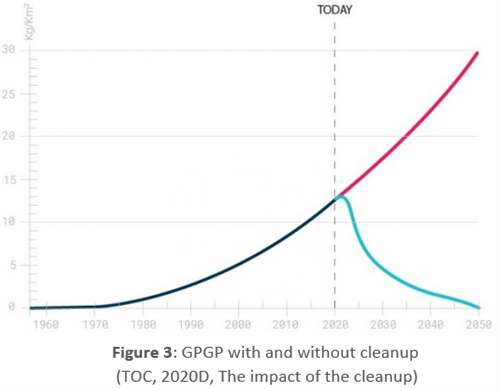
The aim of the project is to clean-up half of the GPGP before 2025, and the remaining half before 2050. The aim can be visualized in Figure 3, together with a scenario of no-action. Although the figure is limited to the GPGP, TOC has equal long-term goals for other ocean garbage patches. For example, TOC aims to reduce the amount of ocean plastic with 90% by 2040 (TOC, 20202D; TOC, n.d.C). If TOC’s operations were complemented by a considerable reduction of plastic sources on land, a plastic-free ocean could be accomplished by 2050 (TOC, 2020C). However, this requires “radical changes at the individual, corporate, and governmental levels of society” (TOC, n.d.C).

Criticism

Despite the ambition to accomplish a plastic free ocean and the received recognition, the TOC project has received criticism as well. Van Franeker & Kühn (2018) reviewed the impact of TOC operations and concluded that if TOC indeed managed to clear half of the GPGP by 2025, it would only remove about 0.1% of the plastic that ends in the ocean every year. Likewise, many scientists stressed that the plastic sources reduction is in fact the most effective mitigation strategy (Rochman; Sherman & Sebille, 2016). Although TOC acknowledges source reduction as important, it does not see it as the solution to current ocean plastic pollution issues (TOC, 2015).

Furthermore, Sherman & Sebille (2016, p.2) declared that “ocean plastic removal might be more effective […] closer to shore than inside the plastic accumulation zones in the centers of the gyres”, like the GPGP. TOC, instead, focuses on ocean garbage patches in high seas gyres “because the plastic floating outside of these ocean garbage patches either naturally removes itself from the ocean by beaching onto a coastline, or eventually also ends up in an ocean garbage patch” (TOC, n.d.B).

Moving forward

To move beyond its first testing and 2015 prototype phase, TOC conducted a feasibility study. Costs were covered with a crowdfunding campaign that raised $100,000. The study included topics such as engineering, oceanology, ecology, maritime law, finance and recycling, and was conducted by a voluntary collaboration of more than a hundred private citizens, organizations and institutions (Slat et al., 2014). The favorable outcome illustrated the sustaining aspect of the innovation.

The positive media coverage that came with the favorable feasibility study was used for the second crowdfunding campaign. This campaign raised over 2 million dollars, becoming the most successful crowdfunding campaign opened by an NGO, so far (TOC, 2015; ABN AMRO, 2014). It allowed TOC to develop and test different prototypes in different locations (TOC, 2020A).

In late 2016 TOC initiated another fundraising round. In May 2017, it issued a press release stating that it “successfully raised 21.7 million USD in donations since last November [bringing TOC’s] total funding since 2013 to 31.5 million USD, [which enables TOC] to initiate large-scale trials of its cleanup technology in the Pacific Ocean” (TOC, 2017). The fact that this latter funding round comprised solely on donations demonstrates the legitimacy perceived by the initial investors that supported the project.

Eventually, after “hundreds of scale-model tests, a series of prototypes, research expeditions and multiple iterations”, a first full-scale clean-up system was ready in 2018 (TOC, 2018). The unique business approach of TOC, however, also created legal complications that had to be solved before the full-scale system could be launched. To overcome these hurdles, TOC signed a covenant with the Dutch Ministry of Infrastructure and Water Management (MIW, 2018). With an applicable legal framework and support from the Dutch government, TOC was ready to launch its first full-scale clean-up system. The aim of the operation was to test the system and collect relevant data while cleaning up the GPGP (TOC, 2018). Nevertheless, the operation was prematurely terminated because the system was not able to actually capture the plastic due to “an inconsistent speed difference between the system and the plastic” (TOC, 2020A, p.17). This led to a systematic failure (TOC, 2020A).

Thanks to a cooperation with two other organizations, TOC later came with an updated prototype, the “System 001/B”. After one year of testing, TOC stated on 3 October 2019 that its self-contained prototype succeeded in passively capturing and concentrating plastic from the GPGP using the natural forces of the ocean. This was the first true success since Boyan Slat presented his ideas in 2012 (TOC, 2019).

Additionally, TOC recycled the captured plastics into valuable goods: it turned them into sunglasses, a durable and useful product. This entrepreneurial activity is crucial to ensure future operations, as potential profit will be fully reinvested and, thus, completed the infinite circle (TOC, 2020B).

The adjustments in the prototype were incorporated in the newly designed system (002), that requires  comprehensive  examination  and  modelling  before  becoming  the  next  full-scale clean-up system (TOC,  2020). Ultimately, “a fleet of systems” would be necessary to be able to clean up the entire GPGP and smaller plastic patches” (TOC, 2020A).

Furthermore, TOC is “looking to expand [its] operations all over the globe to help tackle the 1000 most polluting rivers, five years from the commencement of the scale-up phase” (TOC, 2020A, p.8). Replying to the criticism, TOC not only acknowledges plastic source reduction as important, but also strives for action.


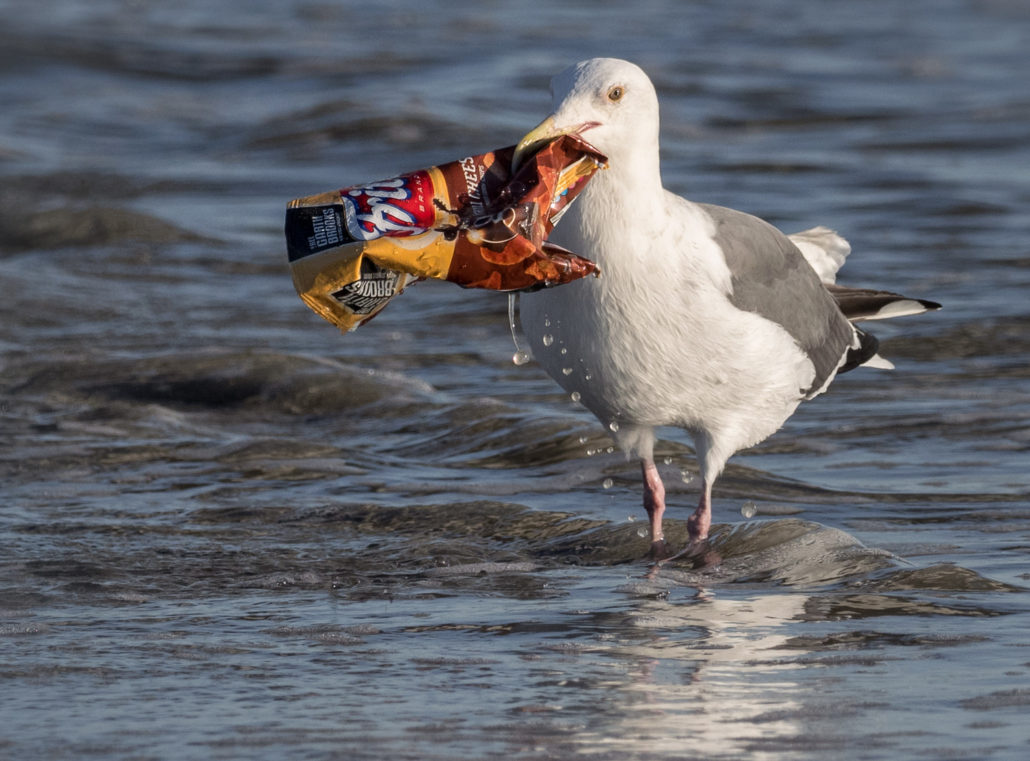
Fig. 2: A seagull holding a plastic package in its peak (Ingrid Taylar, 2016).

Bibliography

ABN AMRO (2014, 11 July). Seeds faciliteert succesvolste crowdfunding voor non-profit organisatie. Retrieved 30 November 2020, from https://www.abnamro.com/nl/newsroom/nieuws/2014/seeds-faciliteert-succesvolste-crowdfunding-voor-non-profit-organisatie.html

Dees, J.G. (2001, 30 May). The Meaning of Social Entrepreneurship. Downloaded 7 December 2020, from https://centers.fuqua.duke.edu/case/wp-content/uploads/sites/7/2015/03/Article_Dees_MeaningofSocialEntrepreneurship_2001.pdf

Franeker, J.A. van & Kühn, S. (2018, 13 September). The Ocean Cleanup. Downloaded 6 November 2020, from https://www.wur.nl/upload_mm/0/0/a/3f5469b5-3e79-423f-a947-80b5a5b06c1a_FAQ-OceanCleanup2018_finalNL_CH-JAF.pdf

Geyer, R., Jambeck, J.R. & Law, K.L. (2017). Production, use, and fate of all plastics ever made. DOI: 10.1126/sciadv.1700782

Jambeck, J.R., Geyer, R., Wilcox, C., Siegler, T.R., Perryman, M., Andrady, A., Narayan, R. & Law, K.L. (2015). Plastic waste inputs from land into the ocean.Science, 347(6223), pp.768-771. DOI: 10.1126/science.1260352

Lebreton, L., Slat, B. […] Brambini, R. & Reisser, J. (2018, 22 March). Evidence that the Great Pacific Garbage Patch is rapidly accumulating plastic. Retrieved 6 November 2020, from https://www.nature.com/articles/s41598-018-22939-w

Ministry of Infrastructure and Water Management of the Netherlands (2018, 6 June). Convenant tussen de Minister van Infrastructuur en Waterstaat en The Ocean Cleanup betreffende de inzet van systemen bedoeld om plastic op volle zee, dat drijft in de bovenste waterlagen, op te ruimen.Retrieved 6 December 2020, from https://zoek.officielebekendmakingen.nl/stcrt-2018-31907.html#d17e790

Rijksoverheid (2016, 29 November). Waterinnovaties in Nederland.Downloaded 6 November 2020, from https://www.rijksoverheid.nl/binaries/rijksoverheid/documenten/brochures/2016/11/29/waterinnovaties-in-nederland/Waterinnovaties-2016.pdf

Rochman, C. M. (2016). Strategies for reducing ocean plastic debris should be diverse and guided by science. Environmental Research Letters, 11(4), 041001. DOI: http://dx.doi.org/10.1088/1748-9326/11/4/041001

Sherman, P. & Sebille, E. van (2016). Modeling marine surface microplastic transport to assess optimal removal locations. Environmental Research Letters, 11(1), 014006. DOI: http://dx.doi.org/10.1088/1748-9326/11/1/014006

Slat, B.D., Arens, E. […] Zuijderwijk, N. & de Sonneville, J. (2014, 3 June). How the oceans can clean themselves. A feasibility study. Downloaded 30 November 2020, from https://ds1.static.rtbf.be/article/pdf/toc_feasibility_study_lowres-1401893379.pdf

The Ocean Cleanup (2015, 30 June). Annual Report 2014.Downloaded 30 November 2020, from https://assets.theoceancleanup.com/app/uploads/2019/04/TOC_2014_Annual_Report.pdf

The Ocean Cleanup (2017, 3 May). THE OCEAN CLEANUP RAISES 21.7 MILLION USD IN DONATIONS TO START PACIFIC CLEANUP TRIALS. Retrieved 12 December 2020, from https://theoceancleanup.com/press/press-releases/the-ocean-cleanup-raises-217-million-usd-in-donations-to-start-pacific-cleanup-trials/

The Ocean Cleanup (2018, 8 September). THE WORLD’S FIRST OCEAN CLEANUP SYSTEM LAUNCHED FROM SAN FRANCISCO. Retrieved 6 December 2020, from https://theoceancleanup.com/press/press-releases/the-worlds-first-ocean-cleanup-system-launched-from-san-francisco/

The Ocean Cleanup (2019, 2 October). THE OCEAN CLEANUP SUCCESSFULLY CATCHES PLASTIC IN GREAT PACIFIC GARBAGE PATCH.Retrieved 13 December 2020, from https://theoceancleanup.com/press/press-releases/the-ocean-cleanup-successfully-catches-plastic-in-great-pacific-garbage-patch/

The Ocean Cleanup (2020A, 9 June). Annual Report 2019.Downloaded 6 November 2020, from https://assets.theoceancleanup.com/app/uploads/2020/06/Annual_Report_2019.pdf

The Ocean Cleanup (2020B, 24 October). THE OCEAN CLEANUP INTRODUCES FIRST PRODUCT MADE WITH OCEAN PLASTIC POLLUTION.Retrieved 13 December 2020, from https://theoceancleanup.com/press/press-releases/the-ocean-cleanup-introduces-first-product-made-with-ocean-plastic-pollution/

The Ocean Cleanup (2020C). About – The impact of the cleanup.Retrieved 13 December 2020, from https://theoceancleanup.com/about/

The Ocean Cleanup (n.d.A). THE FIRST PRODUCT MADE WITH PLASTIC FROM THE GREAT PACIFIC GARBAGE PATCH. Retrieved 7 December 2020, from https://products.theoceancleanup.com/

The Ocean Cleanup (n.d.B). FAQ –
How will you clean up 50% of the plastic in 5 years?Retrieved 16 December 2020, from https://theoceancleanup.com/faq/

The Ocean Cleanup (n.d.C). Can you provide an overall solution to ocean plastic pollution?  Retrieved 17 December 2020, from https://theoceancleanup.com/faq/can-you-provide-an-overall-solution-to-ocean-plastic-pollution/

United Nations (n.d.). Goal 14: Conserve and sustainably use the oceans, seas and marine resources.Retrieved 7 December 2020, from https://www.un.org/sustainabledevelopment/oceans/

Join our Telegram channel

Scelte consapevoli per imballaggi sostenibili

Il mondo come tutti noi lo conosciamo sta cambiando. Lo sta ancora facendo in scala macroscopica a causa dei cambiamenti climatici, che non si fermano, mentre noi umani ci siamo dovuti fermare difronte a qualcosa di microscopico come il virus Covid-19.

Se da un punto di vista questa pandemia riduce le emissioni dei gas serra per l’assenza di mobilità [1], dall’altra porta bisogni più essenziali a prevalere anche sulle questioni ambientali. Tuttavia, non dobbiamo dimenticare che se siamo arrivati a questa situazione, l’ambiente e la biodiversità centrano eccome [2,3].

Nonostante il lock-down, possiamo ancora mettere in atto pratiche per rispettare di più l’ambiente, partendo ad esempio dalla spesa di tutti i giorni.

Quante volte abbiamo sentito che dovremmo acquistare prodotti a km 0, biologici, equosolidali e con soli ingredienti naturali? Chiunque dovrebbe sapere che tutto ciò serve per salvaguardare noi e l’ambiente. Purtroppo, non tutti hanno la fortuna di avere un negozio con questi prodotti vicino a casa. Tutti, però, possiamo riflettere sul ciclo di vita di ogni prodotto che acquistiamo. Questo ciclo comincia dalla produzione e arriva allo smaltimento di quello che resta del prodotto consumato, per esempio il suo imballaggio.

Recentemente si è dibattuto molto sulla messa al bando delle plastiche monouso, regolamentato dall’UE con la Direttiva 2019/904. La questione era prima focalizzata sulle buste di plastica per la spesa, poi sui sacchetti per l’ortofrutta, i quali sono ora prodotti obbligatoriamente con materiali compostabili. La tematica è stata molto discussa dalla comunità scientifica ma i materiali sono in continua evoluzione. Non esiste, ad ora, un materiale meno impattante di tutti in maniera assoluta [4,5].

Questo movimento porterà anche alla regolamentazione degli imballaggi per alimenti. Noi di GreenMarked abbiamo voluto fin da ora cercare di creare un dialogo con alcune aziende alimentari (e non).

Caso 1: Agorà – Pasta Biologica PRIMIA

Fonte immagini [6]

Vorremmo portare l’attenzione a uno dei tanti casi di prodotti buoni perché biologici ma con un imballaggio scadente. Abbiamo segnalato al produttore come le confezioni risultino difficilmente riciclabili. Sulla confezione viene indicato che l’imballaggio va smaltito nella raccolta carta ma l’indicazione è fuorviante: il riciclo del materiale di cui è composto (C/PAP81, poliaccoppiato a prevalenza carta) va smaltito a seconda del centro di raccolta del nostro Comune. Per la piana Rotaliana, l’azienda ASIA indica lo smaltimento del CPAP nel secco residuo. La risposta di Agorà Network non concepisce questa problematica:

La sigla C/PAP81 indica un materiale definito poliaccoppiato a prevalenza carta, che unisce carta all’esterno e plastica all’interno in grado di garantire una chiusura ermetica della confezione. Il film è costituito da una parte di carta da 50gr e plastica da 30micron di spessore.

Considerata la prevalenza della carta e le analisi eseguite, il fornitore conferma che l’imballo può essere quindi riciclato nella carta.

Fig 1: Imballaggio in CPAP81 Pasta Biologica PRIMIA. La buona volontà non è bastata per differenziare i materiali.

Caso 2: Agri90 – Farina di Storo

Fonte immagini [7]

Durante la quarantena ci stiamo improvvisando un po’ tutti panettieri e pasticcieri e come faremmo senza farina? Un famoso produttore trentino è Agri90, che in questo periodo ha avuto un notevole aumento di vendite delle farine di Storo [8]. Nonostante la territorialità del prodotto, l’imballaggio di queste farine è migliorabile. Se da un lato la classica farina gialla di Storo è confezionata in sola plastica (scelta discutibile), le farine bianche sono confezionate in materiale poliaccoppiato.

La nostra proposta è stata semplice “Perché non usare solo carta?”. Il sacchetto di carta è da sempre usato per le farine.La risposta del produttore è la seguente:

[…] Con questa risposta vorrei, da una parte tranquillizzarLa e dall’altra fare una precisazione. Parto da questa seconda affermazione che riporta la scritta da Lei citata “La confezione permette la separazione dei due materiali…” è stata realizzata per poter gestire al meglio la raccolta differenziata, in modo tale da non eliminare tutto nella gestione del rifiuto indifferenziato. Vorrei umilmente invitarLa a dare fiducia al popolo. Non lo diciamo noi, ma le normative: in caso di una confezione mista carta-plastica, la separazione può essere fatta. In fondo basta un po’ di buona volontà. […] Tutto ciò per dire che Agri90 tiene al rapporto armonioso con il suo territorio. […]

Secondo Agri90, quindi, la patata bollente passa al consumatore, che con buona volontà deve separare i materiali.Non si tratta di una pratica immediata: richiede tempo, manualità e buone capacità visive. Secondo voi quanti consumatori differenziano in questo modo? Troppo facile “dare fiducia al popolo”, bisogna evitare il problema alla base, cambiando l’imballaggio.

Fig. 2: Farina Bianca di Storo. Il produttore ha indicato di separare carta e plastica e noi l’abbiamo fatto. Servono davvero due materiali?

Caso 3: CHINDET – Detergenti Aperegina

Fonte immagini [9]

Un altro produttore locale è Chindet, una cooperativa sociale che produce a Villa Lagarina (TN) detergenti ecologici come detersivi per la casa, l’igiene personale e perfino per gli animali domestici. Il tutto aiutando anche persone svantaggiate a venire inserite nel mondo del lavoro. Li abbiamo contattati per avere informazioni sugli imballaggi dei loro prodotti, chiedendo anche se abbiano valutato il processo di vendita alla spina per ridurli. La loro risposta è ricca di informazioni:

  • Presso il punto vendita di Villa Lagarina è possibile ricaricare i flaconi. Purtroppo nei supermercati non è possibile fare altrettanto in quanto, al momento, non c’è disponibilità di spazio nei vari punti vendita.
  • Tutti i flaconi in PET (quelli trasparenti per intenderci) sono realizzati con plastica al 100% proveniente da materiale post consumo (le bottiglie di acqua minerale) quindi non c’è utilizzo di materiale nuovo.
  • Aperegina è entrata in un progetto europeo che riguarda il basso Trentino e la zona di RIVA/ARCO per la riduzione dell’impatto della plastica sul consumo domestico. Se il progetto andrà a buon fine, in queste zone nei supermercati installeremo dei dispositivi per il recupero dei vuoti che consentiranno uno sconto alla cassa. Purtroppo il progetto penso che verrà ritardato vista la grave situazione della pandemia.

Ricarica dei flaconi realizzati con 100% di plastica riciclata e recupero dei vuoti per sconti sulla spesa.Il progetto Aperegina è lodevole su tutti i punti di vista e li ringraziamo per le risposte fornite.

Discussione

La ricetta magica per l’imballaggio ad impatto zero non esiste. Ogni materiale ha dei pro e contro che devono essere valutati grazie all’Analisi del Ciclo di Vita (LCA – Life Cycle Assessment) del prodotto. Per ridurre al massimo il loro impatto dobbiamo quindi
seguire la classica regola delle 3 R:

  1. Ridurre: riduciamo gli imballaggi al minimo indispensabile, acquistando i prodotti che seguono questa filosofia. Sapevate ad esempio che le vecchie lattine “larghe” per bevande usano meno alluminio rispetto a quelle nuove più “lunghe”? [10].
  2. Riutilizzare: il riutilizzo è la chiave per la riduzione dei rifiuti. Riutilizziamo borse, contenitori e tutto ciò che possiamo evitando di acquistarne altri.
  3. Riciclare: il riciclo è fondamentale ma entra in gioco solo quando le due R precedenti non sono abbastanza. Il processo di riciclaggio non è a impatto zero; pensiamo quindi prima a come ridurre i rifiuti che produciamo e poi a come riciclarli.

Inoltre, serve una maggiore coesione a livello nazionale ed europeo riguardo alla produzione e raccolta differenziata degli imballaggi, con regole comuni e non “soggette ai Comuni”, che siano comprensibili facilmente a tutti i cittadini.

E voi, quante volte avete pensato che quell’imballaggio sia nato male?Che abbia le informazioni sbagliate per un corretto riciclaggio? Come lo migliorereste?

Oppure, quale produttore secondo voi è da seguire come modello per i suoi imballaggi?

Mandateci le vostre foto, idee ed opinioni al riguardo, faremo il possibile per metterci in contatto con le aziende e portargli le vostre proposte!

Fig. 3: Corretta indicazione a sinistra e migliorabile a destra.

Bibliografia e sitografia:

[1] Redazione ANSA, 2020. Esa, inquinamento in calo del 50% in Europa. ANSA.it.

[2] Miller, M.L., 2020. Spazio vitale contro COVID-20. Da Wuhan a Codogno, da Shanghai a Mezzocorona. GreenMarked. URL https://greenmarked.it/spaziovitale-contro-covid20/ (accessed 4.21.20).

[3] Lapertosa, A., 2020. Coronavirus: depredare la natura aumenterà la diffusione delle pandemie. ANSA.it.

[4] Lewis, H., Verghese, K., Fitzpatrick, L., 2010. Evaluating the sustainability impacts of packaging: the plastic carry bag dilemma. Packaging Technology and Science 23, 145–160. https://doi.org/10.1002/pts.886

[5] Khoo, H.H., Tan, R.B.H., Chng, K.W.L., 2010. Environmental impacts of conventional plastic and bio-based carrier bags. The International Journal of Life Cycle Assessment 15, 284–293. https://doi.org/10.1007/s11367-010-0162-9

[6] PRIMIA, Fusilli Vivi Verde BIO – Primia [WWW Document]. URL https://www.primia.it/shop/product/vvbio-fusilli-gr-500-vvbio-fusilli-gr-500 (accessed 4.21.20).

[7] AGRI90, Shop Online [WWW Document]. URL https://www.serenestar.it/shop-online/page/1/ (accessed 4.21.20).

[8] Bindi, L., 2020. Coronovirus e approvvigionamenti: è boom per la farina di Storo – TGR Trento. TGR Trento.

[9] Aperegina, Piatti FIOR DI LIMONE 1litro [WWW Document]. URL https://aperegina.myshopify.com/products/piatti-fior-di-limone (accessed 4.21.20).

[10] Zar, 2007. Gli studenti di oggi: Il problema del fabbricante di lattine. Gli studenti di oggi [WWW Document]. URL https://proooof.blogspot.com/2007/10/il-problema-del-fabbricante-di-lattine.html (accessed 4.21.20).

Tra il dire e il fare c’è di mezzo il mare (pieno di plastica?)

Così dice il famoso detto. Tutti sono coscienti che il cambiamento climatico sta diventando la priorità per le politiche future, ma con fatica, e con la paura di perdere voti, si sta cercando di ostacolare ogni possibile misura che aiuti l’ambiente. Coraggio, bisogna avere coraggio, niente di più. E così, in Italia, nelle ultime settimane, è arrivata nella scena politica il clamoroso dibattito sulla Plastic Tax. La Plastic Tax è la tassa sulla plastica monouso, una misura che esiste già in vari altri paesi europeicome la Francia e la Danimarca [1]. Oltre a cercare di ridurre l’uso di plastica nella vita quotidiana, e quindi di promuovere tipi di imballaggi più eco-friendly, la Plastic Tax permetterebbe di portare circa 3 miliardi nelle casse dello stato. Soldi che potrebbero essere utilizzati per incentivare la ricerca, la produzione di materiali biodegradabili e aiutare le aziende di settore ad ammortizzare il colpo [2]. Questa tassa recepirebbe la direttiva europea di questa primavera, che porta alla riduzione (e per alcuni prodotti all’eliminazione) della plastica monouso, con eccezion fatta per le siringhe. In più, la Plastic Tax incentiverebbe l’economia circolare, ridurrebbe la quantità di rifiuti e l’inquinamento, tutelando così l’ambiente.

Credo che la discussione politica sulla Plastic Tax sia stata ridicola [3]. Ancora più ridicola trovo la visione di certi politici, i quali perdono il coraggio per avere sicura la propria poltrona. Sì, coraggio; quello che ci vuole oggi per avere un mondo più green e più equo. Il coraggio di non fermarsi a previsioni economiche di breve termine, il coraggio di pensare alle generazioni future, ai giovani e al nostro pianeta. Quindi, tra dire e il fare c’è di mezzo il mare. Esatto, cari politici; prima di dire e metterci la bella faccia per far felice Greta (Fig.1), attivatemi! Noi giovani vogliamo solo questo: più coraggio.

Fig.1: Greta oggi a Torino con i Fridays For Future per il 69° sciopero per il clima. Fonte: https://twitter.com/GretaThunberg

Referenze:

[1] Foderi, A., 2019. Come funziona la plastic tax fuori dall’Italia. Wired. URL https://www.wired.it/attualita/politica/2019/12/09/plastic-tax-italia-europa/ (accessed 12.13.19).

[2] Fortuna, G., 2019. Italy’s plastic tax proposal angers “packaging valley” before crucial regional vote. www.euractiv.com. URL https://www.euractiv.com/section/energy-environment/news/plastic-tax-proposal-angers-italys-packaging-valley-before-crucial-regional-vote/ (accessed 12.13.19).

[3] Open, 2019. Dalla sugar alla plastic tax: ecco come cambia la Manovra 2020 [WWW Document]. Open. URL https://www.open.online/2019/12/07/manovra-cosa-cambia-slittano-sugar-e-plastic-tax-nuove-accise-sulla-benzina/ (accessed 12.13.19).

Telegram: @greenmarked
LinkedIn: @greenmarked
Instagram: @greenmarked.it

Facebook:  @greenmarked.it


© GreenMarked.it is managed by ECONTROVERTIA APS — Via Alcide De Gasperi 1, 38015 Lavis (TN), Italy — VAT IT02667560227