Author: Etienne Hoekstra

Through travel and working experiences around the world, I witnessed the devastating effects of climate change on humanity and its ecosystem. It motivated me to enhance my business background with a master’s degree in sustainability science and pursue a sustainability career.

Renewable energy at what price?

Worldwide the production of #renewableenergy (RE) is increasing. This, of course, is necessary to catch up with the Paris Agreement. The purchases increase of windmills and solar panels makes RE more competitive than fossil fuel energy.

Yet, the environmental impact from the production process of renewables seems to completely overshadow its gains. Renewables require base metals like nickel and cobalt (Kas, 2018). In line with the purchases increase, the global demand for cobalt grew by approx. 13% annually between 2010 and 2017, whereas the demand for nickel grew by approx. 7% annually between 2015 and 2018. Actually, the demand growth of these #basemetals is greater because they are used to maintain battery efficiency, thus overcome production fluctuation (Statista, 2018a; 2018b).

As a result, vast natural areas have been replaced by mines that extract such base metals (Statista, 2018; 2018B). Sadly, new #mines are also opened in areas of high biodiversity in countries that had stopped licensing mining permits, like the #Philippines. The Philippines have been suffering from this kind of corruption for many years. Despite the stop of licensing mining permits, the number of mines in the country has strongly increased in the last decade. Natural areas around the mines have been destroyed and biodiversity brutally cut down. Rivers have become so polluted that drinking and fishing is now impossible. Obviously, public authorities did not intervene to protect local people, who did not get anything in return for the destruction of their habitats (Kas, 2018).

Renewables producers seem to be the only one gaining profits from this unsustainable business. To remain competitive in the market, they ignore the origin of the base metals (Kiezebrink, 2018). On the contrary, renewables producers and governments of countries issuing RE parks should be aware of the corruption issues behind mining licensing procedures and should act accordingly (Kas, 2018).

From the experience I gained while writing my bachelor thesis about RE, I can claim that RE is business-as-usual. It is not making the world a better place. As soon as RE suppliers obtain a permit for the construction of a RE park, they know that millions of euros will be earned. At the end, the return on investment (ROI) is the only thing that matters them, just like any other business.

If nothing changes, more and more nature will be destroyed because of RE in an attempt to move away from #fossilfuels and save the world from climate change. Nature is far more valuable than just its metals alone. The profits gained by the extraction of metals for RE cannot offset the multitude of drawbacks caused by the mining sites: loss of fertile soils and biodiversity, local unemployment, damage to the local economy and to ecotourism, loss of purpose, meaningfulness and joy by the local people, cost increase of healthcare, value decrease of surrounding property (Ferwerda, 2017; Kas, 2018).

Both governments exploiting RE parks and consumers purchasing RE can be the game changers. They can force RE suppliers to only use products from renewables producers and manufacturers that respect human rights and care about the environment (Kiezebrink, 2018).

Let us be aware of our #energy consumption and its origin. Let us pay the real price!

Are you paying the real price?

Do you think $4 for a Big Mac is a fair price? Do you think $4 is a fair price knowing that it costs 2,500 gallons of water to produce 1 pound of beef?

As marketing causes our needs to increase, our incomes not necessarily increase with the same pace. The desires brought to life by marketers could feel like a disease, as they cripple our rational side, allowing our shopping impulses to prevail. Marketers market their products in such way that it is still affordable for us, even without the need to ask our boss for a pay raise. At the same time, this causes consumers to demand bottom-low prices. Of course, this does not come without consequences.

A common example to explain the consequences of bad marketing is the pricing of disposable products made in China. For such products, Western consumers demand prices that are so low, that one could think that they cannot be profitable for the manufacturer. However, these manufacturers have their own solution to maximize profits while maintaining bottom-low prices. They eliminate essential parts of the production process that cause high prices, like the observance of safety and environmental policies. Chinese manufacturers exploit the lack of national legislation to take high advantage on their Western competitors. However, cutting off certain parts of the process only shifts away the invoice while the real transaction takes place somewhere else, in its own separate way. Of course, this is not what is being communicated by marketeers.

During my time as an intern of a German production company in Kunshan, China, I was able to see many production sites of suppliers. When discussing the conditions of these sites with my German colleague, he told me that I saw nothing compared to the ones he saw. I saw only the “good” ones. To explain me how the others were, he told me this story:

“Somewhat a year before I came to Kunshan, a very big explosion was heard near the company’s site. It came out from a near production sites and caused 70 (!) deaths. The accident was not reported on the news, not nationally, nor locally. The government blocks online reporting in such cases”.

Indeed, you will never read anything bad about working conditions in China. Besides, if this already happens in Kunshan – a very typical Chinese village – it surely happens across the whole country on a regular basis.

Now, the example of Chinese disposable products might be too overheard. However, the same consequences of bad marketing apply just as much for less known products, such as the ones of the food industry. David Simon, lawyer and author of “Meatonomics”, claimed in the documentary “Cowspiracy” that the deficit of animal food production is as much as 414$bn. This deficit includes health care, environmental damage, subsidies, damage to fisheries, etc. As a matter of fact, if the food industry had to charge the real price of a Big Mac, it would cost 11$ instead of 4$.

“Whether you eat meat or not, you are paying part of the costs of somebody else consumption”. The same applies for all other industries that do not charge the real price.

To overcome bad marketing and product pricing, the first step is to make more conscious shopping decisions. If we do not wake up from our shopping impulses, only Mother Nature will keep on paying the deficit and a significant number of living beings will keep on being harmed.

The darkside of marketing

Our society is inundated with marketing. Just look around you and count the promotions you see to confirm this. According to a study of media expert John Faasse, an average Dutchman consumes about 1,550 promotions per day, of which the majority in supermarkets (Faasse, 2012).

In one of his shows, the Spanish Dutch cabaret performer Javier Guzman expresses his anger towards the ongoing manipulation in supermarkets. According to him, everything in supermarkets is structured in a way that supports profit maximization, preceded by intensive research. All this hidden marketing influences the decision-making process of consumers. Guzman illustrates this process with a hilarious example (starting at 1.05).

How far is marketing allowed to go to encourage people to buy their products? Neuromarketing is the next marketing frontier and companies are already conducting a lot of research to understand human brain’s decision-making processes (De Vries, 2013; Neuromarketing, 2017). Nevertheless, ethics are not often considered in marketing nor integrated in a Bachelor of Marketing. Speaking from my own experience, marketing students that are not thought such ethics do not understand the purpose of their use. Also, they neither understand the power of marketing nor the responsibility they have. Just like all normal people, they are not aware of the influence of marketing.

On March 15, 1962, John F. Kennedy first presented the Consumer Bill of Rights, covering all basic rights a consumer should have. One of these rights is the right to be informed. This right is becoming more relevant today, as the world is facing a multitude of sustainability challenges and consumers are increasingly demanding companies more information about production processes (Scarborough & Cornwall, 2016).

Now, if we go back to the supermarket, do you feel like you can make a rational choice of which product is best for the environment? Do you think is the best choice for the environment to pick the shiniest and apparently freshest vegetables on the shelf, when you know that they shine so bright because marketers put the perfect light above the shelf? Most of the time, we do not even know what the production process of these veggies is about. How much pesticides or water did the farmer use?

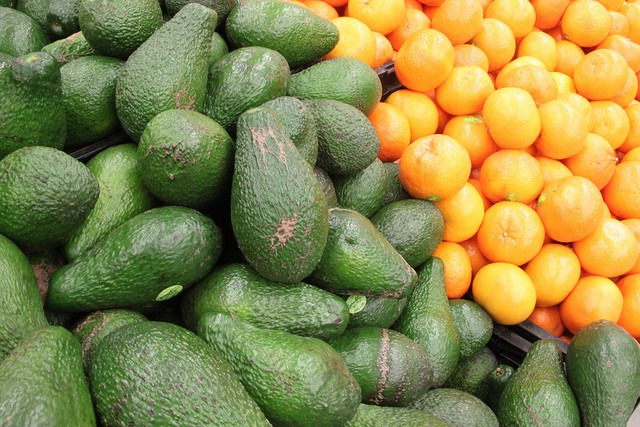
To give an example, avocados consume 2,000L water for just 1KG (Voedingscentrum, n.d.). As a result, whole provinces have no water anymore. In the province of Petorca, Chile, all water available is being illegally taped to produce avocados (Voller, 2017). This, of course, is not what is being told in supermarkets. Marketers neglect their duty to inform consumers about these issues and marketing managers of supermarkets only serve the rule of maximizing profits.

Figure 1: Avocados and oranges in a supermarket (Aharonovitch, 2012).

Because of globalization, European people are spoiled with all kinds of products from around the world. We are so used to bananas that we almost forgot that they do not come from Europe. When buying bananas or other groceries, consumers should first use a little bit of common sense to make environmentally friendly purchases. Yet, some product labels condition such common sense and make uneasy the life of green consumers. For example, a label on a South African red wine, saying the product is sustainably produced, does not necessarily mean that the product is environmental friendly. This because the production process is only one part of the supply chain. The environmental gain can be fully compensated with transportation pollution.

A way to largely overcome these problems is eating locally. Probably this is nothing new for you, but did you know that this is possible also for the inhabitants of major cities? Vertical agriculture allows to farm extensively also in big cities. Instead of using large land areas and one single layer of crops as in conventional agriculture, vertical agriculture uses only one piece of land and multiple layers of crop stacks that grow upwards. On top of that, most stacks are fresh and pesticide-free! (Davis, 2014).

The concept of vertical agriculture is further explained by the Dutch broadcasting organization VPRO in their program Tegenlicht (“Backlight”, in English). The documentary is mainly in English and can be watched at

https://www.vpro.nl/programmas/tegenlicht/kijk/afleveringen/2016-2017/boer-zoekt-voedselflat.html (Rozinga, 2017).

References

Aharonovitch, L. (2012, 15 February). Avocado.Retrieved on 15 July 2017, from https://www.flickr.com/photos/hagoleshet/6880914457/

Davis, N. (2014, 6 February). Vertical farming explained: how cities could be food producers of the future.Retrieved on 29 May 2018, from https://www.theguardian.com/science/2014/feb/06/vertical-farming-explained-erik-murchie

Faasse, J. (2012, 8 March). Hoeveel reclame ziet u per dag? Retrieved on 24 July 2017, from http://uitbijter.nl/nl/2012/03/hoeveel-reclame-ziet-u-per-dag/

Rozinga, G. (2017, 23 April). Boer zoekt voedselflat. Retrieved on 14 July 2017, from https://www.vpro.nl/programmas/tegenlicht/kijk/afleveringen/2016-2017/boer-zoekt-voedselflat.html

Voedingscentrum (n.d.). Watergebruik. Retrieved on 14 July 2017, from http://www.voedingscentrum.nl/encyclopedie/watergebruik.aspx

Voller, L. (2017, 19 March). Avocados and stolen water.Retrieved on 15 July 2017, from https://www.danwatch.dk/en/undersogelse/avocados-and-stolen-water/

De Vries (2013). Neuromarketing. Downloaded on 14 July 2017, from http://www.rug.nl/cic/downloads/rugcic_rapport_201301_neuromarketing.pdf

Neuromarketing (2017). In Cambridge dictionary.Retrieved on 13 July 2017, from http://dictionary.cambridge.org/dictionary/english/neuromarketing

Scarborough & Cornwall (2016). Essentials of Entrepreneurship and Small Business Management. Essex: Pearson

The dynamics of the sustainable transition and why sustainable innovation is lacking

E debbesi considerare come non è cosa più difficile a trattare, nè più dubbia a riuscire, nè più pericolosa a maneggiare, che farsi capo ad introdurre nuovi ordini. Perchè l’introduttore ha per nimici tutti coloro che degli ordini vecchi fanno bene; e tepidi difensori tutti quelli che degli ordini nuovi farebbono bene; la qual tepidezza nasce, parte per paura degli avversari, che hanno le leggi in beneficio loro, parte dalla incredulità degli uomini, i quali non credono in verità le cose nuove, se non ne veggono nata esperienza ferma.

“It ought to be remembered that there is nothing more difficult to take in hand, more perilous to conduct, or more uncertain in its success, than to take the lead in the introduction of a new order of things. Because the innovator has for enemies all those who have done well under the old conditions, and lukewarm defenders in those who may do well under the new. This coolness arises partly from fear of the opponents, who have the laws on their side, and partly from the incredulity of men, who do not readily believe in new things unless they have tested them by experience”.

(Machiavelli, 1515, Il Principe, Chapter 6)

Nowadays, both our economies and societies depend heavily on the environment and the world, in general, is faced with a multitude of sustainability challenges. In order to tackle the consequences of climate change, fundamental modifications and radical sustainable innovations are required. Therefore, sustainability transitions are necessary. Companies need to implement the triple bottom line, which is an accounting framework that includes a social, environmental and financial part, to meet the needs of today’s society without compromising the needs of the society of tomorrow. Nevertheless, studies show that companies alone are not able to overcome environmental challenges. Conversely, a comprehensive approach is required and both companies and governments need to shift their focus away from their financial interests and towards sustainable interests in order to achieve a successful transition to sustainability. Finally, the power of big companies should be reduced to stimulate sustainable innovation.

Telegram: @greenmarked
LinkedIn: @greenmarked
Instagram: @greenmarked.it

Facebook:  @greenmarked.it


© GreenMarked.it is managed by ECONTROVERTIA APS — Via Alcide De Gasperi 1, 38015 Lavis (TN), Italy — VAT IT02667560227